
TOP STORIES:
1. Fear and Loathing at the country club
2. Don’t Believe the Hype: PPP polling in Georgia
3. Tale of two SPLOSTs
4. This weekend: Base (How Low Can You Go) Camp
Fear and Loathing at the Country Club: GOP at war with itself
The New York Times writes that the budget showdown in Washington, DC, has sparked a civil war within the Republican Party in which Establishment types treat more-recently elected Tea Party members like red-headed stepchildren. It’s an awfully-good piece that gives some useful historical context and is worth reading in its entirety if you’re a political junkie like I am.
The budget fight that led to the first government shutdown in 17 years did not just set off a round of recriminations among Republicans over who was to blame for the politically disastrous standoff. It also heralded a very public escalation of a far more consequential battle for control of the Republican Party, a confrontation between Tea Party conservatives and establishment Republicans that will play out in the coming Congressional and presidential primaries in 2014 and 2016 but has been simmering since President George W. Bush’s administration, if not before.
In dozens of interviews, elected officials, strategists and donors from both wings of the party were unusually blunt in drawing the intraparty battle lines, suggesting that the time for an open feud over the Republican future had arrived.
“It’s civil war in the G.O.P.,” said Richard Viguerie, a veteran conservative warrior who helped invent the political direct mail business.
The moment draws comparisons to some of the biggest fights of recent Republican Party history — the 1976 clash between the insurgent faction of activists who supported Ronald Reagan for president that year and the moderate party leaders who stuck by President Gerald R. Ford, and the split between the conservative Goldwater and moderate Rockefeller factions in 1964.
Some optimistic Republicans note that both of those campaigns planted the seeds for the conservative movement’s greatest success: Reagan’s 1980 election and two terms as president.
“The business community thought the supply-siders were nuts, and the country club Republicans thought the social conservatives scary,” William Kristol, the editor of The Weekly Standard, said of those squabbles. “That all worked out O.K.”
….
At its heart, this fight is the latest chapter of a long-running struggle for dominance between a generally pro-business, center-right bloc that seeks to tame but not exactly dismantle Washington, and populist conservatives who call for more extreme measures to shrink government.
Though the election and re-election of Mr. Obama may have radicalized many conservatives, the base’s fury has its roots in the two terms of his predecessor, Mr. Bush, whose expansion of Medicare, proposed immigration overhaul and 2008 bank bailout left many conservatives distraught.
“People just saw a party that had wandered away from its soul,” said Michael A. Needham, the chief executive of Heritage Action, an offshoot of the Heritage Foundation and perhaps now the most influential lobby group among Congressional Republicans.
….
Regardless of what happens in next year’s midterms, the fight for control of the Republican Party will play out most dramatically in the contest for the 2016 presidential nomination. If a candidate from the insurgent wing is to defy recent history and seize the nomination, he or she will have to run in a fashion that, organizationally, more closely resembles the sophisticated campaigns typically waged by establishment hopefuls.
“If there’s going to be a nominee who reflects their views and values,” said the longtime conservative strategist Ralph Reed, “that candidate is also going to have to be a prolific fund-raiser, build an organization in 30 states simultaneously and have to win the support of other elected officials.”
Asked if the insurgents could nominate one of their own in 2016, former Speaker Newt Gingrich, who saw his own presidential hopes battered by an onslaught of negative TV ads financed by top contributors to Mr. Romney, said, “I think it is still very uphill because of the money.”
….
Establishment Republicans worry that electing more hard-line conservatives will do little to address what they see as the party’s fundamental challenge with those swing voters.
“We want to elect a majority of senators and the president,” said Mr. Alexander, who is a former presidential candidate, secretary of education and governor. “And in order to do that, we’ve got to persuade the American people that they can trust us with the government. And you don’t do that by shutting down the government and defaulting on the debt.”
Then again, in the eyes of the new-era conservatives, Mr. Alexander is part of the problem.
“It’s my generation’s time to enter this fight,” said Mr. McDaniel, the newly announced Senate candidate from Mississippi. “We’re excited. We love the idea of having this conversation about the future of the country, and the future of our party.”
Molly Ball, writing in The Atlantic last week, likened the intra-party tension to an impending divorce.
Conservatives have declared war on the GOP.
Tired of feeling taken for granted by a party that alternately panders to them and sells them down the river, in their view, Tea Partiers and others on the right are in revolt. The Republican Party itself is increasingly the focus of their anger, particularly after Wednesday’s deal to reopen the government, which many on the right opposed. Now, many are threatening to take their business elsewhere.
“Conservatives are either going to split [from the GOP] or stay home,” [Erick] Erickson, the influential editor of RedState.com and a Fox News contributor, told me. “They’ll first expend energy in primaries, but if unsuccessful, they’ll bolt.”
Erickson, a former Republican elected official in Georgia, stressed that he wasn’t advocating such a split, only foreseeing it. “I think the GOP is already splitting,” he said, with grassroots activists feeling “played” by elected officials’ unfulfilled promises to defeat Obamacare.
The calls for a split mark a new, more acrimonious chapter in the long-simmering conflict between the Tea Party and the Republican establishment.
The polling doesn’t offer much hope: recent Gallup polls show that Republicans (27% unfavorable toward GOP) are twice as likely as Democrats (13% unfavorable toward Dem. Party_ to have an unfavorable opinion of their own party. Gallup polls show that many non-aligned Americans share that unfavorable view of the GOP: at 28%, the Republican Party has hit the all-time low since Gallup started tracking the number in 1992 and 62% of all Americans view the GOP unfavorably.
Fifty-two percent of self-identified Republican respondents said that a third party is needed. But it appears that the Tea Party is unlikely to assume that mantel, as their favorability numbers are down ten points since the 2010 Congressional takeover and more Americans dislike the Tea Party than favor it. The animosity is mutual, with 43% of self-identified Tea Party supporters disliking the Republican Party to 55% favoring it.
Public Policy Polling: Analysis of Georgia releases
Back in August, I wrote about a survey released by Public Policy Polling (PPP) that purported to show Democrat Michelle Nunn in a close race for United States Senate against the major Republican candidates. I showed that by manipulating the percentages of self-identified Republicans and Democrats in the sample, I could “adjust” the results of a polls I ran independently to bring them closely inline to the PPP released results. I wrote:
Manipulating poll results on the basis of party identification was the idea behind “Unskewed Polls” in the last cycle, and it does have the effect of changing the outcomes of polling. Done correctly, it can enhance the accuracy of a poll; done with a heavy hand, it can produce whatever results you want it to.
Since then, PPP released a poll claiming that Democratic state Senator Jason Carter has drawn within the margin of error in a matchup against Republican Governor Nathan Deal despite Carter not being in the race. PPP also released a poll claiming that Democrat Michelle Nunn now draws even against a generic “Republican candidate.”
Writing in New Republic, Nate Cohn analyzes the PPP results and find that it appears the polling firm manipulated the percentage of black voters in its survey sample frame in a way that boosts stated Democratic numbers, and appears to be systematically biasing its polls.
Back in August, I argued that a PPP survey of Georgia was demonstrably too white (71 percent white, 24 percent black). On Twitter, PPP’s director, Tom Jensen, vigorously defended a relatively white electorate, arguing that 1) there was a black candidate on the ballot in 2010, therefore black turnout would be lower; 2) blacks were 24 percent of the electorate in 2006, the last time there wasn’t a black candidate.
But over the last two weeks, PPP released two new surveys of Georgia voters. One, conducted by PPP for Better Georgia, shows Republican Governor Nathan Deal’s lead falling into the single digits. PPP also conducted a post-shutdown survey of Georgia’s Senate race, finding Michelle Nunn locked in a dead-heat with an unnamed Republican challenger.
What’s striking is the abrupt transformation of the racial composition of the electorate. The white share of the electorate plummeted from 71 percent in August to 63 and 62 percent in the two October polls. The black share of the electorate was at 29 percent in the Better Georgia poll—nearly at 2012 levels—although just 25 percent in PPP’s newest public survey.
I just can’t fathom the justification for these types of fluctuations. PPP said, explicitly, that it did not believe the 2014 electorate would be this diverse.
And it has a real effect on their polls: If PPP had used the August weights for its October poll, Nunn would have trailed by 6 points. Deal would have led by 10 points if PPP used the August weights for its October poll. And obviously, it was in PPP’s interest to avoid both of those outcomes. Rather than show either Nunn or her opponent clearly ahead in the Georgia Senate race, as they would have needed to if they had held the racial composition of the electorate constant at either October or August levels, PPP showed two dead-heats. In the gubernatorial contest, PPP reported that Deal’s standing had faltered after bad news coverage, but much of the change was just due to changes in the racial composition of their sample.
This, dear readers, is why I spend so much time writing about polling methodology, weighting, and how to be an informed consumer of polling information released publicly. Look carefully at the assumptions underlying the weighting and presumed makeup of the electorate when you read that “this polls means such-and-such.” And if a polling firm is not releasing sufficient information for you to judge those criteria, it likely means that (a) they’re hiding something like weighting to produce a desired outcome; or (b) they’re simply too lazy to report full and accurate information, knowing that major media will simply parrot whatever they say their poll means.
Because black voters typically choose the Democratic candidate at a rate of roughly 90%, manipulating the percentage of black voters in a survey will have nearly the same effect as manipulating the percentage of self-identified Democrats.
Statistician Nate Silver spoke to the Online News Association conference in Atlanta, and discussed the need for journalists to have a greater understanding of polling in order to write intelligently about the topic.
“You can train people in methods, you can train people to some extent in writing technique and reporting skills, but do you have that critical thinking ability to look at the data sets and ask good questions?” he continued. “That’s kind of what we love to do — provoke people with questions, not be flashy or listiclely, but have interesting topics each day that are handled in a smart way and, hopefully, inform people a little bit better.”
Using the example of a recent POLITICO article on the Virginia gubernatorial race, Silver said a journalist’s desire to tell a narrative causes reporters to report causations when they are likely just correlations.“Recently for example, I saw an article in POLITICO that claimed the government shutdown was responsible for the Democrat Terry McAuliffe’s expanding lead in the Virginia gubernatorial race,” Silver said. “The article cited one question in the poll that the government wasn’t popular and another showing McAuliffe well ahead, and asserted there was a link between the two. There was no evidence however, of a causal link that anyone had switched their vote because of the shutdown.”
“It was a fine theory, but instead it was stated as a fact when there was no proof of it whatsoever,” he said.
This weekend:
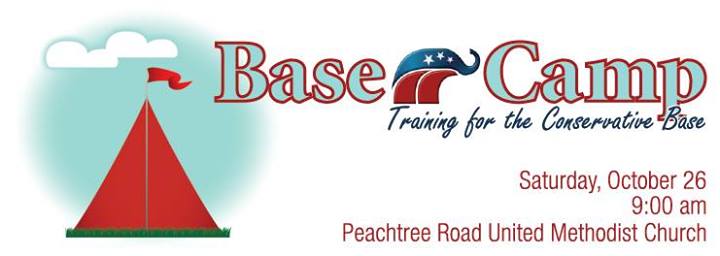
The Republican Party has to be ready for not only the 2014 elections, but for 2016 as well. The Georgia Young Republicans are hosting a training session that will be led by staff from the Leadership Institute in Arlington, VA and the original founder of the Frederick Douglass Foundation. This training will cover a multitude of helpful topics such as:
- How to run an effective conservative organization
- Crafting a persuasive conservative message
- How to organize a precinct
- How to message to the minority community
Please arrive between 8:30-8:55am to check in. We will provide lunch and afternoon snacks.
Parking is available in the church lot behind Wendy’s. We are in room C208. If you park in the lot behind Wendy’s, this room is really easy to get to. We’ll have someone at the door directing you where to go.
***Seating is limited so you MUST register before the event***
THANK YOU to our Sponsors!!
Gold Sponsors:
Representative Bruce Williamson
Senator David Shafer
Judge Marsha Lake
GA Pundit/ Todd Rehm
Silver Sponsors:
Senator Josh McKoon
Representative Mike Jacobs
GFRW Chairwoman Rose Wing
Bronze Sponsors:
PSC Commissioner Chuck Eaton
PSC Commissioner Tim G. Echols
PSC Commissioner Doug Everett
Senator Renee Unterman
Representative Matt Ramsey
ID Builders, Inc.

Please consider attending Thursday’s fundraiser for Bruce Thompson, who is running for the Senate District 14 seat previously held by Barry Loudermilk.
Later in the evening on Thursday, Georgia Right to Life will be hosting its 2013 REACH Benefit dinner at the Cobb Galleria from 7 to 9 PM.
Tale of two SPLOSTs
In November, Gwinnett County voters will go to the polls to consider a three-year SPLOST referendum. Camie Young of the Gwinnett Daily Post has a good story on support for, and opposition to, the measure.
“Everywhere I turn I am touched by those SPLOST dollars,” [Paige] Havens said of the Special Purpose Local Option Sales Tax, which has been a part of the county’s funding mechanism for nearly all of the 25 years she has lived in Gwinnett. “It has truly impacted our family’s quality of life.”
With a proposed renewal of the 1 percent sales tax on Nov. 5 ballots, the marketing maven volunteered to campaign for the tax, which is the only matter on countywide ballots this fall.
“I am constantly reminded, almost daily,” of the benefits, Havens said. “Anything that can help offset my propert taxes I’m all for.”
But for Steve Ramey, any tax is a bad tax.
The co-founder of the Gwinnett Tea Party has watched the county government propose the sales tax a couple of times a decade for 25 years and he’s never voted yes.
“I can’t imagine me wanting to pay more taxes. We are taxed to death,” Ramey said.
“It’s not really special anymore,” he added, pointing out that the Legislature allowed the provision for a short term, pointing out within its very name that it is for a “special purpose.”
Chatham County voters will also decide on a SPLOST, and City of Savannah officials are pushing the plan among the public.
City Manager Stephanie Cutter briefly described her vision for the planned arena on Savannah’s westside before a crowd of about 90 residents Tuesday night.
Cutter said she saw the arena as a way to connect the city’s westside to downtown and revitalize the area, during a meeting about the upcoming sales tax referendum at the Temple of Glory Community Church on Stiles Avenue.
“It’s not about one side of town,” she said. “It’s about the entire community.”
The discussion took place after a video presentation outlined past sales-tax funded projects such as the Ellis Square restoration and Forsyth Park band shell, along with proposed projects that would be funded if voters extend the 1-percent sales tax this November, including traffic-flow improvements to DeRenne Avenue and land acquisition for business investment.
At least $370 million in projects is expected to get funded throughout the county, if the referendum passes. Alderman Van Johnson, who hosted the meeting, said the special purpose local option sales tax revenue allows the city to fund projects that they could not normally fund and that about 38 percent comes from visitors.
“If we don’t support (SPLOST), we save a penny, but we lose millions,” Johnson said.
Related Posts
 Vogtle vote takes pressure off Georgia Power | The Augusta Chronicle
 Georgia Politics, Campaigns, and Elections for November 10, 2021
 Nathan Deal: Bibles to be ‘quickly’ returned to state parks | Political Insider | www.ajc.com
- RN-T.com – Cave Spring schedules candidate forum for Oct 17
 Sen. Johnny Isakson: Legislation Allows Private Sector to Take the Lead in Uplifting Developing Nations


Comments ( 0 )