
Attention Gmail Users
If you’re a Gmail user and have noticed GaPundit’s morning email not landing in your inbox, here’s what to do.
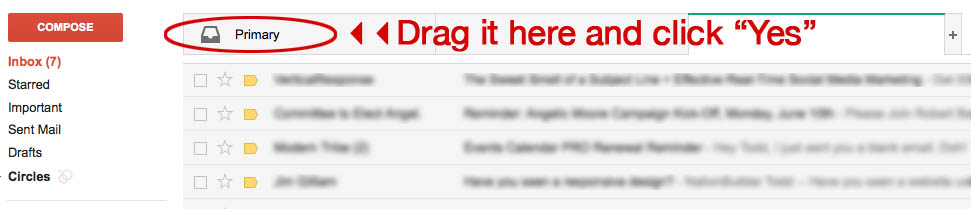
Open your Gmail account, and click on the tab labeled “Promotions.”
 Select a message from GaPundit.
 Drag it on top of the tab labeled “Primary” and click “Yes.”
 Getting real about Nunn’s chances
In the last 24 hours a cold wind of realism is hitting the Washington, DC metro area, causing some political analysts to question all the hype about Michelle Nunn’s campaign for Senate changing the face of Georgia’s Congressional delegation.
Stuart Rothernberg writes in Politico that 2014 may be too early to consider Georgia going blue or even purple:
The last Democratic presidential nominee to get more than 47 percent of the vote in The Peach State was Georgian Jimmy Carter, who drew 55.8 percent in 1980. Republicans now sit in all eight of Georgia’s statewide offices, and they have large majorities in both houses of the Georgia legislature.
As the nation has realigned geographically over the past 30 years, it has become harder for Democrats to win statewide federal office in the Deep South, and Georgia is no exception. Democratic strategists note the state’s changing demographics, and that certainly is true. But while that may change the political equation for 2020, it doesn’t change the state’s political arithmetic for 2014.
Midterm turnout trends suggest Nunn will have a harder time mobilizing Democratic constituencies in 2014 than she would have in 2012 or 2008, making it crucial for her to attract a larger share of independent and even normally Republican voters. That isn’t impossible, though it may be difficult given the normal midterm dynamic (where a sitting president’s party suffers).
Nunn has potential, and the Republican primary could increase her opportunities, both because of its bitterness and potential for producing a seriously flawed nominee.
But there is a heavy burden of proof on Nunn to show that she can win — or, rather, that Republicans are throwing the contest away. She will need every break to go her way to have any kind of real chance. Given that, we are moving this race from Safe Republican to Republican Favored. It’s certainly worth watching, though it doesn’t yet merit some of the early hype that it has received.
In the Daily Caller, Georgian Brandon Howell writes that Georgia Democrats may be getting a little too enthusiastic, and out of touch with political reality.
As the daughter of a Georgia political lion, and a first-time candidate with no political past to define her, save her father’s reputation for centrism, Democrats hail Nunn’s entry as a sure sign that the Peach State will become a battleground state in 2014.
And that’s really just about all they have going for them.
The digital ads following Nunn’s announcement, itself a foregone conclusion, amount to little more than calculated ballyhoo from Democrats desperate to tint a red state purple.
For starters, much of the initial hype surrounding a Nunn campaign stemmed from her famous father’s last name, who served in the Senate seat she now seeks for more than 20 years. Yet he hasn’t been on a ballot of any kind since 1990. A new generation of Georgians has since arrived on the scene, many bringing roots outside of the state, so how much that legacy will matter remains in doubt.
Against this backdrop of strife and bewilderment, Nunn is now running in a red state during a midterm year without President Obama at the top of the ballot.
That leaves Michelle Nunn grasping at straws, a candidate who’s going to need to catch lightning in a bottle.
Voting Rights Act
As President Obama’s Attorney General Eric Holder moves to sue Texas alleging its Voter ID laws are discriminatory, he has indicated that he will use Section 3 of the VRA in other states.
State Representative Calvin Smyre (D-Columbus) met with Obama, Holder, Atlanta Mayor Kasim Reed and others at the White House yesterday to discuss enforcement of the Voting Rights Act through lawsuits.
Mayor Reed said he will work to assist the administration in using the VRA.
The NAACP, the American Civil Liberties Union, the National Urban League, the Leadership Conference on Civil and Human Rights and the Mexican American Legal Defense and Education Fund were some of the groups pledging a coordinated campaign to find alleged voting-rights violations. Reed said he would enlist fellow mayors in the effort and implied that it would require a fundraising campaign.
“More resources are going to be required in order to set the record for the kind of discrimination that we believe is afoot in the United States of America,” Reed said after the meeting “And we cannot rely on these (civil rights) organizations to respond without being well-sourced.”
Advocates are concerned that voting changes in small towns and rural areas that dilute minority voting power will fly under the radar.
“They are open to many of us on the ground to … be resources to bring any violation of the Voting Rights Act directly to the Justice Department,” said the Rev. Al Sharpton. “We’ve been greatly encouraged by that. There is a wound in the Voting Rights Act, but it is far from dead. It’s not even on critical.”
Common Core
The Heritage Foundation writes that Georgia’s decision to develop its own testing instead of the costly and Common Core-base PARCC tests is part of a national movement.
Education leaders in Georgia also understand that doing what’s best for students means keeping educational decisions within the state and in the hands of local leadership—not distant bureaucrats.
Common Core is already proving costly in terms of dollars and will prove even more costly in terms of educational liberty down the road. Educational decisions should be in the hands of those closest to the students: parents and local leaders. Exiting the Common Core national standards push makes it more likely that such decisions will be.
In addition to Georgia and Florida, which is also mentioned in the Heritage piece, an Ohio State Rep. has introduced a bill to move the Buckeye State away from Common Core.
On July 25, state Rep. Andy Thompson filed a bill to repeal Common Core national standards in Ohio.
If passed, the bill would prohibit state funds for Common Core materials, training, and tests in Ohio, prohibit Ohio from sending student information to the federal government or other outside groups, and require public discussion and further study of Common Core and education standards.
Constituent concerns prompted Thompson to begin researching Common Core, he said. The sources he found called into question the frequent line from proponents that standards were “state-led.” Thompson doesn’t believe governors and state superintendents were involved in the hands-on development of Common Core, but is more concerned that Ohio never really got the chance to vet the standards.
Gov. John Kasich (R) has publicly indicated he supports Common Core and does not think Thompson’s bill will make his desk….
Chatham County Health Clinic
Yesterday, I referenced a story on the Chatham County Commission voting to move forward in planning to open a health clinic for public employees. I was surprised to read that it’s being pitched as a cost-control measure:
On-site clinics have grown increasingly popular in the public sector because they’re seen as providing beneficial preventive care that can reduce costly claims down the road. Additionally, workers typically spend less time in waiting rooms in such facilities that are open exclusively to employees, retirees and their dependents.
“We can’t afford not to do this,” said Commissioner Helen Stone, an advocate of the proposed clinic.
This morning, I heard a story on NPR about Montana’s state employee health clinic and how they help save taxpayer money.
A year ago, Montana opened the nation’s first clinic for free primary healthcare services to its state government employees. The Helena, Mont., clinic was pitched as a way to improve overall employee health, but the idea has faced its fair share of political opposition.
A year later, the state says the clinic is already saving money.
The state contracts with a private company to run the facility and pays for everything — wages of the staff, total costs of all the visits. Those are all new expenses, and they all come from the budget for state employee healthcare.
Even so, division manager Russ Hill says it’s actually costing the state $1,500,000 less for healthcare than before the clinic opened.
“Because there’s no markup, our cost per visit is lower than in a private fee-for-service environment,” Hill says.
Physicians are paid by the hour, not by the number of procedures they prescribe like many in the private sector. The state is able to buy supplies at lower prices.
Bottom line: a patient’s visit to the employee health clinic costs the state about half what it would cost if that patient went to a private doctor. And because it’s free to patients, hundreds of people have come in who had not seen a doctor for at least two years.
That’s not to say everyone’s convinced that the cost savings are without cost. From NPR again:
“For goodness sakes, of course the employees and the retirees like it, it’s free,” says Republican State Sen. Dave Lewis.
He wonders what that free price tag is actually costing the state government as well as the wider Helena community.
“If they’re taking money out of the hospital’s pocket, the hospital’s raising the price on other things to offset that,” Lewis says.
Online Campaign and Advertising Watch
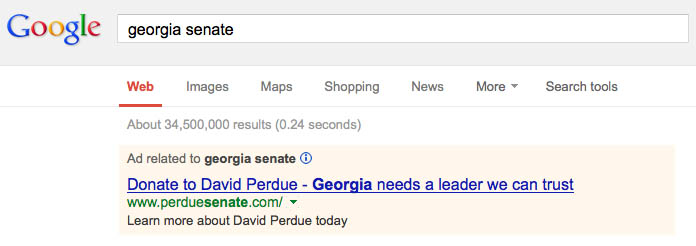 David Perdue’s Senate campaign has gone up again with Google search ads, this time raising money. This makes sense in today’s world.
Rick Allen, running for Congress against Democrat John Barrow in the 12th District, has revamped his website.
“Staying on the cutting edge in this digital age is challenging but the response we have gotten for our campaign online has been enormous,” Allen said. “I think we had 400 Facebook followers in 2012, now we have 35,000? It’s just a mind-boggling amount of support and interest and I am grateful for it.”
Rick campaigned in Dublin, Statesboro and Waynesboro last week, and will travel to Waynesboro and Vidalia next week.
The Obama campaign raised about $1.1 billion dollars for the 2012 campaign; the breakdown of sources was like this:
Online fundraising: $525 million
Bundling and high-dollar: $286 million
Direct mail: $229 million
Telemarketing and other sources accounted for the balance.
Yesterday, an article in the Washington Post discussed the Obama 2012 digital effort and its reliance on data.
One of the hallmarks of Obama’s 2012 campaign was its prodigious appetite for research.
Message and media operated on one track. The other track focused on identifying, registering, mobilizing and ultimately turning out Obama voters.
The Obama campaign had the usual contingent of pollsters and ad makers and opposition researchers and, like all campaigns today, a digital director. But it also had a chief technology officer (who had never done politics before), a chief innovation officer and a director of analytics, which would become one of the most important additions and a likely fixture in campaigns of the future. The team hired software engineers and data experts and number-crunchers and digital designers and video producers by the score. They filled the back of a vast room resembling a brokerage house trading floor or tech start-up that occupied the sixth floor of One Prudential Plaza overlooking Millennium Park in Chicago.
Early in 2011, some Obama operatives visited Facebook, where executives were encouraging them to spend some of the campaign’s advertising money with the company. “We started saying, ‘Okay, that’s nice if we just advertise,’ ” Messina said. “But what if we could build a piece of software that tracked all this and allowed you to match your friends on Facebook with our lists, and we said to you, ‘Okay, so-and-so is a friend of yours, we think he’s unregistered, why don’t you go get him to register?’ Or ‘So-and-so is a friend of yours, we think he’s undecided. Why don’t you get him to be decided?’ And we only gave you a discrete number of friends. That turned out to be millions of dollars and a year of our lives. It was incredibly complex to do.”
Georgia Ports Authority Breaks Records
The Georgia Ports Authority announced yesterday that it set shipping records in many important categories.
The Georgia Ports Authority marked record volumes for fiscal year 2013 in total tonnage, bulk cargo, total auto-machinery units, and freight moved by intermodal rail.
“Our deepwater ports provide vital support to our agricultural, forestry and manufacturing sectors,” said Georgia Governor Nathan Deal. “Because American-made goods are able to reach the global market efficiently through Georgia’s ports, these products are more competitive in international trade. That’s good for jobs in Georgia and across the Southeast.”
GPA Executive Director Curtis Foltz said record levels achieved across important business sectors in fiscal year 2013 are a testament to the superior service enjoyed by the customers of the GPA. “Whether by road, on-terminal rail links or by our 38 weekly global containership services, Georgia’s deepwater ports offer an unmatched gateway to international commerce for Southeast markets,” Foltz said.
Obits: Senator Jim Tysinger to be buried at Arlington and Charles West
The DeKalb County Republican Party informed us yesterday that the late Georgia State Senator Jim Tysinger will be buried at Arlington Cemetery with full military honors on on
Wednesday, September 18, 2013 at 3 PM.
When Jim Tysinger was first elected to the Georgia Senate in 1968, he had a half-dozen Republican colleagues. When he retired in 1998, a Republican majority was within reach.
He and other members organized a regular Saturday morning discussion group, The Sen. Jim Tysinger DeKalb Breakfast Forum, which still meets.
Charles West was a founding member of the influential “Loose Group,” which supported Republican candidates from the early days of the modern party, and continues to play a role today; West passed away on Friday and InsiderAdvantage CEO Matt Towery memorializes him.
West was a contemporary of business and civic leaders such as Howard “Bo” Callaway, who captured the popular vote for governor in 1966 over Democrat Lester Maddox but lost the contest when the election was tossed into the then-Democratically controlled Georgia House of Representatives. Along with other well-known business leaders of the time including the late-convenience store magnate Dillard Munford, the-late Robert Readfern (a food manufacturer), and Ed Noble who founded Lenox Square, Charles West formed an early forerunner of today’s Political Action Committees known as “The Loose Group.” The organization’s name reflected the fact that it had few rules. The group’s one and only clear goal was to promote and elect political candidates who reflected the organization’s devotion to conservative policy and preservation of individual rights and liberty.
The Loose Group as an organization and Charles West as an individual contributed much needed funds and moral support for such early-on GOP names as Newt Gingrich (who sought election twice before finally capturing a seat in Congress in 1978), and Mack Mattingly, who with the Loose Group and West’s help was elected Georgia’s first Republican Senator since Reconstruction in 1980. Among those who received decisive help both from Charles West and the Loose Group were GOP luminaries such as the-late Paul Coverdell as well as Johnny Isakson, Guy Millner, and Saxby Chambliss. The organization continues to exist and has been extended to several new generations of business leaders.
It is fair to say that Georgia might have never seen a Republican Governor Nathan Deal or Republican Senators Saxby Chambliss or Johnny Isakson in office today were it not for the persistent and bold support of Charles West and the Loose Group early-on in the GOP’s emergence towards creating a true two party state. Former Republican House Speaker Newt Gingrich has openly credited West and the Loose Group for sticking with him through numerous campaigns which led to his ultimate position in the U.S. House.






Comments ( 0 )