
On January 31, 1733, six boats carried Georgia’s first colonists to Trench’s Island, now called Hilton Head Island, where they spent the night before continuing on to land in Georgia at Yamacraw Bluff on February 1, 1733.
On January 29, 1779, British forces captured Augusta, Georgia.
On January 30, 1788, the Georgia legislature passed a resolution calling for a state Constitutional Convention in Augusta to adopt a state Constitution that conformed to the new Constitution of the United States.
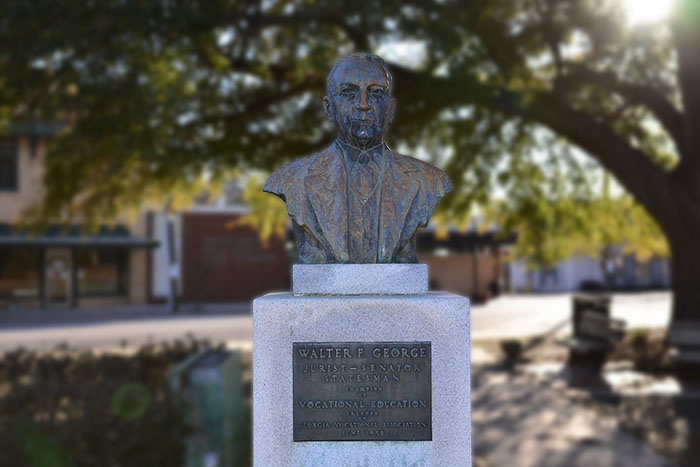
Walter F. George was born on January 29, 1878 in Preston, the county seat for Webster County, Georgia. Ron Daniels has a brief bio of the United States Senator who gave his name to a Law School, a courthouse, and a lake. The photo above is a bust in the town square of Vienna, Georgia, in Dooly County, where George made his home.
On January 30, 1862, the United States launced its first ironclad warship, USS Monitor.
On January 31, 1865, the Confederate Congress created the position of General-in-Chief of the Confederate armies. On the same day, the U.S. Congress passed the Thirteenth Amendment to the Constitution, outlawing slavery.
General William Tecumseh Sherman visited Kimball Opera House in Atlanta on January 31, 1879, which was then serving as State Capitol, fifteen years after burning the city.
Franklin Delano Roosevelt was born on January 30, 1882 in Hyde Park, New York. In 1942, Roosevelt ordered Japanese-Americans on the west coast of the United States into concentration camps, leaving German and Italian Americans free.
On January 29, 1892, the Coca Cola Company was incorporated in Georgia in Fulton County Superior Court.
On January 31, 1893, the trademark for “Coca-Cola” was filed.
On January 30, 1935, the Rev. Martin Luther King, Sr. protested segregated elevators at the Fulton County Courthouse.
On January 30, 1948, Mohandas K. Gandhi was assassinated.
On January 29, 1955, Georgia Governor Marvin Griffin signed legislation granting the power to take land needed for the Stone Mountain Park through condemnation if negotiations to buy it fell through.

On January 30, 1956, six members of the Georgia State House of Representatives introduced House Bill 98 to replace the red and white stripes on Georgia’s flag (above) with a Confederate battle flag (below). That same day, a bomb was thrown at the Birmingham, AL home of Rev. Martin Luther King, Jr.

January 30, 1972 is remembered as Bloody Sunday in commemoration of the shooting of 26 civilians by British troops in Northern Ireland.
On January 29, 1977, Congressman Andrew Young resigned his seat to accept the nomination by President Carter as United States Ambassador to the United Nations.
On January 29, 1998, a bomb exploded in a Birmingham, Alabama abortion clinic, killing a police officer. Eric Rudolph would later admit to setting that bomb, along with the Centennial Park bombing in 1996, and the bombing of a Sandy Springs abortion clinic and an Atlanta bar in 1997.
Atlanta Braves pitcher John Rocker was suspended on January 31, 2000 for remarks made to ESPN.
On January 30, 2001, the Georgia State Senate passed a house bill changing the state flag from the 1956 version to one that aggregated the State Seal and five former state flags, pictured below.

On January 29, 2020, Georgia Congressman Doug Collins announced he would run against Kelly Loeffler, who was appointed to the United States Senate by Gov. Brian Kemp.
“We’re in for the Georgia Senate race down here. I’ve still got a lot of work left to do to help this president finish this impeachment out, and we’re going to make a bigger announcement down here in Georgia,” he told the “Fox & Friends” hosts.
“The shortsightedness in this decision is stunning,” NRSC Executive Director Kevin McLaughlin said in a statement. “Doug Collins’ selfishness will hurt David Perdue, Kelly Loeffler, and President Trump. Not to mention the people of Georgia who stand to bear the burden of it for years to come. All he has done is put two senate seats, multiple house seats, and Georgia’s 16 electoral votes in play. The NRSC stands firmly behind Sen. Kelly Loeffler and urges anyone who wants to re-elect President Trump, hold the GOP senate majority, and stop socialism to do the same.”
Collins’ entrance into the race makes a runoff far more likely, which could potentially decide the balance of the Senate in a vote held in January, a month when most people are not accustomed to going to the polls.
Georgia Politics, Campaigns, and Elections
United States House Speaker Nancy Pelosi (D-SF) single-handedly ensured the reelection of U.S. Representative Marjorie Taylor Greene (R-Extreme Northwest Georgia). From the Valdosta Daily Times:
Speaker Nancy Pelosi condemned U.S. Rep. Marjorie Taylor Greene’s unfounded comments about two mass school shootings and questioned why Republican leadership placed the controversial freshman congresswoman on the chamber’s education committee.
“Assigning her to the education committee when she has mocked the killing of little children at Sandy Hook Elementary School, when she has mocked the killing of teenagers in high school at the Marjory Stoneman Douglas High School — what could they be thinking?” Pelosi said Thursday during her weekly press briefing. “Or is thinking too generous a word for what they might be doing? It’s absolutely appalling, and I think the focus has to be on the Republican leadership of this House of Representatives for the disregard they have for the death of those children.”
Pelosi’s comments focused on Rep. Marjorie Taylor Greene, R-Rome, whose views were in the spotlight even before she joined the House this month. Greene supported Facebook posts that advocated violence against Democrats and the FBI. One suggested shooting Pelosi in the head. In response to a post raising the prospect of hanging former President Barack Obama, Greene responded that the “stage is being set.”
California Democratic Rep. Jimmy Gomez announced Wednesday night that he was readying a resolution to expel Greene from Congress because of her past social media activity.
Under the Gold Dome – Legislative Day 8
12:00 PM Senate Rules Upon Adjournment – 450 CAP
6:30 AM Senate Appropriations Human Development Sub – 450 CAP
7:30 AM Senate Appropriations Agriculture Sub – Mezz 1
7:30 AM Senate Appropriations Economic Dev Sub – 450 CAP
9:30 AM HOUSE FLOOR SESSION (LD8) – House Chamber
10:00 AM Senate FLOOR SESSION (LD8) – Senate Chamber
12:00 PM Senate Rules Upon Adjournment – 450 CAP
1:00 PM Senate Appropriations Community Health Sub – 450 CAP
1:00 PM Senate Appropriations Education and Higher Education Sub – Mezz 1
2:00 PM Senate Appropriations Public Safety Sub – Mezz 1
2:00 PM Senate Appropriations Transportation Sub – 450 CAP
The Georgia State House of Representatives voted to adopt a Supplemental Budget for the current fiscal year, according to the Valdosta Daily Times.
The House appropriations committee unanimously approved a $26.6 billion spending plan Wednesday. Lawmakers want to quickly approve the mid-year budget — which runs through June 30 — in case the coronavirus forces legislators to suspend the General Assembly. If the legislature were to halt without passing a budget, state agencies would be left without funds.
House Appropriations Chairman Terry England, R-Auburn, cautioned lawmakers throughout the “harried” budget process that the situation could be grave if decisions aren’t made quickly.
“We are on an expedited pace on trying to get the amended budget done,” England said Wednesday. “So that if COVID necessitates we take a break at some point, our state agencies and in all of those that rely on state funding will know what their budget is for the remainder of the year.”
“Last year we had to suspend the session and I think we resolved early on that we needed to get the amended budget done so that if we have that situation again the state can function at least through the end of the fiscal year,” [Speaker David Ralston] said.
The measure went before the full chamber Thursday and passed in a 149-20 vote.
The Republican-controlled House, however, has earmarked $18 million to replace the state’s outdated Georgia Immunization Registry that has collapsed under the wave of vaccination data.
“They have had a tremendous amount of money come to them on the federal level right now,” England told lawmakers. “I think they’re sitting somewhere at about a billion dollars in federal money that they will be receiving in the next week or so that’ll be going to the COVID response. But there are some things that we can do.”
The House proposed adding funds for new top positions in the department to support Commissioner Dr. Kathleen Toomey and agency staff. About $286,000 is tagged for hiring a chief medical officer, deputy commissioner of public head and chief data officer to aid the agency throughout the pandemic and in the future.
Senate Bill 29 by Sen. Jason Anavitarte (R-Paulding County) would required absentee ballot applicants to send copies of two forms of photo ID in their absentee ballot application, according to the Valdosta Daily Times.
Senate Bill 29 would require Georgia voters to make copies of the photo ID and mail them to elections officials at two different stages of the absentee ballot process in order to cast a mail-in vote.
Voters would be required to submit photo ID both when requesting and returning an absentee ballot.
An analysis by CNHI showed Republicans have a historically higher use of mail-in ballots in Georgia and Florida. But experts suspect Trump’s continued demonization of the voting method turned his voters away from using absentee — unintentionally suppressing his own voting base.
Democrats capitalized on the expanded use of absentee ballots during the pandemic. As votes were slowly tallied in Georgia and across the nation, absentee ballots pushed President Joe Biden ahead.
During a press conference Wednesday, [Lt. Governor Geoff] Duncan said he supports adding another verification step to absentee ballots and sees it as a priority for the 2021 session, but does not support the call from his chamber’s top GOP lawmakers to do away with no-excuse.
“I don’t necessarily identify a problem we’re trying to solve. I think this is an opportunity,” Duncan said. “I think the best step forward is for us to just look for an opportunity to create a photo ID process.”
“By requiring access to a printer, which many Georgians obviously do not have, Republicans are attempting to purposely take away the ability of many Georgians to vote by mail simply because they believe too many Democrats and too many people of color voted by mail,” [Fair Fight Action spokesperson Seth] Bringman said in a statement.
“This was the most scrutinized election in Georgia history. Two recounts and an audit that included the Georgia Bureau of Investigation. If it ain’t broke, don’t fix it,” Andrea Young, [Georgia ACLU] executive director, said in a statement. “This bill limits ballot access for everyone without an electronic scanner/printer at home. This is wrong.”
From the Capitol Beat News Service via the Savannah Morning News:
Instead of the current signature-verification process, voters would need to provide a photocopy of their driver’s license, passport or other valid ID card when applying for an absentee ballot. Then, another photocopy of that ID would have to be placed in the envelope used to mail back the ballot.
Gov. Brian Kemp and Georgia Secretary of State Brad Raffensperger have pushed for the change after doubts from many conservative voters over verifying signatures stirred mistrust in Georgia’s election integrity. Republicans stand a strong chance of passing legislation since they control both chambers in the General Assembly.
Currently, registered Georgia voters need only provide their signature on an application form to request an absentee ballot. Signatures on that request form as well as on the envelope in which voters mail their ballots are matched with other signatures in voters’ registration files before those ballots are accepted.
“Georgians will see through these cynical power grabs, but it’s going to take a big fight on the part of everyone who cares about the right to vote in Georgia,” said the group Fair Fight, which was founded by former gubernatorial candidate Stacey Abrams. “Republicans are more desperate than ever to hold onto their waning power.”
From the Associated Press via AccessWDUN:
Other, simpler ways of requiring photo ID have been floated including requiring a driver’s license number on the absentee ballot request form though no legislation has been introduced yet.
Fair Fight also noted that the proposal in its current form could raise concerns about identity theft.
Columbus could get a riverfront casino under a proposed Constitutional Amendment, according to the Ledger Enquirer.
Columbus’ Calvin Smyre is one of six state lawmakers who signed on to a proposed constitutional amendment Tuesday that would allow casino operation in Georgia, reviving talks of a possible riverfront resort on the city’s south side.
Under the legislation, a limited number of casinos would be allowed to operate in Georgia. A portion of the state’s casino income would fund HOPE and other scholarship programs. The amendment would appear on the ballot in 2022, Smyre told the Ledger-Enquirer.
Constitutional amendments require two-thirds majorities in the state House and Senate. Voters at the state level then would have to sign off.
“This is just the start,” [Rep. Smyre] said. “In order for this to have any hope of passing, it would have to be a bipartisan effort.”
House Resolution 30 is the legislation referenced above.
Foster care and adoption legislation is likely to be addressed in this session, according to the AJC.
Lawmakers in the House and Senate this week filed bills that will lower the age at which someone can adopt a child form 25 to 21, increase the tax credit for families who adopt children from the foster care system and makechanges to the juvenile court process for children in foster care.
“The most fundamental need for any child is a safe, loving home,” Kemp said in a statement. “By making it more affordable to adopt, reducing bureaucratic red tape that stands in the way of loved ones adopting kids, and championing the safety of children across our state, we can ensure Georgia’s children are placed in those homes and secure a safer, brighter future for generations to come.”
Among the bills that returned this year are House Bill 114, which would increase the tax credit for families that adopt a child from foster care from $2,000 to $6,000 per year for five years and House Bill 154, which would allow people who are 21 to petition to adopt a child — something often seen among older siblings.
“Keep in mind that the standard the judge (uses) in an adoption is the best interests of child, and based on that it would be a narrow lane, practically, where younger adults would be permitted to adopt,” said state Rep. Bert Reeves, a Marietta Republican who sponsored HB 114 and HB 154. “This is by no means an absolute right for anyone of any age to adopt, it just lowers the age that one can petition (for adoption).”
Senate Bill 28 would, among other things, allow the court to consider testimony from witnesses that includes second-hand information during certain child protective hearings. Judges typically do not allow what is called “hearsay” in court proceedings.
A query by State Rep. Emory Dunahoo (R-Gillsville) about whether Georgia colleges are teaching about “white privilege” has some professors balking, according to the Ledger-Enquirer.
Based on a state legislator’s request, University System of Georgia administrators have been asking faculty members this week whether any classes are teaching students about white privilege, prompting some professors to call the query an infringement on academic freedom.
The Jan. 21 email from Chancellor Steve Wrigley explains the request came from state Rep. Emory Dunahoo, R-Gillsville, after Wrigley’s presentation to the legislature’s joint appropriations committee.
“If the answer is ‘yes’ to any of the questions below,” Wrigley said in the email, “please list the relevant course section for reference.”
“I view these questions as a threat to academic freedom because it’s clear from their content and tone that they’re designed to intimidate faculty members from teaching legitimate educational content,” [Columbus State University biology professor Brian] Schwartz said in the email.
“Academic freedom is crucial to providing a high-quality education,” he said. “We don’t want — and I think our students and society doesn’t expect — professors to convey a party line, for example, a message from the government. Hopefully, society expects and values that professors would have the freedom to teach what they believe to be true, with our expertise, our training and our goodwill to do what’s right, that we not be restrained.”
Asked why the USG complied with the legislator’s request, Wallace told the L-E, “We are a state agency and are always responsive to the elected representatives of the people of Georgia.”
“The request is an attack on higher education,” said Matt Boedy, a University of North Georgia professor who is Georgia conference president of the American Association of University Professors. “It perpetrates a pernicious agenda. I don’t know why a state representative who won his district by 40 points needs to throw red meat to his base, but this echoes national conservative discourse that has been laughed from the public square by historians and other experts.”
I would suggest that arrogance and disdain toward the people who write your budget is not a good look.
Burke County is asking state legislators to consider the cost of splitting the Augusta Judicial Circuit, according to the Augusta Chronicle.
Columbia County wants to break from the circuit and have its own superior court system and district attorney. A state legislative committee bypassed traditional review by the Administrative Office of the Courts and OK’d a bill splitting the circuit Wednesday.
The five-member Burke County Commission unanimously approved a resolution Thursday asking the state to consider the impact of the split.
Burke County is asking the state to perform the traditionally required judicial caseload and boundary study to “determine the most efficient delivery of court services” in each county, and address how the new system will function, including juvenile court and public defender’s office, how jointly-owned property will be assigned and how much it will cost the counties.
“Senate Bill 9 requires the dissolution of the Augusta Circuit by July 1, 2021, which does not allow ample time to adjust budgets that have already been set for expenses of the superior court, district attorney, public defender and the juvenile court,” the resolution says.
An earlier analysis done by circuit judges – who do not support breaking up the circuit they’ve served for years – showed stark increases in expenses to all three counties and the state, which pays judges, district attorneys and a handful of other staffers.
Initial claims for unemployment insurance were down last week, according to the Gwinnett Daily Post.
First-time unemployment claims in Georgia fell by 7,896 last week to 28,016, reflecting a weekly decline at the national level, the state Department of Labor reported Thursday.
Since the coronavirus pandemic broke out in Georgia last March, the labor department has paid out almost $17.6 billion in state and federal benefits to more than 4.3 million Georgians, more than the last nine years before the pandemic combined.
During the week ending June 23, the job sector accounting for the most initial unemployment claims in Georgia was accommodation and food services with 6,064. The health care and social assistance job sector was next with 3,145 claims, followed by manufacturing with 3,052.
Governor Brian Kemp appointed Claiborne “Clay” W. Davis, III to serve as Spalding County Commissioner for District 5 while Commissioner Donald Hawbaker is suspended due to his indictment on a number of felony charges.
The City of Dalton will grant rent assistance using federal CARES act funds for COVID relief, according to the Dalton Daily Citizen News.
The Dalton-Whitfield Community Development Corp. (DWCDC) is managing this rental assistance program on behalf of the city. The assistance available is a grant directly payable to a landlord through an agreement with the CDBG office. A total of $174,800 is available through the city’s CARES Act grant. The funding is available on a first-come, first-served basis starting on Monday when the application goes online.
Applicants must meet several requirements to be eligible for assistance, including having a household income lower than 80% of the area median income (AMI), which for a family of four in Dalton would be $43,750. The rental property must be within the city limits of Dalton. The applicant must present proof of identity and proof of residence. The applicant also must provide documentation of a substantial decrease in household income due to the COVID-19 pandemic (for example, loss of job, medical crisis, business closures, etc).
Those who have received assistance from another rental assistance program since March 16, 2020, are not eligible for this assistance grant. Also ineligible are those who rent property from immediate relatives whether by blood or by marriage (child, parent, sister, brother, grandparent, aunt, uncle, etc.). Those who rent a room in an owner-occupied residence are also not eligible for this program. Assistance is not available to undocumented immigrants.
Glynn County held a town hall meeting to discuss bad odors wafting, according to The Brunswick News.
Rachael Thompson, executive director of the Glynn Environmental Coalition, said residents are experiencing symptoms, including coughing, sore throat, watery eyes, irritation to the skin, difficulty breathing and more as a result of whatever is causing the odor.
According to Brett Berry, environmental compliance specialist for the EPD, over 30 facilities within a five-mile radius of Brunswick have air quality permits, meaning they either are emitting or may emit chemicals.
Berry also noted that odors are not necessarily under the purview of the EPD. If no underlying emissions violation is uncovered, the only answer may be legislative action by the Georgia General Assembly.
City commissioners asked a few questions but mostly took a backseat at the town hall moderated by Mayor Cornell Harvey, allowing experts from the state EPD and other government agencies to do most of the talking.
Athens-Clarke County Mayor Kelly Girtz delivered an annual address, according to the Athens Banner Herald.
Public safety, which Girtz described as a critical part of the national and local conversation, will see a new government job created along with an “enhanced public safety officer pay scale” the mayor believes will create greater retention among those positions.
On environmental issues, the mayor pointed to measures designed to move the local government away from fossil fuels. He also mentioned the purchase of a rock quarry near the airport that will be filled with water after 2030, providing security in times of drought, like the severe periods of 2007, 2011 and 2016.
Related Posts
 Deal: Judge sustains suspensions of two former DeKalb school board members
 Adoptable Georgia Dogs for January 13, 2016
 League of Women Voters of Georgia Joins Civic Engagement Organizations For National Voter Registration Day at Capitol
 Adoptable (Official) Georgia Dogs for June 1, 2020
 Stolen guns take years to recover | The Augusta Chronicle


Comments ( 0 )