
On January 28, 1733, Georgia’s first colonists celebrated a day of thanksgiving for their safe arrival in Savannah and Chief Tomochichi’s granting them permission to settle on the Yamacraw Bluff.
On January 29, 1779, British forces captured Augusta, Georgia.
On January 30, 1788, the Georgia legislature passed a resolution calling for a state Constitutional Convention in Augusta to adopt a state Constitution that conformed to the new Constitution of the United States.
On January 30, 1862, the United States launced its first ironclad warship, USS Monitor.

Walter F. George was born on January 29, 1878 in Preston, the county seat for Webster County, Georgia. Ron Daniels has a brief bio of the United States Senator who gave his name to a Law School, a courthouse, and a lake. The photo above is a bust in the town square of Vienna, Georgia, in Dooly County, where George made his home.
Franklin Delano Roosevelt was born on January 30, 1882 in Hyde Park, New York. In 1942, Roosevelt ordered Japanese-Americans on the west coast of the United States into concentration camps, leaving German and Italian Americans free.
On January 29, 1892, the Coca Cola Company was incorporated in Georgia in Fulton County Superior Court.
On January 30, 1935, the Rev. Martin Luther King, Sr. protested segregated elevators at the Fulton County Courthouse.
On January 28, 1943, Governor Ellis Arnall signed a joint resolution of the Georgia House and Senate amending the Georgia Constitution to make the Board of Regents of the University System of Georgia a constitutional board and reduce the power of the Governor over the Regents.
The movement to a constitutional board came after the loss of accreditation of all Georgia state higher education institutions for white people. The previous Governor, Eugene Talmadge, had engineered the firing of UGA’s Dean of the College of Education; after the Board of Regents initially refused to fire the Dean, Talmadge dismissed three members, and replaced them with new appointees who voted for the firing. Talmadge lost the 1942 election to Arnall.
On January 30, 1948, Mohandas K. Gandhi was assassinated.
On January 29, 1955, Georgia Governor Marvin Griffin signed legislation granting the power to take land needed for the Stone Mountain Park through condemnation if negotiations to buy it fell through.

On January 30, 1956, six members of the Georgia State House of Representatives introduced House Bill 98 to replace the red and white stripes on Georgia’s flag (above) with a Confederate battle flag (below). That same day, a bomb was thrown at the Birmingham, AL home of Rev. Martin Luther King, Jr.

Elvis Presley made his first appearance on television on January 28, 1956 on the Stage Show on CBS.
January 30, 1972 is remembered as Bloody Sunday in commemoration of the shooting of 26 civilians by British troops in Northern Ireland.
On January 29, 1977, Congressman Andrew Young resigned his seat to accept the nomination by President Carter as United States Ambassador to the United Nations.
On January 28, 1986, the space shuttle Challenger exploded 73 seconds after liftoff as many Americans watched on live television. President Ronald Reagan addressed the loss of seven astronauts.
Reagan had originally been scheduled to give his State of the Union that evening, but cancelled the speech. His address on the Challenger disaster was written by Peggy Noonan. The speech written by Noonan and delivered by Reagan is ranked as one of the top ten political speeches of the 20th Century.
On January 29, 1998, a bomb exploded in a Birmingham, Alabama abortion clinic, killing a police officer. Eric Rudolph would later admit to setting that bomb, along with the Centennial Park bombing in 1996, and the bombing of a Sandy Springs abortion clinic and an Atlanta bar in 1997.
Atlanta Braves pitcher John Rocker was suspended on January 31, 2000 for remarks made to ESPN.
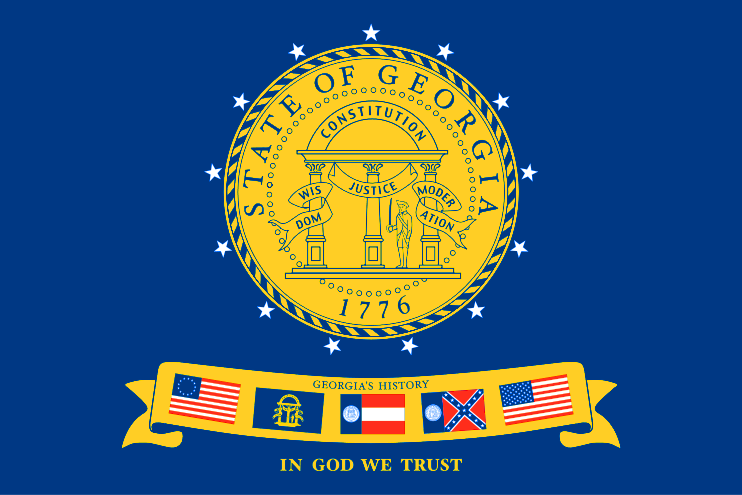
On January 30, 2001, the Georgia State Senate passed a house bill changing the state flag from the 1956 version to one that aggregated the State Seal and five former state flags, pictured below.
On January 29, 2020, Georgia Congressman Doug Collins announced he would run against Kelly Loeffler, who was appointed to the United States Senate by Gov. Brian Kemp.
“We’re in for the Georgia Senate race down here. I’ve still got a lot of work left to do to help this president finish this impeachment out, and we’re going to make a bigger announcement down here in Georgia,” he told the “Fox & Friends” hosts.
“The shortsightedness in this decision is stunning,” NRSC Executive Director Kevin McLaughlin said in a statement. “Doug Collins’ selfishness will hurt David Perdue, Kelly Loeffler, and President Trump. Not to mention the people of Georgia who stand to bear the burden of it for years to come. All he has done is put two senate seats, multiple house seats, and Georgia’s 16 electoral votes in play. The NRSC stands firmly behind Sen. Kelly Loeffler and urges anyone who wants to re-elect President Trump, hold the GOP senate majority, and stop socialism to do the same.”
Collins’ entrance into the race makes a runoff far more likely, which could potentially decide the balance of the Senate in a vote held in January, a month when most people are not accustomed to going to the polls.
Happy birthday today to Northwestern University (1851), Yale Daily News (1878), the first daily college newspaper in the country, the United States Coast Guard (1915), and the Lego brick, which was patented on January 28, 1958.
Georgia Politics, Campaigns, and Elections
Lieutenant Governor Geoff Duncan (R-2.0) supports legislation to improve Georgia’s crime reporting, according to the Capitol Beat News Service via the Albany Herald.
A bill sponsored by Sen. Bo Hatchett, R-Cornelia, would modernize the current system with input from the various criminal justice agencies involved in implementing the proposed changes.
“As the nation grapples with rising crime, all facets of the judicial system must be properly equipped to respond immediately and effectively,” said Lt. Gov. Geoff Duncan, the Senate’s presiding officer. “Current reporting data shows unacceptable metrics that pose a major public safety risk for communities.”
“Solving this ongoing issue is critical to keeping our communities and crime victims safe,” Gov. Brian Kemp added. “When communication breakdowns exist between law enforcement, crime victims, prosecutors, judges, and potential employers, then justice cannot be effectively served.”
The Criminal Record Responsibility Act would update requirements for submitting documents to the Georgia Crime Information Center and remove unnecessary, outdated steps from the submission process.
The Georgia Senate State and Local Government Operations Committee voted to recommend passage of Senate Bill 369 by Sen. Clint Dixon (R-Buford), according to the Associated Press via AccessWDUN.
The Senate State and Local Government Operations Committee voted 4-2 on Thursday to advance Senate Bill 369, which would take effect for this year’s school board elections in Gwinnett County, the state’s largest school district. They would take place in May, when Georgia holds nonpartisan elections, instead of in the November partisan general election.
“The education of our children should be a nonpartisan issue,” said Sen. Clint Dixon of Buford, the measure’s Republican sponsor. “We need to get politics out of our schools.”
The move bypasses the normal local legislation process. Democrats say Dixon couldn’t get support from Democrats who dominate the county’s delegation. Normally, a majority of Gwinnett lawmakers must agree to a local bill for it to pass.
Sen. Michelle Au, a Johns Creek Democrat who represents parts of Gwinnett, said she saw no proof that Gwinnett residents, as a whole, wanted to change to nonpartisan elections. She also said that getting the switch made in time to hold qualifying in March and elections in May could be impossible for county election officials.
“Losing is not a cause for overhauling policy. Instead, this issue has become an ideological battleground over school mask mandates and truth in education,” [Democratic State Senator Nikki] Merritt said. “Now that Gwinnett County has flipped, we are just witnessing a power grab over local control.”
Gwinnett County Board of Education Chair Tarece Johnson was more blunt, suggesting the move targeted school board members because of their race. Johnson in particular has been criticized because of videos she has made supporting the Black Lives Matter movement and discussing her views on systemic racism and racial equity.
“I ask you to consider that reasons are rooted in retaliation and political agendas. If you move to support this, you are supporting a bill based on bigotry. Because this bill and others that come before you are targeting people of color and attempting to suppress their votes, erase their historical truths and censure diverse perspectives,” Johnson said.
The Senate’s State and Local Government Operations Committee took up Senate Bill 369 on Thursday morning and passed it on a 4-2 party-line vote. It’s next stop would be the Senate Rules Committee, which decides the daily agenda for the full Senate. The bill was put into the Senate hopper on Monday and moved quickly through the SLGO committee.
Earlier this week, Dixon stood by previously stated reasons for pushing a bill for nonpartisan Gwinnett school board elections, but he added the recent appointment of board member Tarece Johnson as the board’s 2022 chairwoman as a new reason.
Dixon filed the legislation as a general bill since rules, at least in the state House of Representatives, say changes to the political nature of a governmental body, such as school board, are considered general legislation instead of local bills.
Dixon told the Daily Post that the bill, if passed by the Georgia Senate and House, will go into effect as soon as Gov. Brian Kemp signs it into law. Dixon’s goal is to have the bill in place in time for this year’s school board elections to be nonpartisan races.
Gwinnett County school board member Tarece Johnson spoke against Senate Bill 369 on Thursday. She questioned its timing after her party’s victories in Gwinnett and said it would result in lower voter turnout since nonpartisan elections are held months before general elections.
She said SB 369 is a GOP push to “usurp” power, “targeting people of color and attempting to suppress their vote, erase their historical truths and censor diverse perspectives.” Johnson said she was speaking for herself rather than as the Gwinnett school board’s new chair.
The State House of Representatives voted to pass House Bill 841 to allow for the incorporation of a new City of East Cobb, according to the Associated Press via AccessWDUN.
The House voted 98-63 for House Bill 841; the measure will next move to the Senate for more debate. If the bill becomes law, residents would vote on cityhood on May 25. If approved, they would elect council members and a mayor in November, with the city coming into existence on Jan. 1.
Proponents say the move will bring government closer to the people, with sponsor Matt Dollar, a Marietta Republican, saying it’s “a true community effort.” The city would provide zoning and code enforcement, police and fire protection, parks and road paving.
“What this is doing is shifting very specific services to a level of government that is closer to the people,” Dollar told lawmakers, saying people should get a chance to decide on their own self governance.
Metro Atlanta has seen a wave of suburban incorporations since 2005, fostered by Republicans. Those changes resulted in almost all of Fulton County becoming part of a city and chunks of DeKalb and Gwinnett counties formed into new cities. This is the first time the wave has reached Cobb County, coming after Democrats took control of the county commission, which governs unincorporated areas, for the first time in decades.
Three more Cobb cityhood approvals are pending this year: Lost Mountain in western Cobb, and Vinings and Mableton in southern Cobb.
A House subcommittee later Thursday approved House Bill 826 to create Lost Mountain and House Bill 840 to create Vinings.
House Bill 1013, co-sponsored by House Speaker David Ralston (R-Blue Ridge) and intended to improve Georgia’s mental health care system, includes a measure to limit profits reaped by Care Management Organizations, according to Georgia Health News.
Tucked inside the legislation is a provision that would require the Medicaid managed-care companies to refund payments to the state if they don’t spend enough on medical care and quality improvements for patients.
Each year, Georgia pays three insurance companies — CareSource, Peach State Health Plan, and Amerigroup — a total of more than $4 billion to run the federal-state health insurance program for low-income residents and people with disabilities. For 2019 and 2020, the companies’ combined profits averaged $189 million per year, according to insurer filings reported by the National Association of Insurance Commissioners.
“Instead of ensuring adequate health care networks for Georgia’s children, Georgians with disabilities, and Georgians in nursing facilities, hundreds of millions of dollars go instead to the Georgia [insurers’] bottom lines,” said Roland Behm, a board member for the Georgia chapter of the American Foundation for Suicide Prevention.
Most states with a spending requirement set that ratio at a minimum of 85% of premium dollars that insurers are paid. So when a Medicaid insurer spends less than that on medical care and quality improvements, it must return money to the government.
The Georgia bill also calls for setting the threshold at 85%. If the bill is approved, the Medicaid insurers would face the medical spending requirement in 2023.
The Terry School of Business at the University of Georgia released their analysis of Georgia’s economic outlook, according to WTVM.
Georgia expects to see statewide economic grow of 4.3-percent in 2022, powered by mostly private sector growth.
The so called ‘back-to-normal index’ is predicted to be 95-percent, which means Georgia will almost fully recover from the pandemic in 2022.
When it comes to Columbus, jobs are expected to grow 3.6-percent in 2022.
The current pillars of the Columbus economy: Fort Benning, Columbus State University, TSYS, Aflac and Piedmont Columbus Regional and St. Francis Hospitals will continue to play big roles in our recovery.
Federal jobs and the insurance and medical industries are still the most vibrant economic sectors, keeping Columbus on a post-pandemic growth path.
Click here for the full text of the Georgia Economic Outlook 2022 document.
Dr. Jeffrey Dorfman, a UGA Agricultural Economist and the State Fiscal Economist spoke about the outlook in the ag sector, according to WALB.
“So right now the state agriculture economy is in good shape financially in the sense that farmers don’t have excessive debt. Interest rates are pretty low, and most have got some money in the bank. But for the most part, farmers are trying to ride out the period of very high inputs. Costs. And just try to get through 2022 and hope things will be better in 2023,” Dr. Dorfman said.
[WALB reporter Jim] Wallace replied, “as people head to the stores, obviously they see prices are up and of course the price of the inputs. Just about everything a farmer uses, the price is up.”
“That’s right. Most, a lot of input prices are up 30 to 40%. Fertilizers are up in a lot of cases 100%. About the only thing that is getting better now is transportation costs are coming down a little. Particularly container shipments. But for the most part input prices are very high. And food processing prices are very high, transportation costs are high. So by the time they get on the shelf, it’s much more expensive.”
“And even though the food is expensive, does the grower end up with more profit because of that?” Wallace questioned.
“So grower profits are down because input costs are up so much. Commodity prices are at decent levels, but they have not gone up anywhere near as much as input costs. So farmers’ margins have been squeezed. And they are getting a little less of the food dollar. Processors and grocery store costs have gone up, in some cases even more than farmers because they are having to put in protective equipment for COVID and dealing with a lot of sick workers,” answered Dorfman.
“Well, the good news is agriculture went into this in good financial shape, so we can ride this our for the next year. Farmers are not likely to make a lot of money in the next year, but you won’t see farmers going broke for the most part either. I think farmers can ride this out and there’s enough other money in the system. I think the state’s economy is doing very well and will continue to do just fine,” said Dr. Dorfman.
Supply chain and staffing issues are indirectly affecting school meal programs, according to the Gainesville Times.
School nutrition officials for the Gainesville and Hall County school districts said labor shortages among their manufacturers and suppliers are the main reasons certain foods are sometimes unavailable for breakfast or lunch.
“It has to do with production and labor,” said Penny Fowler, nutrition director for Gainesville City Schools. “They (the food distributors) send us letters and let us know that there are going to be shortages and what items are going to be shorted and when they’ll possibly be back in stock. Most of the letters that I’ve received have been based around labor.”
Fowler and others named two types of foods in particular: cereal and chicken.
“They’re trying to keep up with their own food budget at their school,” said Sara Sheridan, nutrition coordinator for Hall County Schools. “They’re trying to keep a good level of inventory on hand. They’re trying to follow the menu, so I know it’s very stressful for our managers, but I think they’re doing a great job.”
Both school districts order the bulk of their food from U.S. Foods and Gordon Food Service, food distribution companies that act as middlemen between manufacturers and schools. Jones said they receive at least 80% of their food through the companies.
Certain cereal brands are sometimes unavailable not because cereal itself is in short supply. Rather, a greater demand for the single-serving cereal boxes purchased by schools overwhelms the production lines that make the smaller boxes.
Why the increase in demand? A possible explanation is that shortly after the coronavirus pandemic struck, school meals have been provided at no cost to students thanks to a waiver by the federal government.e
I want to take a moment to point out two ironies. First is that Gainesville, the “Poultry Capital of the World,” is experiencing chicken shortages. Second is that the lady in charge of nutrition for Gainesville City Schools is named “Fowler.”
Savannah City Council members voted to remove Alderwoman At-Large Kesha Gibson-Carter from the position of Chair, according to WSAV.
“Council has the authority to evaluate its officers. The evaluation can be compared to an employee evaluation. The results can range from increased responsibilities to removal of office,” explained [Council member Kurtis] Purtee, “So making this about responsibility, we must take into consideration that one must be held accountable for their actions. In light of the reprimand voted on by city council and since the reprimand was approved.”
The council voted back in December to publicly reprimand Gibson-Carter, a Black woman, for calling a fellow council member racist.
“I move to remove Kesha Gibson-Carter as council chairperson,” said Purtee Thursday night.
“So of all the things going on in this city. and all the things going on in each your districts, with it taking five members of council to put an item on the agenda,” said Gibson-Carter, “This is the best you can do of us eclipsing the number of homicide in this city? The cuff of us eclipsing aggravated assaults in Atlanta, Georgia. This is the best we can do?”
The council vote was 6-2 with Johnson, Palumbo, Shabazz, Legget, Purtee, and Wilder-Bryan voting ‘yes.’ Miller-Blakely and Lanier voted ‘no.’
“It’s really a moot point. For me it’s not even about the principle. because the people of Savannah sent me to this seat and it doesn’t matter about the chair, when I’m one day going to be the mayor. So, carry on,” Gibson-Carter said before leaving the chamber.
“I move to remove Alderwoman Kesha Gibson-Carter from the council office position of council chairman,” said District 6 Alderman Kurtis Purtee.
“And Mr. Purtee, if we look at this crap you pulled at Garden City, you shouldn’t even be carrying a badge or a gun,” said Post 1 At-Large Alderwoman Kesha Gibson-Carter.
“I’m not gonna major in the minor. I’m not going to get caught up in the semantics of who’s here, who’s on first and who’s on second. I’m in the Post 1 seat and I’m gonna be in the Post 1 seat until the citizens of Savannah move me up a little bit higher,” said Post 1 At-Large Alderwoman Kesha Gibson-Carter.
Cobb County Commissioners voted to seek an additional $40 million in federal funding to provide additional rental assistance, according to the AJC.
The funds would come courtesy of the state Department of Community Affairs, which has struggled to distribute its allotment of federal rental assistance dollars despite overwhelming demand. As of late November, less than 15% of the $989 million provided to the state had reached renters, even as evictions have soared and a backlog of applications await processing.
Cobb County, by contrast, has spent nearly all of the money it has received to date — about $39 million in total, with another $13.8 million expected from the U.S. Treasury in the future. But that still hasn’t prevented a surge in evictions.
According to data tracked by the Atlanta Regional Commission, landlords have filed an average of 1,500 evictions a month in Cobb since a federal moratorium was lifted in August. That’s up 50% from about 1,000 a month in the first eight months of the year.
At Tuesday’s board meeting, Chairwoman Lisa Cupid, a Democrat, said the county was asked by the state to help distribute some of its remaining funding, which is earmarked for those who fell behind on rent due to pandemic-related hardships.
Columbus residents discussed parking in the Uptown district, according to WTVM.
The Valdosta Board of Education decided against a mask mandate, according to the Valdosta Daily Times.
“The responses from a survey given to school principals, they report only 6% of students are wearing, requesting, or at least bringing masks to school,” Cason said. “Also, a majority of principals are seeing a decline in absences of faculty and staff due to COVID-19.”
Board members agreed to continue to monitor the COVID-19 data and base the decision to reinstate the mask mandate on the numbers reported within the school system.
Most Glynn County Commissioners said they oppose tolling the bridge to St Simons Island, according to The Brunswick News.
The question was posed after Commissioners Wayne Neal, Walter Rafolski, Sammy Tostensen, David O’Quinn and Bill Brunson voiced opposition to the proposed toll. They were asked why discussions have continued about a toll if there is no support among a majority of commissioners.
“The toll will be dropped,” Rafolski said. “I just don’t see it.”
Brunson defended Commissioner Cap Fendig, who has been meeting with state officials to see if a toll is even possible for the county to impose.
“He just wants the information,” Brunson said. “Right now, all of us are just guessing (if a toll is possible).”
Brunson said voter approval of a SPLOST referendum this fall is important. One of the main proposed projects is a courthouse annex, which would force an increase in property taxes without the 1-cent tax.
“SPLOST is the best way,” he said.
Lawrenceville Police Chief Tim Wallis has been suspended after an investigation into allegations of sexual harassment within the department, according to the Gwinnett Daily Post.
The city announced the results of the investigation on Thursday. The report details several incidents involving various members of the department, such as an allegation that Wallis a female captain that she looked “like a Hooters girl when the air conditioner’s not working” among other allegations.
“I was disturbed by the findings of the investigation and issued penalties to the appropriate employees, including a requirement for individual training,” Lawrenceville City Manager Chuck Warbington said. “The City of Lawrenceville prides itself as an inclusive and safe work place for all employees. The workplace culture revealed through this investigation did not meet the standards of excellence expected of all departments in the City. This is unacceptable and will not be tolerated.”
Shatara Powell was sworn in as interim Probate Judge for Talbot County, according to WTVM.
This appointment comes abruptly after the sudden death of former Judge Sherrell Terry, who Powell says she will miss dearly.
“Still in disbelief over the death of Judge Terry but I’m excited to come in as her predecessor and tackle the job,” said Powell.
Following Judge Powell swearing in her first steps will be to order a special election within 10 days of being in office. Judge Powell says she will do her best to fill the shoes of former Judge Sherrell Terry.
The Georgia River Network is planning a Mother’s Day weekend paddle, according to the Albany Herald.
Georgia families looking for a Mother’s Day gift on the wild side can treat mom to two days of camping and paddling May 6-8 as Georgia River Network hosts a special adventure on the Yellow and Alcovy Rivers.
“Georgia River Network loves getting families on rivers,” Paddle Georgia Coordinator Joe Cook said. “Electronic devices don’t mix well with water, so parents and children alike are assured of each others’ undivided attention. Georgia’s rivers are a great place to disconnect and reconnect with each other and the beauty that surrounds us.”
The two-day canoe/kayak trip will begin with a 7-mile journey on the Yellow River as it winds gently into historic Porterdale and the following day will culminate with a 10-mile adventure down the Alcovy River’s numerous gentle shoals as it descends to Newton County’s Factory Shoals Park.
Camping will be at historic Salem Campground near Covington, where participants will have the option of tent camping or staying in the campground’s rustic circa-1940 hotel. The event will feature catered meals, educational programs about the rivers, crafts and on-river activities for youths and tours of the interdenominational camp meeting grounds, which were founded in 1828.
Registration fees are $360 for adults and $220 for students 17 and under. Additional information and registration is available at www.garivers.org/events/yellow-alcovy.
This is one of more than 15 on-river adventures planned by Georgia River Network this year. Other weekend trips are planned for the Conasauga River Aug. 20-21, Flint River Oct. 7-9, Ossabaw Island Oct. 28-30 and Okefenokee-Suwannee River Nov. 11-13. Day trips are planned for the Etowah River May 21, South Chickamauga Creek May 28, Chattahoochee River July 23, Flint River Aug. 6, Oconee River Sept. 10 and Ebenezer Creek/Savannah River Nov. 19.
That Ossabaw Island trip really appeals to me.







Comments ( 0 )