
On January 29, 1779, British forces captured Augusta, Georgia.
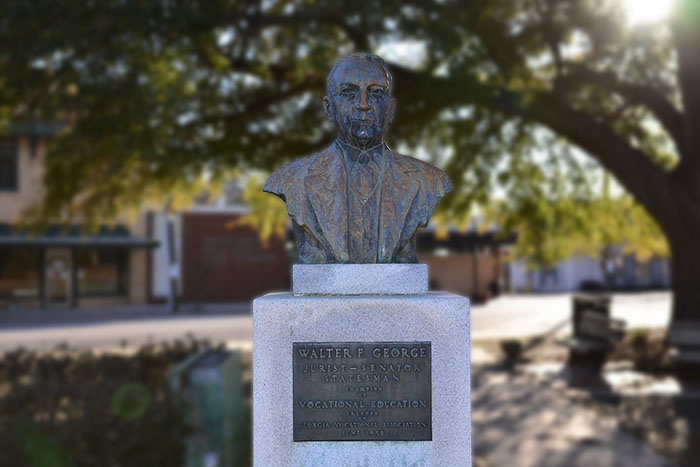
Walter F. George was born on January 29, 1878 in Preston, the county seat for Webster County, Georgia. Ron Daniels has a brief bio of the United States Senator who gave his name to a Law School, a courthouse, and a lake. The photo above is a bust in the town square of Vienna, Georgia, in Dooly County, where George made his home.
On January 29, 1892, the Coca Cola Company was incorporated in Georgia in Fulton County Superior Court.
On January 29, 1955, Georgia Governor Marvin Griffin signed legislation granting the power to take land needed for the Stone Mountain Park through condemnation if negotiations to buy it fell through.
On January 29, 1977, Congressman Andrew Young resigned his seat to accept the nomination by President Carter as United States Ambassador to the United Nations.
On January 29, 1998, a bomb exploded in a Birmingham, Alabama abortion clinic, killing a police officer. Eric Rudolph would later admit to setting that bomb, along with the Centennial Park bombing in 1996, and the bombing of a Sandy Springs abortion clinic and an Atlanta bar in 1997.
On January 29, 2020, Georgia Congressman Doug Collins announced he would run against Kelly Loeffler, who was appointed to the United States Senate by Gov. Brian Kemp.
“We’re in for the Georgia Senate race down here. I’ve still got a lot of work left to do to help this president finish this impeachment out, and we’re going to make a bigger announcement down here in Georgia,” he told the “Fox & Friends” hosts.
“The shortsightedness in this decision is stunning,” NRSC Executive Director Kevin McLaughlin said in a statement. “Doug Collins’ selfishness will hurt David Perdue, Kelly Loeffler, and President Trump. Not to mention the people of Georgia who stand to bear the burden of it for years to come. All he has done is put two senate seats, multiple house seats, and Georgia’s 16 electoral votes in play. The NRSC stands firmly behind Sen. Kelly Loeffler and urges anyone who wants to re-elect President Trump, hold the GOP senate majority, and stop socialism to do the same.”
Collins’ entrance into the race makes a runoff far more likely, which could potentially decide the balance of the Senate in a vote held in January, a month when most people are not accustomed to going to the polls.
Georgia Politics, Campaigns, and Elections
Early voting continues in the Special Election for House District 125, according to WRDW.
A leadership committee associated with Gov. Brian Kemp is taking a stand against one of the candidates for HD125, according to the AJC.
The broadsides by Kemp’s leadership committee come as no surprise, given that Pearson was the top aide to former gubernatorial candidate Vernon Jones. He is the party-switching former Democrat whose far-right challenge to Kemp imploded in spectacular fashion in 2022 after former President Donald Trump refused to back him.
But what’s more noteworthy is the ferocity of the attacks against Pearson. His main Republican rival in the four-candidate race on Feb. 13 is Gary Richardson, a former Columbia County commissioner.
Flyers targeting reliable conservative voters dub Pearson, a first-time candidate and former chair of “Teens for Trump,” as “Pacific Coast Pearson” because he said he dropped out of the University of Alabama to join PragerU, a conservative online media outlet based in Los Angeles, as a commentator. The materials also note that Pearson endorsed democratic socialist Bernie Sanders in 2015, though they don’t mention Pearson was just 13 years old at the time.
Kemp’s allies are also behind a residency challenge filed last week that raised “significant questions” about how long Pearson has lived at the Grovetown address he claims as his residence. Under Georgia law, legislators must live in their districts for a year before they’re elected.
Pearson spokesman Dan McLagan said Pearson has tax records and driver’s licenses to verify his residency. He suggested Kemp’s machine was hijacked by drunken kids who “took Daddy’s super PAC out to do donuts in the parking lot.”
“This looks like a rogue operation. I can’t imagine Gov. Kemp signing off on fake attacks against a Gen Z Republican who is growing our party with both African-Americans and young people,” he said. “Those constituencies could really help Republicans win in 2024”
Under the Gold Dome Today
TBD Senate Rules Committee: Upon Adj – 450 CAP
8:30 AM House Ins Sub Property and Casualty – 406 CLOB
9:00 AM HOUSE RULES – 341 CAP
10:00 AM HOUSE FLOOR SESSION (LD11) – House Chamber
10:00 AM Senate Floor Session (LD 11) – Senate Chamber
1:00 PM HOUSE Education Sub Ed Policy – 506 CLOB
1:00 PM Senate Ag & Cons Aff – 450
1:00 PM Cancelled- Senate Transportation – Mezz 1 CAP
1:30 PM HOUSE Judy Non-Civil Hong Sub – 132 CAP
2:00 PM HOUSE Regulated Ind Occ / Prol Lic Sub – 606 CLOB
2:00 PM HOUSE HEALTH – 403 CAP
2:00 PM HOUSE Education Sub Curriculum – 506 CLOB
2:00 PM HOUSE Insurance Life & Health Sub – 415 CLOB
2:00 PM Senate Health & HS – 450 CAP
2:00 PM Cancelled – Senate Govt Oversight – 307 CLOB
3:00 PM Senate Finance – Mezz 1 CAP
4:00 PM Senate Judiciary – 307 CLOB
Today at 2 PM, the state Senate Republican Caucus will announce its priorities for the Session, according to a Press Release.
The press conference will include remarks from Lt. Governor Burt Jones, Senate Majority Leader Steve Gooch (R–Dahlonega), and Senate President Pro-Tempore John F. Kennedy (R–Macon) on the 2024 Majority Caucus priorities.
Senate Resolution 465 by State Sen. Greg Dolezal (R-Forsyth County) passed the Senate, creating a Senate Special Committee on Investigations, according to the Associated Press via Access WDUN.
Georgia’s state Senate joined attempts to investigate Fulton County District Attorney Fani Willis on Friday, voting 30-19 to create a special committee that Republican senators say is needed to determine whether the Democratic district attorney misspent state tax money in her prosecution of former President Donald Trump and others.
The committee, which doesn’t require approval by the state House or Gov. Brian Kemp, is tasked with making recommendations on state laws and spending based on its findings. But the committee can’t directly sanction Willis, and Democrats denounced it as a partisan attempt to try to play to Trump and his supporters.
The new panel would be able to issue subpoenas and require people to testify under oath — powers that no other Georgia legislative committee routinely uses.
The action comes at the beginning of Georgia’s 2024 legislative session, with all 56 Senate and 180 House seats up for election later this year. With few of the 56 Senate districts expected to be competitive between Republicans and Democrats, the most serious opposition that many lawmakers could face would be in their party primary in June. Attacks on Willis by Republicans and a defense of her by Democrats could deter primary challenges on both sides in advance of the March deadline for candidates to file for election.
Most of the top supporters are Republican lawmakers who also publicly backed Trump’s efforts to overturn Georgia’s 2020 election results, including Republican Lt. Gov. Burt Jones. Willis was barred from prosecuting Jones by a judge after she hosted a fundraiser for a Democratic opponent. Jones on Wednesday reaffirmed his support for Trump after the former president won the New Hampshire primary.
“I’ve never shied away from it,” Jones told reporters. “I’m a Trump guy. I’ve been a Trump supporter since 2015.”
Kemp, though, has said he favors a revived prosecutor oversight board looking into whether Willis did anything wrong, instead of a legislative committee.
Democratic Sen. Josh McLaurin accused Republicans of going down a “dangerous path” by catering to Republicans who have shown themselves willing to threaten violence against Georgia lawmakers seen as insufficiently supportive of Trump.
“If you guys think you can handle it — if you think you can inflame that base, and feed them more, feed them misinformation, or let them persist in their misinformation about the results of elections — and not face the consequences someday, I think you’re mistaken,” McLaurin said.
House Bill 990 by four Democrats and a Republican, would place some artistic expression inadmissible at trial, according to the Dalton Daily Citizen News.
A bill introduced during the 2024 Georgia General Assembly session on Jan. 22 would amend Georgia code to make “creative and artistic expression evidence” inadmissible in trials.
House Bill 990 is sponsored by three Democratic legislators and two Republican lawmakers, including District 4 state Rep. Kasey Carpenter, R-Dalton.
“Subject to any other valid objection, photographs, motion pictures, video recordings and audio recordings shall be admissible in evidence when necessitated by the unavailability of a witness who can provide personal authentication and when the court determines, based on competent evidence presented to the court, that such items tend to show reliably the fact or facts for which the items are offered,” the text of the bill reads. “As used in this subsection, the term ‘creative or artistic expression’ means the expression or application of creativity or imagination in the production or arrangement of forms, sounds, words, movements or symbols, including music, dance, performance art, visual art, poetry, literature, film and other such objects or media.”
Carpenter is also one of six Republicans backing House Bill 1002, which was introduced to the legislature on Jan. 23.
HB 1002, if ultimately signed into law, would allow operators of “bona fide coin operated amusement machines” — sometimes referred to as “Class B” machines — to dispense gift cards at automated kiosks — pending certain conditions.
House Bill 1048 by State Rep. Kasey Carpenter (R-Dalton) would designate Cornbread as the official state bread of Georgia, according to Atlanta News First via WALB.
“The colorful history and traditions of the State of Georgia are inextricably associated with the food traditions of corn,” the bill reads. “Cornbread enjoys a singular stature in Georgia history and culture that is rivaled only by its undeniable appeal as a versatile and satisfying food. Establishing cornbread as the official Georgia state bread is necessary to fully recognize the importance of this product to this state.”
If approved by lawmakers and signed into law, cornbread will join the peach, Vidalia onion and grits in the ranks of state-designated foods.
Currently, the bill has only been introduced in the Georgia House.
Should the legislation impose penalties for adding sugar?
State Rep. Gerald Greene (R-Cuthbert), the Dean of the Georgia General Assembly, write about legislation passed in the Albany Herald.
As we are now in the second session of the 157th Georgia General Assembly, or the second year of the biennial, any bills that did not receive passage during the 2023 legislative session are still eligible for consideration. As such, we also gave final passage this week to an important measure that carried over from last session. On Friday, the House passed House Bill 502, or the “Georgia Cosmetic Laser Services Act,” which updates the definition of “cosmetic laser services” in state law as a result of the development of new dermatological procedures that were not encompassed in the previous definition.
Lastly, the House gave final passage this week to an important measure previously introduced and passed by the House during the 2023 legislative session. House Bill 30 addresses anti-Semitism in our state and would add the practice as a category covered by our hate crimes law. Under the law, the internationally recognized definition of “anti-Semitism,” as adopted by the International Holocaust Remembrance Alliance, would become part of state law.
Additionally, this bill would require all state agencies that enforce criminal or noncriminal law or regulation that prohibits discrimination to consider the definition of anti-Semitism during that enforcement. The final passage of this bill is a victory for our friends in the Jewish community and was especially timely given the rise in anti-Semitic acts in our state and across the country. HB 30 now heads to Gov. Brian Kemp’s desk to be signed into law.
Aside from our work in committees and on the House floor, it was a busy week under the Gold Dome with many events, activities and recognition of special guests. This week, the Japanese Consulate in Atlanta held a 50-year celebration at the Capitol and received a special recognition while the House was in session. My colleagues and I also welcomed guests for Korean American Day who were recognized by the House during session.
Events also were held at the Capitol this week for Addiction Recovery Awareness Day and Mental Health Day to raise awareness for these important initiatives. Finally, we honored National Guard Day in the House with a special invitation resolution recognizing Jan. 25 as National Guard Day at the state Capitol. Members of Georgia’s National Guard joined us on the floor of the House Chamber and were honored for their heroic acts and selfless service to our state and nation.
Senate Bill 355 by State Sen. Randy Robertson (R-Cataula) prohibits use of ranked choice runoff voting in Georgia elections, and passed the Senate, according to the Augusta Chronicle.
Ranked choice voting in Georgia has been legal since the 2021 passage of SB 202, also known as the Election Integrity Act, which received unanimous support from Senate Republicans at the time. The legislation established ranked choice voting for active military members and voters who live overseas in an effort to make runoff elections more efficient for election officials.
Also referred to as instant runoff voting, ranked choice voting allows voters to rank candidates in order of preference, rather than choosing one candidate, with the goal of electing candidates with broad appeal who may not have been able to amass a majority under a traditional voting system. Only two states — Maine and Alaska — currently use a ranked choice voting statewide, though many municipalities across the country have begun to adopt the system.
But three years after the passage of the Election Integrity Act, Senate Republicans have reversed their stance on the issue, arguing that ranked choice voting is an unnecessarily time-intensive, confusing, and inefficient practice.
“Georgia is moving beyond the confusion and misinformation that we have experienced in the campaigns of 2016 and 2020,” said state Senate Majority Whip Randy Robertson (R-Cataula), who sponsored the bill. “We must aggressively fend off anyone attempting to hijack our election software, while also combatting those who attempt to reduce voter turnout or confuse our citizens with overcomplicated processes under the guise of saving money.”
“Ranked choice voting is not some monster under the bed,” said state Sen. Elena Parent (D-Atlanta). “So why would any reasonable legislator want to prevent local governments from taking advantage of the cost savings that the instant runoff voting system could offer? Preventing local governments from saving money and being good financial stewards is bad policy.”
Senate Bill 358 by State Sen. Max Burns (R-Sylvania) would allow the State Election Board to investigate the Secretary of State, and passed the Senate, according to the Associated Press via WRDW.
Georgia’s Senate is backing a plan to give the state’s appointed election board the power to investigate Secretary of State Brad Raffensperger’s handling of elections, despite the measure’s sponsor saying that the bill is in “murky water” when it comes to its constitutionality.
The Senate voted 30-19 along party lines Friday for Senate Bill 358, sending it to the House for more debate.
Raffensperger, also a Republican, says it is unconstitutional for the Senate to give the State Election Board the power to oversee an elected official.
“There is no precedent for an unelected board of political appointees to have oversight authority over members of the executive branch,” Raffensperger’s general counsel, Charlene McGowan, wrote Tuesday.
But Senate Ethics Committee Chairman Sen. Max Burns disagreed, saying Friday that the measure only alters legal powers that the General Assembly has given to Raffensperger and the election board, and not Raffensperger’s constitutional authority.
“The majority of powers of the secretary of state are vested through statute and not through constitutional law,” said Burns, a Sylvania Republican.
Burns has asked Republican Attorney General Chris Carr to provide an opinion on the measure’s constitutionality, saying Friday that even though it the measure is legally murky, the courts could sort out problems.
The proposal would remove Raffensperger from his nonvoting post on the board, three years after lawmakers removed him as the voting chair of the board. It would also allow the board to hire election investigators instead of solely relying on those working for Raffensperger and clearly give the board power to investigate the secretary of state.
Senate Bill 386 by State Sen. Clint Dixon (R-Buford) would allow sports betting under the Georgia Lottery, according to the Capitol Beat News Service.
Senate Bill 386 would authorize sports betting in Georgia under the oversight of the Georgia Lottery Corp. The bill would provide for both online betting on sports and retail betting at sites operated by licensees who would pay $1 million each.
The measure is being backed by Republican Lt. Gov. Burt Jones, who presides over the Senate, as well as Senate Minority Leader Gloria Butler, D-Stone Mountain.
A coalition of Atlanta’s professional sports teams also is getting behind the bill.
“The Braves are excited about the opportunity to bring mobile sports betting to Georgia,” said Derek Schiller, president and CEO of the Atlanta Braves. “Over the last several years, we have watched closely as 38 other states have legalized mobile sports betting and collected billions of dollars in tax revenue.”
Under the bill, 15% of the revenue generated by sports betting in Georgia would go to benefit the state’s HOPE Scholarships and pre-kindergarten programs.
“Sports betting is an easy way to pick up $80 million to $100 million (in tax revenue),” the lieutenant governor said Wednesday.
Senate Bill 386, introduced by Sen. Clint Dixon, R-Buford, would not require a constitutional amendment to become law. A second measure, sponsored by Sen. Bill Cowsert, R-Athens, would require changing the state constitution.
Cowsert and others have argued that legalizing sports betting in Georgia requires a constitutional amendment, which then would land on the statewide ballot for voters to decide.
However, constitutional changes need the support of two-thirds of the state House and Senate, a more difficult obstacle than Dixon’s bill, which would need only simple majorities of each chamber to pass.
House Bill 82 by State Rep. Mack Jackson, (D-Sandersville) passed the House and will be considered by the Senate Finance Committee, according to the Rome News Tribune.
House Bill 82, sponsored by Rep. Mack Jackson, D-Sandersville, passed that chamber with just one “no” vote last year but ran out of time to cross over. It’s scheduled for a hearing Monday in the Senate Finance Committee chaired by Sen. Chuck Hufstetler, R-Rome.
Hufstetler and other members indicated support for the measure when Jackson first presented it last week. However, they requested a few updates, primarily focused on the dates used in the 2023 version.
The bill would provide a tax credit of up to $5,000 to doctors and dentists who choose to practice in a rural county, defined by a population of no more than 65 people per square mile. It would not be available to those currently practicing in those places.
Senate Bill 333 by State Sen. Clint Dixon (R-Buford) would set up an incorporation vote for a new city in Gwinnett and passed out of the Senate Committee on State and Local Governmental Operations, according to the AJC.
SB333 would create the new city of Mulberry, which would be the county’s second most populous city with about 41,000 residents. The bill could be scheduled for floor debate in the Senate as soon this week, a senate spokesperson said.
Only residents within the proposed city’s boundaries would vote on a referendum.
New details about the proposed city emerged during the hearing: it would have five council members, each serving four-year terms, and council members would internally vote in a mayor who would serve two years, according to State Sen. Clint Dixon, who is sponsoring the bill.
A feasibility study has determined that the city would generate about $9.4 million in annual revenue, mostly from ad valorem taxes, insurance premiums and business occupation licenses. There would be no new property taxes.
“The reason the citizens of this area are urging for the creation of the city is more local control,” Dixon said.
A few senators had questions for Dixon during the hearing, but Sen. Derek Mallow (D-Savannah), expressed concern about residents not voting for the mayor.
“I just don’t like unelected positions,” Mallow said.
Dixon responded by saying that council selecting a mayor is just one option.
State Rep. Eddie Lumsden (R-Rome) is carrying local legislation for Chattooga County, according to the Rome News Tribune.
His House Bill 877, creating a countywide homestead freeze, passed the House unanimously on Thursday and is awaiting a hearing in the Senate State and Local Government Operations Committee.
Lumsden’s HB 961, submitted last week, is pending action in the House Intragovernmental Coordination Committee. It would set up four-year staggered terms for the Menlo mayor and city council.
The homestead freeze would essentially lock in the valuation of Chattooga County residents’ primary homes for county property tax purposes.
The Georgia Department of Transportation (GDOT) consider a new Interstate highway through Augsuta a bad deal, according to the Augusta Chronicle.
A newly released study of options for moving freight through Georgia by the state Department of Transportation (DOT) has concluded that a plan to build the Peach State’s first interstate highway since the 1960s would not be a good return on investment.
“I-14 demonstrated moderate benefits, including reduced congestion costs … and a decrease in vehicle hours of delay,” according to the report. “However, it is not projected to yield the same degree of positive impacts as other interstate highway projects such as I-75, I-20, I-95, and segments of I-16, especially considering the project’s initial cost estimate of more than $5 billion.”
On the state level, Georgia’s General Assembly passed a resolution back in 2019 supporting construction of the Georgia portion of I-14, picking up at the Alabama line at Columbus and extending to the South Carolina line in Augusta.
“It would be highly convenient for us in that part of the state,” said state Sen. Ed Harbison, D-Columbus, who sponsored the resolution. “When you come into Columbus from the west, you have to go almost to Atlanta to get to Augusta.”
The good news for Harbison and other I-14 backers is that the DOT isn’t giving up on the project completely.
“Because the I-14 project shows some benefit under the KPIs (Key Performance Indicators), a corridor study to further evaluate its feasibility would enable a more comprehensive understanding of the construction practicalities … as well as more specific project costs,” the report stated.
Port Wentworth City Council approved a $25 million dollar agreement with the Savannah Ghost Pirates and Port Wentworth Development Authority to build a new facility, according to the Savannah Morning News.
In April 2023, the Ghost Pirates announced plans to construct the $25 million, 90,000 square-foot facility in Port Wentworth’s planned 150-acre recreation complex, which will be at the corner of Monteith Road and Interstate 95, and signed a letter of intent the same month. The groundbreaking for the facility will be in March 2024 and construction is expected to be complete in the summer of 2025.
The 58-page document expands on the letter of intent signed by the Ghost Pirates and Port Wentworth in April 2023, laying out all the mechanisms by which the city, the Ghost Pirates and the Port Wentworth Development Authority will operate under the agreement.
Robichaux said that the city had been operating under the letter of intent for so long, because it took time to negotiate the contract due to the state of Georgia having restrictions on how involved cities can be with private business developments. He mentioned that the attorneys for the city and Ghost Pirates are still hammering out final details, and if there were any major changes, he would bring it back to council to review.
The facility will include two regulation-size ice rinks, a sports bar and grill, a pro shop and other amenities. It will primarily be a practice facility for the Ghost Pirates, but will also host youth and adult hockey, public figure skating and learn-to-skate programs.
Muscogee County School District did not apply for federal funding for electric school buses, according to the Ledger Enquirer.
When asked why MCSD did not apply for the buses, Kimberly Wright, the spokesperson for the district responded on behalf of the Chief Operations Officer, Travis Anderson via email:
“The mileage range and required charge time for a typical electric bus does not align with the driving pattern for MCSD. We continue to monitor improvements in the technology and hope to one day be able to incorporate electric buses into our fleet. We do not intend to seek funding for electric buses. It would be impractical and cause significant delays with getting students to school and back home each day.”
The buses are virtually free to districts thanks to the EPA grant. The electric buses do not contribute to poor health conditions in children and carbon pollution, a known ingredient for warming up the planet.
Nationally, 2,700 clean school buses were purchased with $1 billion in grants from the Bipartisan Infrastructure Law throughout 37 states. 151 buses were awarded to Georgia with a total award of $50 million.
Columbus Mayor Skip Henderson asked the Muscogee County Sheriff’s Office to investigate alleged releases of personal information, according to the Ledger-Enquirer.
The Columbus mayor has asked the Muscogee County Sheriff’s Office to investigate the release of some personal information from the city’s finance department.
Reports of the requested probe sparked fears that city administrators were trying to ferret out whistleblowers who reported problems in the city’s revenue collections. Those whistleblower reports triggered an internal audit and a private investigation commissioned by city councilors.
Mayor Skip Henderson said he asked for the probe because someone in the city government released personal tax information related to City Manager Isaiah Hugley, who owned a janitorial service called Hugley’s Facility Management.
A resident filed an open records request related to that business, and was provided information that should not have been disclosed, the mayor said, adding, “We can’t do that.”
“We protect whistleblowers,” said Henderson, insisting the sheriff’s probe was not targeting those individuals.
City workers, who wanted to remain anonymous because they felt threatened, said Finance Director Angelica Alexander sent her employees an email this week notifying them of the sheriff’s investigation.
Sheriff Greg Countryman initially declined comment, but on Friday confirmed he’d been asked to conduct an “administrative investigation” of the finance department.
Burke County officials hosted a forum for announced and potential candidates for law enforcement positions, according to WJBF.
Local leaders in Burke County held a Law Enforcement Candidate Forum– allowing candidates running for Burke County official positions to talk about matters important to them. Lewis Blanchard is running to unseat Sheriff Alfonzo Williams.
The forum included candidates running for Burke County District Attorney and Sheriff’s Office.
“We have worked hard to keep you safe; I’ve said to you that I’m not gonna do law enforcement badly and I mean that,” Burke County Sheriff Alfonso Williams said.
“Help kids never have to see a prosecutor or a defense attorney but go get new friends and new mentors and a new path to travel down…,” District Attorney Jared Williams said.
District Attorney Williams says his office has plans to create more opportunities for children and teens.
Amber Brantley is running to become the Augusta-Richmond County District Attorney and says events like the candidate forum help build a leader and citizen relationship.
The general primary election will be May 21st, so be sure to register and vote for your next community servants.
Forsyth County Probate Court will offer free Valentine’s Day weddings, according to AccessWDUN.
Forsyth County’s Probate Court will celebrate Valentine’s Day this February with free wedding ceremonies for county residents.
“It is an honor to be a part of this special day as these couples begin their new lives together,” said Probate Court Judge Daisy Weeks-Marisko. “What better way to celebrate love than weddings on Valentine’s Day?”
The free ceremonies will be held in a basic civil ceremony format. They will be held in the Probate Court Courtroom (100 W. Courthouse Square, Suite 008) between 9 a.m. and 4:30 p.m. on Valentine’s Day — Wednesday, Feb. 14.
Couples must fill out a registration form and apply for a marriage license in Probate Court on or before Feb. 9. Parties must also bring their marriage license and valid photo ID to their ceremony appointment time.
Additionally, couples must email ProbateHearing@forsythco.com to request a ceremony time.
Columbus will elect a new at-large member of City Council, according to WTVM.
On May 21, an election will be held where Columbus voters from every district will get to pick their next at-large city councilor.
Tyson Begly is currently serving in that seat following his appointment last April after John House stepped down. He told News Leader 9 again he does not plan to run in this next election and does not feel it’s appropriate to endorse anyone.
Travis Chambers publicly announced his candidacy for the City Council District 10 seat on Jan. 27 becoming the fourth candidate who has filed for this race.
Challengers include Dr. Rocky Marsh, who launched his campaign in 2023.
Another candidate who’s filed is Columbus businessman John Anker.
Anker ran for Mayor, losing to Skip Henderson in 2022.
There is one more candidate, Dr. Patrick Leonard. We did try to contact him multiple times but did not get a response. However, we will continue to reach out and will air his plans for his candidacy.
The Gwinnett County Association of Educators announced two endorsements for Gwinnett County Board of Education, according to the Gwinnett Daily Post.
The group announced endorsements in the school board Districts 1 and 5 races this week. Among the announcements is the news that the group is endorsing board member Tarece Johnson-Morgan in the District 5 school board race. Johnson-Morgan is her fourth year on the school board and spent the last two years as its chairwoman.
The more eye-catching news out of the endorsements, however, is that the group is not backing board member Karen Watkins in the District 1 race. Instead, GCAE endorsed Watkins’ opponent, Leroy Ranel Jr.
“Leroy Ranel Jr.’s campaign represents an opportunity to elect a longtime resident of Gwinnett County with extensive public service in law enforcement and a commitment to ensuring a safe and supportive learning environment for all of our children,” GCAE President Brian Westlake said in a statement.
Gwinnett County’s nonpartisan school board elections will be held on May 21 in conjunction with Georgia’s general primary election. The winner this spring will take office at the beginning of 2025.
Three school board seats are up for election this year. In additional to the Districts 1 and 5 races, the District 3 seat will also be on the ballot.
GCAE has not yet endorsed anyone in the sprawling field to replace retiring school board member Mary Kay Murphy in District 3, however. There are currently six people running for that seat.
Related Posts
 David Schwarz is off and running in Georgia First District
 Who’s Watching Your Statehouse? No One. – The Daily Beast
 The Marietta Daily Journal – Transportation is a priority for Cobb residents
 Adoptable (Official) Georgia Dogs for April 26, 2024
 Push for tax reform likely to resurface in Ga. | savannahnow.com


Comments ( 0 )