
Colonel James Fannin, a Georgia native and Colonel in the Texas Regular Army and more than 300 other members of the Georgia battalion were executed on March 27, 1836 after surrendering to Santa Anna’s Mexican Army. Fannin County, Georgia is named after Col Fannin.
On March 27, 1912, the first Japanese cherry trees were planted on the northern bank of the Potomac River near the Jefferson Memorial in Washington, DC. Tomorrow, Georgia will celebrate the 40th Anniversary of its relations with Japan by planting 40 Somei-Yoshino cherry trees around the park at the Millennium Gate Museum in Atlantic Station, beginning at 3 PM.
On March 27, 1941, Governor Eugene Talmadge signed legislation outlawing the handling of venomous snakes in such a way as to endanger another person or to encourage another person to handle a snake in such a way as to endanger them. The legislation resulted from a six-year old handling a venomous snake during a church service in Adel, Georgia, during which she was bitten and died. Under that act you could still handle snakes yourself as long as you didn’t endanger someone else.
On March 27, 1947, Governor Melvin Thompson signed legislation that made Georgia a “Right to Work State,” meaning that employees cannot generally be forced to join a union or pay dues in order to take a job. On the same day, gambling on sporting events was outlawed by another bill signed by Gov. Thompson.
Polling Report
Yesterday, WSB released a poll showing David Perdue leading the candidates for the Republican nomination for United States Senate.
Of the 600 likely Republican voters polled, 21 percent picked David Perdue, followed by Rep. Jack Kingston and Rep. Paul Broun tied at 15 percent.
Next in line are Rep. Phil Gingrey and former Georgia Secretary of State Karen Handel. About 25 percent of the people polled are still undecided.
Perdue’s message of being a Washington outsider may be resonating.
“He has an early lead but it’s an early lead with a very large vote still undecided,” said Emory political science professor Merle Black.
Black says Perdue’s ads of crying babies are having an impact and that Kingston’s ads of him driving a 20-year-old Buick may be off message.
“Kingston is kind of like a trip down memory lane.
It’s unclear whether that’s the kind of ad that really connects with a lot of voters. It’s more about the past than it is the future,” Black said.Black said Handel, who lost to Gov. Nathan Deal in 2010 by less than 2,500 votes, needs to start gaining momentum.
“It may well be that she had her moment in 2010, if these polls are correct. But right now, it looks like she’s running a very uphill battle.”
This follows by a week a poll by 11Alive showing Perdue in the top slot.
In the Republican primary for Governor, incumbent Nathan Deal overwhelms two nominal challengers: Deal 65%, David Pennington.11%, John Barge 7%. Some 17% said they were undecided.
In a Republican primary for the U.S. Senate being vacated by retiring Sen. Saxby Chambliss, David Perdue tops six challengers: Perdue at 29%, Jack Kingston at 19%, with Phil Gingrey, Paul Broun, and Karen Handel effectively tied for 3rd place. A runoff is likely, according to the poll.
So, according to my principles for reading polls, I’d first say to look at what’s happening in the real world and ask whether it explains a change in the electorate. I can believe that David Perdue is breaking out of the pack on the basis of a million-dollar media buy, followed closely by Jack Kingston, who has spent $800k. Knowing that about the race, these results seem consistent with an election that is starting to take shape.
| 11Alive/SurveyUSA 3/16-18 | WSB TV 3-23-24 | |
|---|---|---|
| Sample Size | 508 | 600 |
| Perdue | 29 | 21 |
| Kingston | 19 | 15 |
| Broun | 11 | 15 |
| Gingrey | 12 | 12.5 |
| Handel | 10 | 10 |
| Undecided | 15 | 25 |
| TOTAL | 96 | 98.5 |
At this point, I think what we can say is that Perdue appears to be leading in the range of 21-29% and Kingston may be in second place by a small margin over Broun and Gingrey.
Dueling Polls in 11th Congressional District
Yesterday afternoon, I received two polls both purporting to show who is leading in the Republican Primary for the 11th Congressional District. The two polls are distinctly different, leading me to conclude that at least one of them is dead wrong. But is there anything we can learn from them anyway?
First in my mailbox was an email breathlessly announcing, “Poll Shows Loudermilk Tied for Lead in CD-11”. In a 600 sample survey fielded March 20-24, the ballot question in the Loudermilk poll looked like this:
Loudermilk 12.3
Lindsey 2.7
Barr 12.2
Pridemore 3.7
Mrozinski .3
Levene .3
Unsure 65.5
Refused 3
Fast forward a couple of hours and another email containing poll results landed in my inbox, this time from Ed Lindsey. The subject line read “Poll: Ed Lindsey Leap Frogs Competition, Momentum Building” and the poll was conducted March 10-11.
Undecided 41
Barr 25
Lindsey 15
Loudermilk 13
Pridemore 4
Other 2
Clearly it is impossible to believe both polls. Further, I would say that I find it hard to believe that more than 65% of the electorate is undecided for the May 20 Primary. What is clear from both polls, is that Bob Barr is almost certainly headed into a runoff. The other name on the runoff ballot, coincidentally, is the name of the candidate who sponsored the poll. More than that I cannot say.
Judicial Nominating Commission shortlists 4 for Gwinnett Superior Court
Here are the four candidates whose names the JNC forwarded to Governor Deal:
- Teresa D. Hoyt – Assistant United States Attorney, U.S. Attorney’s Office-Northern District of Georgia
- Jeffery (Jeff) Lanier, Sr. – Deputy Legislative Counsel, Office of Legislative Counsel, Georgia General Assembly
- Randy Rich – Judge, State Court of Gwinnett County
- Laura M. Tate – Judge, Magistrate Court of Gwinnett County
If I were a betting man, and based on history, I’d wager that Randy Rich will be appointed to Gwinnett County Superior Court. It appears that Gov. Deal appears to prefer turning judicial appointments into “two-fers” by elevating a sitting judge whose seat on the bench he then gets to fill. There’s also the advantage of naming a judge who has bench experience in a closely-related court.
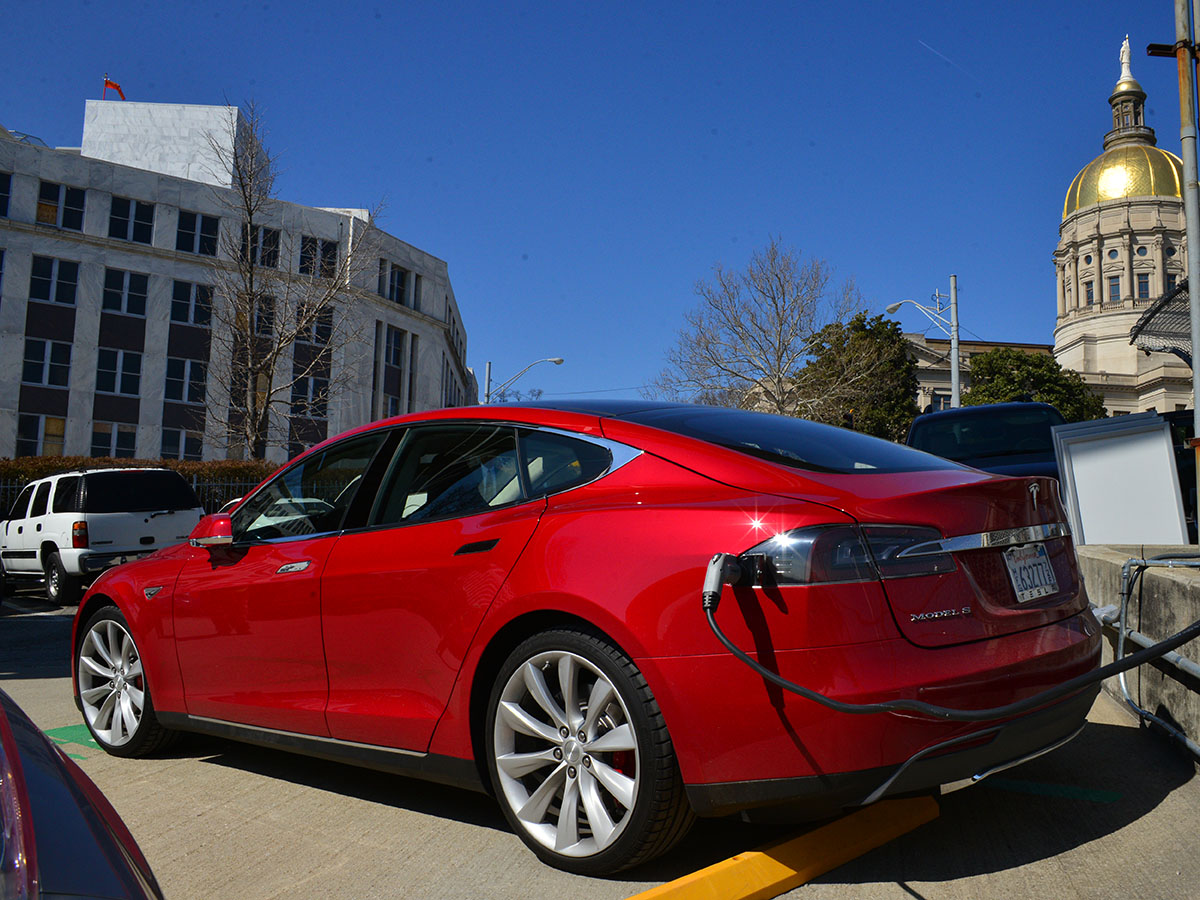
Tesla takes the stage in 2016 GOP Presidential race?
Yesterday, I wrote at InsiderAdvantage.com that the approach taken to allowing direct sales to consumers by Tesla Motors appears to be differentiating Republican elected officials who are often named as potential Presidential candidates in 2016.
Three of the elected officials most-frequently mentioned as potential 2016 Republican Presidential candidates have weighed-in on the fight between Tesla Motors and various state regulatory regimes that outlaw direct sales of automobiles to consumers.
Governor Chris Christie of New Jersey didn’t directly address whether he would be willing to change the state’s law that prohibits Tesla’s sales model after the New Jersey Motor Vehicle Commission, whose members he appoints, voted to ban direct sales by Tesla to Garden State residents. Christie may have the opportunity to act on state legislation that would exempt the manufacturer of electric vehicles from the state’s requirement that retail sales go through a franchised auto dealer.
Taking the opposite approach is Texas Governor Rick Perry, who made an abortive run in 2012 but may return to the Presidential arena. Like Christie, Gov. Perry faces opposition from retail auto dealers in his state, but Tesla site search for a new multi-billion dollar battery Gigafactory has Perry appearing ready to take on the entrenched system in the Lone Star State.
In the hopes of landing that $5-billion Tesla factory, Arizona lawmakers are itching to kill off legislation that keeps car-makers from selling directly to the public. On FOX Business today, Gov. Rick Perry suggested the great state of Texas needs to do the same thing and at least try to vanish those “antiquated” rules, lest it see 6,500 new jobs go elsewhere.
“Tesla’s a big project,” Perry told Maria Bartiromo. “The cachet of being able to say we put that manufacturing facility in your state is hard to pass up.”
Said Perry, it’s in the “best interest” of Texans to revisit those rules — or, he said, what “some would say are antiquated protections … for the car dealers. The people of Texas will say, We don’t need to be protected. We like to be able to negotiate straight away.’”
Finally, Senator Marco Rubio (R-Florida) has also aligned himself in favor of allowing direct-to-consumer sales by Tesla.
Senator Marco Rubio has voiced support for Tesla Motors’ direct-sales business model, while criticizing any attempts to use laws as a “defensive weapon.”
In an interview with CNBC, the Florida Republican noted that Tesla offers an “established product” and customers should be able to buy products that fit their need, “especially a product that we know is safe and has consumer confidence beneath it.”
The comments align with Rubio’s conservative position, viewing many government regulations as negative influences on economic growth.
Rubio’s comments and Christie’s actions appear to highlight a discord within the their party. Dealer lobbyists have catered to Republicans’ focus on local jobs, while arguing that Tesla’s direct-sales approach is a threat to established businesses. Tesla has countered by arguing that franchise laws are “an affront to the very concept of a free market.”
There’s a chance that the issue of Tesla’s sales model may be resolved before the 2016 Presidential nomination begins, or that it will fail to capture voters’ interests. But as a showcase for potential candidates approaches when faced by a choice between home-state small businesses and conservative, market-oriented philosophy, it’s an interesting test case.
Sabato’s Crystal Ball: Don’t Count on Millenials
If UVA Political Scientist Larry Sabato had a magic eight ball instead of a crystal ball, it might read, “Don’t Count on it,” when Democrats ask if turning out greater numbers of Millenials is the ticket to holding GOP gains this year. Associate Editor Geoffrey Skelley writes about the Democrats’ apparent desire to turn Millenial angst into blue votes.
A key cog in this coalition has been young voters — often called Millennials — who are more diverse than their elders. Exit poll data in 2012 suggest that young people were vital in securing President Barack Obama’s second term in the White House. He garnered 60% of the 18-to-29 vote (after winning 66% of it in 2008), by far the highest percentage Obama won among any age group. Estimating from exit poll data, all else equal, it’s possible that Obama would have narrowly lost the popular vote (and perhaps the Electoral College vote, too) had he won the same percentage among 18-to-29 year olds as he did among 30-to-44 year olds (52%). Continued strong support for Democratic presidential candidates in the future among younger voters could spell trouble for the GOP as generational replacement occurs (yes, that’s a euphemism).
However, one aspect of this trend is anything but rosy for Democrats: Since the first national exit poll was taken for a midterm election in 1978, only once (in that first survey) has the 18-to-29 age group made up a larger portion of a midterm electorate than voters who were 60 or older. And not only have young people almost always been the smallest part of midterm electorates in this period, their participation has usually been much smaller compared to presidential years. With Democrats more reliant on young voters to win elections, drop-off among that group could make it harder for Democrats to find success in midterm cycles.
For the time being, this political generation gap spells trouble for Democrats in midterm elections. On average, the youngest cohort of voters made up just over one-fifth of presidential electorates from 1972 to 2008, but only about 14% of midterm electorates. Younger voters have consistently shown up in smaller numbers in midterm cycles. Not once have 18-29s made up a larger portion of the electorate in a midterm election than they did in the prior or subsequent presidential election since midterm exit polling began in 1978.
The population is getting older — the nation’s median age rose from 28.1 in 1970 to 32.9 in 1990 to 37.2 in 2010 — so, naturally, older voters make up a greater share of the electorate. Still, sharply lower young voter participation in midterm elections is surely a trend that predates national exit polls. Older people are simply more likely to vote in general due to a number of lifestyle factors, such as buying a house, starting a family and becoming settled in a community. Even when the 18-to-29 cohort made up a plurality (30.4%) of the country’s adult population in 1980 (the last time that was true as the Baby Boomers got older), the 1982 midterm election saw an eight-point drop in that group’s portion of the electorate from the 1980 presidential election, falling from 22.9% to 14.9%.
Here’s the TL:DR version: younger voters compose a smaller percentage of the electorate due to lower birth rate, exacerbated by lower percentage turnout in non-Presidential election years.
Julianne Thompson on Religious Liberty, Hobby Lobby, and SB 377
Tea Party leader Julianne Thompson has put pen to paper, digitally, with an Op-Ed on the Religious Freedom bill advanced by Senator Josh McKoon in this year’s General Assembly, and the larger political context nationally.
This week marks a very important event in our country’s history as the Hobby Lobby v. Kathleen Sebelius case is being heard before the Supreme Court. The Christian-owned private company is opposed to abortion, and fighting for it’s right to not be forced to provide abortifacients as part of it’s health care plan.
Religious freedom and conviction is protected First Amendment, and also by the Religious Freedom Restoration Act, bi-partisan legislation passed almost unanimously by Congress, and signed into law in 1993 by President Clinton. RFRA protects people from government action being taken against them for exercising their right to not participate in an act that violates their beliefs.
This year in Georgia, State Senators Josh McKoon, David Shafer, and William Ligon introduced SB 377, which would have been a statewide mirror of the same law that is providing protection to 31 other states, including Illinois, where it was supported by President Barrack Obama when he served as a State Senator.
This bill is not discriminatory. There has never been a single case where the outcome calls this truth into question. It is also not a guarantee that a plaintiff will be legally successful. This is not the Arizona bill vetoed by Gov. Brewer. State RFRA is already the law in Arizona and has been for years.
This bill is about freedom.
Related Posts
 GA GOP: Jason Carter: “Can’t Have it Both Ways” With His GrandDaddy’s Money
 Georgia Politics, Campaigns, and Elections for September 18, 2018
- Georgia Politics, Campaigns, and Elections for May 2, 2016
 Adoptable Georgia Dogs for November 13, 2014
 Gun Legislation’s Failure Shadows Immigration Bill – NYTimes.com


Comments ( 2 )