
Today is the 25th Legislative Day of the Georgia General Assembly. The Senate and House both convene at 10 AM.
SB 115 by Senator Lindsey Tippins and others – relating to free public instruction, so as to provide that performance data of students in certain placements are included in the resident school system data
SB 134 by Senator Buddy Carter and others – relating to definitions relative to controlled substances, so as to revise the definition of “prescriber”
SB 137 by Senator Rick Jeffares and others – relating to tax credits for business enterprises in less developed areas, so as to authorize the commissioner of economic development to designate areas as opportunity zones
SB 139 by Senator Butch Miller and others – elating to general provisions for contracts, so as to provide for the collection of closing fees for contracts for the advance of money or the extension of credit; to provide for the refund of closing fees in certain instances
| 8:00 AM | FINANCE | 450 CAP |
| 12:00 PM – 12:30 PM | RULES UPON ADJOURNMENT | 450 CAP |
| 1:00 PM | REGULATED INDUSTRIES & UTILITIES | 307 CLOB |
| 1:00 PM | STATE & LOCAL GOV OP | 310 CLOB |
| 2:00 PM | HEALTH & HUMAN SERVICES | 450 CAP |
| 2:00 PM | TRANSPORTATION | MEZZ 1 |
| 2:00 PM | INTERSTATE COOP-CANCELLED | 125 CAP |
| 3:00 PM | HIGHER EDUCATION-cancelled | 125 CAP |
| 3:00 PM | JUDICIARY NON-CIVIL | 307 CLOB |
| 3:00 PM | RETIREMENT | 310 CLOB |
| 4:00 PM | AGRICULTURE & CONSUMER AFFAIRS | 310 CLOB |
| 4:00 PM | JUDICIARY | 307 CLOB |
HB 141 by Rep. Edward Lindsey and others – relating to kidnapping, false imprisonment, and related offenses, so as to require certain businesses and establishments post a model notice so as to enable persons who are the subject of human trafficking to obtain help and services; to provide for the Department of Public Safety to develop and post the model notice on its website
HB 187 by Rep. Pam Dickerson and others – relating to manufacturing, distributing, dispensing, or possessing with intent to distribute controlled substances or marijuana in, on, or within drug-free commercial zones, so as to change the date of incorporation of local ordinances by reference
HB 252 by Rep. Regina Quick and others – to provide that future elections for the office of chief magistrate judge of the magistrate court of Athens-Clarke County shall be nonpartisan elections held at the time of certain general primary elections; to provide for submission of this Act under the federal Voting Rights Act of 1965, as amended
HB 328 by Rep. Amy Carter and others – to provide for the nonpartisan nomination and election of the judge of the Probate Court of Lowndes County; to provide for terms of office
HB 329 by Rep. Amy Carter and others – to amend an Act creating a Small Claims Court for Lowndes County, approved April 18, 1967 (Ga. L. 1967, p. 3197), as amended by an Act approved February 18, 1977 (Ga. L. 1977, p. 2736), so as to provide that the judge of the Small Claims Court for Lowndes County shall be the magistrate judge and shall be elected on a nonpartisan basis
HB 384 by Rep. Jay Roberts and others – relating to the authority of local governing bodies and crossing streets under jurisdiction of the Department of Transportation, so as to modify provisions relating to a local governing authority designating public streets or portions thereof that are under its jurisdiction for the combined use of motorized carts and regular vehicular traffic
HB 226 by Rep. Randy Nix and others – relating to solid waste management generally, so as to revise certain requirements related to tire transportation, storage, and disposal; to provide for definitions; to correct cross-references; to provide enforcement authority to certain officers; to require permits and vehicle decals for used tire and scrap tire carriers; to amend Code Section 12-2-2 of the Official Code of Georgia Annotated, relating to general provisions regarding the Environmental Protection Division and Environmental Advisory Council,
HB 302 by Rep. Bruce Broadrick and others – relating to controlled substances, so as to add substances included under Schedule I controlled substances; to add substances included under Schedule III controlled substances; to revise drugs and substances identified as dangerous drugs; to revise exceptions to and exemptions from drugs and substances identified as dangerous drugs
HB 315 by Rep. Sharon Cooper and others – relating to registered professional nurses, so as to provide for continuing competency requirements as a requirement for license renewal; to provide for inactive licenses
HB 336 by Rep. Jay Powell and others – relating to provisional and final remedies and special proceedings in civil practice, so as to provide for certain pre-suit settlement offers and agreements as to tort claims arising out of use of motor vehicles
HR 205 by Rep. Jay Neal and others – A RESOLUTION authorizing the conveyance of certain state owned real property
HB 210 by Rep. Chad Nimmer and others – relating to the temporary suspension of the collection of taxes on gasoline and aviation fuel, so as to provide for legislative findings; to provide for procedures, conditions, and limitations; to provide for powers, duties, and authority of the state revenue commissioner with respect to the foregoing; to ratify an executive order of the Governor suspending temporarily the collection of such taxes
| TBD | Floor Session (LD25) | HOUSE CHAMBER (10:00am) |
| 8:00 AM – 9:00 AM | INSURANCE | 606 CLOB |
| 8:00 AM – 9:00 AM | AGRICULTURE & CONSUMER AFFAIRS | 406 CLOB |
| 8:00 AM – 9:00 AM | Appropriation Higher Education Subcommittee | 506 CLOB |
| 9:00 AM – 10:00 AM | RULES | 341 CAP |
| 1:00 PM – 3:00 PM | JUDICIARY NON-CIVIL | 132 CAP |
| 1:00 PM – 2:00 PM | STATE PLANNING & COMMUNITY AFFAIRS | 515 CLOB |
| 1:00 PM – 2:00 PM | Income Tax Subcommittee of Ways & Means | 133 CAP |
| 1:00 PM – 2:30 PM | Environmental Quality Subcommittee of Natural Resources | 606 CLOB |
| 1:30 PM – 2:00 PM | BUDGET & FISCAL AFFAIRS | 415 CLOB |
| 2:00 PM – 3:00 PM | Telecommunications Subcommittee of Energy, Utilities & Telecommunications | 506 CLOB |
| 2:00 PM – 3:00 PM | RETIREMENT | 515 CLOB |
| 2:00 PM – 3:00 PM | CODE REVISION | 403 CAP |
| 3:00 PM – 4:00 PM | MOTOR VEHICLES | 506 CLOB |
| 3:00 PM – 4:00 PM | Resolution Subcommittee of Transportation | 515 CLOB |
| 3:00 PM – 5:00 PM | HEALTH & HUMAN SERVICES | 606 CLOB |
| 3:00 PM – 4:00 PM | REGULATED INDUSTRIES | 406 CLOB |
| 3:00 PM – 4:00 PM | STATE PROPERTIES | 403 CAP |
| 3:00 PM – 5:00 PM | Jacobs Subcommittee (Two) of Judiciary Civil | 415 CLOB |
| 3:00 PM – 4:00 PM | Sales Tax Subcommittee of Ways & Means | 133 CAP |
| 4:00 PM – 4:30 PM | Welch Subcommittee of Juvenile Justice | 406 CLOB |
| 4:00 PM – 5:00 PM | Ad Valorem Subcommittee of Ways & Means | 133 CAP |
| 4:00 PM – 5:30 PM | INTRAGOVERNMENTAL COORDINATION | 506 CLOB |
| 4:30 PM – 5:30 PM | JUVENILE JUSTICE | 406 CLOB (Upon Adjournment of Welch Subcommittee) |
#DeKalbBOE
DeKalb County school board member Gene Walker will not resign from the Board and will continue fighting his suspension by Governor Nathan Deal. Not because he’s small-minded, greedy, and putting his own financial interests ahead of the interests of parents, students, and taxpayers, but because he loves America. Walker writes:
The governor is wrong in his decision to suspend members of the DeKalb County Board of Education.
It is the democratic process: the electorate chooses its representative leadership. My constituents elected me, my colleagues’ constituents elected them and Gov. Deal’s elected him. It’s the model our founding fathers took great pains to create. It’s the way it should be.
What we have here is the state of Georgia once again meddling in local affairs.
It is against this backdrop that I take a stand to fight for and preserve the democratic process and remain hopeful that those who believe in and support the U.S. and state Constitution will join. I will not quit or step aside. Gov. Deal is wrong to thumb his nose at the U.S. and Georgia constitutions, and he knows he is wrong.
I place my faith in God and the voters of DeKalb County, not elitists under the Gold Dome who never set foot east of Moreland Avenue.
State Rep. Scott Holcomb said that while he expects the statute under which Gov. Deal suspended the six members of the school board to be upheld, the process could take two months.
Meanwhile, Fulton County Superior Court Judge Kelly Amanda Lee dismissed the state court lawsuit by the Board, but the Federal court that enjoined Gov. Deal’s Executive Order from taking effect is still scheduled for Friday.
#VRA
The United States Supreme Court will hear a challenge today to Section 5 of the Voting Rights Act, which requires Georgia and other covered jurisdictions to seek federal approval of any changes that affect voting rights, which includes redistricting and changes in polling location. Georgia Public Broadcasting argues that Section 5 is still relevant to Georgia:
Plaintiffs in the case (Shelby County, Alabama v. Eric Holder) say times have changed, and the oversight is no longer needed.
But a look at recent cases shows that the Voting Rights Act is hardly ancient history in Georgia.
Since the year 2000, federal authorities have blocked changes to Georgia election law 13 times, which is more than any other state except Texas.
The most recent instance was in December, when the Department of Justice struck down a Georgia state law that moved local elections in Augusta and Richmond County from November to July.
A DOJ analysis determined that turnout tends to be lower in Augusta-Richmond for July elections, particularly among minority voters.
Assistant U.S. Attorney General Thomas Perez blocked the change to Augusta-Richmond’s election calendar on the basis that it would have the effect of reducing the ability of minorities to choose their representation in government.
A nearly identical fight is now playing out in Macon and Bibb County, where a new state law calls for the same calendar shift.
Republican state Rep. Allen Peake of Macon was a chief proponent of that legislation. When asked by GPB if he thought the change might affect minority voters, Peake replied: “Bibb County is 51 percent African American, so I mean, if voters turn out, their voice will be heard.”
Republican Georgia Attorney General Sam Olens disagrees:
Sam Olens said Georgia and eight other states should be freed from automatic federal scrutiny required by the Voting Rights Act.
“It’s very different, 2013, than it was 1964. And it is time for Section 5 to be found unconstitutional,” Olens said.
“Section 2 of the Voting Rights Act applies to everyone. And that protects the rights of all voters to make sure that they’re treated properly. Section 5 relates to nine states in full – and we’re guilty before proven innocent. And that’s totally inappropriate.
“The public should also understand that, under Section 5, it’s just not elections for candidates. If a local government wants an election for a park bond, you have to get pre-clearance from the Justice Department. So I would concur with Alabama.
“It’s very different, 2013, than it was 1964. And it is time for Section 5 to be found unconstitutional, and for Section 2 to be the standard by which all 50 states have to seek fair elections.”
Congressman John Lewis, with whom I disagree, but who earned his right to have an opinion on the Edmund Pettis Bridge, writes that the VRA is still vital to protect Constitutional rights.
On “Bloody Sunday,” nearly 50 years ago, Hosea Williams and I led 600 peaceful, nonviolent protesters attempting to march from Selma to Montgomery to dramatize the need for voting rights protection in Alabama. As we crossed the Edmund Pettus Bridge, we were attacked by state troopers who tear-gassed, clubbed and whipped us and trampled us with horses. I was hit in the head with a nightstick and suffered a concussion on the bridge. Seventeen marchers were hospitalized that day.
In response, President Lyndon Johnson introduced the Voting Rights Act and later signed it into law. We have come a great distance since then, in large part thanks to the act, but efforts to undermine the voting power of minorities did not end after 1965. They still persist today.
In 2006, Congress debated this very question over 10 months. We held 21 hearings, heard from more than 90 witnesses and reviewed more than 15,000 pages of evidence. We analyzed voting patterns in and outside the 16 covered jurisdictions. We considered four amendments on the floor of the House; the Senate Judiciary Committee considered several others.
After all of that, Congress came to a near-unanimous conclusion: While some change has occurred, the places with a legacy of long-standing, entrenched and state-sponsored voting discrimination still have the most persistent, flagrant, contemporary records of discrimination in this country. While the 16 jurisdictions affected by Section 5 represent only 25 percent of the nation’s population, they still represent more than 80 percent of the lawsuits proving cases of voting discrimination.
The McDuffie Board of Education asked Sen. Jesse Stone to have the General Assembly again pass legislation redistricting the board members.
The unusual repeat is because the U.S. Department of Justice failed to complete its required review of board’s redistricting by the deadline last year, and the county attorney figured a second attempt may do the trick.
The Atlanta Cities edition discusses the distribution of class and income in Atlanta in a fascinating study of political geography. In the modern United States, it is difficult to separate discussion of income and class from race.
[A] clear class divide … splits the city of Atlanta nearly in half. The creative class lives in the areas that are shaded in purple, the red areas are primarily service class, and the blue are working class. Each colored space on the map is a Census tract, a small area within a city or county that can be even smaller than a neighborhood.
The purple (creative class) areas dominate the entire Northeast of the city, from downtown up through Midtown, including adjacent Georgia Tech and Virginia Highland out to Buckhead in the North and Rockdale in the West.
The purple blotch in the southwest is Cascade Heights, an upscale black suburban neighborhood and the home to Spellman College, Morehouse College, and Clark Atlanta University, which make up the largest contiguous consortium of African higher education in the United States.
The creative class is clustered in the center of the metro, from downtown Atlanta to Marietta and Roswell in the North, with some pockets or islands mainly throughout the upper half of the metro. The service class (red areas) surround the creative class districts at the metro’s periphery, with the more concentrated working class districts (blue areas) mainly pushed far out to the metro’s Western and Southern peripheries.
The creative class, which includes people who work in science and technology, business and management, arts, culture, media, and entertainment, law and healthcare professions, make up 36.3 percent of the metro’s workers (above the national average of 32.6 percent). They average $73,272 in wages in salaries, better than the national average of $70,890, and over $25,000 more than the average wages ($46,442) for the metro.
The service class entails workers in low wage, low-skill occupations in the food service industry, retail sales, clerical and administrative positions and the like — some of the fastest growing job categories in the nation. The service class comprises 43.8 percent of Atlanta’s workers, slightly less than the national average of 46.6 percent. Troublingly, they average $28,973 in wages and salaries, less than the national average of $30,597, and just 42 percent of the region’s creative class workers. There are 165 tracts (17.8 percent) where more than half the residents are service class.
Finally, a separate article in the Atlanta Cities edition discusses the impossibility of using computers to automate redistricting because of the interplay of race, population density and distribution, and the requirements of Section 5 of the Voting Rights Act.
The problem is that districts need to be more than equally populous. Proposition 5 of the Voting Rights Act, which is being debated in the Supreme Court this week, requires that states may not deprive minority voters of the opportunity to “elect representatives of their choice.” It’s for this reason that some Southern states are still required to have their redistricting plans approved by the Department of Justice so that their boundary lines do not gerrymander minority groups completely out of representation.
The historical example of this is the 1973 redistricting plan for Hinds County, Mississippi. Officials there were able to devise a county-dividing algorithm that would equalize population, land area, county road mileage, and number of bridges. Egalitarian and simple on the surface, the resulting map split the largely African American city of Jackson into five divisions, all without minority representation. Although lacking the abstract expressionist geometry of what we commonly think of as a gerrymandered district – the divisions were simple, rhomboid-esque shapes – Hinds County had all the political implications of one.
Because we’re discussing maps, the Lakeside City Alliance unveiled a new map of their proposed city limits within DeKalb County. State Rep. Scott Holcomb (D), who represents part of the area told a public meeting he will support his constituents’ wishes, but prefers a more systematic approach to creating new cities.
“We need to bring those communities that want their own cities together and find some common ground,” Holcomb said Monday during a town hall meeting in Brookhaven. “The ad hoc approach that we’ve been pursuing is not the best approach.”
Holcomb represents District 81, which includes much of the North Druid Hills and Briarcliff communities.
Holcomb acknowledged several communities in his district are exploring municipalization.
“But communities have to realize they are not getting a divorce from DeKalb County,” he said. “I live in the Northlake area, and Brookhaven’s cityhood affected me but we didn’t get to have a voice in that decision.”
#GaEthics
The Georgia Ethics Government Transparency and Campaign Finance Commission is hiring a junior auditor to audit filings for compliance with state law. If you meet the following qualifications, you can earn a salary in the range of $32-56k while becoming one of the most-hated state employees around.
Qualifications: Minimum
- Bachelor’s degree in business administration, finance or a related field.
- 2-3 year of related experience.
Qualifications: Preferred
- Bachelor’s degree in business administration, finance or a related field.
- 4-6 year of related experience.
- Prior work experience for a state or federal government agency.
Forward resume and 2 to 3 sample audits you have completed to careers@ethics.ga.gov.
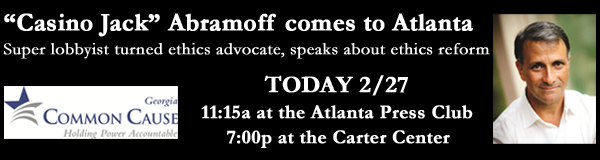
Casino Jack Abramoff in Atlanta today
In addition to his appearances today at the Atlanta Press Club and the Carter Center, Lobbyist turned federal inmate Jack Abramoff will address any legislators who attend a legislative briefing today from 4-4:45 PM at a location to be announced. No word on whether former Senate Majority Leader Chip Rogers will attend.
George P. Bush Event Announcement
George P. Bush will visit Georgia on March 5, 2013 to continue his family tradition of hoovering money from the pockets of Georgia donors public service. Event hosts and Chairs are an all-star cast of GAGOP leaders. Scheduled to announce in May exactly which office he is seeking, one thing of which we’re certain is that it won’t be the Georgia seat in the United States that will open in 2014.

Related Posts
 Georgia Politics, Campaigns, and Elections for September 24, 2014
- Georgia’s legislature adopts resolution on East Sea
 500-pound tiger shark cruising waters near Savannah | savannahnow.com
 Politics, Campaigns, and Elections for November 4, 2016
 State lifts suspension on radar use by Danielsville Police Department | Online Athens


Comments ( 1 )