
Senate President Pro Tem David Shafer (R-Duluth and Johns Creek) noted on Facebook that yesterday marked the 12-year anniversary of the runoff election that sent him to the State Senate. Earlier this week, Kyle Wingfield wrote in the AJC about a proposal by Shafer to cap the state income tax rate.
[T]he state Senate is expected to take up a constitutional amendment that would cap Georgia’s top income-tax rate at 6 percent. David Shafer, president pro tempore of the Senate, is the sponsor of the bill, SR 415. If passed by the Senate and then the House, the amendment would go before voters in a referendum this November.
“Two of our neighboring states, Florida and Tennessee, have no income tax,” Shafer explained. “And every other neighboring state has an income tax lower than ours. North Carolina just lowered its maximum [income] tax rate to 5.75 percent so that it can say its income tax rate is lower than ours. I believe it puts us at a competitive disadvantage.”
Georgia Republicans have long discussed lowering the income-tax rate. Shafer, who represents parts of Gwinnett and Fulton counties, said this amendment can be an important step toward doing that.
“I would like to see the income tax reduced,” he said, “not just because I believe in limited government but because I believe it makes it more difficult for us to attract business investment and jobs. But I think capping it sends a clear signal that Georgia is a low-tax state. And the neighboring states — even though their tax rate may not be as high as ours, there’s nothing that would prevent them from raising it tomorrow.”
As for Georgia, he noted, “No one has even proposed raising the income tax. But it’s the last tax I would increase. There are excise taxes, a small [state] property tax that’s being phased out, sales taxes, lottery ticket sales — there are other sources of revenue besides taxing productivity. Taxes tend to discourage the activity being taxed. And the last thing we should discourage is productivity.”
If a future General Assembly disagreed, it could eliminate exemptions and deductions to increase the amount of income subject to the tax. But the only way to increase the rate would be via another constitutional amendment.
Shafer often invokes Margaret Thatcher’s approach of “relentless incrementalism,” and nothing illustrates that approach to changing Georgia’s tax structure better than Shafer’s current bill.
The Atlanta Young Republicans released the results of a straw poll they held for the United State Senate and 11th Congressional District race, along with a question about medical marijuana. Best line in their analysis?
One Democratic interloper wrote in Michelle Nunn to win the Republican primary for U.S. Senate. That person also supports the complete legalization of marijuana. We suspect that ample amounts of the latter would be required to result in the former.
This morning I wrote on InsiderAdvantage.com about three lessons we can take from Winter Storm Pax and its predecessor. Here’s the short version, you can click over and read the full text.
1. The traffic issues that knotted up Atlanta a couple of weeks ago and led to pictures of cars abandoned en masse on the interstates are not unique to Metro Atlanta.
2. 2. Working hard isn’t always enough – you should be seen to be working hard. Jim Galloway at the AJC Political Insider makes the case convincingly that the optics of dealing with a major weather-related incident are as important as the reality. From Jim’s column,
If there is a political difference between the current storm and the last, [Sandy Springs Mayor Rusty] Paul said, it’s the fact that – this time — the governor has become its public face. “He’s probably doing some of the things he did last time, but in today’s world it’s not enough just to be active. You have to be seen being active,” Paul said. ”People are engaged politically in real time. If they don’t see things happening, they perceive nothing is happening.”
Inaction, or the perception of inaction, is how storms are lost. “That’s what Kasim and Nathan are doing differently this time. They’re being seen at work,” Paul said. “They know it’s not humanly possible to beat back Mother Nature. But you doggone well better be seen battling her.”
3. Many of us are reminded this week of how much work, effort, and money goes into keeping our electrical grid reliable.
The high level of reliability and service that Georgia businesses and homeowners receive is sometimes lost in political squabbles over such things as solar power, or governance of local cooperatives, but we are sure to be reminded of this week’s efforts the next time the private and public utilities come under fire from the legislature or citizen activists.
While it’s fair to debate rates and return-on-equity of a private company granted a monopoly territory, it also takes great financial strength to mobilize the way we’ve seen this week.
Senator Charlie Bethel on Gov. Deal’s Leadership
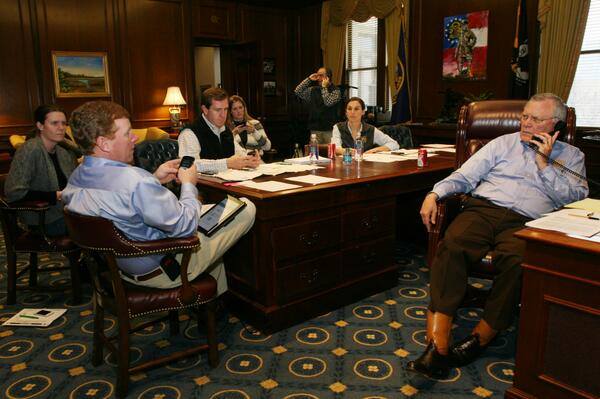
Governor Deal and his staffing reaching out to local leaders to offer state help with weather-related issues.
Matt Dollar on the Hot Seat?
State Rep. Matt Dollar (R-Cobb) and other members of the Cobb delegation introduced House Bill 921, called the “Development Authority Transparency and Accountability Act” after questions were raised about a tax abatement proposal and the process under which it was considered. The bill would require local Development Authorities to report quarterly on projects under consideration and progress toward existing projects. The Cobb Chamber of Commerce announced its opposition to the bill.
[Ben Mathis, chairman of the influential Cobb Chamber] maintains that if Dollar’s bill were to become law, economic development across Georgia would become more difficult.
“The Chamber opposes the bill. I think everybody understands in a perfect world that it would be nice to not have to address abatements and incentives but that’s not reality,” Mathis said. “If it weren’t for abatements and incentives you wouldn’t have businesses like Caterpillar… you wouldn’t have Kia (in West Point on the Georgia-Alabama line). In Cobb County abatements and incentives help to secure the new developments that have led to Home Depot’s call center that have led to 700 jobs.”
Confidentiality is paramount, Mathis said, in courting large corporations seeking tax breaks, and Dollar’s legislation “almost guarantees” a breach of confidentiality and loss of confidence in Cobb.
“We lost an opportunity for a 1,500-job initiative in the last couple of weeks where the people involved feared the confidentiality issue,” Mathis said.
He also pointed to the quietly negotiated $673 million deal that will bring the Atlanta Braves to Cobb.
“If there had been a breach of that confidentially, they never would have come here,” Mathis said.
Critics have argued unelected appointed boards, like the Development Authority, should not have the sole power to hand out tax subsidies to wealthy corporations….
In December, Pam Hallacy announced she would run against Matt Dollar in the Republican Primary on May 20th.
Hallacy is a recent appointee to The Development Authority of Cobb County and chaired the Neighborhood Safety Commission but perhaps is best known for her volunteer work for Cobb schools, serving as state PTA legislative chair. She was named East Cobb Citizen of the Year last year and is a member of the Leadership Cobb Class of 2012.
Of mice and markets
Kyle Wingfield’s second gem this week addresses Georgia’s bipolar response to disruptive technologies that call into question the underpinnings of our patchwork of business regulation.
Two highly regulated quasi-monopolies. Two new business models offering the kind of competition consumers want. Two very different responses from Georgia lawmakers.
If you’ve ever considered installing solar panels on your own home, you may have found the upfront cost prohibitively high.
In 22 states, the solar industry has an answer: Lease the equipment or finance the cost with the company installing the equipment. Georgia isn’t one of those states. “It’d be like saying you can’t lease a car; you’ve got to pay cash for a car,” says Bobby Baker, a Republican who served on the Public Service Commission from 1993 through 2010.
The response in this case was HB 874, introduced by Rep. Mike Dudgeon, R-Johns Creek.
Entrepreneurs harnessing new technologies to spark competition in a free market, with government lowering barriers to entry and not picking winners and losers. Every day, some Republican somewhere says that’s what he or she is for. Unfortunately, it’s not the way some Republicans are reacting to another disruptive technology.
If you’ve ever tried to hail a cab in Atlanta — downtown, Midtown, Buckhead, or pretty much anywhere besides the airport — or called a cab company and expected your ride to arrive on time, you probably know you’re out of luck far too often. I’m 35 years old, and I don’t know anyone my age who even bothers with the taxi oligopoly anymore. They go straight to Uber.
So naturally, the taxi companies are lobbying here, as they previously have in Washington, D.C., and elsewhere, to shut down Uber and similar businesses like Lyft. And they found some Republicans who forgot about all that free-market talk and introduced a bill, HB 907, that would put Uber and Lyft out of business in Georgia as it’s currently written.
t’s not too late to turn the “Uber bill,” as it’s become known, into a free-market solution — or, of course, for the power companies to kill the solar-lease bill. The fates of these two bills will tell us a lot about whose interests are being served under the Gold Dome.
Buzz Brockway spoke to Martha Zoller about the Uber bill. In some other cities, the response to Uber and the questions it raises about taxi regulation is to deregulate taxi service. Folks in Austin, TX and Washington, DC are pushing the idea.
Seattle tried deregulating taxis in 1979, and later re-regulated them because of complaints over declining service quality.
The taxicab industry was deregulated in 1979 because it was believed that competition would provide the public with improved service and lower rates. In fact, service quality declined and rates were often higher. Subsequently, the taxicab industry was reregulated starting in 1984. Initially, rate ceilings were established and later a moratorium was placed on issuance of new taxicab licenses. Seattle, like nearly all of the other cities that experimented with deregulation, eventually returned to regulation of entry and rates.
I would argue that a major difference between Seattle’s 20th century experiment and today is the very quick and effective feedback that Uber and similar web/app services provide.
Another bill coming through the General Assembly also highlights the crazy-quilt nature of Georgia’s approach to business regulation. From the Wall Street Journal:
Tesla, is backing a move in Georgia to adjust the law that limits sales of Teslas to 150 per year, pushing for a shift to a new cap of 1,500. Last year, the company tried to change the law in Texas to allow it to have a dealership there, but failed. People in Texas still can buy vehicles online and have them shipped to their home.
Diarmuid O’Connell, Tesla’s vice president of business development, has been the point man on many of the legislative debates, and in each case, it’s clear that the general public is fully behind the Tesla point of view.
Indeed, the comments section on stories about the legislative efforts in this paper, and the local papers, is filled with nearly 100% opposition to the dealer efforts, from people expressing both liberal and conservative backgrounds.
The dealers aren’t worried about the small number of sales Tesla generates. Instead, they are concerned with the precedent that it could set for other manufacturers that might like to circumvent the franchise system. Most manufacturers wouldn’t bother though — they need dealers to finance their inventory, cover the costs of dealership expansions and market the product. But even a small number of sales going straight from the plant to a customer could push some dealers over the edge, particularly in rural areas where volumes are low.
That bill is House Bill 925, by State Reps. Chuck Martin (R-Alpharetta), Buzz Brockway (R-Gwinnett) and Earl Ehrhart (R-Cobb).
Erratum/Clarification
Yesterday, I wrote about State House action on a bill to make some seasonal school workers ineligible for unemployment during their time off. I’d like to clairfy that the bill, if passed and signed by the Governor, will affect only “outsourced” workers who are employed by private companies contracted by local school systems.
In recent years, schools – facing tight budgets and hoping to cut costs – have contracted out some services, like bus driving and cafeteria work. Instead of offering full-year salaries, these privately contracted companies hire workers only for the length of the school year – nine months. Then during the summer, workers are encouraged to file for unemployment benefits, even when it’s expected they’ll return the following school year.
HB 714’s sponsor, Rep. Mark Hamilton, R-Cumming, wants to send a message to employers that rely on the unemployment system to supplement what they pay their employees.
“I hope those companies realize that they’re going to lose their contract or they’re going to lose the employees unless they adjust their wages up. I want these people to be paid that fair wage,” said Hamilton.
It has been said that those companies were taking advantage of the unemployment premiums paid by other Georgia companies to reduce their own salary load during the summer months, and that such “cheating“ shouldn’t be rewarded. After all, such “savings” to the local school system are really shifting the burden to other employers who pay into the state’s unemployment fund.






Comments ( 0 )