
On April 6, 1776, the United States Congress opened American ports to all countries not under British rule.
President George Washington exercised the veto power for the first time on April 5, 1792.
The bill introduced a new plan for dividing seats in the House of Representatives that would have increased the amount of seats for northern states. After consulting with his politically divided and contentious cabinet, Washington, who came from the southern state of Virginia, ultimately decided that the plan was unconstitutional because, in providing for additional representatives for some states, it would have introduced a number of representatives higher than that proscribed by the Constitution.
On April 7, 1798, President John Adams signed legislation authorizing negotiations between three representatives of Georgia and three Presidential appointees over Georgia’s claim to land west of what is now the Georgia-Alabama state lines. Georgia would continue to claim most of what are currently Alabama and Mississippi until 1802.

Map by Carl Vinson Institute of Government at UGA.
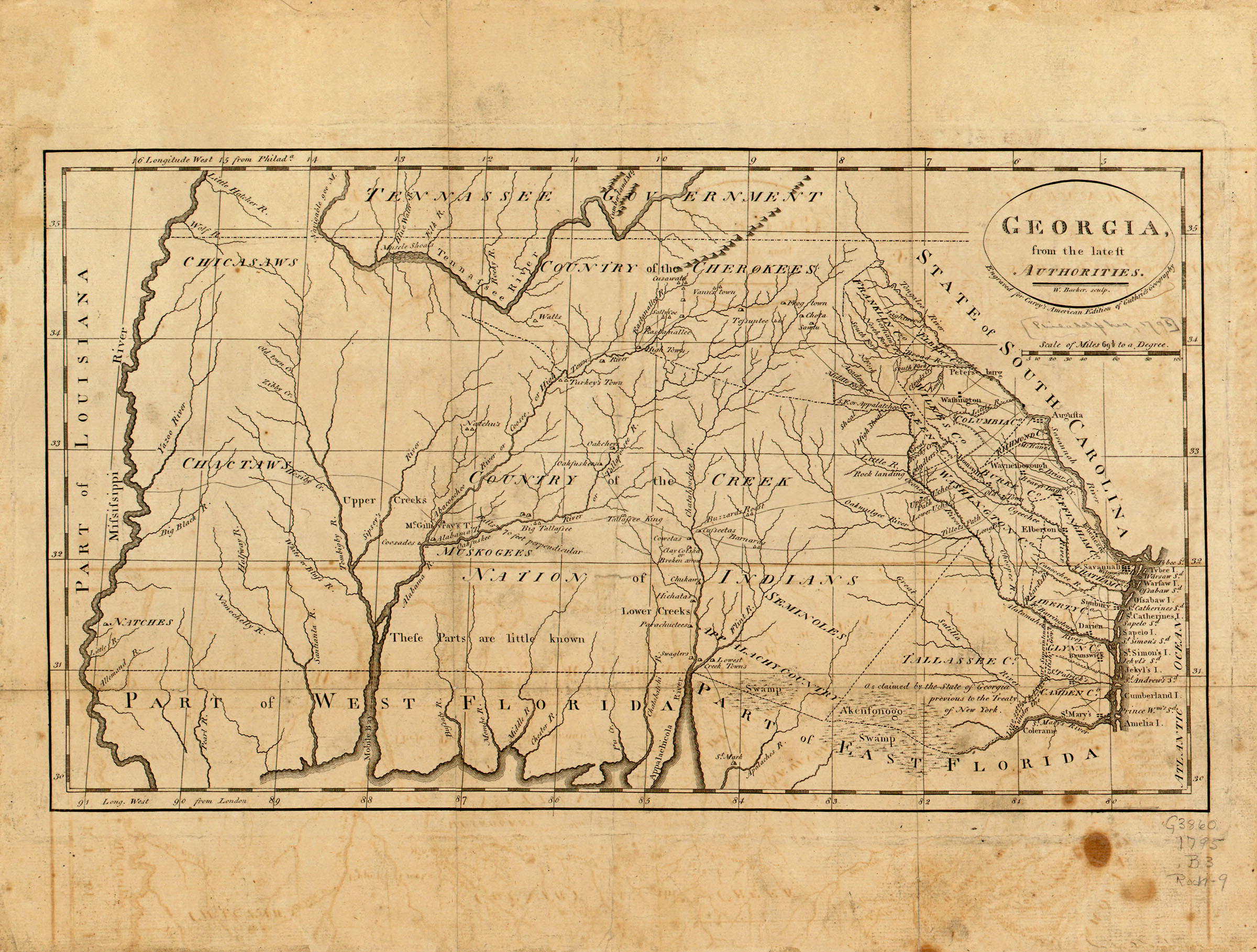
Above: a 1795 map showing Georgia extending west to Louisiana. “These Parts are little known.”
John Tyler was sworn in as the tenth President of the United States on April 6, 1841.
Tyler was elected as William Harrison’s vice president earlier in 1841 and was suddenly thrust into the role of president when Harrison died one month into office. He was the first vice president to immediately assume the role of president after a sitting president’s untimely exit and set the precedent for succession thereafter.
The Brown Thrasher was first recognized as the official state bird of Georgia on April 5, 1935 through an Executive Order signed by Governor Eugene Talmadge. Later the designation of official state symbols through executive fiat was challenged and the General Assembly would recognize the Brown Thrasher again as official state bird in 1970.
On April 5, 1962, Governor Ernest Vandiver called a Special Session of the Georgia General Assembly to revise the state’s election code following a decision by the United States Supreme Court in the case of Baker v. Carr.
On April 5, 1977, Wyche Fowler won a runoff election over John Lewis for the Fifth Congressional District, following the appointment of Andrew Young as Ambassador to the United Nations. Fowler would win election to the United States Senate in 1986, and ironically, lose his seat in a 1992 runoff election to the late Paul Coverdell.
On April 7, 1985, Governor Zell Miller signed legislation recognizing the peach as the official state fruit of Georgia.
This Weekend in Campaigns and Elections
State School Superintendent Debate
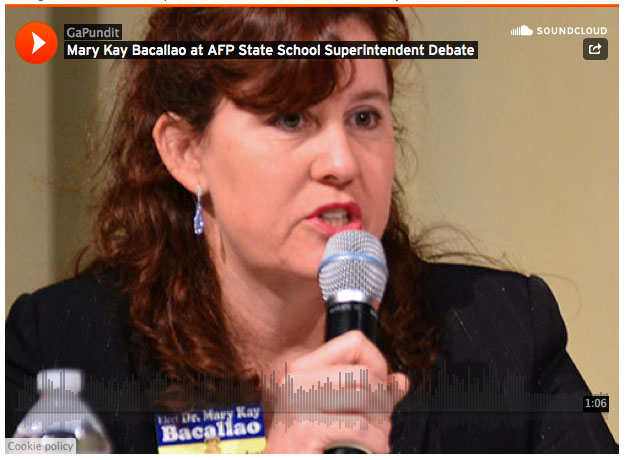
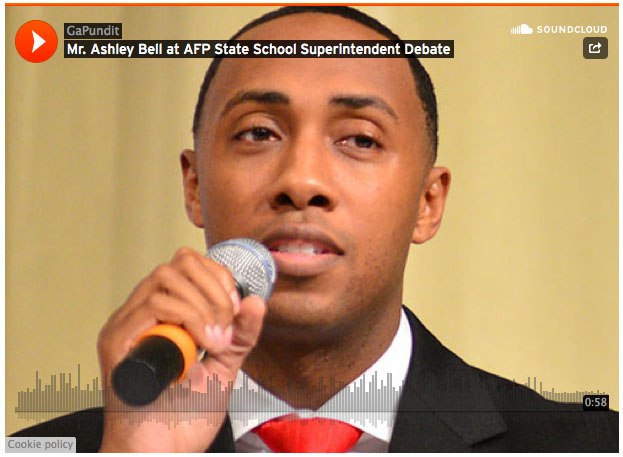

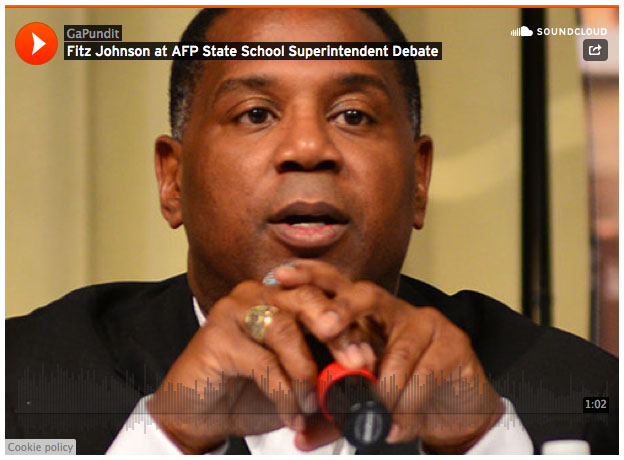
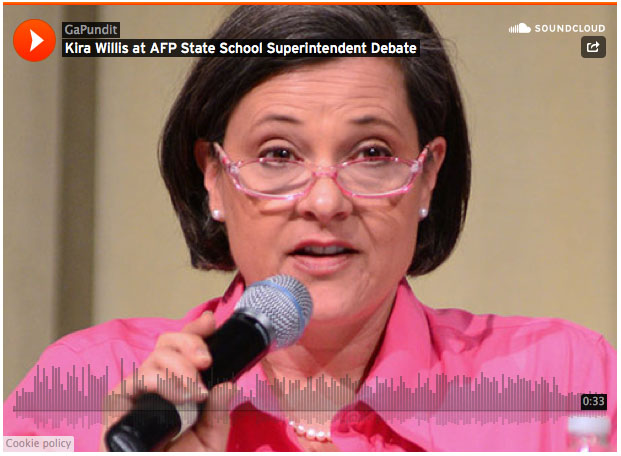
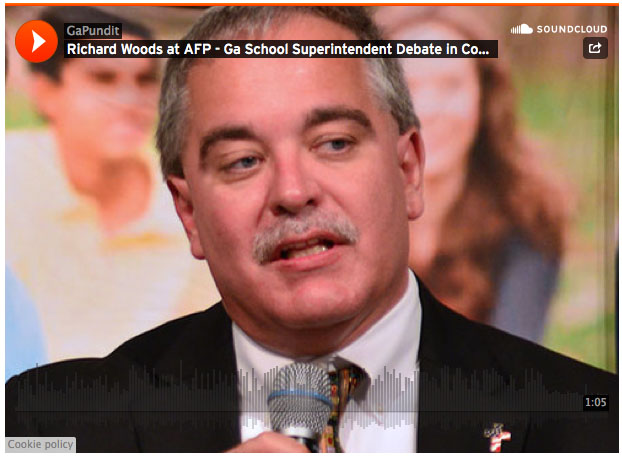
The Marietta Daily Journal covered the debate among candidates for State School Superintendent.
Six Democrats and nine Republicans are running for the seat now held by Georgia Superintendent John Barge, who opted not to seek re-election so he could challenge Gov. Nathan Deal in the May 20 Republican gubernatorial primary.
Republicans who attended the debate were Nancy Jester, Kira Willis, Mary Kay Bacallao, Ashley Bell, Richard Woods and Fitz Johnson. Democrats present were Jurita Mays and Tarnisha Dent.
Common Core unpopular but views differ
Few of the candidates had anything good to say about the much maligned Common Core national testing standards, though some said the state was stuck with the standards and should try to make the best of a bad situation.
Nancy Jester, an actuarial consultant, called the standards pushed by the federal government and adopted by 45 states “quasi-governmental” and “another bureaucracy.”
“That’s six-figure jobs that don’t help the classroom,” said Jester, who served on the DeKalb County Board of Education.
State standards should be developed by Georgians for Georgians, Jester said.
Common Core is in Georgia, said Kira Willis, a graduate coach at a Fulton County charter school, and educators have to make the most of what has been adopted, even though it may not be ideal.
“We’ve got to stop changing the standards on our teachers,” Willis said.
It’s possible to raise the bar above what Common Core requires, she said, and “we can do that with what we have.”
“Standards does not equal curriculum, and we need to remember that,” Willis said.
But Mary Kay Bacallao argued the word “standards” has been used merely to circumvent laws preventing the federal government from sponsoring a common curriculum.
The former member of the Fayette County Board of Education is vehemently opposed to Common Core.
“I will work with everything I have to fight against Common Core,” Bacallao said.
Ashley Bell, who chairs a charter school in Gainesville, maintains the standards are an example of the federal government working to undermine local control over education.
“There is no way you can create a national standard with an apples to apples comparison,” said Bell.
Others, such as Richard Woods, who ran for the seat in 2010, and Cobb native Fitz Johnson, said standards should be rigorous, should give students an opportunity to compete and should be measurable. Johnson’s three children graduated from public schools in the city of Marietta.
Eleventh Congressional District Debate
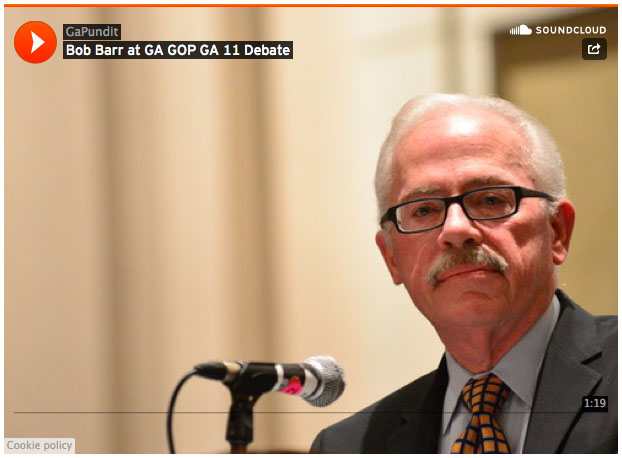
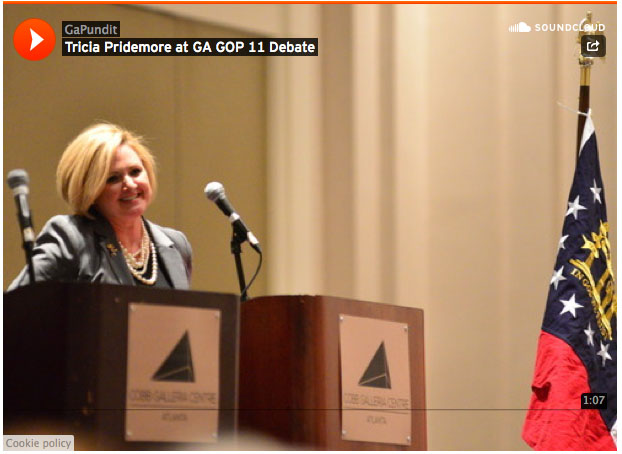
The Cherokee Tribune included some coverage from the 11th District debate:
Stop Obama with the power of the purse, Barr says One of the questions candidates were asked is how they would serve as a check against the “uncontrolled power” of President Barack Obama.
Former U.S. Rep. Bob Barr of Smyrna was first to answer.
“As the House of Representatives member who first called for the impeachment of President Clinton, I have a little familiarity with how to stop a president run amok,” Barr said to applause.
Barr said the president cannot spend “a dime” on the running of the White House without funds appropriated by law from Congress.
indsey says Georgia won’t participate in Obamacare
State Rep. Ed Lindsey (R-Buckhead) said he has already started several measures to pull back on “the imperial presidency.” Lindsey spoke of cosponsoring House Bill 707 this year.
“What it simply does is it takes on Obamacare, says the state of Georgia will not be a participant in this economic train wreck,” Lindsey said. “The second thing we did this year in the Georgia House and the Georgia Senate is we passed that Constitutional Convention that I called for that will call for a balanced budget.”
Lindsey said the best way to curtail government overreach is to limit how much can be spent.
“Now the federal government has a blank check,” he said. “We need to put an end to that.”
Former state Sen. Barry Loudermilk (R-Cassville) said Congress can’t control the other branches if it doesn’t have a budget.
“For years, we didn’t even have a budget. We were giving a blank check to the president,” Loudermilk said.
Pridemore called for a balanced budget.
“We cannot go on continuing to spend over $17 trillion in the future, borrowing money that we simply may never be able to afford to repay,” Pridemore said. “The second of which we need to use the power of the House committee structure to call in the department heads and call in those agency executives, those bureaucrats, and make them answer for the policies and procedures that they’re passing off as laws. Laws are made by the legislative branch. They’re enacted by the executive branch. And we need to stand firm on that.”
Who won the debate in the 11th District? At least three of the campaigns have sent out emails claiming, if not victory, then at least satisfaction with their candidate’s performance.
Professor Kerwin Swint of Kennesaw State served as a moderator and told the Cherokee Tribune that he thought Loudermilk scored some points.
Swint said after the debate the evening’s winner couldn’t be chosen based on applause given how many of the candidates’ supporters were in attendance.
“If you were looking for thoughtful answers, stuff that’s not just canned in a box, I thought Barry Loudermilk did a good job of answering the questions in a thoughtful way, putting forth ideas that aren’t focus-grouped and ballot-tested and all that,” Swint said. “I thought Tricia Pridemore did a good job, too, of answering the questions in a thoughtful way. If you were looking for red meat, it was Bob Barr. And Ed Lindsey did a little bit of both. He had some red meat in there, but I think he had some interesting things to say, too.”
As for who Swint believes won the evening: “If I was an unattached voter and just was coming in trying to learn, I would probably go with Loudermilk, but that’s just an off-the-cuff reaction,” he said.
Back in 2009, I was taking classed in statistics and Political Science at Kennesaw State as a post-baccalaureate student. Dr. Swint declined my request to be added to his class on campaigns, and ever since then I have considered his judgment suspect.
This morning, I wrote at InsiderAdvantage that the biggest question from a day full of debates is whether the party primary debate has become the straw poll of 2014 – full of sound and fury, signifying nothing.
Next month, the RNC convenes again, this time in Memphis, and will take up the issue of debates in the Republican nomination process. RNC Chairman Reince Priebus is expected to propose fewer than half the number of debate for 2016, down to 10 or less, from the 27 that 2012 saw.
In 2012, the debate-heavy schedule is credited, or blamed, with Newt Gingrich’s temporary ascent, as well as Texas Governor Rick Perry’s hasty retreat. Last month, Priebus described the rigorous debate schedule as “a traveling circus” in speaking to the California GOP. I suspect that after the 2014 Elections are over, Georgia voters, and especially Republicans, may view debates in the same way as Chairman Priebus.
This year, Georgia’s GOP has been pitching its tent across the state, in debates that sometimes resemble a clown car, with as many as eight candidates for United States Senate appearing in a GAGOP-sponsored series taking place mostly outside Metro Atlanta, and nine State School Superintendent hopefuls appearing in various forums and debate before local parties or conservative groups.
This weekend, Cobb County saw debates for State School Superintendent sponsored by conservative activist group Americans for Prosperity, a Cobb GOP Breakfast with two candidates for Congress and one Senate hopeful, and an afternoon debate for Commission District One. Later that evening, the 11th District GOP and local Young Republican groups sponsored a very good debate for CD11 aspirants seeking the seat being vacated by Phil Gingrey.
“Strategist” means “Consultant without a Client”
Twice this weekend I’ve been called a Republican strategist in the national media, and both times it was because I appear to be the last Republican consultant in Georgia who isn’t drawing a retainer from anybody in the Senate race.
In Ballot Box, The Hill’s Campaign Blog, I talked to Cameron Joseph about the Senate race and David Perdue‘s appearing to have stepped in something.
The wealthy businessman had been starting to build a lead in public polls and it appeared that he was on his way towards winning a spot in the two-person primary runoff. But that was before video surfaced of him attacking former Georgia Secretary of State Karen Handel’s (R ) qualifications.
“It’s a major gaffe,” Georgia Republican strategist and state blogger Todd Rehm told The Hill. “I think five candidates have conceivable paths to a runoff and David Perdue, who had the clearest path, just made his a lot more complicated.”
Footage obtained by the Atlanta Journal-Constitution this week from a January GOP captured the now-infamous slight.
I mean, there’s a high school graduate in this race, OK? I’m sorry, but these issues are so much broader, so complex,” said Perdue. “There’s only one candidate in this race that’s ever lived outside the United States. How can you bring value to a debate about the economy unless you have any understanding about the free enterprise system and how — what it takes to compete in the global economy?”
The remarks drew rebukes from across the political spectrum, including an entire segment on Fox News’s “The Five” ripping Perdue.
“One of the reasons you have a primary is to figure out who’s going to be your best candidate to run against an opponent. I think the voters in Georgia who are going to vote in the Republican primary have their answer: Not him,” former White House Press Secretary Dana Perino said on the show.
I also spoke to Bill Barrow of the Associated Press about the tension for Congressmen between pressure from some conservative voters to vote against any government spending, and the expectation from the home district to bring home federal funds for economic development projects.
Republicans can’t seem to reach an official party line this election year on the old Washington custom of using the federal budget to benefit the folks back home.
The disagreement is a byproduct of divisions between conservative and establishment Republicans, and is on display in three races that will help determine whether the GOP wins control of the U.S. Senate for the final two years of Barack Obama‘s presidency.
It’s forcing veteran appropriators and their opponents in Mississippi, Georgia and Kentucky to navigate between conservatives’ distaste for tax-and-spend government and voters’ fondness for public projects and programs.
“There’s all this pressure on Republicans on spending, most of it self-generated,” said GOP strategist Todd Rehm of Georgia. “It creates a bind between wanting to campaign as a fiscal conservative while still meeting people’s expectations for economic development help.”
In Georgia, some of the challengers even advocate for spending restraint everywhere except at home.
Kingston is one of three U.S. House members vying for promotion to the Senate in Georgia, along with Paul Broun and Phil Gingrey. Two other top GOP hopefuls — Karen Handel and David Perdue — saddle the congressmen with responsibility for the nation’s balance sheet, noting their previous votes for deficit budgets and debt-limit increases.
But Kingston, the only candidate with a budget leadership post, gets hit from both sides.
At the most recent debate, Handel, a former secretary of state, and Perdue, a former Reebok and Dollar General CEO, blasted Kingston because a planned Savannah port expansion in Kingston’s district lacks financing. Previously, the candidates focused their ire on Obama for not financing the project.
As for the long-sought port development, Kingston avoids accusing his opponents of hypocrisy on fiscal restraint, instead chiding them for not working for the federal support they want. “They have no fingerprints on anything,” he said. “I’ve been engaged from the beginning.”
I wrote about this recently at InsiderAdvantage.com, noting that Kingston’s vote for the federal Farm Bill also set him apart from the field, as he cast his vote for a measure widely seen as positive among those in Georgia’s largest industry, agriculture.
Last month, Kingston also showed a policy difference, being the only candidate on stage to support the federal Farm Bill. Support for the Farm Bill also has both an upside with Kingston’s district and much of the Agriculture and Agribusinesses that compose the state’s largest industry, but carries the possibility of criticism from ideological purists.
Time will tell whether the advantages gained by a voting record in line with Coastal and South Georgia will outweigh the need for ideological purity on government spending and regulation issues, but Kingston is emerging as not just a front-runner in the election, but as a candidate with distinct differences on policy issues related to his current constituency.
Related Posts
 Georgia Politics, Campaigns, and Elections for January 18, 2018
 The Marietta Daily Journal – Legislators address guns at universities
 Fla. asks US Supreme Court to stop Ga. water use | savannahnow.com
 David Perdue pledges to be Senate race’s biggest “investor” | Political Insider | www.ajc.com
 Kathy Schrader pink t-shirts now available on her website


Comments ( 0 )