
The first Day of Thanksgiving in what is now the United States was celebrated on December 4, 1619 at Berkeley Plantation on the banks of the James River in Virginia.
On December 4, 1619, a group of 38 English settlers arrived at Berkeley Hundred, about 8,000 acres on the north bank of the James River near Herring Creek in an area then known as Charles Cittie (sic). It was named for one of the original founders, Richard Berkeley,a member of the Berkeley family of Gloucestershire, England. It was about 20 miles upstream from Jamestown, where the first permanent settlement of the Colony of Virginia was established on May 14, 1607.
The group’s charter required that the day of arrival be observed yearly as a “day of thanksgiving” to God. On that first day, Captain John Woodleaf held the service of thanksgiving. The Charter of Berkeley Plantation specified the thanksgiving service: “Wee ordaine that the day of our ships arrival at the place assigned for plantacon in the land of Virginia shall be yearly and perpetually keept holy as a day of thanksgiving to Almighty God.”.
President George Washington declared November 26, 1789 the first “public day of thanksgiving and prayer.”
By the President of the United States of America, a Proclamation.
Whereas it is the duty of all nations to acknowledge the providence of Almighty God, to obey His will, to be grateful for His benefits, and humbly to implore His protection and favor; and—Whereas both Houses of Congress have, by their joint committee, requested me “to recommend to the people of the United States a day of public thanksgiving and prayer, to be observed by acknowledging with grateful hearts the many and signal favors of Almighty God, especially by affording them an opportunity peaceably to establish a form of government for their safety and happiness:”
Now, therefore, I do recommend and assign Thursday, the 26th day of November next, to be devoted by the people of these States to the service of that great and glorious Being who is the beneficent author of all the good that was, that is, or that will be; that we may then all unite in rendering unto Him our sincere and humble thanks for His kind care and protection of the people of this country previous to their becoming a nation; for the signal and manifold mercies and the favor, able interpositions of His providence in the course and conclusion of the late war; for the great degree of tranquillity, union, and plenty which we have since enjoyed; for the peaceable and rational manner in which we have been enabled to establish constitutions of government for our safety and happiness, and particularly the national one now lately instituted; for the civil and religious liberty with which we are blessed, and the means we have of acquiring and diffusing useful knowledge; and, in general, for all the great and various favors which He has been pleased to confer upon us.
And also that we may then unite in most humbly offering our prayers and supplications to the great Lord and Ruler of Nations, and beseech Him to pardon our national and other trangressions; to enable us all, whether in public or private stations, to perform our several and relative duties properly and punctually; to render our National Government a blessing to all the people by constantly being a Government of wise, just, and constitutional laws, discreetly and faithfully executed and obeyed; to protect and guide all sovereigns and nations (especially such as have shown kindness to us), and to bless them with good governments, peace, and concord; to promote the knowledge and practice of true religion and virtue, and the increase of science among them and us; and, generally, to grant unto all mankind such a degree of temporal prosperity as He alone knows to be best.
Given under my hand at the City of New York the third day of October in the year of our Lord 1789.
Go. Washington
On November 25, 1864, Sherman’s 14th and 20th Corps moved toward Sandersville while the 17th Corps fought briefly against a mix of Kentucky Militia, Georgia Military Institute cadets, and Georgia convicts.
On November 25, 1867, Swedish chemist Alfred Nobel filed a patent for dynamite. On November 25, 1895, Nobel wrote his will, leaving the equivalent of roughly $186 million (2008 dollars) to endow the Nobel prizes.
On November 25, 1920, the first play-by-play broadcast of a college football game took place at College Station as Texas A&M (then Mechanical College of Texas) took the field against Texas University.
On November 26, 1941, President Franklin D. Roosevelt established the Fourth Thursday in November as the modern Thanksgiving celebration.
[I]t was not until 1863, when President Abraham Lincoln declared Thanksgiving to fall on the last Thursday of November, that the modern holiday was celebrated nationally.
With a few deviations, Lincoln’s precedent was followed annually by every subsequent president–until 1939. In 1939, Franklin D. Roosevelt departed from tradition by declaring November 23, the next to last Thursday that year, as Thanksgiving Day. Considerable controversy surrounded this deviation, and some Americans refused to honor Roosevelt’s declaration. For the next two years, Roosevelt repeated the unpopular proclamation, but on November 26, 1941, he admitted his mistake and signed a bill into law officially making the fourth Thursday in November the national holiday of Thanksgiving Day.
On the same day, a Japanese navy fleet left port headed toward Pearl Harbor.
President John F. Kennedy was buried at Arlington National Cemetery on November 25, 1963.
The Jimi Hendrix Experience played its first show at the Bag O’Nails Club in London on November 25, 1966.
Chatham County Sheriff Al St. Lawrence has died following a battle with cancer.
St Lawrence, 81, had been battling cancer since at least July when he disclosed his condition to the department’s command staff.
St Lawrence was elected sheriff in 1992. He had said this would be his last term.
The sheriff’s office released a statement around 8:30 a.m. today expressing its “profound sadness that the family and this Office announce the passing of our beloved Sheriff, Al St Lawrence to cancer on November 24, 2015.”
St Lawrence, a five-year veteran of the United States Air Force, was stationed at Hunter Army Airfield and decided to make Savannah his home. He began a career in law enforcement in 1959 with the Chatham County Police Department. In 1971, he was appoint chief, a position he held for 21 years unit his retirement in April 1992 to pursue the office of sheriff, according to the Chatham County Sheriff’s Office.
Gratitude
Reagan said it well indeed, in his 1985 Thanksgiving Address to the nation.
Good morning, everyone. You know, the Statue of Liberty and this wonderful holiday called Thanksgiving go together naturally because although as Americans we have many things for which to be thankful, none is more important than our liberty. Liberty: that quality of government, that brightness of mind and spirit for which the Pilgrim Fathers braved the seas and Americans for two centuries have laid down their lives.
“Today, while religion is suppressed in perhaps one third of the world, we Americans are free to worship the Almighty as we choose. While entire nations must endure the yoke of tyranny, we are free to speak our minds, to enjoy an unfettered and vigorous press, and to make government abide by the limits we deem just. While millions live behind walls, we remain free to travel throughout the land to share this precious day with those we love most deeply – the members of our families.
“My fellow Americans, let us keep this Thanksgiving Day sacred. Let us thank God for the bounty and goodness of our nation. And as a measure of our gratitude, let us rededicate ourselves to the preservation of this: the land of the free and the home of the brave.
“From the Reagan family to your family: happy Thanksgiving and God bless you all.”
Georgia Politics, Campaigns, and Elections

Yesterday, we wrote about a rumor that Donald J. Trump would return to Georgia with an event in Macon on November 30th. And later in the day, it was confirmed by the Macon Telegraph.
Republican presidential front-runner Donald Trump is coming to Macon on Monday night.
Trump is set to speak at the Macon Coliseum during a campaign rally that begins at 7:30 p.m., said Brandon Phillips, the Georgia director for the Trump campaign. Doors will open at 5 p.m.
The event will be free to attend — it will cost $5 to park — but those who want to go must have a ticket, Phillips said.
The event will last about an hour, until 8:30 p.m. or so, Phillips said, “but I’ve seen him speak in Iowa for 90 minutes.”
For those who follow politics, Macon would seem to be a contrary destination for a Republican presidential hopeful.
Nearly 60 percent of Bibb County’s registered voters cast ballots for Barack Obama in the 2012 election. Mitt Romney drew just under 40 percent. Statewide, voters gave Romney more than 53 percent of the vote, to about 45 percent for Obama.
In Houston County, meanwhile, Romney drew nearly 60 percent of the ballots, and GOP tallies were even better in Monroe County, with about 68 percent for Romney, and in Jones County, where about 64 percent of men and women voted for Romney.
Click here for your free tickets.
Whether Macon is a “contrary” location for a presidential event or not, it’s great to see Presidential candidates all across Georgia.
Speaking of Georgia, the Peach State also figures prominently in the electoral strategy of Ted Cruz. And there is a strategy, no question about it.
But suddenly it seems that Cruz is running what even Dan Pfeiffer, a former top aide to President Obama, concedes is “the best campaign on the other side.” He has raised more money than any Republican other than Jeb Bush and more non-PAC money than any other Republican, period; he also has more cash on hand than any of his GOP rivals. He was the first candidate to recruit chairmen in all 171 counties in Iowa, New Hampshire, South Carolina and Nevada.
He is only candidate who for months has been consistently calling and sending surrogates to all five U.S. territories — Puerto Rico, the Commonwealth of the Northern Mariana Islands, American Samoa, Guam and the Virgin Islands — in order to secure extra delegates who could prove decisive down the road. (More on that later.)
He is doing more than any other Republican to prepare for the so-called “SEC primary,” a new Southern voting blitz set to take place on March 1; he has already enlisted more than 100 countywide campaign directors and 1,500 volunteers in Georgia alone.
Noting that the RNC has sped up the 2016 primary schedule — almost two-thirds of Republican delegates will be allocated by March 22 — Cruz spent August traveling across the South and strengthening his a regional turnout operation rather than camping out in Iowa or New Hampshire like everyone else. Having since secured key endorsements in the Hawkeye State, where he is rising in the polls, Cruz is now poised to head into the March 1 “SEC primary,” and the rest of the race, with stronger support among conservatives than most pundits predicted.
“In past election years, a candidate could essentially move to Iowa or move to New Hampshire, live there for a year, and hope to catch lightning in a bottle and surprise everyone,” Cruz recently explained. “I don’t think that’s possible this cycle.”
Likewise, Team Cruz noticed early on that the RNC’s obscure rule No. 40 (b), which was rewritten in 2012, currently stipulates that a candidate cannot receive the nomination without first winning a majority of the delegates in eight separate states or territories. The territory part is crucial.
It’s conceivable, even likely, that none of the Republican candidates will get more than 50 percent of the vote in the crowded Iowa, New Hampshire, South Carolina and Nevada contests, which means that none of those states will count toward fulfilling the requirements of rule No. 40 (b).
But competition for delegates is much less heated in Puerto Rico, Guam, American Samoa, the Northern Mariana Islands and the Virgin Islands than it is on the mainland — even though, for the purposes of winning the nomination, each territory still counts just as much as a state. And so Cruz has been calling the governor of Guam, dispatching an emissary to American Samoa, sending his father, Rafael, to the Virgin Islands and so on. The more delegates he can pick up overseas, the thinking goes, the better his chances of reaching the RNC’s magic number of majorities — regardless of what happens in the early states.
That story is a lengthy but fascinating read about Cruz’s career and his 2016 electoral strategy. Worth reading in its entirety for political professionals and hobbyists alike.
Finally, we’ll wrap up with a piece from the Washington Post on presidential strategies and the SEC Primary.
While the February states — Iowa, New Hampshire, South Carolina and Nevada — are expected to set the tone and winnow the field, Super Tuesday will arrive like a thunderclap, probably determining which candidates will survive for what could be a protracted battle for the nomination.
“It’s a huge delegate haul, and it’s either going to change the momentum coming out of the early states or reaffirm it,” said John Weaver, chief strategist for Ohio Gov. John Kasich, who is building an Alabama coalition led by the state’s governor.
For centrist Republicans such as Kasich, the aim may not be so much sweeping Super Tuesday as surviving it. After March 1, the calendar turns more to their liking, with a number of winner-take-all states in less-conservative regions where suburban, business-friendly Republicans may matter more than evangelicals and tea party activists.
For Trump and Carson, the political outsiders who have dominated the race for months, Super Tuesday has long been seen by party operatives as the turning point when one of them could surge.
For Cruz, who has sought to appeal to many of the same voters as Trump and Carson, the Southern states are essential. He sees them as his best chance to leap ahead of his rivals after what could be a muddled field by late February. In Georgia, for instance, he has enlisted more than 100 county organizers and has volunteer chairmen in all 14 congressional districts. His wife, Heidi, visited the Atlanta suburbs last week to talk up her husband’s candidacy to Republican women.
Cruz campaign manager Jeff Roe said: “Our approach is to have neighbors call neighbors, pro-lifer to pro-lifer, gun owner to gun owner. That philosophy is painted on our wall — to personalize each contact so that it’s not somebody calling from a remote-access phone bank in another state with a neutral dialect.”
Securing the nomination is a matter of accumulating delegates, and exponentially more are up for grabs on March 1 — 595 total — than in the four early-voting states, which together have 133 delegates, according to figures provided by the Republican National Committee.
Super Tuesday delegates will be awarded proportionally, many of them by congressional district. This gives lower-tier candidates opportunities to pick up delegates without winning the states outright, so long as their vote totals meet the minimum thresholds, which vary by state from 5 percent to 20 percent.
“Everyone feels like they can come in and leave with a few delegates, so we see an uptick in campaigning and organizing over the past few cycles,” said Brent Leatherwood, executive director of the Tennessee Republican Party.
Consider former Arkansas governor Mike Huckabee, who is struggling nationally but hopes to win delegates by overperforming in the March 1 Southern states, many of which he carried in 2008.
“We’re focused on where we can get the most delegates, the biggest bang for the buck,” strategist Chip Saltsman said. “For example, in Texas, there are some rural congressional districts where if you go do a visit, you might pick up more voters than if you were up on Dallas TV for a week.”
Carson’s playbook in Texas is similar to that in other Southern states — targeting majority-African-American congressional districts to win delegates.
“Dr. Carson is already a legend in these communities,” said Barry Bennett, Carson’s campaign manager. “So we’re going to churches, to community centers where, frankly, most of the others don’t go.”
Jeb Bush’s allied super PAC, Right to Rise, has booked $14.5 million in television advertising in March 1 states and plans to spend at least $2 million more. The ad reservations offer clues about the former Florida governor’s strategy.
Right to Rise is spending heavily in Texas, home to former presidents George H.W. Bush and George W. Bush, as well as Georgia, Tennessee and Virginia, where there are suburban districts with relatively moderate Republican electorates. But it has not reserved any time in Alabama or Arkansas, which are ruby-red conservative bastions.
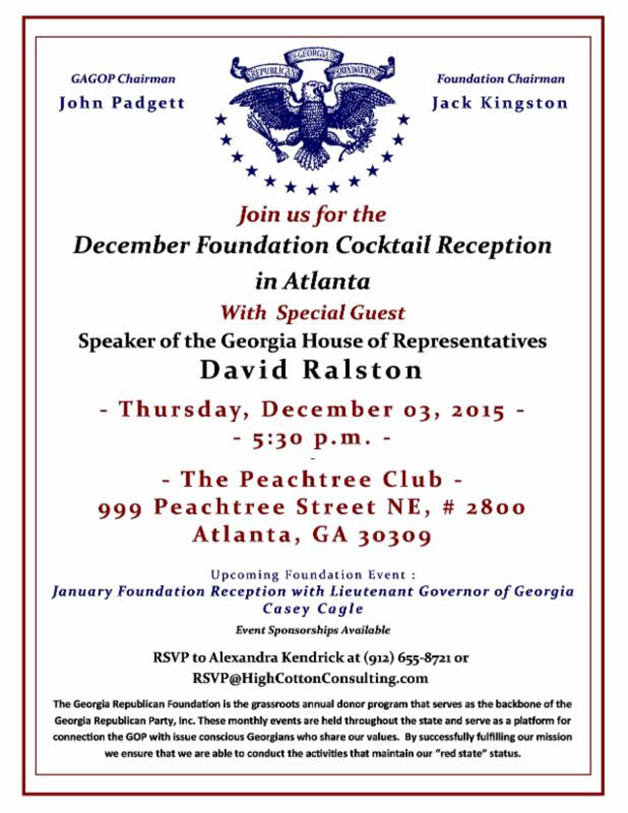
Georgia House Speaker David Ralston will headline a fundraiser for the Georgia Republican Party on Thursday, December 3d.
Related Posts
 Georgia Politics, Campaigns, and Elections for March 7, 2023
 A second Democratic hat in the ring for U.S. Senate
 AUDIO – Mike Griffin of Georgia Right To Life: GRTL Citizen Lobby Day at Capitol 19 February
  Latest disclosures detail Reed’s multimillion-dollar election… | www.myajc.com
 I-85 HOT lane: “Lexus Lanes” or an option for all? | www.myajc.com


Comments ( 0 )