
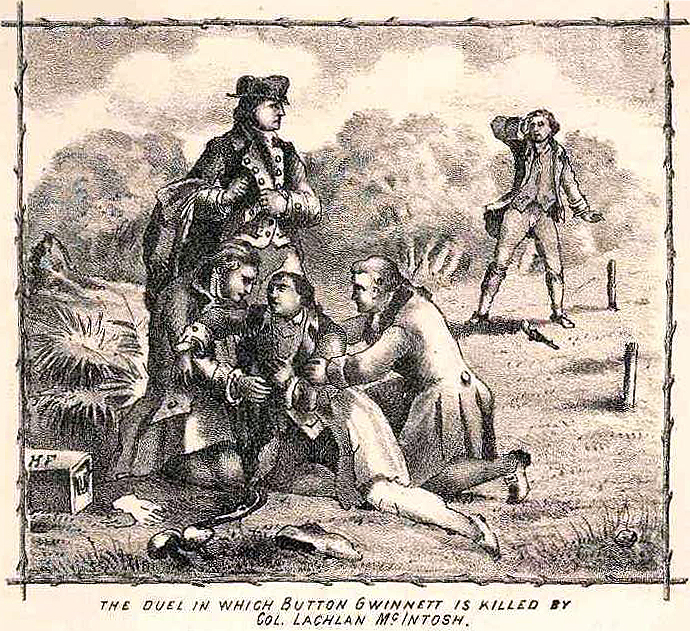
Button Gwinnett and Lachlan McIntosh met outside Savannah on May 16, 1777 and fought a duel; Gwinnett was mortally wounded.
Gwinnett returned to Georgia immediately after signing the [Declaration of Independence] to find city Whig Lachlan McIntosh commanding Georgia’s nascent military efforts. Determined to take control of Georgia politics, Gwinnett became speaker of the legislature, guided the Georgia Constitution of 1777 into existence and took over as governor when Archibald Bulloch died suddenly in office.
Gwinnett then wanted to lead an expedition to secure Georgia’s border with Florida. A dispute between McIntosh and Gwinnett over who would command the effort ultimately led to their duel and Gwinnett’s death.
Delegates to the Constitutional Convention began assembling in Philadelphia, Pennsylvania on May 14, 1787, the designated starting day. Because a large number of delegates had not arrived the opening of the Convention was moved to May 25.
On May 14, 1791, George Washington addressed the Grand Lodge of Georgia Masons in Savannah.
On May 15, 1791, George Washington left Augusta for Savannah.
A Constitutional Convention met on May 16, 1795 in the capital of Louisville to amend the Georgia Constitution of 1789.
On May 15, 1800, President John Adams ordered all 125 employees of the federal government to begin packing to move the capital from Philadelphia to Washington, DC.
On May 14, 1804, Meriwether Lewis and William Clark left St. Louis, Missouri to explore the Northwest United States from the Mississippi River to the Pacific Ocean.
On May 14, 1864, the VMI Corps of Cadets marched 15 miles and camped overnight at Mt. Tabor, near New Market, Virginia. The next day they would march into history.
On May 15, 1864, General William Tecumseh Sherman’s Military Division of the Mississippi remained engaged against Confederate General Joseph E. Johnston’s Army of Tennessee at Resaca, Georgia.
On May 15, 1864, at New Market, Virginia, in the Shenandoah Valley, Major General John C. Breckenridge commanded 4800 Confederate soldiers, including the entire Corps of Cadets from Virginia Military Institute. Breckenridge previously had served as United State Representative and Senator from Kentucky, and as the youngest Vice President of the United States under President James Buchanan. Breckenridge was the Democratic nominee for President in 1860, coming in third in the popular vote and second in the Electoral College to Abraham Lincoln.
Breckenridge attacked forces under Major General Franz Sigel and they skirmished through the morning until Union forces broke through the Confederate lines.
When a gap opened in the Confederate lines, Breckenridge realized that the only force available was the VMI cadets.
He turned toward an aide and issued the following command;
“Put the boys in, and may God forgive me for the order.”
The charge of the VMI cadets remains the most noticeable feature of the Battle of New Market. With rain pouring the cadets broke the charge of the 34th Massachusetts Regiment and then advanced themselves in attack.
When the day ended, 10 cadets had been killed and/or mortally wounded. Another 48 suffered wounds.
Ten cadets died or suffered mortal wounds that day. New Market hosts the oldest continuous historical battle reenactment in the United States that is still held on the original terrain, but this year’s is canceled because of COVID-19, as was last year’s.
On the anniversary of the Battle of New Market, the roll of those who died there is called.
On the same day, the Battle of Resaca was fully engaged in Northwest Georgia.
On Saturday, May 14, the fighting at Resaca escalated into a full-scale battle. Beginning at dawn, Union forces engaged the Confederates along the entire four-mile front. In the early afternoon Schofield’s Army of the Ohio attacked the sharply angled center of the Confederate line. The assault was badly managed and disorganized, in part because one of Schofield’s division commanders was drunk. As the Union attack unraveled and became a fiasco, Johnston launched a counterattack on Sherman’s left flank. The counterattack collapsed, however, in the face of a determined stand by a Union artillery battery. In the evening Union forces pushed forward and seized the high ground west of Resaca, which placed the bridges leading south from the town within artillery range and threatened Johnston’s line of retreat.The following day Sherman renewed his assault on the Confederate center.
The United States Senate voted to acquit President Andrew Johnson of 11 Articles of Impeachment passed by the House of Representatives on May 16, 1868.
The North Georgia Electric Company was incorporated on May 16, 1901 to build a hydroelectric dam on the Chattahoochee River near Gainesville; in 1916, it would be bought by the company that today is known as Georgia Power.
Carl Sanders was born on May 15, 1925 in Augusta, Georgia. He served in the United States Air Force, Georgia House of Representatives and State Senate, where he was President Pro Tem. In 1962, Sanders won the Democratic Primary for Governor, defeating former Governor Marvin Griffin, and in November was the first Governor of Georgia elected by popular vote after the County Unit System was abolished.

American artist Jasper Johns was born May 15, 1930 in Augusta, Georgia.
Former Atlanta Braves pitcher John Smoltz was born on May 15, 1967 in Lansing, Michigan. Smoltz pitched a complete game shutout against the Pittsburgh Pirates in the seventh game of the National League Championship Series in 1991, sending the Braves to their first World Series since moving to Atlanta in 1966. Smoltz was chosen for the All Star team eight times and won the Cy Young award in 1996.
Georgia Politics, Campaigns, and Elections
Georgia Governor Brian Kemp and Labor Commissioner Mark Butler announced plans intended to assuage business owner, according to a press release.
Governor Brian P. Kemp and Georgia Department of Labor Commissioner Mark Butler announced Georgia’s plan for reemployment and economic recovery. To address workforce shortages and boost a full economic recovery, state labor officials plan to end Georgia’s participation in federal pandemic unemployment programs, effective Saturday, June 26, 2021. Over the next several weeks, state officials will provide resources for job search support, education and training opportunities, childcare and transportation services, and safe workplace initiatives for workers, families, and employers.
“During truly unprecedented times, hardworking Georgians have stayed resilient and businesses of all sizes have quickly adapted to an unpredictable environment,” said Governor Kemp. “Even in the middle of a global pandemic, job growth and economic development in Georgia remained strong – including an unemployment rate below the national average. To build on our momentum, accelerate a full economic recovery, and get more Georgians back to work in good-paying jobs, our state will end its participation in the federal COVID-19 unemployment programs, effective June 26th. As we emerge from this pandemic, Georgians deserve to get back to normal – and today’s announced economic recovery plan will help more employees and businesses across our state do so.”
In accordance with Commissioner Butler’s recommendations, effective Saturday, June 26, Georgia will no longer participate in the following federal programs:
• Federal Pandemic Unemployment Compensation (FPUC), which provides for an additional $300 weekly payment to recipients of unemployment compensation
• Pandemic Unemployment Assistance (PUA), which provides benefits for those who would not usually qualify, such as the self-employed, gig workers, and part-time workers
• Pandemic Emergency Unemployment Compensation (PEUC), which provides for an extension of benefits once regular benefits have been exhausted
• Mixed Earner Unemployment Compensation (MEUC), which provides an additional $100 benefit to certain people with mixed earningsAll payments under any of these federal programs will be processed and issued to eligible claimants through June 26, 2021. Once Georgia opts out of the federal programs, the Department of Labor (GDOL) will continue offering regular state unemployment insurance benefits to eligible Georgians. The maximum weekly benefit in the state is $365.
“GDOL has dispersed almost $22 billion in the past fourteen months to support families in this crisis, paying mortgages, electric bills, and grocery tabs when Georgians were in greatest need. It is critical for us to support our economy and local businesses by providing solutions to the roadblocks many Georgians have faced when returning to work,” said Labor Commissioner Mark Butler. “Right now, the state has a historic number of jobs listed on Employ Georgia. We are seeing some of the highest pay scales with enhanced benefits and signing bonuses.”
GDOL provides extensive online support to job seekers looking to rejoin the workforce. Claimants receive access to Employ Georgia’s over 251,000 job listings, resume assistance, career counseling, skills testing, job fair information, job training services, and accessibility and special accommodations for people with disabilities and veterans transitioning back into the workplace.
Kemp framed the federal supplement as overgenerous, characterizing it as “encouraging people not to get into the workforce.”
“What I’m seeing on the ground here is that every small business owner and the workers that are currently working, they need more people. It is hurting our productivity, not only in Georgia, but across the country,” the governor said. “We’ve got to get more people into the workforce, we wanna encourage people to do that, we have a lot of resources for them… we’ve got job training, we’ve got child care assistance for lower income families and we’ve got jobs available.”
Asked if the move would be characterized by political opponents as cruel, Kemp said he was hearing from small business owners that it was necessary.
“First of all, we’re not doing away with regular unemployment, we’re just taking away this federal subsidy that’s encouraging people not to get into the workforce,” he said. “We’ve got a great economy in Georgia, our unemployment is well below the national average, and for people like President Biden and Vice President Harris, they should get out and talk to people on the ground. I’ve been all over the coast of Georgia, I’ve been in middle Georgia, it’s the same – I heard it yesterday in the metro Atlanta region, this is an issue I’m getting pounded on every day with our small business people and working Georgians. And it’s not fair to the people currently in the workforce, they’re getting killed right now working so many hours, they need some help.”
From the Capitol Beat News Service via the Athens Banner Herald:
“It is hurting our productivity not only in Georgia but across the country,” Kemp said. “We’ve got to get more people into the workforce.”
Georgia Senate President Pro Tempore Butch Miller, R-Gainesville, a car dealer, supported the step.
“President Biden and the federal government have turned their back on local business owners desperately facing labor shortages by continuing to hand out taxpayer dollars in the form of needless unemployment benefits,” Miller said in a prepared statement.
But worker advocates panned the move to end the higher benefit amount Thursday, saying it is untrue that the extra $300 each month has kept many jobless Georgians from seeking new employment.
“Gov. Kemp intentionally choosing to end the $300 federal unemployment supplement while Georgians are continuing to live through a pandemic, balance child care needs, and attempt to pay for basic necessities is not consistent with a balanced approach and not responsible,” said Democratic state Rep. William Boddie of East Point, who is seeking his party’s nomination for labor commissioner.
Despite those numbers, Georgia’s workforce is only 44,000 below the record of 5.2 million that it hit in March 2020. Employer payrolls are 4%, or 180,000, below the all-time high of 4.67 million.
Georgia had a 4.5% unemployment rate in March, below the 6% national average.
From the Associated Press via the Statesboro Herald:
“We’re not doing away with regular unemployment,” Kemp said in an appearance on Fox News. “We’re just taking away this federal subsidy that’s encouraging people not to get in the workforce.”
Advocates for keeping the benefits say it’s still too soon to remove extra support for the unemployed and that the labor market remains deeply disrupted, especially among women who are struggling to provide child care to children who are neither in school nor in child care five days a week. About 32,000 Georgians filed new unemployment claims in the week that ended May 8, a number that remains well above pre-pandemic levels.
Elizabeth Knight, a Savannah resident, said she was furloughed in July and terminated in November from her job as an employment counselor for the disabled because the COVID-19 pandemic shut down operations. She’s been drawing unemployment since. Knight said one issue holding her back is that her son attends school in person only three days a week.
“It’s kind of hard to go back and try to find a new job when my current job is not available anymore,” Knight said. “Now I have to go and find another career.”
State Rep. Matt Dubnik, R-Gainesville, told The Times that one reason for the disappearing workforce is how much unemployment benefits can incentivize people to stay home.
“The number one thing employers are telling me: their former employees are being paid more to sit at home than they are to come to work,” said Dubnik. “We have a record number of open jobs in Georgia. We are open for business. It’s time to get Georgians in the workforce.”
Sen. Butch Miller, R-Gainesville, also commended the governor’s move.
“As our federal government approaches $29 trillion in debt, President Biden and the federal government have turned their back on our local business owners desperately facing labor shortages by continuing to hand out taxpayers’ dollars in the form of needless unemployment benefits,” Miller said in a statement. “I applaud Gov. Kemp for standing up for Georgians and for Georgia businesses.”
Gov. Kemp also appointed Eric A. Brewton to the State Court of Cobb County, Division I, filling a vacancy created when Judge David P. Darden went on senior status.
State Representative Timothy Barr (R-Lawrenceville) announced on Facebook that he will run for Congress in the 10th District seat being vacated by Rep. Jody Hice.
Savannah will continue to require masks despite new CDC guidance, according to the Savannah Morning News.
“It’s been confusing for the last year,” Savannah Mayor Van Johnson said at his weekly news conference Tuesday before the CDC’s latest guidance came out. “We have not spoken in a singular voice, and it’s been confusing for everybody.”
Johnson holds that masks are needed until higher vaccination rates decrease the cases seen locally. His most recent order on the issue remains in effect through May 31.
“In our community, we’re not being as vaccinated as fast as we want to, and people have complained about our mask ordinance,” Johnson said. “Well, my response is you get vaccinated, you get us that much closer to getting rid of our mask mandate. I don’t like them, myself. But I recognize it’s an essential part of our community safety.”
Savannah City Council actually voted to continue the mask mandate, according to WTOC.
Savannah City Council voted Thursday to extend the emergency order requiring face coverings in public in the city.
The mask mandate has been extended to Memorial Day on Monday, May 31.
The threshold requirement [for a local mask mandate] imposed by the governor’s executive order is 100 per 100,000.
According to data provided by the Coastal Health District (CHD), the CTI in Chatham County was below 100 on Wednesday, May 12. The CHD data on May 12 puts Chatham County’s CTI at 92.
Columbus will also keep its mask requirement, according to the Ledger-Enquirer.
Columbus’ mask mandate remains in effect despite the Centers for Disease Control’s newest guidance issued Thursday, but it will likely be repealed once the county’s 14-day COVID-19 case rate drops, Mayor Skip Henderson told the Ledger-Enquirer.
Henderson said the removal was planned before the CDC announced fully vaccinated Americans could go most places without masks, but added the new federal guidance made him “feel better about the decision.”
Under Gov. Brian Kemp’s COVID-19 executive orders, a Georgia county can enact a mask ordinance if its 14-day COVID-19 case rate is equal to or greater than 100 per 100,000 people.
A repeal of the local ordinance would come several days after Columbus dips below the threshold, Henderson said.
The City of Gainesville will use some of its federal stimulus money to reduce property taxes, according to AccessWDUN.
Gainesville is receiving nearly $12-million in federal assistance under the American Rescue Plan Act of 2021 over a two year period and city leaders want to return that money to those invested in the city through property ownership.
“To cut to the chase of what we are doing here,” Lackey told council members as he gestured to his PowerPoint presentation, “we are going to do a full roll back so there will be no advertised tax increase. The key thing out of that is no tax increase because of a pretty healthy rollback, a rollback-plus I call it on our General Fund.”
That is possible because of the monies received under the American Rescue Plan Act of 2021 mentioned above. “We’re going to return 1.00-mil of tax money as a credit on the tax bill coming up, to give that back to our community.”
Lackey says the reasoning behind using the federal funds to create a tax credit for property owners is simple; many of them were ineligible to receive those income-based payments. “There’s a lot of people getting checks…and we’re glad they are getting that. People who need help, that’s what they need, but there’s a lot of people in our community that didn’t get it, and maybe we felt like it was our ability to give that federal money back to them.”
“If your home or property is valued at $250,000 you’ll get a $250 credit on your tax bill; if you’re fortunate enough to have a million dollar business you’ll get a thousand dollars back as a credit,” Lackey said by way of illustration.
The Rome Downtown Development Authority wants a third bite at the apple after City Council twice rejected proposals to allow open alcohol containers outside in part of downtown, according to the Rome News Tribune.
The issue has been rejected by the Rome City Commission twice in the past four years, but DDA members feel there’s been a show of public responsibility during local festivals.
Currently, restaurateurs can sell alcoholic beverages to customers seated inside the fencing around sidewalk cafes, but those patrons are not permitted to take the beverages outside of the designated cafe.
For special events like the ArtsWalk, the DDA has the option of seeking permission to allow open containers within certain areas.
DDA Director Aundi Lesley said that Cartersville and Carrollton have each passed open container laws without any serious problems.
“It really does drive traffic into the businesses,” Lesley said.
Three candidates have qualified for a special election to an open seat on the Henry County Commission, according to the AJC.
Three people have qualified to run for the seat of former Henry County Commissioner Gary Barham, who died in March from complications of COVID-19.
Democrats Briana Clay and Sarita Dyer will face incumbent Republican Charles “Greg” Cannon in the June 15 special election. Barham, a Republican, had been the commissioner for District 3 since 2013 and spent 31 years working for the city of McDonough before his death.
Cannon was appointed to fill Barham’s position in early April after a controversial law giving the party in control of a vacated seat — in this case Republicans — the right to name a temporary successor. The legislation was pushed through the General Assembly’s 2021 session by Sen. Emanuel Jones, D-Decatur.
Related Posts
 Georgia leaders rethink China strategy | www.myajc.com
 Adoptable (Official) Georgia Dogs for January 12, 2021
 Georgia Politics, Campaigns, and Elections for August 6, 2021
 Georgia Senate Press Office » Senator Josh McKoon Commends $3.15 Million in Funding for Troup County College and Career Academy
 Georgia Politics, Campaigns & Elections for December 19, 2013


Comments ( 0 )