
The first printed copy of the Declaration of Independence arrived in Savannah on August 8, 1776 and was read publicly for the first time on August 10, 1776.
General George Washington created the Purple Heart on August 7, 1782. Click here for an interesting history of the award.
On August 6, 1787, delegates to the Constitutional Convention in Philadelphia began debating the first draft of the Constitution of the United States.
On August 7, 1790, a delegation of Creeks met with the United States Secretary of War and signed the Treaty of New York, ceding all land between the Ogeechee and Oconee Rivers to Georgia.
On August 8, 1863, General Robert E. Lee offered his resignation in a letter to Confederate President Jefferson Davis, following the Battle of Gettysburg.
Theodore Roosevelt, who served as President from 1901 to 1909, was nominated for President by the Progressive Party, also called the Bull Moose Party, on August 7, 1912.
On August 8, 1925, Georgia Governor Clifford Walker signed legislation outlawing the brazen act of dancing publicly on Sunday.
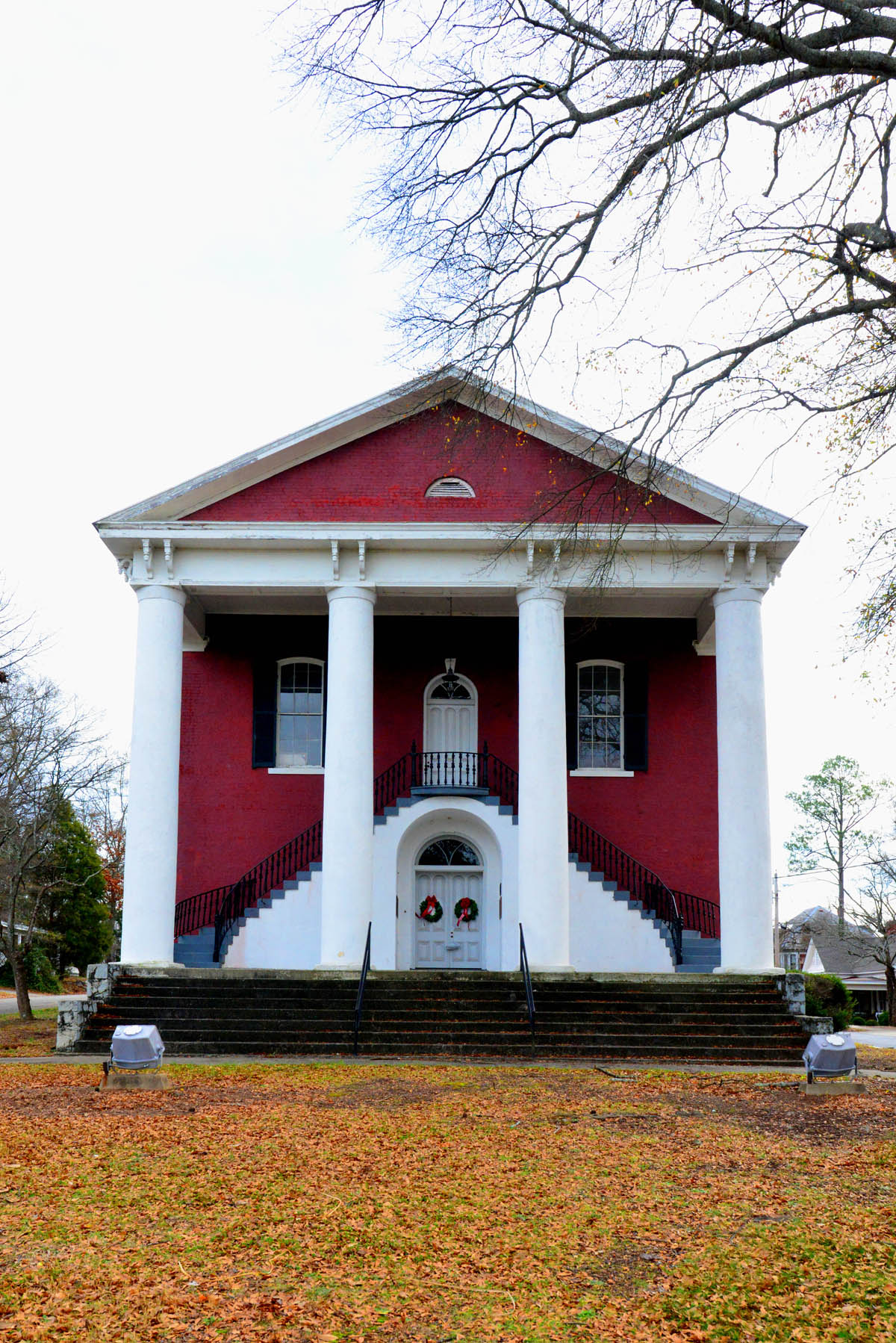
On August 8, 1929, Georgia Governor Lamartine Hardman signed legislation placing on the ballot for Fulton and Campbell County voters a merger of the two.
The old Campbell County Courthouse still stands in Fairburn, Georgia.
On August 7, 1942, Marine forces landed at Guadalcanal.
Voters ratified a new version of the State Constitution on August 7, 1945. Among the new features was the establishment of the State Board of Corrections to ensure humane conditions.
The board was directed to be more humane in its treatment of prisoners and abolished whippings, leg irons, and chains. Until 1945, prisoners in Georgia could expect to have heavy steel shackles put on by a blacksmith upon arrival. They were then taken out to work under severe conditions.
On August 6, 1958 the wagon train carrying gold from Dahlonega to gild the State Capitol dome reached Atlanta, where city officials were not prepared to receive them. The caravan bearing 43 ounces of Dahlonega gold to be used in covering the Georgia State Capitol dome reached the Capitol and delivered it to Governor Marvin Griffin on August 7, 1958.
On August 7, 1964, Congress passed the Tonkin Gulf Resolution, which would be used as the legal basis for U.S. involvement in Vietnam.
On August 6, 1965, President Lyndon B. Johnson signed the Voting Rights Act; Rev. Martin Luther King, Jr. was in attendance and was given one of the pens Johnson used to sign the Act. Here is an auction for one of the pens used in the VRA signing. And another pen auction.
USA Today looks at the history of the Voting Rights Act and the role black women played in its passage.
“Men always got the attention, but the ones who were really organizing it and were really making it work were women,” [author Lynn] Olson said. “And that was true going back to the time of the time of abolitionists.”
When Boynton Robinson’s husband died in 1963, she used his memorial service at Tabernacle Baptist Church as the first mass meeting for voting rights in Selma.
“Mrs. Boynton [Robinson] really was the organizer of this and I think the person who actually wrote the letter that invited Dr. King and SCLC to come to Selma to help them with the voting rights movement,” Dawson said.
Richard Nixon and Spiro Agnew were nominated for President and Vice President by the Republican National Convention on August 8, 1968.
On August 8, 1974, President Richard Nixon resigned, effective at noon the next day.
On August 9, 1988, President Ronald Reagan announced his nomination of Dr. Lauro Cavazos as Secretary of Education, succeeding William Bennett. Cavazos was the first Hispanic to serve in a Presidential Cabinet position. Interestingly, he was born on the King Ranch.
On August 9, 1990, voters in the City of Athens and Clarke County chose to unify the two governments into Athens-Clarke County government.
John Hughes, director of every meaningful teen angst movie of the 1980s (except Say Anything and Better Off Dead) died on August 6, 2009.
Molly Ringwald wrote in The New Yorker about working as a young woman with John Hughes.
Georgia Politics, Campaigns, and Elections
The Secretary of State’s Office began sending notifications to voters who may be stricken from the rolls for inactivity, according to the Associated Press.
Georgia election officials are mailing notifications this week to more than 185,000 registered voters, starting a process that could ultimately result in them being removed from the voter rolls if they don’t take action.
The notices are being sent to people who haven’t participated in an election or had other contact with the state’s election system for the past five years, according to a news release from Secretary of State Brad Raffensperger’s office. That means they haven’t voted, asked for an absentee ballot, updated their registration by changing their address, signed a petition or renewed their driver’s license.
A second notification will be sent to people who remain on the inactive voter list for the next two election cycles and their registration will be canceled if they don’t respond to that cancellation notice, the release says.
Raffensperger announced in June that nearly 102,000 voters would be removed from the rolls unless they responded to cancellation notices. Those notices were sent to about 67,000 voters who submitted a change of address form to the U.S. Postal Service, and about 34,000 voters who had election mail returned, his office said at the time.
Georgia election officials are mailing letters this week to over 185,000 registered voters who haven’t participated in elections for at least five years, a step toward eventually canceling their registrations under the state’s “use it or lose it” law.
Many of them likely moved out of state and are no longer eligible to cast a ballot in Georgia, according to Republican Secretary of State Brad Raffensperger’s office. But the notifications also cover an unknown number of residents who haven’t moved and decided not to vote in recent elections.
“Accurate voter lists are fundamental to election integrity,” Raffensperger said Thursday. “They ensure ineligible people cannot vote, allow counties to effectively allocate resources so there are no long lines, and help make sure voters get accurate information about casting their ballot.”
Voters can check their registration status online on the state’s My Voter Page at www.mvp.sos.ga.gov.
The number of cancellations is down from the last list maintenance cycle in 2019.
Many of the names on the list are people who moved away, Raffensperger said, pointing to U.S. Census Bureau estimates that more than 250,000 people move in and out of Georgia each year.
For example, about 100 of the names on the list facing inactive status belong to student residential addresses for Emory University in Atlanta, including some who were registered to vote in an election before 2016, and have since moved away.
The distribution of no contact voters mirrors the population distribution of Georgia’s 159 counties, with major urban and suburban centers like Fulton, DeKalb, Cobb and Gwinnett counties having the highest number of names and the least-populous counties like Glascock and Taliaferro counties with the smallest numbers.
A record number of Georgians are registered to vote, including about 7.4 million active voters and another 286,000 or so inactive voters. Georgia has automatic voter registration that updates your status when you interact with the Department of Driver Services and an online registration portal.
From the Capitol Beat News Service via the Athens Banner Herald:
Following Raffensperger’s June announcement, Fair Fight Action launched an online tool, GeorgiaVoterSearch.com, to help voters in danger of being purged from the state’s voter lists.
“It is critical that every Georgia voter check their voter registration status to make sure it is active and up to date,” said Liza Conrad, voter protection director for Fair Fight Action. “GeorgiaVoterSearch.com will allow Georgia voters to make sure they are not unjustly stripped of their access to the ballot box.”
Raffensperger pointed to legislation then-President Bill Clinton signed in 1993 requiring states to regularly maintain their voter lists.
Georgians receiving a notification from Raffensperger’s office can return it, postage-free, to avoid being classified as inactive.
United States Senator Jon Ossoff (D-Atlanta) wants to federalize elections. From the Capitol Beat News Service via the Albany Herald:
The right of Americans to vote in federal elections would be codified in federal law for the first time under legislation introduced this week by U.S. Sen. Jon Ossoff, D-Ga.
The Right to Vote Act is aimed at new laws around the country legislatures in Republican-controlled states have passed or considered since last year’s elections, including an election-law overhaul in Georgia that took effect July 1.
Ossoff’s bill would empower U.S. citizens to challenge in court any state or local government act that makes it more difficult to vote. Defendants in such cases would have to demonstrate a legitimate governmental interest in enacting such a law and that the new law is the least restrictive alternative available to accomplish that goal, Ossoff said Thursday.
Along with Ossoff’s bill, congressional Democrats are working to pass other legislation that would set national voting standards. Republicans, including Gov. Brian Kemp, say such efforts represent an unconstitutional usurpation of states’ rights to run elections.
United States Transportation Secretary Pete Buttigieg will visit Atlanta today, according to the AJC.
U.S. Transportation Secretary Pete Buttigieg will make a stop in DeKalb and Gwinnett counties to support the [infrastructure] bill’s proposed investments in transportation safety and electric vehicle charging infrastructure.
Buttigieg will hold a press conference with state and local officials at noon in front of Peachtree Corners City Hall to discuss suburban transportation needs. Among the officials will be U.S. Carolyn Bourdeaux, who has voiced support for expanding public transit and greenway systems in suburban areas.
Buttigieg will tour the Buford Highway corridor at 1 p.m. in Doraville with U.S. Rep. Lucy McBath and local officials to view planned improvements to New Peachtree Road. A press conference will be held at the Doraville MARTA station after the tour.
Buttigieg visited Georgia to tout Biden’s infrastructure plan in May. He’ll be the third Cabinet official to visit metro Atlanta this week, following U.S. Secretary of Health and Human Services Xavier Becerra on Monday and U.S. Treasury Secretary Janet Yellen on Wednesday.
The Georgia Supreme Court will again hold remote hearings, according to the Capitol Beat News Service.
This month’s oral arguments before the Georgia Supreme Court will be held remotely, Chief Justice David Nahmias announced Thursday.
Nahmias cited the increase in cases of COVID-19 resulting from the highly contagious delta variant and the resulting revision of public health guidelines.
“We continue to encourage courts to conduct remote proceedings when it is lawful, effective and safer,” Nahmias said. “Our court would prefer in-person oral arguments, but we have found remote oral arguments to be reasonably effective and safer for those involved with them.”
Nahmias said evidentiary hearings and jury trials elsewhere in Georgia’s court system that must be done in person should continue subject to “appropriate health protections.”
Although the most recent of [former Chief Justice Harold Melton’s COVID-related] orders expired June 30, the state Supreme Court has extended emergency rules allowing all levels of the court system to continue conducting some proceedings using video conferencing technology.
Statesboro City Council tabled an application for an alcohol license for a snowcone drive-through, according to the Statesboro Herald.
Married couple Annie and Johnathan Natson own the “New Orleans-style snowball” stand at 408 South Main St. In operation since April selling nonalcoholic “Sneauxballs” and snack items, Sneaux La La is one of two competing “snowball” or shaved ice, businesses facing off across the Blue Mile.
Annie Natson’s application for a low-volume alcoholic beverage serving license received “no issues” approval recommendations from the city Planning and Development office and the Statesboro Fire Department and an “approval” recommendation from the Police Department on a written form.
[Police Chief Mike] Broadhead’s specific concerns, he said, included wondering how the alcohol service area would be kept apart from the small children such a business attracts and not knowing “how you would take… an alcohol-infused icy away from the location and not have an open-container violation.”
“There is no way the beverage could be removed from there and it not be an open-container violation,” [City Attorney Cain] Smith said. “Even with the state’s new to-go cocktails law, it wouldn’t be applicable here because there’s not a prepared meal served alongside with it.”
The new state law allows up to two mixed drinks in sealed containers to be included with a to-go order picked up by the same person who ordered it. The drinks have to be placed in a closed trunk or compartment, or in the farthest back seat in a vehicle that has no trunk.
Georgia Power‘s plan for an ash pond will receive a hearing next week, according to the Rome News Tribune.
The state Environmental Protection Division has scheduled a public hearing on the issue for Tuesday. It will be conducted virtually, via Zoom, starting at 6 p.m.
The draft coal ash permit for Plant Hammond Ash Pond 3 is the first one that proposes a cap-in-place plan for an unlined pond.
Four ash ponds are located at Plant Hammond in Floyd County’s Coosa community but the concern has mainly rested with AP-3. An environmental group study states it lies in a floodplain and, if left unlined, it will leak toxins into the Coosa River.
Georgia Power is also seeking to have cap-in-place permits at Plant McDonough near Smyrna, Plant Wansley near Carrollton, Plant Scherer at Juliette and Plant Yates near Newnan.
Plant Hammond, which was shut down over a year ago, is on the northern banks of the Coosa River. The ash pond that the utility is seeking to cap in place is just to the east of the plant, coming back toward Rome.
The Glynn County Board of Education discussed reopening plans and COVID precautions, according to The Brunswick News.
The new school year begins Tuesday, and masks in Glynn County Schools are currently not required but are recommended based on guidance from the Centers for Disease Control and Prevention.
Beginning the school year virtually will be 135 students in sixth through 12th grades. The school district opened an application for virtual learning for middle and high school students in June and received a total of 311 applications, said Senetra Haywood, director of student services for Glynn County Schools.
“We had a number of parents who called that submitted apps who have since rescinded those applications, as they felt it would be best for their children to participate in instruction face to face,” Haywood said.
The district will not offer a virtual learning option for elementary school students at the start of the year.
Bibb County District 1 Commissioner Valerie Wynn hosted a community meeting on violence prevention, according to 13WMAZ.
Glynn County Commissioners voted on garbage service bills, according to The Brunswick News.
Glynn County’s annual waste collection fee will remain at $125 a year.
County commissioners unanimously approved maintaining the annual fee, but without recycling. Those who choose to have a recycling bin will have to pay an extra $81 a year for the service.
Flowery Branch elections are heating up, according to AccessWDUN.
Flowery Branch City Councilman Ed Asbridge announced Thursday evening his candidacy for mayor.
“We have an election coming up (November 2) and our mayor has decided not to run, and after a lot of prayer…I have decided I will be resigning this seat in a few days and I will be running for the mayor’s job,” Asbridge said.
Asbridge still has two years left on his current term as Post 2 representative so he will step down from the council once he completes the qualification process during the qualifying period of August 16-18.
That means candidates will be sought to fill the remaining two years of Asbridge’s term, in addition to the regularly scheduled election for Posts 3, 4 and 5, currently held by Leslie Jarchow, Joe Anglin and Amy Farah respectively.
Jesup Mayor David Keith announced he is resigning, according to WTOC.
The mayor says his last day will be Sept. 1. He said in a statement, “While serving until the end of my term would have been my intention, I feel that with the dynamics at work the city commissioners can move ahead without any disruption.”
Related Posts
 Georgia Regents to vote on same-sex marriage retirement benefits | www.ajc.com
 Adoptable Georgia Dogs for March 2, 2015
 Forever homes: Animals from recent hoarding case now available for adoption – Douglas County Sentinel: Local News
 Adoptable (Official) Georgia Dogs for February 4, 2020
 Budget, education among top Georgia legislative issues for General Assembly session | The Augusta Chronicle


Comments ( 0 )