
On March 5, 1735, James Oglethorpe presented a budget to the trustees of Georgia and proposed seeking an appropriation from Parliament, thus beginning the addiction of the Georgia government to Other People’s Money.
On March 5, 1869, the United States Congress refused to seat Georgia’s elected members of the House and Senate.
On March 5, 1977, President Jimmy Carter held the first “Dial-A-President” radio broadcast in which he fielded questions from radio listeners.
Ron Daniels brings you more on the Presidential Q&A from 1977.
Regardless of Carter’s policy positions and his answers to questions, “Ask President Carter” was a truly historic broadcast. Never before had the President been accessible via telephone on a live radio broadcast. And the questions presented to the President weren’t confined to one or two issues that he had been prepared to handle. One can argue that the American people were also fascinated with the concept of calling and speaking directly to Carter; nine million people called into the broadcast trying to reach him.
The President seemed to enjoy the broadcast as well, remarking: “[t]he questions that come in from people all over the country are the kind that you would never get in a press conference. The news people would never raise them, like the Ottawa Indian question. And I think it’s very good for me to understand directly from the American people what they are concerned about and questions that have never been asked of me and reported through the news media.”
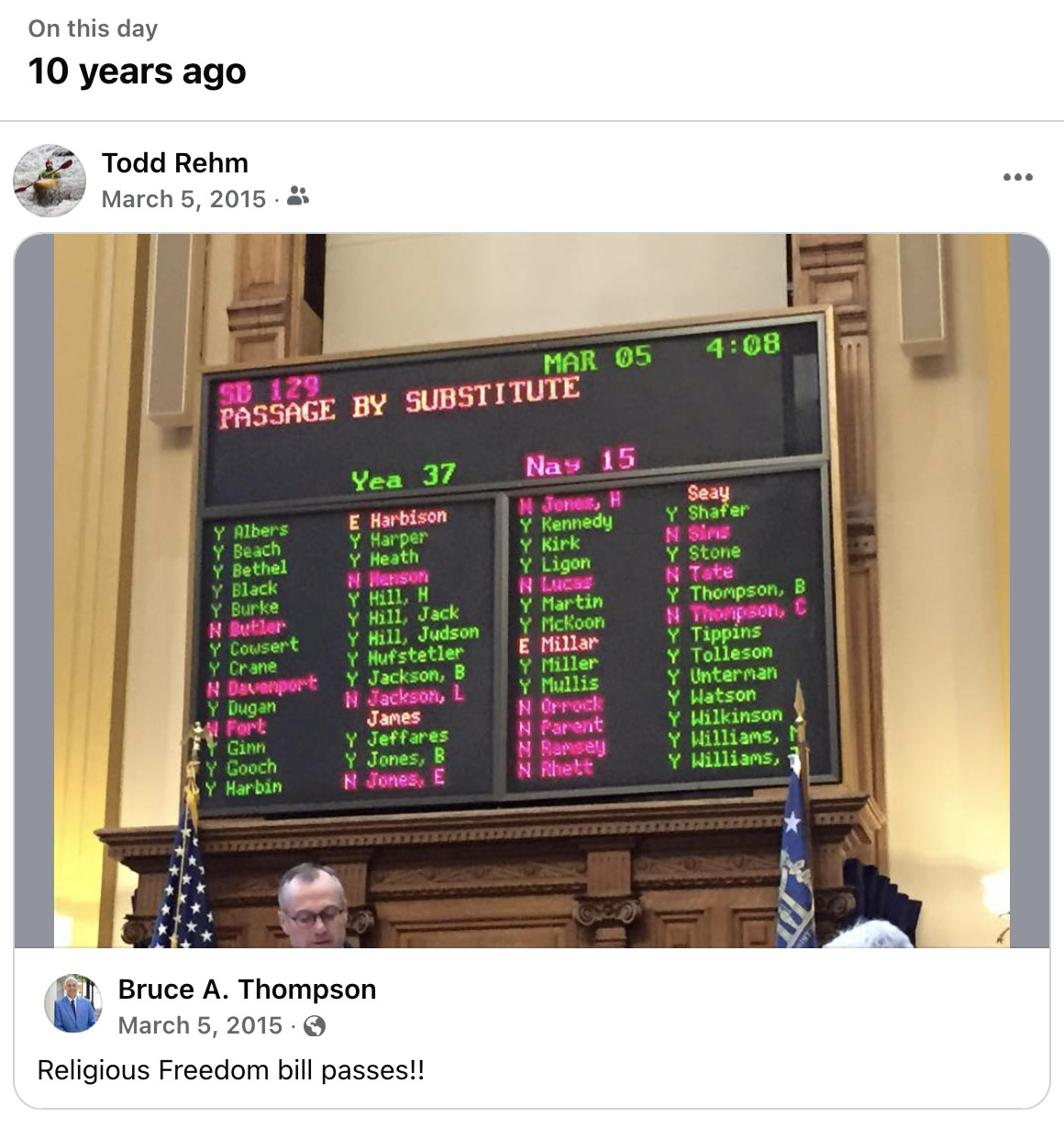
On March 5, 2015, the State Senate passed the Georgia Religious Freedom Restoration Act (RFRA). Keep this in mind a few moments as you read about yesterday in the State Senate.
On March 5, 2016, then-State Rep. Joe Wilkinson (R-Sandy Springs) introduced House Bill 561 to name “The Adoptable Dog” as the Official State Dog of Georgia.
State Representative Joe Wilkinson (R-Atlanta), along with officials from the Atlanta Humane Society, FixGeorgiaPets.org, GaPundit.com, and Georgia English Bulldog Rescue, held a press conference on Wednesday, March 4, to discuss legislation that would designate the official state dog of Georgia. Rep. Wilkinson’s legislation, House Bill 561, was officially in the House on Thursday and names “the adoptable dog” as the official state dog of Georgia.
“Georgia was founded by James Oglethorpe and became a place where people could go for a second chance at life,” said Rep. Wilkinson. “So, it is fitting that we recognize the importance of giving homeless dogs a second chance at life in this state.”
Georgia Politics, Campaigns, and Elections
Governor Brian Kemp issued a weather warning, according to the Savannah Morning News.
Georgia Governor Brian Kemp issued a statement on his X.com (formerly Twitter) page regarding the potential for inclement weather starting tonight and into tomorrow.
“We are preparing for a quick-moving storm system that will make its way across Georgia overnight. Make sure you can receive weather alerts throughout the evening and early morning hours. Damaging winds could impact trees and powerlines, causing outages and blocking roads which may affect commutes tomorrow morning.”
Voters in Enigma, Georgia will elect a new City Council member for Post Four on March 18, 2025, according to WALB.
Four people have qualified to run for the post four seat, and current city council members are hoping it brings some order.
Mayor Pro Tem Doug Webb said, “I hope it will calm it down some, and it may help out with the voting, you know? So we just have to wait and see.”
The special election is scheduled for March 18. Right now, the city council is focused on hiring a new police chief after months without one.
Albany voters will elect two City Commissioners, one on March 18, 2025 and teh second in June, according to the Albany Herald.
ALBANY, Ga. (WALB) – Albany city leaders said that right now, government business can be hard to conduct with two vacant positions and only four remaining commissioners to handle that business.
The vacancies came after Ward 6 City Commissioner Demetrius Young’s untimely death and Ward 2 Jalen Johnson’s sudden resignation. Johnson’s last day was March 1.
The Ward 6 special election is scheduled for March 18, but right now, early voting is ongoing. So far, there’s been a low voter turnout, with only 45 voters heading to the polls.
Albany mayor Bo Dorough said more neighbors should use their voices through their vote to help resolve the greater issue.
“It’s very unusual to have one vacancy, but to have two vacancies, it’s certainly unprecedented,” he said. “The two vacant seats are clearly a problem, and operationally, without the four votes, the city’s not taking any action.”
The qualified candidates for this race include Samuel Wright, Samuel Gaines and Diana Brown.
Ward 2 Special Election
As for the Ward 2 special election, city leaders are requesting to schedule it in June, around the same time as the State’s special election. They are also requesting that the candidate fee be $684.
Dorough said he looks forward to moving the process to the next steps to fill both seats as soon as they can.
“We need to have representatives from every ward, but additionally, there’s a challenge because citizens have complaints, have concerns, have issues; they need to be able to talk to their commissioner,” he said.
The City Clerk’s Office said they planned to send the Ward 2 special elections request to the local board of elections office on Tuesday. Once they approve it, the Secretary of State’s Office will give final approval.
Robocop or Minority Report?: Macon-Bibb County attributes part of their crime reduction to Artificial Intelligence, according to the Macon Telegraph.
Utilizing artificial intelligence in policing programs and youth outreach contributed to a decrease in homicides in 2024 compared to previous years in Macon-Bibb County, according to local officials.
A multi-agency approach to decrease the violent deaths involved suspect-tracking technologies at the Bibb County Sheriff’s Office, as well as community support programs by Macon Violence Prevention and District Attorney Anita Howard’s office, Mayor Lester Miller said at the pre-commission meeting Tuesday afternoon.
ShotSpotter, an audio and AI company used in some areas of Bibb County, detects the number of shots fired at a certain location. “It was not uncommon to hear a number of shots, as many as 15, 20 or 25 rounds at one time go off,” Davis told the Chamber. “Now, we may only hear one or two.”
Even if a suspect flees from a shooting, ShotSpotter helps direct deputies to where shell casings could be found as evidence and also linked to other cases.
“We have been able to solve some homicides based on those shell casings,” Davis said. He asked DA Howard to “expand that footprint of ShotSpotter.”
The first time the technology was used in the DA’s courtroom was in August 2024, she said. “We talked to the jurors and they said it made all the difference,” Davis said.
The sheriff’s office has also installed about 150 Flock Safety cameras across the county, which track suspects’ license plates and alert deputies when a vehicle moves to other locations, Davis said.
“It may be on Bass Road right now, and then in a couple hours it might be on Rivoli (Drive) or Bloomfield (Road) somewhere,” he told the Commission. “So we get a hit each time that vehicle moves by a Flock camera… then the deputies are able to make a stop.”
Another AI policing tool called Verkada quickly identifies people in surveillance footage, which saves hours of investigating. T
here are around 500 Verkada cameras in downtown Macon and public housing properties owned by Macon Housing Authority, according to Davis.
“That would have taken investigators and deputies hours to do the work that we can find out in just a few minutes,” Davis said.
Under the Gold Dome This Week
Wednesday, March 5. . . . . . . . . . . . . . . . . . . . . . . . committee work day
Thursday, March 6 . . . . . . . (Crossover) convene for legislative day 28
Wednesday – March 5, 2025
9:00 AM HOUSE RULES 341 CAP
10:00 AM HOUSE INSURANCE 606 CLOB
10:00 AM HOUSE Rules Sub Lawsuit Reform 341 CAP
10:00 AM HOUSE INDUSTRY & LABOR 506 CLOB
10:00 AM Cancelled – Senate Banking & Fin Inst 307 CLOB
11:00 AM HOUSE ENERGY, UTLITIES & TELE 403 CAP
12:00 PM HOUSE JUDICIARY NON-CIVIL 132 CAP
12:00 PM HOUSE PUBLIC & COMM HEALTH 403 CAP
12:30 PM HOUSE Reg Ind Sub Alcohol-Tob 606 CLOB
12:45 PM Senate Rules 450 CAP
1:00 PM HOUSE HIGHER EDUCATION 606 CLOB
1:00 PM HOUSE EDUCATION 406 CLOB
2:00 PM HOUSE SMALL BUS DEV 406 CLOB
3:00 PM HOUSE RURAL DEV 515 CLOB
3:00 PM HOUSE GOVTAL AFF 606 CLOB
3:00 PM Senate Education & Youth 307 CLOB
Thursday – March 6, 2025
TBD Senate Rules: Upon Adj 450 CAP
9:00 AM HOUSE RULES 341 CAP
10:00 AM HOUSE FLOOR SESSION (LD28) House Chamber
10:00 AM Senate Floor Session (LD 28) Senate Chamber
1:00 PM HOUSE ECON DEV & TOURISM (House) 403 CAP
Senate Bill 36 by State Senator Ed Setzler (R-Acworth), the “Georgia Religious Freedom Restoration Act” passed the Senate, according to the Capitol Beat News Service via the Savannah Morning News.
Georgia courts would have to give more weight to religious custom and preference when applying the law in disputes about individual rights if legislation adopted by the Republican-led state Senate Tuesday becomes law.
The Georgia Religious Freedom Restoration Act, which passed 32-23 along party lines, reignites a fight in the General Assembly dating back a decade.
In 2016, lawmakers passed another such measure over objections by civil rights groups that it threatened the state’s LGBTQ community. Business organizations fretted over the risk of convention and sporting event boycotts, and then-Gov. Nathan Deal vetoed the bill.
The current iteration, Senate Bill 36, says government “shall not substantially burden” a person’s exercise of religion except “in furtherance of a compelling government interest.”
Sen. Ed Setzler, R-Acworth, the chief sponsor, said the need is demonstrated by examples from other states that already have such a law — of a Native American youth who wanted to wear his hair long though the school wanted him to cut it and of a Muslim woman who refused to remove her veil for a photo in front of men while applying for a driver’s license.
The boy got to keep his locks, and the woman got her photo taken by a female photographer in a room with no men present, Setzler said, explaining that the courts had to balance their religious rights against local and state policies.
“People from all of your communities, no matter where you come from, need this basic protection in place,” Setzler said.
The vast majority of states have one of these religious freedom laws but nearly all of them have coupled such laws with anti-discrimination mandates, said Sen. Jason Esteves, D-Atlanta.
If SB 36 were to pass without civil rights protections, he said, hotels and restaurants could refuse to serve LGBTQ patrons, pharmacists could withhold birth control or HIV medicines for religious reasons, a venue could decline to host a Jewish wedding, and a landlord could deny housing to an unmarried couple.
Sen. RaShaun Kemp, D-Atlanta, said SB 36 would allow businesses to use religion as a reason to deny service to him, his husband and their two children.
“This isn’t about politics for me,” he said. “It’s about the ability for my family to live freely in this state.”
The measure now moves to the Georgia House of Representatives, which declined to consider a similar Senate measure last year.
“Every Georgian should be free to worship and exercise their faith without unfair federal, state and local government intrusion,” said state Sen. Ed Setzler, R-Acworth.
Meanwhile, Democratic senators said the proposal could be used to legally discriminate against certain groups of people, such as same-sex couples adopting children, landlords denying housing to an unmarried couple or an employer firing an employee based on religious beliefs.
“We’re all for religious freedom when it’s appropriately used,” said Sen. Jason Esteves, D-Atlanta. “But if you want to make sure that it is appropriately used, then you have to have the proper safeguards in place.”
Esteves said Georgia is one of the few states that does not have a state-level civil rights law protecting against discrimination.
Sen. RaShaun Kemp, D-South Fulton, said Georgians already have religious freedom. The only thing the “bill does is use their religion as a free pass to discriminate,” he said.
“When I go to church with my husband and my two kids, I get to worship and praise God with no limitations, and you can actually do the same,” he said.
Senate Republicans have routinely sought religious rights legislation since then-Gov. Nathan Deal vetoed a 2016 proposal.
Gov. Brian Kemp said during his 2018 campaign that he would only sign a bill if the language mirrored religious rights legislation enacted by Congress in 1993. Setzler said his proposal closely resembles that federal statute.
Following Deal’s veto, previous religious rights proposals have continually stalled in the House chamber. But a Republican push on conservative cultural priorities, both at the state Capitol and in Washington, has given the bill perhaps its best opportunity in recent years to make it into state law.
If SB 36 passed this year, Setzler said Georgia would join 39 other states that already have religious rights laws or protections set by precedents in state courts.
House Bill 465 by State Rep. Carl Gilliard (D-Garden City), the “Autism Missing Person Alert System Act” passed the House, according to WTOC.
House Bill 465, known as the Autism Missing Person Alert System Act, recently passed the Georgia House of Representatives with a 172-0 vote.
Georgia Representative Carl Gilliard said this bill, modeled after Mattie’s Law, marks a step forward in the safety and welfare of individuals with autism and their families.
“This alert system is designed to ensure a swift and coordinated response when a person with autism goes missing, helping to reunite families as quickly as possible,” said Rep. Gilliard.
According to Gilliard, when a person with autism goes missing, an alert will be sent out throughout the community- prompting the public to aid in the search.
As one of the bills sponsors, Rep. Gilliard said he was grateful for the bipartisan support the bill received.
“Together, we can make Georgia a safe and supportive place for everyone,” said Gilliard. “This alert system is not just a legislative win; it is a commitment to compassion and community responsibility.”
Now, the bill will go on to be presented to the Georgia State Senate.
If approved in the Senate, the bill will be sent to the Governor for final consideration.
Senate Bill 9 by State Sen. John Albers (R- Roswell), the “Ensuring Accountability for Illegal AI Activities Act” passed the Senate and criminalizes AI-created pornography depicting minors, according to the Capitol Beat News Service via the Augusta Chronicle.
The Georgia Senate adopted legislation Tuesday that would make it a felony to distribute computer-generated obscenity that appears to depict a child, even one that isn’t real.
Senate Bill 9, which passed 46-9, would also enhance the criminal penalties for offenses that involve the use of artificial intelligence.
The penalty for depicting a child would be one to 15 years in prison. It wouldn’t have to be a child “who actually exists.”
Sen. John Albers, R-Roswell, said the enhanced sentencing is necessary because artificial intelligence has become such a powerful tool.
“It’s not just about punishment,” he said. “It’s about deterrence.”
There was discussion about simulated versus actual obscene acts, and Albers said prosecutors would have discretion to use the enhanced sentencing in such cases.
Two bills to restrict speed camera use passed the State House, according to the Capitol Beat News Service via the Savannah Morning News.
The Georgia House of Representatives passed two bills Tuesday aimed at reining in abuses in the use of speed-detection cameras in school zones.
One of the bills would ban the cameras altogether, while a second would put restrictions on the use of the cameras without prohibiting them.
House Bill 225, the legislation repealing the cameras, passed the House 129-37, seven years after the General Assembly first authorized their use.
“Operation of these cameras has not improved public safety but become a highly profitable revenue stream for private corporations and local governments,” said Rep. Dale Washburn, R-Macon, the bill’s chief sponsor.
Washburn also argued the use of speed-detection cameras in school zones is unfair because there’s no way for motorists to contest a ticket.
The second measure, House Bill 651, takes a less dramatic approach. It would limit the hours speed cameras could be operated to two hours in the morning before school starts and two hours in the afternoon after school lets out.
The cameras would have to be accompanied by flashing signs that would warn motorists when they’re driving too fast through a school zone.
Only half of the fines levied against violators could be retained by the local government, while the other half would have to go to local schools to be used for safety improvements.
“It ceases to be a revenue-driving device for local governments,” said Rep. Alan Powell, R-Hartwell, the bill’s chief sponsor.
Powell’s bill also would give motorists accused of speeding through school zones based on evidence from a camera the right to contest the ticket through the local courts.
It’s unusual for a legislative chamber to pass two bills on the same subject during the same session. Powell said that was done because the state Senate hasn’t been willing to address speed-detection cameras in the past.
“This House of Representatives is very serious about dealing with this problem,” he said. “We want to give them a second choice.”
The House passed Powell’s bill 164-8.
House lawmakers are divided about how to respond to the public backlash over the increasing use of cameras to catch speeders in school zones. Should they try and fix what they think is a broken system? Or should they just ban the cameras completely?
The answer, for now, is both.
The Georgia House of Representatives on Tuesday voted to ban and regulate the cameras, sending dueling proposals to the state Senate just two days before a key legislative deadline.
One bill from state Rep. Dale Washburn, R-Macon, would ban the cameras completely. Another bill from Rep. Alan Powell, R-Hartwell, would require signs warning drivers when the cameras are in use and set rules for who gets the money from the speeding tickets and how they can spend it.
Washburn said he voted for both bills, even though he believes banning them is the best thing to do. He said it was either that or risk his bill failing to pass.
“I can’t do anything on the Senate side until I get it over there,” he said. “It gives me a chance.”
Complicating matters, the state Senate has their own proposal that would regulate the use of cameras in school zones. If that bill passes this week, it will likely become part of the negotiations in the coming weeks.
House Bill 123 by State Rep. Bill Werkhiser (R-Glennville) passed the House and would lower the burden of proof for capital case defendants seeking to prove intellectual disability, according to the Capitol Beat News Service via the Savannah Morning News.
The state House of Representatives voted unanimously Tuesday to make it easier for defendants in death penalty cases to establish intellectual disability as a defense.
Georgia is the only state among the 27 that allow capital punishment to execute convicted murderers with intellectual disabilities, defined as having an IQ below 70.
“This will be that fix,” state Rep. Bill Werkheiser, R-Glennville, chief sponsor of House Bill 123, said on the House floor before Tuesday’s 172-0 vote.
Under Werkheiser’s bill, the burden of proof to establish a defendant’s claim of an intellectual disability would be eased from “beyond a reasonable doubt” to “by a preponderance of the evidence.”
The legislation also would remove the determination of whether a defendant in a capital case has an intellectual disability from the guilt phase of the trial. Instead, that determination would take place following a pre-trial hearing.
“This is not getting rid of the death penalty,” said Rep. Tyler Paul Smith, R-Bremen, whose House Judiciary Committee (Non-Civil) took up the bill. “This ensures our criminal justice system operates with fairness and integrity.”
Werkheiser said he received a letter signed by more than 100 religious organizations endorsing his bill. It also got the backing of the Georgia Council on Developmental Disabilities.
The bill now moves to the state Senate.
House Bill 268 by State Rep. Holt Persinger (R-Winder) passed the House and comprises a number of measures to improve school safety, according to the Capitol Beat News Service.
A comprehensive school-safety bill prompted by last year’s school shooting in Barrow County passed the Georgia House of Representatives overwhelmingly Tuesday.
House Bill 268, which cleared the House 159-13, is a top priority for House Speaker Jon Burns. It’s chief sponsor is Rep. Holt Persinger, R-Winder, whose district includes Apalachee High School, where two teachers and two students were shot to death last September.
A student, 14-year-old Colt Gray, was arrested at the scene and has been charged in the murders. His father, Colin Gray, also faces criminal charges for allegedly letting his son possess the AR-15 style rifle used in the killings.
“This legislation represents an opportunity to save lives and protect our students in every corner of the state,” Persinger told his House colleagues before Tuesday’s vote.
Persinger’s 65-page bill is aimed at filling in communication gaps between schools about at-risk students, particularly when they transfer from one school to another, as Gray did before last September’s mass shooting. It would create a statewide information-sharing database on students considered a potential threat to themselves or others as well as a new app for reporting tips anonymously.
The measure also calls for placing mental-health counselors inside Georgia schools, which the state would pay for. Between the fiscal 2025 mid-year budget that cleared the General Assembly this week and the proposed fiscal 2026 spending plan, the state would spend more than $150 million on safety improvements in the schools, including the mental-health counselors.
The legislation would require schools to form threat-assessment teams that would use technology to detect the presence of firearms before they enter a school building and increase penalties for students who make “terroristic threats.”
“I believe this bill brings common sense to school safety,” Burns, R-Newington, told House lawmakers during a rare appearance in the well of the House. “Our children deserve to be dropped off at school with the assurance they will have a safe environment.”
Some of the bill’s opponents expressed privacy concerns they said a statewide database on students would engender.
“Why are we essentially creating a criminal record for students?” said Rep. Gabriel Sanchez, D-Smyrna. “Do you know what that would do to students trying to better themselves?”
Sanchez also argued enhanced surveillance of students considered potential threats would be used disproportionately on Black and brown students.
Others complained the bill makes no mention of guns or firearms. However, House lawmakers passed a separate bill shortly before voting on the school-safety measure that would offer tax credits to firearm owners who purchase safe storage devices such as trigger locks or gun safes. House Bill 79 passed 165-8.
That bill, too, came in for criticism from Democrats who argued incentivizing safe firearm storage rather than requiring it doesn’t go far enough.
Both bills now move to the state Senate.
House Bill 539 and HB 540 by State Rep. Matt Reeves (R-Duluth) passed the House and would address homestead exemptions in Gwinnett County, according to the Gwinnett Daily Post.
Two bills designed to increase and expand homestead exemptions on school taxes in Gwinnett were approved by the Georgia House of Representatives on Tuesday. House Bills 539 and 540, which are backed by both Republicans and Democrats in Gwinnett’s House Delegation, are now headed to the Georgia Senate for consideration.
“House Bill 539 and 540 represent a crucial step forward in easing the financial burdens of Gwinnett County homeowners and public service employees, continuing the legacy of meaningful tax relief,” Rep. Matt Reeves, R-Duluth, said.
“As these bills move to the Georgia State Senate, they offer a reminder that local collaboration, bipartisan support and a shared commitment to our community’s well-being can make a lasting impact on the lives of those who serve and reside here.”
If the Senate approves both bills, Gwinnett voters will decide in a pair of referendums on the 2026 general primary ballot if the proposed homestead exemption changes should go into effect, starting in 2027.
This would be the second increase in school tax exemptions in just a few years. Last year, voters approved a doubling of the homestead exemption from $4,000 to $8,000 as well as the creation of a new homestead exemption for public servants, including teachers. Taxpayers will see the impact of those changes for the first time when they receive their tax bills in the fall.
House Bill 539 would increase the general exemption on school taxes for all homeowners from $8,000 to $10,000.
Meanwhile, House Bill 540 would expand the exemption for public servants by adding military veterans and all Gwinnett County Public Schools and Buford City Schools employees who were not covered when the exemption was created.
The proposed new relief on school taxes comes after the Gwinnett County Board of Education voted to opt out of a statewide homestead exemption that had widespread voter support in Gwinnett. GCPS officials had said that exemption would have cost the district $35 million per year and about $100 million over a three-year period.
Unlike the state exemption, school system officials would not be allowed to opt out of the local exemption.
So you’re telling me there’s a chance? The AJC writes that the future of two bills to protect the Okefenokee have an uncertain future.
A pair of bills that would keep mining from expanding at least temporarily near the Okefenokee Swamp got an audience before state lawmakers this week, but their fates are not certain as a key legislative deadline approaches.
The House Natural Resources & Environment Resource Management Subcommittee did not vote Monday as Crossover Day looms on Thursday. Any bills that have not cleared at least one legislative chamber by that deadline typically face long odds of passing before the legislative session ends in April.
Both bills were introduced last month by state Rep. Darlene Taylor, R-Thomasville, who has championed past legislation concerning the Okefenokee. The bills have bipartisan backing.
The first piece of legislation, the Okefenokee Protection Act (House Bill 561), would prohibit EPD from issuing, modifying or renewing any mining permits on Trail Ridge after July 1. The bill is nearly identical to legislation proposed in past sessions that failed to pass.
The second bill, House Bill 562, takes a lighter approach and would only keep EPD from considering new permits for mines on Trail Ridge or tweaking existing ones until mid-2030.
My personal opinion is that those bills are at least mostly dead. With Crossover Day tomorrow, and the need for the bills to pass (1) out of Subcommittee; and (2) out of the full Committee, with no meetings scheduled for either the sub or the full committee, it’s probably not too early to plan a funeral for the two pieces of legislation.
The chair of the National Republican Congressional Committee discouraged federal legislators from holding in-person Town Hall meetings, according to NBC News.
The chair of the National Republican Congressional Committee, which is the Hill committee that works to get Republicans elected to the House, told lawmakers in a closed-door meeting Tuesday morning that there were more efficient ways to reach constituents than in-person town halls, according to two sources in the room.
The chairman, Rep. Richard Hudson, R-N.C., compared the moment to 2017, when a series of GOP town halls made headlines after angry attendees confronted lawmakers.
Separately, House Speaker Mike Johnson, R-La., said today that House Republicans were encouraging members to “communicate directly with their constituents” in telephone town halls and small groups rather than open forums.
“They’re professional protesters,” Johnson said, though there is not evidence to back up the claim. “So, why would we give them a forum to do that right now? The best thing that our members can do is communicate directly, frequently, consistently, with their constituents, and there are other avenues to do it.”
Hudson’s and Johnson’s cautions against in-person town halls are just the latest warnings by top Republican leaders about participating in the events, which give constituents the opportunity to ask questions and voice concerns. Hudson also claimed without evidence that the disruptions were from paid protesters.
NBC News has previously reported that House GOP leaders have urged lawmakers to stop engaging in town halls, according to a GOP aide. Party leaders have also suggested that lawmakers instead participate in tele-town halls or vet attendees, according to GOP sources.
Protestors in Gainesville demanded an in-person Town Hall with U.S. Rep. Andrew Clyde (R-Athens), according to AccessWDUN.
On Tuesday, a large group of protestors gathered in the downtown Gainesville square to demand a town hall with Georgia’s Representative for District 9 Andrew Clyde.
Eric Towers, a Rabun County resident, said he was protesting Elon Musk’s involvement in the Trump administration.
“We are out here to protest the fact that Andrew Clyde will not have a town hall, and we are also protesting Elon Musk, an unelected official. And this is what democracy looks like,” Towers said.
Towers added that he has seen prices for goods go up and believes the Trump administration is to blame.
“What I have seen is grocery prices going up. I was at Walmart this morning, eggs were more than five dollars a dozen. Groceries are going up. Gas is going up. And you talk to the people in the trades in Rabun County and lumber and pipe, everything’s going up, we need to figure out why and put a stop to it. And I think it’s tariffs and Elon Musk,” Towers said.
George and Marilyn Langford came from Cleveland to join the protest.
Marilyn who is a former federal employee, said she had found no record of Clyde holding a town hall, but he is obligated to listen to their demands.
“Why can’t you see what Trump is doing to our nation? Why are you so blind to him? You know, forget about the beef that I have with him about his gun stance, machine gun Clyde. Forget about that. But he is just so devoted to Donald Trump, and Donald Trump is destroying our world as we know it, and people must wise up, or we are in deep trouble,” Marylin said.
George, who is the former director of claims and appeals for the Georgia Department of Veteran Services, talked about how veterans are being hurt by the current administration.
“Well, 30% of the federal employees are veterans. 53% of those veterans are disabled veterans, according to federal law, that is a protected class,” George said. “But 53% of the veterans that work for the federal government are being discriminated and fired. Well, it’s ridiculous.”
George said Clyde should be standing up for veterans.
“Before there was a term like DEI, disabled veterans were set aside as a special class because its an earned benefit. So it’s a very unfair attack on disabled veterans, and it’s stupid Congressman Clyde is a veteran, and he should be shouting from the rooftops disabled veterans are being mistreated right now by his party,” George said. “My guess is I don’t agree with him politically, but I doubt that he disagrees with me on that subject, and he needs to say it.”
Marilyn said the group is planning on organizing another protest.
In a statement to AccessWDUN Clyde said “I’m honored to represent the Ninth’s voice and fight for our shared values in Congress. I encourage folks to contact my office to share any comments, questions, or concerns they may have about my work on their behalf.”
State Sen. Mike Hodges, (R-SSI) continues to support legislation mandating origin disclosure for shrimp served at restaurants, according to The Brunswick News.
The district’s state senator says he will support the bill to require Georgia restaurants to identify the origin of the shrimp they serve as long as two meats that were added to the legislation by a committee substitute are removed.
Meanwhile, closer to home, the state’s shrimping fleet is likely grimacing over the results of the sample testing of restaurants in Coastal Georgia’s largest city. Over 50% of the eating establishments sampled were untruthful about where the shrimp they were serving came from.
State Sen. Mike Hodges, R-St. Simons Island, said he is opposed to a substitute that adds chicken and beef to a bill that would require restaurants in Georgia to state in writing the origin of the shrimp and any dishes containing the crustacean that are prepared in their kitchens.
The substitute was passed out of the Senate Committee on Interstate Cooperation. State Sen. Colton Moore, R-Trenton, chairs the committee, which is co-chaired by Sen. Donzella James, D-Atlanta.
“I support the bill as it originally passed the House,” Hodges said. “I do not support the Senate committee substitute.”
Hodges has not given up on the House-passed version.
“I will work with others in the Senate to change our version of this bill back to the…House version,” Hodges said.
He said he and others will approach U.S. Rep. Buddy Carter, R-1, about asking the Trump Administration to set tariffs on imported shrimp, which he said is being dumped on American markets by foreign nations, including ones unfriendly to the United States.
Commercial shrimpers in Georgia and elsewhere in the U.S. are unable to compete against them.
“We do not have people dumping beef and chicken on the states,” Hodges said. “The issue is shrimp.”
Regardless of what the bill entails, HB 117 should make it out of the Senate by Thursday, crossover day, he said. Crossover day is the deadline for legislation to pass in either the House or Senate and cross over for consideration by the other chamber this session of the General Assembly.
President Donald Trump had some choice words for former Georgia Democratic nominee for Governor Stacey Abrams, according to the AJC.
During his address to Congress, Trump repeated a claim by Lee Zeldin, his pick to lead the Environmental Protection Agency, that the Georgia Democrat benefited from a $2 billion grant to combat climate change.
“At the last moment,” Trump said, the money went to a “woman named Stacey Abrams — have you heard of her?” Republicans in the House chamber erupted in boos.
Until December, Abrams was a senior counsel for one of the groups, Rewiring America, and her spokesman said she wasn’t paid for her work by the EPA. The fact-checking Politifact site rated Trump’s claim as false.
And just last week, Republicans in the Georgia Senate unveiled plans to probe Zeldin’s claims, with Lt. Gov. Burt Jones saying the “people of Georgia were defrauded” by the two-time Democratic gubernatorial candidate.
Trump and other national Republicans have also seized on that trend, using Abrams as a symbol of everything they oppose on the left, from voting rights expansions to culture war battles.
There’s one notable exception. At the height of Trump’s bitter feud with Gov. Brian Kemp, he suggested that Abrams would be a better governor than the incumbent. It was perhaps the harshest insult he could hurl at a fellow Republican.
United State Representative and Georgia Democratic Party Chair Nikema Williams walked out of Trump’s Congressional address, according to the AJC.
[L]ess than halfway through Trump’s speech, Williams walked out of the chambers. She said in a statement afterward that she couldn’t stomach the president taking credit for things he was doing in the White House that were harming her constituents in Atlanta.
“His actions threaten to rip food from the tables of families who rely on SNAP, gut Medicaid for those who need it most, and he’s already put federal workers — many of them in my district — on the chopping block,” said Williams, who also serves as chair of the Democratic Party of Georgia.
Other Georgia Democrats never showed up at all. That included U.S. Sen. Raphael Warnock, whose staff said he planned to watch the joint address from his home in D.C.
U.S. Rep. Hank Johnson announced in advance that he would not be attending.
After U.S. Rep. Al Green of Texas was ejected from the chamber for repeatedly shouting at Trump, U.S. Rep. Mike Collins was elated.
“They’re about to have to escort me out for being too damn excited watching Dems getting thrown out,” he posted.
United States Secretary of Veterans’ Affairs Doug Collins was the designated survivor, according to the AJC.
Veterans Affairs Secretary Doug Collins is sitting out President Donald Trump’s address to a joint session of Congress Tuesday night as the designated survivor.
The Associated Press, citing a White House official, reported that Collins is the one government official being kept away in the case there is an attack on the proceeding to ensure someone in the line of presidential succession stays alive.
Former Georgia Gov. Sonny Perdue, then serving as agriculture secretary, was the designated survivor during Trump’s State of the Union address in 2018. Because Trump is in his first year in office this term, tonight’s speech is considered a joint session although it serves the same purpose.
Another Georgian serving on Trump’s Cabinet, former U.S. Sen. Kelly Loeffler, is in attendance in the U.S. House chambers for tonight’s speech. Loeffler was confirmed two weeks ago to serve as Trump’s Small Business Administrator.
President Trump’s tariffs could damage Georgia’s peach industry, according to the Ledger-Enquirer.
President Trump’s administration implemented new tariffs on imports from some of the U.S.’s major suppliers and Georgia consumers may feel the pinch. Mexico, Canada and China have imposed retaliatory tariffs, further driving prices up on everything from peaches to iPhones.
Despite Trump’s allegations that neighboring nations continue to allow illegal drugs to enter at the borders, Canada, Mexico and China are the U.S.’s largest trading partners, according to ABC News. The U.S. depends on goods and items from these countries, and a new trade war has the potential to upend economic partnerships.
Economist and professor of finance at Emory’s Goizueta Business School, Tom Smith, told Fox5 Atlanta, in early February, “ Businesses are going to pass as many of those costs on to consumers as possible.”
The Federal Reserve Bank of Atlanta study suggests that if all costs from the import taxes are passed on to consumers, the price of retail purchases could increase by up to 2.6%
United States Representative Lucy McBath (D-TN GA) created an exploratory committee to consider a run for Governor in 2026, according to the AJC.
The four-term congresswoman launched an exploratory committee that allows her to start raising campaign cash, and her allies say she’s expected to roll out a full-scale campaign for Georgia’s top office within weeks.
McBath, 64, is trying to build early momentum and scare off potential rivals in the wide-open race to succeed Republican Gov. Brian Kemp, who cannot seek a third term. Though the GOP race for the office is well underway, the Democratic field has been more muddled.
“Georgians deserve a governor who understands what’s at stake, because they’ve lived it,” McBath said in a statement to The Atlanta Journal-Constitution.“As a mom and breast cancer survivor, I’ve seen first hand how regular people are too often left out of the political process. I look forward to continuing this conversation with my neighbors and fellow Georgians.”
Her expected entry could help sort out the Democratic field as the party looks to reclaim the governor’s mansion for the first time in more than two decades. While Democrats flipped both of the state’s U.S. Senate contests in 2020, the governor’s office has remained out of reach.
Former Atlanta Mayor Keisha Lance Bottoms, state Sen. Jason Esteves and former DeKalb chief executive Michael Thurmond are also weighing bids for governor. And two-time gubernatorial nominee Stacey Abrams, who twice lost to Kemp, hasn’t ruled out a third campaign.
Republicans, by contrast, have been jockeying for position for months. Attorney General Chris Carr launched his campaign shortly after the November election, and he’s been in a growing rivalry with Lt. Gov. Burt Jones, who is expected to announce within months.
United States Senator Jon Ossoff (D-Atlanta) demanded the Trump Administration reverse its decision to close five Social Security Administration offices in Georgia, according to The Brunswick News.
“I am demanding that the Trump Administration reverse course and abandon these cuts to access the Social Security for seniors in Georgia,” U.S. Sen. Jon Ossoff, D-Georgia, said during a media conference Tuesday from his office in Washington.
“These are cuts to access Social Security for Georgia seniors. Seniors in Georgia rely on Social Security offices to apply for benefits, to get a new Social Security card, to appeal a denial of benefits, to apply for Medicare eligibility.”
He said it will “deeply damage” seniors.
Other field offices in Georgia being closed are in Vidalia, Gainesville, Columbus and Thomasville. Leases on the five facilities have been terminated by the Department of Government Efficiency (DOGE), which it says will save the government hundreds of thousands of dollars.
The closest of the remaining 29 Social Security offices in Georgia to Brunswick is in Savannah, 78 miles away.
Ossoff said seniors need face-to-face time with Social Security personnel to apply for benefits.
“Not every senior is able to do all of this on the internet,” Ossoff said. “Not every senior can travel across the state in order to meet with someone at Social Security to claim their benefits. My office supports seniors every day who need to go to these offices in order to access their benefits, in order to meet with representatives with the Social Security Administration.
“I would also note that Georgia has the second longest backlog for Social Security disability applications in the entire country already. We already face a crisis of Social Security benefits.”
Retirees are lured to the Peach State by its policy of not taxing the Social Security payments.
U.S. Rep. Buddy Carter, R-1, said he supports the work DOGE is doing to eliminate waste, fraud and abuse.
However, Carter added, “We must ensure that these efforts do not limit Georgians’ access to critical services.”
State Sen. Mike Hodges, R-St. Simons Island, said he sat down with someone at the Brunswick office for assistance when retiring and wonders why the facility is being closed.
“I do believe that our federal government is completely fraught with waste and inefficiency, but why hang it on seniors?” he said when asked about the closure of the local field office.
“I think there are better places to cut. Don’t take it out on our seniors.”
United States Representative Andrew Clyde (R-Athens) also discussed the closures, according to AccessWDUN.
Representative for Georgia’s 9th Congressional District Andrew Clyde also offered a statement.
“My office and I are in touch with the SSA Regional Office in Atlanta to gather more information on this matter. My team in Gainesville is equipped with phenomenal case workers who are always ready to help folks with federal agencies … I encourage the Ninth to contact my office if they ever need assistance with a federal agency, and I remain committed to ensuring Northeast Georgians receive the federal services they deserve,” the statement reads.
SSA claimed that in fiscal year 2024, 20-percent of offices held “no in-person hearings” while other offices are not public facing, being consolidated into nearby locations, or were already planned to close.
Former Clayton County Sheriff Victor Hill’s appeal of an excessive force verdict was rejected by the United States Circuit Court of Appeals, according to the AJC.
Hill argued he was immune to Glenn Howell’s excessive force claim because he ordered Howell’s restraint in 2020 as part of his sheriff duties, which included keeping the county jail safe. On Tuesday, the Atlanta-based federal appeals court rejected that theory.
The court cited its April 2024 decision to uphold Hill’s conviction on charges he violated the civil rights of Howell and other jail detainees by forcing them into restraint chairs.
“Hill’s conviction arose from his punishment of Howell and five other compliant, nonresistant detainees by leaving them in a restraint chair for hours at a time,” the court said Tuesday. “In that case we held it was clearly established that Hill’s use of force against Howell and the other detainees was constitutionally excessive.”



Comments ( 0 )