
An elected Provincial Assembly first convened in Georgia on January 15, 1751. The Assembly did not have the power to tax or spend money, but was to advise the Trustees.
The state of New Connecticut declared its independence of both Britain and New York on January 15, 1777. In June of that year they would decide on the name Vermont. Vermont would be considered part of New York for a number of years, finally being admitted as the 14th state in 1791.
On January 16, 1786, the Virginia Statute for Religious Freedom, drafted by Thomas Jefferson, was adopted by the Virginia General Assembly.
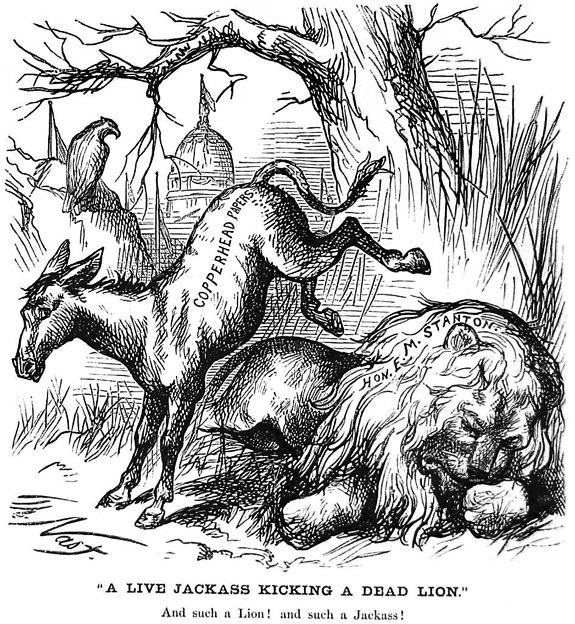
The donkey was first used as a symbol for the Democratic Party on January 15, 1870 by cartoonist Thomas Nash.
On January 16, 1919, the Eighteenth Amendment to the Constitution was ratified, prohibiting alcoholic beverages, when Nebraska became the 36th of the 48 states then in the Union to ratify the Amendment.
Martin Luther King, Jr. was born on January 15, 1929 in Atlanta, Georgia.
At 4:30 PM on January 16, 1991, the Persian Gulf War began as air attacks against Iraq launched from US and British aircraft carriers, beginning Operation Desert Storm.
On January 16, 1997, a bomb exploded in a Sandy Springs abortion clinic, later determined to be the work of Eric Rudolph, who also bombed Centennial Olympic Park in 1996, a lesbian bar in Atlanta in February 1997, and a Birmingham abortion clinic in 1998.
Georgia Politics, Campaigns, and Elections
Under the Gold Dome Today (and Next Week)
10:00 AM FLOOR SESSION (LD3) (House) House Chamber
10:00 AM Floor Session (LD 3) (Senate) Senate Chamber
11:00 AM Senate Transportation Committee 450 CAP
Tuesday – January 21, 2025
9:00 AM Joint Appropriations (House & Senate) 341 CAP
Wednesday – January 22, 2025
8:00 AM Joint Appropriations (House & Senate) 341 CAP
Thursday – January 23, 2025
8:00 AM Joint Appropriations (House & Senate) 341 CAP
Governor Brian Kemp discussed his legislative priorities at the Eggs & Issues breakfast yesterday.
[Yesterday], at the Georgia Chamber of Commerce’s annual Eggs and Issues legislative preview event, Governor Brian P. Kemp delivered an address announcing some of his top legislative and budgetary priorities for the 2025 legislative session.
To ensure Georgia remains the No. 1 state for business, the Governor announced proposals to ensure Georgia is the Top State for Talent; his intention to enact meaningful tort reform; and new investments in key infrastructure projects statewide.
Below are the Governor’s prepared remarks:
“Good morning! Thank you, Ed, for that introduction.”
“I’m glad to be here with Speaker Burns, Lt. Governor Jones, our constitutional officers, members of the General Assembly, Mayor Dickens, and some of the great local partners who have helped us keep Georgia the best state for opportunity. I also want to thank Chris Clark and the Georgia Chamber team for making this yearly event possible.”
“When I last spoke before you, I challenged us all to consider both where we need to be generations from now and how we get there. And as we have done in the past, we worked together as partners on that very challenge – delivering historic investments, reforms, and initiatives that are not just worthy of our status as the No. 1 state for business but reflect our state’s values and priorities.”
“As a result of that partnership approach, including with many others throughout Georgia, we’ve seen more than 193,000 new jobs created in communities across our state since 2019. And we’ve brought in over 90 billion dollars in private investments, with the majority going to our rural communities. We also have more people working than ever before in our state, and have jobs open for anyone looking for work or a new career.”
“Along with us maintaining our status as the No. 1 state for business for more than a decade, these achievements are all a part of a track record that everyone in this room should be proud of. But as I always say, we can never rest on our laurels.”
“In this new year, we must remain clear-eyed and focused towards building on these successes in the future. And that begins with ensuring that Georgia not only remains the top state in the nation for business, but also is the top state for talent.”
“We have made great strides in job creation and diversifying our economy, but we cannot allow workforce development to fall to the wayside.”
“It was at our second annual Workforce Summit last year that I unveiled this new initiative, which aims to develop an educated and skilled workforce aligned with our state’s current and future industry needs.”
“We plan to accomplish this by aligning our education pathways to access high-demand, high-skill, and high-wage careers.”
“Last summer I proposed and signed legislation enabling us to do just that and I’m proud to say we are already seeing implementation at the state and local levels.”
“After months of collaborations with industry partners and education professionals, my office unveiled Georgia’s High Career Demand List, enabling us to align education and job training programs with the needs of employers, grow our skilled workforce, ensure training programs meet industry standards, and increase awareness of career opportunities across the state.”
“We also continue to witness strong results from our innovative, direct-college admissions program: Georgia MATCH. Since we launched Georgia MATCH, enrollment at the University System of Georgia has not only hit an all-time-record high but did so at a rate that was more than double the national average, with a majority of that increase coming from in-state students.”
“Our Technical College System experienced an over 9% enrollment growth, bringing their total enrollment to the highest levels we’ve seen in over a decade.”
“Combine this with a surge in students enrolling in high-demand programs and our state is well on its way to being a magnet for skilled talent. But even with these successes, we are mindful of the challenges in this space that lie ahead nationwide.”
“Challenges like what many are referring to as the “demographic cliff” which describes a nationwide decline in high school graduates, caused in part by a decreasing birth rate. However, as our state has done time and again, we see obstacles as something to overcome and challenges as opportunities.”
“That is why my administration will be proposing the Top State for Talent Act this session to: incorporate Georgia MATCH into the individual graduation plans of our students beginning in the 9th grade; align our existing, career-tech and academic credentials with the high demand list we’ve unveiled; increase opportunities for articulation from high school to postsecondary programs in those high demand fields; and finally, to include a return on investment analysis measuring the effectiveness of our secondary and postsecondary programs that are aligned with the high demand career list.”
“We are not only focused on developing our workforce. Through our Rural Workforce Housing Initiative, we also continue to work with our local partners in communities across the state to support their efforts in ensuring that this growing workforce can live in the same communities where our industry partners are creating good paying jobs.”
“Since the program’s launch, we have awarded more than 42 million dollars in infrastructure grants to 21 rural communities.”
“Communities like Elliott’s Walk in Columbus where they’ve already built 18 homes and are building 24 more, or in the city of Colquitt where they are constructing 49 sustainable units for their workforce to call home. ”
“We also recently awarded our first ever Rural Site Development Awards, to help our local partners turn what some have called “fields of dreams” into ready-to-go sites for job creation.”
“It is through innovative approaches and partnerships like these, that we not only solidify our status as the No.1 State for Business but also grow the gap between us and the competition.”
“However, we must also ensure current and future partners know they can find not just great talent here, but an infrastructure network that can support their growth and needs.”
“Since 2019, our private sector partners have committed over 66 billion dollars in investments for logistics-enabled businesses, creating over 140,000 new jobs across our state.”
“This accounts for over three-fourths of total jobs created and total private investments made in our state since I entered office.”
“That is why last year I announced that we would be investing an additional $1.5 billion into our infrastructure needs – expediting 23 projects more than 40 years ahead of schedule and funding 19 new projects.”
“I am proud to report that this has not just served us well in terms of economic development, but it has also benefited our state and partners from a fiscal management approach as well.”
“As a result of these investments, by 2035 we will have saved more than 1 billion dollars from delay and crash reduction and saved more than 4 billion dollars by 2050. Additionally, Georgia is ranked No. 1 in the nation for our infrastructure by CNBC and ranked No. 1 state for bridge quality by ConsumerAffairs.”
“This return on investment is something we should all be proud of and as a result, I am proposing that we double down.”
“Last year, with the help of the General Assembly, we provided $250 million dollars to double our grant investment in local roads without doubling the cost for local governments, and after hearing how beneficial this was from our local leaders, I am proud to say we’re doing it again.”
“Furthermore, my upcoming budget proposal includes 530 million dollars to invest in our freight and logistic transportation infrastructure. And finally, I will be proposing another infusion of 250 million dollars into the Georgia Environmental Finance Authority fund to support the development of water, wastewater, and solid waste infrastructure projects.”
“Thanks to our previous investments in this fund, 135 Georgia communities have received nearly 500 million dollars in financing, providing over 1 million Georgians with reliable water services. While other states are raising taxes, we are cutting them, while also returning billions of dollars to taxpayers, paying down our debt, investing in our priorities and saving billions in future costs to our state and industry partners.”
“Yet, in all of that good news there is one more thing that we must address, the need for a legal environment that is balanced with our neighbors.”
“When I spoke to you all this time last year, I announced that my administration would work with the General Assembly to gather data that would prepare us to take on the issue of tort reform head on.”
“That data has now been gathered and following multiple roundtable conversations on the impact our current legal environment is having on our economic growth and healthcare needs, I will soon be unveiling a robust legislative package that will bring balance to our proceedings and parity with our neighbors.”
“We will move forward with an open mind and work with all of you as a team – just like we have successfully done on so many tough issues.”
“Tort reform will be my top legislative priority for this upcoming session, and I look forward to sharing more about those plans in the coming weeks. But I need your help. Every local or regional chamber in this room has a critical role to play this session to make sure we finally get tort reform done.”
“I’m asking you to engage earlier and harder than you ever have. Talk to your members, get them involved, and give them the tools necessary to be influential with their House and Senate delegation.”
“In fact, given the seating chart here, local chamber delegations, you can take this opportunity to give your legislators a look or a nudge under the table.”
“They need to hear from you not just today, this week, or this month. They need to hear from you and your members every day from now until Sine Die.”
“Because this is not a partisan issue. No matter your party, your district, your zip code, or your background, this issue impacts us all.”
“This is the year – so let’s get to work and get it done.”
“As you can see from what I’ve laid out here today, by working together, we have accomplished great things as a state.”
“With a new legislative session upon us, I’m confident that by continuing this approach, we can keep Georgia the best place to live, work, and raise a family for years to come.”
“God bless you all and may God bless our great state. Thank you!”
From the Capitol Beat News Service:
Gov. Brian Kemp asked business leaders from across Georgia Tuesday to help him get tort reform, his top priority for the 2025 General Assembly session, across the finish line.
“Every local or regional chamber (of commerce) in this room has a critical role to play this session to make sure we finally get tort reform done,” Kemp told an audience of Georgia business and political leaders during the Eggs and Issues breakfast at the Georgia World Congress Center, an annual event at the start of each legislative session sponsored by the Georgia Chamber of Commerce.
“I’m asking you to engage earlier and harder than you ever have. Talk to your members, get them involved, and give them the tools necessary to be influential with their House and Senate delegation.”
Tort reform has been a goal of Georgia Republicans and their allies in the business community for decades. But the most significant reform legislation to make it through the General Assembly came 20 years ago in a bill that imposed a $350,000 cap on non-economic damage awards in medical malpractice and product liability lawsuits.
The cap immediately came under fire in the form of lawsuits challenging its constitutionality. The Georgia Supreme Court sided with the plaintiffs and threw out the cap in 2010.
Calls for tort reform have come like clockwork virtually every year since, with Republican lawmakers and conservative policy groups warning that huge jury verdicts from frivolous lawsuits are hurting job creation by forcing companies to close their doors. Legislative Democrats and their allies in the trial lawyers’ lobby have warned tort reform threatens to rob Georgians hurt by medical malpractice or defective products of their day in court.
Lawmakers passed a bill last year aimed at laying the groundwork for significant tort reform in 2025. The measure directed the state insurance department to gather data on legal trends affecting insurance premiums and prepare a report.
“That data has now been gathered and, following multiple roundtable conversations on the impact our current legal environment is having on our economic growth and health-care needs, I will soon be unveiling a robust legislative package that will bring balance to our proceedings and parity with our neighbors,” Kemp said Tuesday.
The governor also announced at Tuesday’s breakfast a plan to pour an additional $780 million into infrastructure improvements on top of the $250 million set aside in this year’s budget. Of the new funds, $530 million would go toward road building, and $250 million would be spent on water and sewer projects.
Kemp will share more details on his spending proposals on Thursday when he delivers his annual State of the State message to a joint session of the Georgia House and Senate.
On the school funding ask by Gov. Kemp, from the Capitol Beat News Service:
Gov. Brian Kemp said Monday he will ask the General Assembly to provide an additional $50 million in state grants to improve security in Georgia schools.
The added funding would bring the total for the current fiscal year to $158 million, Kemp said during a news conference at the state Capitol.
“This is going to keep our students, teachers, and school systems safer,” he said.
The issue of school safety has taken on greater urgency under the Gold Dome since last September’s mass shooting at Apalachee High School near Winder that killed two students and two teachers. A 14-year-old student was arrested at the scene and charged with the murders.
Lt. Gov. Burt Jones credited the school-safety grant program with reducing the potential carnage at the school in Barrow County.
“Had we not made that investment, the tragedy that hit Apalachee could have been much worse,” he said.
The added funding for school safety would be enough to give each school in the state $68,760.
Kemp said local school systems would be given discretion over how to use the money.
“They know their schools and their needs better than we do,” he said.
However, legislation the General Assembly passed in 2023 requires schools to submit safety plans to the Georgia Emergency Management and Homeland Security Agency in order to receive the funds.
On Monday, Governor Brian Kemp unveiled his legislative package aimed at boosting the security of Georgia’s schools, addressing mental health support, and providing pay raises for educators and other school needs.
The centerpiece of Kemp’s proposal is a significant investment in school safety. The package allocates $50 million for one-time school safety grants, providing nearly $70,000 for each school in the state to enhance security measures, such as cameras, detection systems, school resource officer pay increases, and wearable devices.
This initiative comes as districts like Peach County and Bibb County continue to refine their safety strategies.
At Byron Elementary in Peach County, Assistant Superintendent Dr. Jesse Davis says several key security measures are already in place, including multiple access control points designed to prevent unauthorized entry.
One security measure at Peach County schools is the installation of keyless access points. These systems are controlled with key fobs, Davis says, allowing only authorized individuals to pass through secured doors.
Davis says these security upgrades ensure that individuals must clear multiple checkpoints before entering the school premises, further safeguarding students and staff.
Kemp’s proposed funding would support even more security improvements.
Other plans in the proposal include supporting Georgia teachers and staff like increasing the public school employer’s contribution to the Teachers’ State Health Benefit Plan.
For mental health support, Kemp has proposed adding funds to the crisis counseling training with the Southern Regional Education Board (SREB), which will give 20 counselors from local school districts intensive training on providing counseling support in the school.
In Bibb County, Howard Middle School’s Security Manager, Matthew Giegler, sees the value of continued funding for updated security technologies.
“With technological advancements comes increased cost,” Giegler says. “It’s great that the federal and state government have made safety a priority and are providing additional funds for that,” Giegler said.
Governor Kemp plans a state investment in Coastal Georgia’s water supply, according to WSAV.
Gov. Brian Kemp (R-Ga.) is carving out a large portion of the 2025 budget to make sure Savannah and its neighboring regions have enough water.
“I’m very happy, pleased, jubilated, that Gov. Kemp has committed a major investment in the future of our water in our region,” said Savannah Mayor Van Johnson Tuesday.
The investment comes in the form of $500 million in regional water supply for the city of Savannah and Chatham, Effingham and Bryan counties.
“This is big because this will help us reach the forecasted need of providing nearly 100 million gallons of fresh water every single day to our current and future customers,” said Johnson.
“The reality is water continues to be an issue for us,” said Johnson. “Water is essential. Our city, this region continues to grow, and not just Savannah, everywhere around us, and so our ability to survive will really depend on our ability to able to provide water to our customers.”
Gov. Kemp says projects like the one coming to the Coastal Empire have already helped over 100 communities with their water issues.
“Thanks to our previous investments in these funds, 135 Georgia communities have received nearly $500M in financing, providing over 1-million Georgians with reliable water services,” said Gov. Kemp.
State leaders say Georgia needs to double down on transportation and infrastructure investments.
Governor Brian Kemp says with a $1.5 billion dollar investment, it will speed up 20 transportation projects across the state.
Another goal is to tackle tort reform to prevent lawsuits which Governor Kemp says drives up insurance costs.
With new jobs, Governor Kemp says it means making housing more affordable and creating the next generation of skilled workers which means prioritizing higher education.
“We are not only focused on developing our workforce but through our rural housing workforce initiative, we also continue to with our local partners across the state and efforts to ensure this growing workforce can live in the community where our industries are creating these good paying jobs,” said Governor Kemp.
Governor Kemp wants to invest $530 million dollars in logistics and freight and $250 million dollars to support waste water projects.
He is expected to outline his full budget priorities on Thursday in his annual State of the State Address to lawmakers at the capitol.
“Tort reform will be my top legislative priority this session,” Gov. Brian Kemp pledged, hinting that the package he plans to unveil soon will address the state’s runaway and frivolous jury awards and ensure Georgia remains the No. 1 place to do business.
Once the governor was done speaking, the crowd began leaving, but Georgia Chamber organizers urged folks to stick around for “a second serving”: an update on the Democratic agenda with state Sen. Sonya Halpern, D-Atlanta, and Rep. Al Williams, D-Midway.
The pair discussed economic development, particularly in rural areas; affordable health care, with a focus on Medicaid expansion; mental health and literacy concerns; workforce development; and affordable housing. They spoke with Georgia Beverage Association President Kevin Perry.
Williams used his county to illustrate the state’s need for more housing and the related challenges of getting and keeping workers.
“As the chairman of the development authority in Liberty County, I have a contractor waiting to build 300 houses, but we’re in a community that does not have the water to supply [the construction]. So we’ve got to deal with that,” Williams said. “People are lined up to work, but if you can’t move your family into an affordable house, then you’re in trouble. So we’ve got to address that. The state has to pump some of the $16 billion in reserves out there to make this happen.”
The lack of affordable child care keeps a lot of people out of the workforce, Halpern said. The mother of three noted that the $22,000 a year she earns as a senator isn’t enough to cover the cost of her third grader’s day care.
“Earned income credit checks were very helpful at the federal level. We can think about doing something like that here,” Halpern said. She also suggested creating a child care trust fund.
The 15-minute fireside chat was a tale of two agendas — and a glimpse into the difference between the two parties’ 2025 agendas — and the deference given to Republicans.
“I’m trying to speak for the have-nots, left-outs and those who are not on the front page of The AJC, and when we do that, there’s not a problem in Georgia that cannot be only addressed but solved,” Williams said.
More on Tort Reform from Georgia Recorder:
The governor pointed to the results of a review done last year as part of a Kemp-backed data-collection effort designed to lay the groundwork for changes. A report, written and released in November by Kemp ally and elected Insurance Commissioner John King, blamed several factors for contributing to the rising cost of insurance across the board, including what the report called “inflated medical costs” and third-party litigation funding.
Representatives of the influential Georgia Chamber of Commerce have also highlighted four areas where they argue Georgia is an outlier in the region: premises protection, damages reform, limits on attorney fees and trial bifurcation, which refers to splitting a case into separate phases for trial.
Chris Clark, president and CEO of the chamber, said curbing premises liability is a top concern for the group’s members.
“It shouldn’t be legal for two bad guys to come on your property, hurt each other, and then you’re to blame and you get sued for it,” Clark told reporters. “I think we hear that consistently from the medical community as well as small businesses all over the state.”
Clark said Tuesday that the chamber will be “lockstep” with the governor’s plans.
“Our justice system should not be about jackpots. It should be about justice, and we just want what’s fair and balanced,” he said.
Clark conceded that any legislative changes pursued this year may not bring down prices but said they could help “stabilize the market” and boost competition.
[State Rep. Al] Williams [D-Midway] said he is skeptical of how many so-called nuclear verdicts there really are and said he is concerned about the impact new lawsuit limits could have on plaintiffs’ rights.
“Who can determine what my arm is worth, what my life is worth, what my children are worth? I like a jury of my peers,” Williams said. “Let’s protect the plaintiffs’ rights too. Many of them don’t have a voice at the table. I will be there to help in any way I can to make sure that we maintain a good business environment, which we can do without sacrificing the rights of the victims.”
State House Speaker Jon Burns (R-Newington) wants to develop a state plan for energy and water supplies, according to the Savannah Morning News.
Georgia House Speaker Jon Burns this week announced plans to develop a plan to ensure the state has enough energy and water to support the ongoing economic development boom.
Burns made the announcement while laying out his priorities for the upcoming legislative session, and amid an influx of new economic development projects including high-profile manufacturing projects and data centers. He said State Representative Brad Thomas will lead the effort, which he said would create the state’s first comprehensive resource management plan in over 20 years.
“We will leave no stone unturned. There will be nothing that we can’t talk about,” Burns said. “We want to make sure that we look at how sustainable our energy production is, our energy usage, and certainly our water usage.”
“We would have had our big study commission, which is what we should have done,” said Georgia Sierra Club legislative chair Mark Woodall of the 2024 bill. “So, better late than never.”
Woodall and other environmental advocates have raised concerns about data centers because they say the high energy usage could hamper Georgia’s transition from fossil fuels to clean energy. Georgia Power is already planning to build new gas-powered turbines to meet growing energy demand the utility says comes mostly from data centers, and analysts are watching for more fossil fuel use when the company unveils its next long-term plan this month.
“We’re not gonna be able to put in clean energy and batteries fast enough to handle these data centers where they’re locating them here,” said Woodall. “We’re just bracing now for a possible fossil fuel bonanza.”
State House Democratic Leader State Rep. Carolyn Hugley (D-Albany) discussed her legislative priorities, according to the Albany Herald.
After 48 years of representing Columbus in the Georgia House, retired State Rep. Calvin Smyre knows what it takes to be an effective leader under the Capitol’s gold dome in Atlanta.
So he didn’t hesitate when asked whether State Rep. Carolyn Hugley of Columbus has the ability to be successful in her new role as leader of the Georgia House Democrats.
“I really think she is ready,” Smyre, who from 1986-89 was the first Black representative to be floor leader in the Georgia House, told the Ledger-Enquirer. “… She doesn’t need on-the-job training. She’s been minority whip (2003-18 as the first Black representative in that position at the Georgia House), so she has engaged with the membership as it relates to the caucus position and carrying out the policy of the caucus on the floor of the General Assembly.”
Smyre described Hugley as trustworthy, knowledgeable, thoughtful, courageous, persistent and respected on both sides of the political aisle because she shows integrity and communicates well to form constructive relationships.
Hugley, starting her 33rd year in the Georgia House, impressed Smyre with her leadership when she chaired the Legislative and Congressional Reapportionment Committee.
What is your reaction to being elected by your colleagues as leader of the Democrats in the Georgia House?
“It’s a tremendous honor. … We are 80 members, which makes us 45% of the House of Representatives, so it’s the largest number of Democrats that we’ve had in a long time, and we’re excited about that. We have a tremendous amount of diversity in terms of geography and in terms of age, in terms of ethnicity, race, all of those things. All of those factors are part of our caucus, such that our caucus is Georgia. We reflect Georgia, and so it’s a tremendous opportunity for us … to try and do the work that the people of Georgia sent us there to do.”
Looking ahead to the 2025 legislative session, what’s your biggest priority, and what do you want to accomplish as minority leader?
“The first thing the leader wants to do is keep their caucus together. Other than that, … we need to really look at our school funding formula, … particularly as we look at students with special needs because the formula does not really capture the cost for taking care of those students. And so, if there was an exodus of students using vouchers, the students with special needs are still going to be in our public schools because the money that it will require to take care of their needs will not follow them.”
“… We sometimes have to send students outside of our state in order to find the resources they need, … and that’s not really reflected in our funding weights. And as we move forward with vouchers, I think that problem will be exacerbated. So that’s something that our caucus wants us to take a look at as it relates to education, and that’s something that our local board has expressed concerns about as well.”
What are other state issues that you know the Muscogee County School District Board and the Columbus Council have on their legislative agenda for the local delegation to advocate?
“Younger and younger students are participating in vaping, and so they’re asking us to make vape detectors eligible for school safety grants. … They are wanting to make sure that what we have at Brewer (Early Innovation Academy, a K-2 initiative designed to help students below grade level in literacy and numeracy) can be extended and can get state funding.”
“… The city had several items on their agenda. Most of it was health-related. … Both the city and the school district want point-of-sale data so that they’ll know where the taxes have come from. … Another thing the school district has wanted us to continue to work on is the whole notion of foster students. They come into our county, they have to be assigned to a school, but they arrive before the records arrive with the students.”
Two Moultrie-area state legislators discussed their priorities in the Session, according to The Moultrie Observer.
The 158th Georgia General Assembly convened on Monday. State Sen. Sam Watson and Rep. Chas Cannon gave The Observer a preview of the legislation and issues the legislature will most likely address this session.
Hurricane Helene Relief
Both legislators agreed that, from the appropriations side, there will be more budgetary relief for Hurricane Helene coming from Governor Brian Kemp.
“Probably the first thing we see come out of the gate from the governor’s office is something on Hurricane Helene. I’m not sure what that package looks like, but we’ll see what happens,” Cannon said.
Watson said that they were also looking at putting a little more money in the Department of Corrections to help retain staff and do some updates on some state prisons.
“Overall, the State still has some surplus and that’s good,” he said of Georgia’s budget this year.
Tort reform
Watson said that tort reform legislation is a topic that Kemp would address to try to bring a more even playing field to the tort process.
“There’s been a lot of conversation about that,” he said. “Something needs to be done to balance it out a little bit.” Cannon said the governor would be the one that will be driving legislation on that.
“So, we really won’t know what that bill looks like until we get into the session,” he said.
He went on to say that tort has a lot of different components to it, but the overall goal of tort reform legislation is to avoid the frivolous lawsuits.
“The overall thought process is lawsuits are a little bit too far out of whack. They need to come back to the middle,” Cannon said.
Conservation Use Valuation Assessment
CUVA was a topic that both Watson and Cannon were specifically looking to work together to address as both believed that it was legislation that needed to be updated. CUVA allows landowners to enter a covenant for forested lands or agricultural lands that can significantly reduce their property taxes. Enrollment in CUVA is capped at 2,000 acres.
This statute, as it stands now, does not let non-family farm members join up to lease farmland, Cannon said. He said that these days, because of legal issues or insurance, farmers like to form LLCs for liability protection.
Watson said the statute needed to be updated to reflect today’s farming industry, echoing Cannon, that many farms, today, are LLC’s or partnerships between individuals that aren’t related to each other.
Board of Education millage rate
A bill that Cannon was working on last year addressed lowering the boards of education’s millage rates.
“There’s been a lot of interest in that,” he said of the bill to bring the required mileage rate for board of educations down from 14 mills to 10 mills.
Especially since the property assessments have gone up all over the state last year, it has become an important issue, he said. Lowering the school’s millage rate can accommodate for higher property values and help reduce property taxes, he said.
As the statute stands now, for a school system to receive state equalization funding, its millage rate cannot drop below 14 mills.
Cannon noted that the Colquitt County school system could’ve dropped its millage rate, but was not allowed because of the state law currently in effect.
“And as a result, they passed on a 20 something percent increase in property tax. And they didn’t even need the money. But because of those laws… And that’s happening all over the state not just here, locally,“ he said.
The state requires counties and cities to roll their mileage rates back when their tax digest goes up a certain amount, he said. But, he continued, there’s not an equitable state law that requires the school system to lower their millage rate.
“That’s kind of what this does,” he said.
State Senator Mike Hodges (R-St. Simons Island) said he will support Senate Bill 1 on transgender students in school sports, according to The Brunswick News.
State Sen. Greg Delezal, R-Alpharetta, introduced SB 1, the Fair and Safe Opportunities Act, on the opening day of the General Assembly on Monday with the signatures of 25 Republican co-sponsors.
Sen. Mike Hodges, R-St. Simons Island, was not where he could sign the bill as a co-sponsor at the time, but he said Tuesday he fully supports it.
Hodges said to his knowledge, the legislation addresses an issue that has not been a problem in Georgia.
“If it is, I don’t know about it,” he said.
It certainly has not been a problem in Glynn County’s public schools, Superintendent Scott Spence acknowledged Tuesday.
“I think it’s a problem in other places,” Hodges said, which suggests that SB 1 is a preventative measure.
At any rate, “I’m certain Republicans will vote for it,” Hodges said.
The bill is aimed at transgender students. Except for coed competitions, which feature both male and female competitors, SB 1 would prohibit “males from participating in interscholastic and intercollegiate competitions on teams designated as female” and “prohibit females from participating in competition on intercollegiate teams designated as male.”
The restriction includes middle schools, high schools and colleges in the state.
The bill requires private schools that compete against public schools to comply with the legislation.
“Requiring the designation of separate, sex-specific athletic teams or sports is necessary to protect student athletes from harm and to promote and preserve the competitive fairness of sports,” the bill reads.
SB 1 also would require multiple occupancy restrooms and changing areas and sleeping quarters to be designated for exclusive use by males or females.
Democrats in the Senate say, among other things, that SB 1 is unnecessary.
Bryan County Commissioners voted against opting-out of HB581’s expanded property tax homestead exemption, according to the Savannah Morning News.
County Commissioners decided not to opt out of HB 581 and encouraged municipalities to not opt out as well.
County Manager Ben Taylor read aloud a portion of what the bill entails, saying it, “Provides for a floating homestead exemption that limits annual increases in assessed value for residential properties to the inflationary rate as determined by the State Revenue Commissioner.”
Waterways
Waterways continues to grow as a sketch plat for a 206-lot subdivision was approved by commissioners Tuesday night. The neighborhood features a number of lakes, a lagoon and multipurpose paths, giving residents direct access to outdoor recreation such as kayaking and fishing. The new homes will be built on 47 acres.
The Houston County Board of Education held a public hearing to discuss whether to opt out of HB 581, according to 13WMAZ.
Tuesday, Houston County’s Board of Education held its second public hearing on whether to opt out of House Bill 581.
Supporters called it the legislation the “The Save Our Homes Act,” but across the state, some schools and local governments are considering the opt-out provision; they must decide by March 1.
The bill addresses property tax assessments for homeowners by capping the tax value of their homes to counter inflation, but school districts have stated that could be costly, also putting a limit their state funding.
A lot of people have been talking about the floating homestead exemption. Many homeowners have taken to social media opposing county’s and schools opt-ing out. In this past election, 62.9% of Georgians voted yes for the law.
[T]he district’s chief financial officer, Michelle Morris, spoke in favor of opting out and he said that will preserve financial stability for educational resources.
“Property taxes help fund part of our teacher salaries, also our support staff salaries and benefits such as bus drivers, bus monitors, para-professionals and custodians, it also helps pay for our SROS, instructional material and student transportation and much more for our district,” she said.
During the meeting she stated if the district does not opt-out, they’d have to considering increasing the millage rate, which she said has not increased in the past 16 years, adding it’s either decreased or stayed the same.
She also said if the district accepts the cap, the school district would have to contribute more money to the state, then it receives in revenue.
Houston County Board of Education holds their third and final public hearing on HB 581, Wednesday, Jan. 22 at 2 p.m.
The Richmond County Board of Education is preparing to opt-out of HB 581, according to WRDW.
“ I think it’d be difficult to determine long term how many people will necessarily benefit,” Richmond County Chief Appraiser Scott Rountree said. “But I think it is, it is definitely geared toward property owners who own and live in their properties for a long time.”
Before opting out of the so-called “floating” rate, the Richmond County Board of Education had to schedule a series of public hearings, and Tuesday’s was the first.
“Really the only properties that would benefit are, one, if you have a homestead, and your property value over time continues to appreciate at a rate higher than whatever the cap is, you’ll see a long-term benefit to this,” says Rountree. “That’s a question that the commission has to ask is do we think this benefit is great enough to shift that burden or not?”
Meanwhile, the Columbia County Board of Commissioners said Tuesday it intends to opt out of the statewide adjusted base year ad valorem homestead exemption for Columbia County.
Tuesday’s announcement came after officials said last week they were exploring their options.
The Columbia County Board of Commissioners is having the required public hearings to gather citizen input.
“The way this works is it’s an additional exemption, not in lieu of your current one, but in addition to your current exemption,” says Rountree. “So, for example, if your property increased 10% due to inflation, but the cap was 5%, you would be taxed at basically 5% above what your prior year value was. And anything beyond that, that additional 5% would be exempted.”
House Bill 581 is meant to change how local governments look at property taxes with your homestead exemption.
Lawmakers drafted this with the purpose of putting a cap on how much property taxes could rise each year to prevent tax spikes.
It’s a new system meant to ease the burden on people with fixed incomes or salaries that can’t keep up with growing market values.
“You only get so many bites at the apple to control taxes, and we want to get it right,” Doug Duncan, chairman of Columbia County Commission, said last week as officials examined whether to opt out.
All local governments and school boards have until March 1 to decide what they will do and if they opt out, it will go to the state for approval.
Other rural Georgia governments are considering whether to opt out of HB 581, according to the Albany Herald.
The majority of Georgians voted yes in November for a statewide floating homestead exemption that would limit annual increases on assessed values of homesteads, unless a local government chooses to opt out.
However, rural governments across the state are realizing the benefit of this exemption might not extend beyond suburbs near Georgia’s Capital. Larger metro areas may see meaningful tax cuts, but poorer, smaller areas with low business or homeownership could face higher taxes elsewhere to compensate.
Tommy Coleman, an Albany attorney, said rural areas struggle with stagnant tax bases.
“How would you continue to provide services when the tax base isn’t growing?” he said.
House Bill 581 went into effect New Year’s Day. It was introduced by Rep. Shaw Blackmon (R-Bonaire) who represents parts of Houston County – one of Georgia’s wealthiest counties. Lawmakers representing southwest Georgia’s districts, many of them poor and rural, voted in favor of House Bill 581. Sixty three percent of Georgia’s constituents voted yes for the amendment.
The law essentially places a “freeze” on a homestead’s value assessment. It does this by increasing the value of an exemption to offset inflation.
For example, under a typical floating homestead exemption, if a property had a taxable value of $100,000 and the taxable value increased the next year due to market changes to $110,000, then the exemption “floats” to be worth $10,000 so the homeowner still pays taxes on the base year value of $100,000
HB581 is unique because the base year value is adjusted and will increase by an inflation rate determined by the State Revenue Commissioner – likely the consumer price index (CPI). So, take that same property with a value of $100,000 and say the CPI is 2% the next year. Then that base value may increase up to 2% to give an adjusted base year value of $102,000. The homeowner would pay $102,000 in that second year.
It doesn’t affect homestead exemptions currently in place.
If every city in a county decides not to opt out, then the county can pass a new local option sales tax, referred to as a FLOST, between half a cent and $0.01, that can be used for property tax relief. It’s only in place for five years. The FLOST is not available to school boards.
Coleman pointed out that there is no provision in the law to opt out of HB581 after March 1 or to renew the FLOST after five years.
In rural governmental systems, concerns multiply. A 2021 presentation from the University of Georgia listed 120 out of 159 Georgia counties as rural.
HB581 provides a tax break to homeowners but not agricultural property, businesses, industrial or rental property. Many rural areas in Georgia depend on farm economies and lack industry or significant home ownership.
“When you give a tax break to one segment of the population, somebody else has to pick it up,” Coleman said. “The demand for the funding to the government doesn’t go away so it really shifts the burden to others.”
The law gives local governments a chance to opt out. Before they do that, they need to go through a process of advertising and hosting three public hearings – a process that couldn’t begin until Jan. 1 and must be completed by March 1.
Calhoun County Clerk Mandie Milner said the county is leaning toward opting out to avoid having to raise the county’s millage rate “exponentially” – an effect that most taxpayers aren’t aware of. Calhoun County is a rural county west of Albany with a population of about 5,500
Leaders in Calhoun County and its municipalities are hosting a meeting Jan. 14 to discuss the new law and how it may affect their area’s tax bases.
Coleman said the March 1 deadline is bound to be tight for smaller local governments as many struggle with short staffing. He said in order to meet the deadline, these governments had to begin the decision making process before Jan. 1.
Edison, one of Calhoun county’s municipalities, began discussing the exemption at their December council meeting.
Edison’s Mayor Shirley Worthy said since then, the city has been trying to assess if the exemption would help the city’s tax base in any way.
“But we have no industry. We have very few businesses,” Worthy said. “All these places that are larger can get income off of that. We can’t.”
Worthy said the same people that would benefit from the floating homestead exemption in Edison would then be hit with higher taxes in other areas in order to keep fueling the city’s revenue.
Sen. Freddie Powell Sims (D-Dawson) voted yes to HB581 in last year’s legislative session. She said areas in her district are probably some of the most rural in the state, but she doesn’t expect them to have difficulty meeting the March deadline if they wish to opt out.
“When you make laws, there are sometimes unintended consequences for different regions of the state, whether it’s rural or urban,” she said. “But remember, we make laws for everybody.”
She encouraged county and municipal leaders to reach out if help was needed.
Darlene Paul, the Chief Appraiser of Terrell County’s Tax Assessor’s Office said the short timeline is a stressor. Terrell County commissioners voted to opt out Tuesday night. She said the county is also in the midst of a tax base reevaluation.
“We’re really in crunch time now,” Paul said. “We’re busy trying to figure out what kind of values we’re gonna use and what we’re gonna do.”
She said she also worries about unequal treatment for taxpayers under governments that opt in.
“If I have a house and you have an identical house beside me that isn’t homesteaded, then they’re not going to be valued alike,” she said.
Paul said to her, the law seems to target larger, more metro counties with expensive homes. Many, including Coleman, said it just doesn’t make sense for rural communities.
That’s an outstanding article that does an excellent job of explaining why rural counties may be different than urban and suburban counties and how that affects local governments’ decisions. Ten Points awarded and a nomination for best story of the year.
The Macon Water Authority is seeking funding from the Special Purpose Local Option Sales Tax (SPLOST) on the March 18, 2025 ballot, according to 13WMAZ.
The date is set for Macon-Bibb voters to decide whether to approve a new SPLOST fund on March 18.
While Bibb County leaders have a list of priorities to tend to, such as road repairs and funding a new jail, the Macon Water Authority is looking to drain some of that money to improve storm water systems and repair the Macon levee.
In 1994, Tropical Storm Alberto caused the Ocmulgee River to rise over its bank, costing the state millions in damages and claiming two lives in Bibb county.
Macon Water Authority Board Member Elaine Lucas is pointing to the traumatic event as a reason why MWA is seeking SPLOST funding.
“We’ve got to make plans as leaders to take care of those problems before we have a major emergency, we don’t want to wait for a catastrophe like the flooding way back in ’94,” Lucas said. “The Corps of Engineers has said we could face some problems in the future, so we’ve got to accommodate.”
As the county awaits a potential new SPLOST, the Macon Water Authority passed a resolution of $29 million for levee repairs and $43 million for stormwater improvements.
I’m reluctantly awarding +1 point to 13WMAZ for the dad joke in the sub-headline: While Bibb leaders look to repair roads and fund a new jail, the Macon Water Authority is looking to drain some of that money to fix stormwater issues.
Tifton local governments adopted property tax millage rates, according to The Tifton Gazette.
Following the strenuous affair of the 2024 property tax revaluation, city, county, and school system leaders are moving to set their millage rates.
The three governing bodies approved their new millage rates during recent meetings across both this week and last week, bringing in rollbacks across the board.
Members of the Tift County Schools Board of Education moved to set their rate at 14 mills, while the Tift County Board of Commissioners has set theirs at 8.427, a rollback from 11.853, and the Tifton City Council has established 6.236 as their new millage rate.
Jim Carter and Anthony Rowell, county manager and county attorney, respectively, reported at the Jan. 13 County Board of Commissioners meeting that property tax bills would likely be sent out by the end of the month, to be due 60 days from the date mailed.
C. Shanelle Booker is serving as Acting United States Attorney for the Middle District of Georgia, according to WALB.
Booker officially took the position on Jan. 12.
According to the U.S. Attorney’s Office, Booker is the first black person and first black woman to hold the top law enforcement job. Booker has served the residents of the Middle District of Georgia as a federal prosecutor since 2015.
As Acting U.S. Attorney, Booker will cover 70 of Georgia’s 159 counties and several SGA cities including Albany, Athens, Columbus, Macon and Valdosta. The Office is responsible for prosecuting federal crimes, including terrorism, child exploitations, illegal gangs, narcotics and more.
Habersham County Schools Superintendent Matthew Cooper announced he will retire April 1, 2025, according to AccessWDUN. No word on whether that’s an extended setup for an April Fools’ Day prank.
Hall County Assistant County Administrator Katie Crumley is leaving her job, according to AccessWDUN.
Three new members of the Bulloch County Board of Education were sworn in, according to the Statesboro Herald.
Three new members — Lannie Lanier of District 1, Jennifer Campbell Mock of District 3 and Lisha Nevil of District 7 — joined the Bulloch County Board of Education with a swearing-in ceremony at the start of the Jan. 9 first meeting of 2025. One member re-elected last year, Maurice Hill of District 8, was also sworn in for a new four-year term.
The Glynn County Board of Education voted to hire Mike Blackerby as their new superintendent beginning July 1, according to The Brunswick News.
Current Superintendent Scott Spence announced earlier this year that he will retire after the school year, which ends June 30, 2025.
Blackerby currently serves as deputy superintendent of operations for the school system and has been in public education for nearly 30 years as a teacher, principal and system-level administrator.
Related Posts
 Georgia Politics, Campaigns, and Elections for September 28, 2022
 Proposal: Eliminate four furlough days – The Cherokee Ledger-News: Top Stories
 Savannah Navy League serves Thanksgiving dinner to Coast Guard | savannahnow.com
 City to appeal $12M verdict | savannahnow.com
 Augusta region’s transportation tax collections falling below projections | The Augusta Chronicle


Comments ( 0 )