
George Washington was inaugurated as the first President of the United States of America in New York City on April 30, 1789. From Washington’s inaugural address:
it would be peculiarly improper to omit in this first official act my fervent supplications to that Almighty Being who rules over the universe, who presides in the councils of nations, and whose providential aids can supply every human defect, that His benediction may consecrate to the liberties and happiness of the people of the United States a Government instituted by themselves for these essential purposes, and may enable every instrument employed in its administration to execute with success the functions allotted to his charge.
In tendering this homage to the Great Author of every public and private good, I assure myself that it expresses your sentiments not less than my own, nor those of my fellow-citizens at large less than either.
No people can be bound to acknowledge and adore the Invisible Hand which conducts the affairs of men more than those of the United States.
On April 30, 1803, negotiators from France and the United States finished discussions of the Louisiana Purchase, which would double the size of the country.
By the middle of the 18th century, France controlled more of the modern United States than any other European power: from New Orleans northeast to the Great Lakes and northwest to modern-day Montana. In 1762, during the French and Indian War, France ceded its America territory west of the Mississippi River to Spain and in 1763 transferred nearly all of its remaining North American holdings to Great Britain. Spain, no longer a dominant European power, did little to develop Louisiana Territory during the next three decades. In 1796, Spain allied itself with France, leading Britain to use its powerful navy to cut off Spain from America.In 1801, Spain signed a secret treaty with France to return Louisiana Territory to France.
Reports of the retrocession caused considerable uneasiness in the United States. Since the late 1780s, Americans had been moving westward into the Ohio and Tennessee River valleys, and these settlers were highly dependent on free access to the Mississippi River and the strategic port of New Orleans. U.S. officials feared that France, resurgent under the leadership of Napoleon Bonaparte, would soon seek to dominate the Mississippi River and access to the Gulf of Mexico.
U.S. envoys agreed to pay $11,250,000 and assumed claims of its citizens against France in the amount of $3,750,000. In exchange, the United States acquired the vast domain of Louisiana Territory, some 828,000 square miles of land. In October, Congress ratified the purchase, and in December 1803 France formally transferred authority over the region to the United States. The acquisition of the Louisiana Territory for the bargain price of less than three cents an acre was Thomas Jefferson’s most notable achievement as president.
On April 30, 1886, former Confederate President Jefferson Davis arrived in LaGrange, Georgia for the unveiling of a monument to Benjamin Hill.
Georgia Politics
Bill Signings
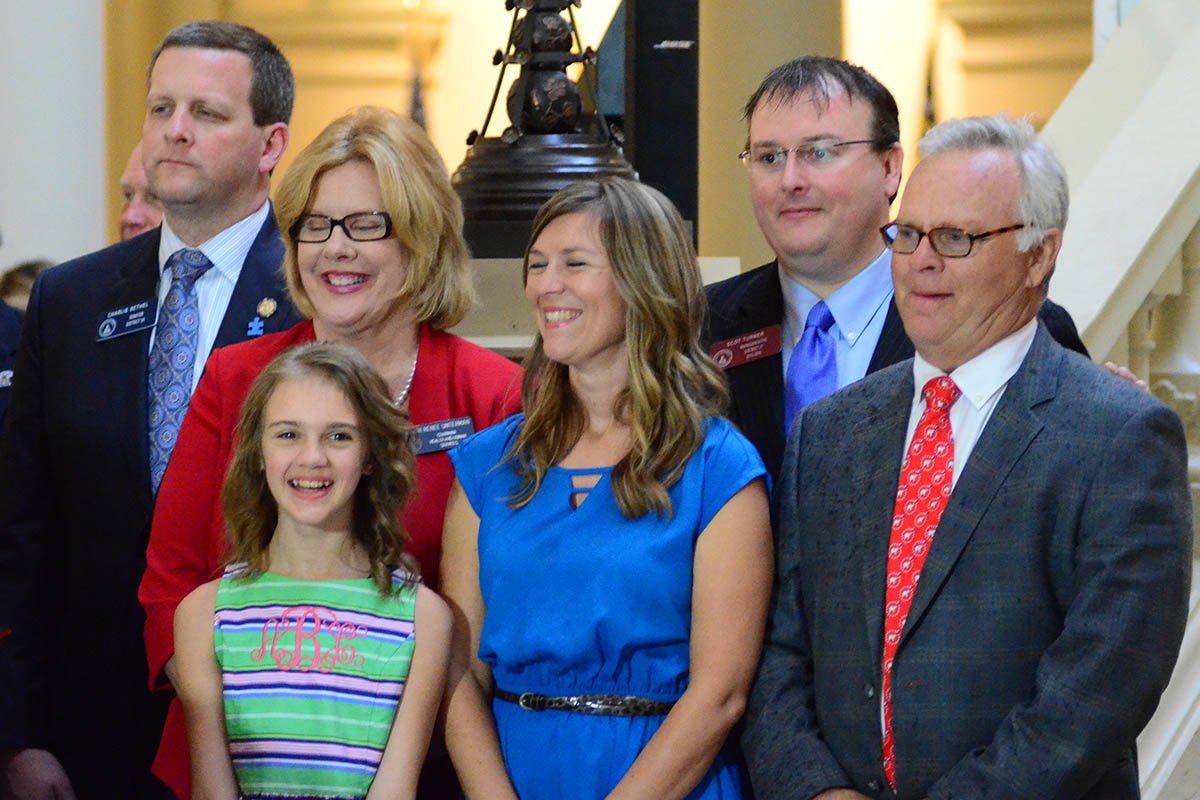
L to R: Sen. Charlie Bethel, Sen. Renee Unterman, Ava Bullard, Anna Bullard, State Rep. Scot Turner, Sen. Tommie Williams
Yesterday at the Georgia State Capitol, Governor Nathan Deal signed HB 429, “Ava’s Law,” with the bill’s namesake, Ava Bullard at his side.
“In Georgia, 1 out of every 64 children is diagnosed with an Autism Spectrum Disorder,” Deal said. “For boys, the risk is more prevalent, with 1 in 39 diagnosed with some form of autism. For these vulnerable young minds, daily interactions that most of us take for granted are a challenge. Treating children at early stages of development, however, makes it more likely he or she will achieve meaningful progress. ”
“That’s why I instructed the Department of Community Health to include autism treatment coverage in state health plans last year. This legislation, named for Ava Bullard, builds upon that model. I commend Lt. Gov. Cagle and the General Assembly for their efforts on behalf of our youngest, most vulnerable patients. Moving forward, this law will increase access to treatment for children struggling with autism while lessening the financial burdens it imposes on families.”
HB 429 also provides protection for patients diagnosed with terminal illnesses by prohibiting insurance carriers from dropping coverage or declining treatment.

His bill signing total is up to 31 bills. He also appeared at a lunch at the Atlanta Press Club.
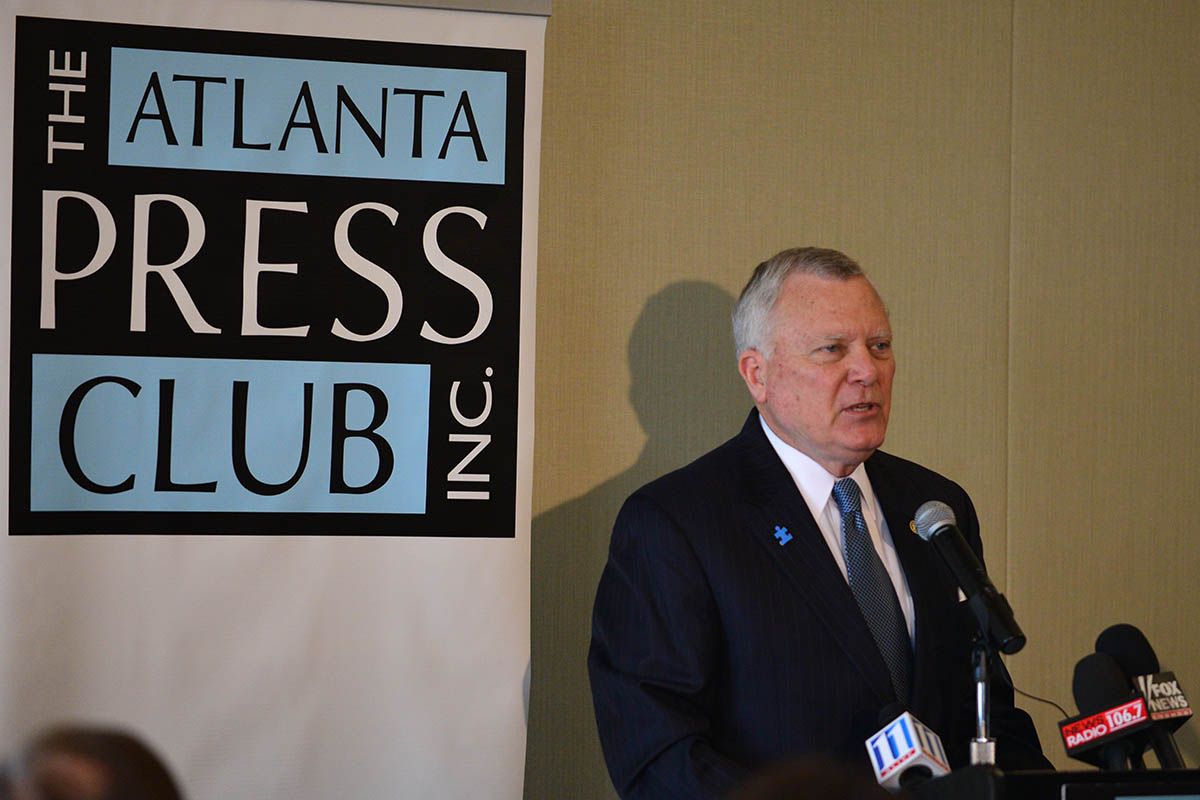
After Walter Jones of Morris News, who currently serves as President of the Atlanta Press Club, introduced Deal, the Governor said, “That was the most factually correct statement made by a journalist about me in modern times.”
Walter himself writes about the rest of the appearance at the Press Club.
Gov. Nathan Deal expressed disappointment Wednesday with a former chairman of the Board of Regents who criticized him for meddling in the selection of the current University System of Georgia chancellor and University of Georgia president.
“If Mr. NeSmith is disappointed in the selection of [Chancellor] Hank Huckaby or [UGa President] Jere Morehead, he should be man enough to say that that’s his problem,” Deal said.
Deal said in case of both Huckaby and Morehead, the regents invited him to interview the two finalists for the job and to state his preference.
“Dink NeSmith was the chairman of the Board of Regents. If he didn’t want my opinion, he shouldn’t have asked for it,” Deal said.
[Deal] also got into a debate with William Perry, a member of the audience who is the executive director of Common Cause Georgia, a group frequently critical of Deal’s ethics.
Perry challenged Deal with underfunding the agency that enforces campaign-finance laws and with not restructuring the agency’s board as he had promised during his 2014 re-election campaign. The governor said he recommended doubling the budget but that the legislature pared down his proposal and that he is delaying any reforms at the request of board members who said operations will improve sufficiently with the funding increase.
Perry also said a jury had concluded last year that interference by Deal’s staff led to the wrongful dismissal of the agency’s director and three other employees.
“They did not. That’s absolutely false. You know that’s false,” Deal shot back, adding that neither he nor his staff was even called to testify in the lawsuits filed by those fired employees who eventually won nearly $3 million from the state in settlements.
“In fairness to the organization you represent, you ought not to continue to spread false information,” he told Perry. “I’m disappointed in you.”
At the Press Club event, Deal also signed HB 62, which makes it easier for military families to take advantage of special needs scholarships for children by waiving the one-year residency requirement. The Gainesville Times writes about the genesis of the bill.
The idea began as a project by four Brenau students in the Master of Occupational Therapy program. Their professor, Dr. David Miller, encouraged them to come up with a plan to alter an existing state policy and propose it. They did so to state Sen. Steve Gooch, R-Dahlonega, and Rep. Kevin Tanner, R-Dawsonville, who then turned it into legislation that passed both houses.
“We came over (to Brenau) and when we heard their ideas, we said, ‘You really have got something here,’” Tanner said. “It’s great that they know their fellow students will benefit from this bill.”
Each of the students graduated last May. Three attended Wednesday’s event: Allison Guisasola of Braselton; Rachel Strazynski Sushner, formerly of Atlanta and now of Baltimore; and Shelby Wrenn of Clarkesville. The fourth, Ashley McCoy of Maysville, is on her honeymoon and was unable to attend.
“We’re so excited. We had no idea this could happen,” Sushner said beforehand.
“They got the ball rolling,” said Philip Wilheit Sr., Gainesville businessman and Board of Regents member, in his opening remarks.
Each smiled broadly and stood behind as Deal signed the bill. The governor then handed each a pen as a souvenir.
“This bill fits with the theme (of other legislation) of helping children,” Deal said.
Afterward, state Sen. Butch Miller, who sponsored the bill in the Senate, told the three he was proud of their efforts.
“You’re here in a room full of professionals in government, but you were able to get something done,” he said.
How Larry O’Neal Scored Judicial Appointment
The Fulton Daily Report has an excellent report about how outgoing State House Majority Leader Larry O’Neal scored an appointment as Georgia Tax Tribunal Judge.
The application for the job submitted by Rep. Larry O’Neal, R-Bonaire, arrived in Deal’s office on April 13. That was three days before Deal announced O’Neal was his choice—and two months after Deal’s Judicial Nominating Commission presented him with a short list of three other candidates.
While the governor is not bound to the recommendations of his JNC, Deal and previous governors almost always have chosen someone from the JNC’s short list.
There have been exceptions. Gov. Roy Barnes, a Democrat, made headlines in 2000 when he bypassed his JNC altogether and appointed his executive counsel, Penny Brown Reynolds, to the Fulton County State Court. Republican Gov. Sonny Perdue also made news in 2005 when he appointed Ralph “Rusty” Simpson to the Tift County Superior Court in the midst of the JNC’s vetting process. Perdue’s JNC was not considering Simpson when Perdue named him to the bench.
JNC co-chairman Randy Evans told the Daily Report that week that O’Neal was vetted by the JNC, but he couldn’t recall when O’Neal applied or interviewed. Evans also said O’Neal’s candidacy was purposefully shielded from the public to avoid distraction during the legislative session.
Records obtained through the state open records laws showed that O’Neal’s name was not on the JNC’s February interview list. The records also show that the JNC sent an email to Deal’s secretary and executive counsel on April 13 alerting them of O’Neal’s application—two days before O’Neal announced his planned departure from the Legislature.
“Although the entire JNC has not reviewed the application, Randy Evans and [co-chairman] Pete Robinson have reviewed the application and met with Mr. O’Neal and believe that he is eminently qualified for the position,” the email stated.
Fear and Loathing in the Electorate
Emory University Political Scientist Alan Abramowitz has written with Steven Webster an article suggesting that what they call “negative partisanship” is reshaping the attitudes of the American electorate.
The paper is filled with interesting findings, but the major one is an attempt to resolve a paradox. Measured by self-identification, partisanship is actually declining — growing numbers of Americans describe themselves as “independent” rather than loyal to one of the parties. But measured by actual voting behavior, the opposite is happening: Straight ticket voting continues to grow. This matches what operatives like Dan Pfeiffer have seen, and what Karl Rove saw a decade before — the swing voter had nearly vanished.
One common explanation is that it has become increasingly vogue, especially among college-educated voters, to describe yourself as independent, which implies that you form educated judgments about politics rather than blindly following the dictates of a party. Abramowitz and Webster add to this by introducing a phenomenon they call negative partisanship. That is to say, voters form strong loyalties based more on loathing for the opposing party than on the old kind of tribal loyalty (“My daddy was a Democrat, his daddy was a Democrat …”) that used to prevail. The party system has split along racial, cultural, and religious lines, creating a kind of tribal system where each party’s supports regard the other side with incomprehension and loathing.
Measuring how this new, negative partisanship has changed presidential politics is hard because only a handful of presidential elections have taken place in the polarized era. It’s easier to measure the impact at the Congressional level, though, since the data set is much larger. And the impact is absolutely transformative. As split ticket voting has disappeared, House races have become almost perfect reflections of their districts’ presidential votes. As Abramowitz and Webster write, “the correlation between the Democratic share of the House vote and the Democratic share of the presidential vote in districts with contested races averaged .54 between 1972 and 1980, .65 between 1982 and 1990, .78 between 1992 and 2000, .83 between 2002 and 2010 and .94 in 2012-2014.”
The effect on the Senate has been even deeper. “The average correlation between the Democratic share of the presidential vote and the Democratic share of the Senate vote in states with contested races has risen from .16 between 1972 and 1980 to .25 between 1982 and 1990 to .42 between 1992 and 2000 to .66 between 2002 and 2010 and to .84 in 2012-2014,” they write. “This means that, in terms of shared variance, the relationship is now more than four times stronger than it was during the 1990s and more than 27 times stronger than it was during the 1970s.”
In this trench-warfare atmosphere, the fact that the bloc of voters loyal to the Democrats is growing steadily would seem to loom large. It is surely true that eventually, the alignment of the two parties will change, either because the Republicans move to the center or the Democrats move away from it. It is also probably true that the Democratic advantage is narrow enough that a major short-term event, like a recession or a huge scandal, could disrupt it. But the understandable reliance on the models of the past, and the assumption that nothing ever changes, may be missing the fact that something very important has.
The Washington Post sums up the findings thusly,
Racial, cultural and economic attitudes have contributed to the political separation of the population. Republicans are more conservative than they were in the past while Democrats are more liberal. The result, Abramowitz and Webster write, is that there has been “a very large increase in the ideological distance between supporters of the two parties” — more than a doubling in the past four decades.
The larger this gap has become, the more that partisans on each side see important differences between the major parties. And seemingly, the more they see those differences, the less they are likely to vote for a candidate from the other party — despite a rise in the percentage of people who call themselves independent or who register with no party affiliation.
Presidentially, Democrats enjoy an advantage in the electoral college arithmetic. Their electoral foundation, based on the past half-dozen elections, is bigger than that of the Republicans — although certainly not insurmountable.
Democratic-leaning states are more likely to elect Democratic Senate candidates than they once were, and Republican-leaning states are more likely to elect Republican Senate candidates. Last November, according to the authors, the “advantaged party” won 33 of 36 Senate races.
Election Qualifying
By noon today, the election for State House District 55, vacated by former State Rep. Tyrone Brooks, will be set as qualifying closes then.
In Hall County, qualifying closed for two open seats on the Flowery Branch City Council election to be held June 16, 2015.
Elizabeth M. Beatty, Nicole Kriews, Ed Edwards and Alan Davenport all submitted papers on Wednesday to qualify for the Post 5 position, recently vacated by Tara Richards.
The election to fill Post 1, held by Damon Gibbs, and Post 5 will be June 16. Both Gibbs and Richards resigned for job opportunities that require them to relocate from the South Hall city.
Sterling on the Lake residents Chris Mundy and Michael G. Justice both filed papers to qualify for the Post 1 seat Monday.
The Post 5 position runs through December 2017, while the Post 1 term is over Dec. 31.
Related Posts
 Adoptable (Official) Georgia Dogs for April 16, 2018
 State insurance chief still hoping to halt ‘Obamacare’ | www.myajc.com
 Adoptable (Official) Georgia Dogs for June 23, 2017
 Georgia Supremes uphold business tax on lawyers – Atlanta Business Chronicle
 Gwinnett Daily Post | Nash takes role in statewide association


Comments ( 0 )