
John Percival, an Irish Member of Parliament who served as a Georgia Trustee, was born on July 12, 1733.
In the British House of Commons, Percival served on the committee on jails with a young member named James Oglethorpe, who shared his idea about a new colony in North America for the deserving poor. Percival, like Oglethorpe became a Georgia Trustee, and during Georgia’s first decade, with Oglethorpe in America, Percival worked harder than anyone to champion Georgia’s cause and secure its future.
On July 11, 1782, British colonists including British Royal Governor Sir James Wright, fled Georgia.
Wright had been the only colonial governor and Georgia the only colony to successfully implement the Stamp Act in 1765. As revolutionary fervor grew elsewhere in the colonies, Georgia remained the most loyal colony, declining to send delegates to the Continental Congress in 1774.
On July 13, 1787, Congress enacted the Northwest Ordinance, in which states ceded some claims to the west, and a process was set up for admitting new states.
Congress ordered the creation of the United States Marine Corps on July 11, 1798, after the Corps was inactive for a period following the Revolutionary War. From 1799 to 1921, Marine Corps Day was observed on July 11, but is now celebrated on November 10, the date of it’s Revolutionary War establishment.
On July 11, 1804, Aaron Burr shot Alexander Hamilton in a duel in Weehawken, New Jersey. Burr was the sitting Vice President of the United States and Hamilton a former Secretary of the Treasury.
After he shot Hamilton, Aaron Burr quickly fled the nation’s capitol, making his way to St. Simons Island, Georgia, spending a month as a guest of Pierce Butler at Hampton Plantation.
Burr was a fugitive, but his killing Hamilton in a duel held a certain justifiable reasoning since dueling was not illegal, though morally questionable, to be sure. According to H. S. Parmet and M. B. Hecht in their Aaron Burr: Portrait of an Ambitious Man, after the duel, he immediately completed, by mid-August, plans which he had already initiated, to go to St. Simons, “an island off the coast of Georgia, one mile below the town of Darien.”
Jonathan Daniels’ “Ordeal of Ambition” handles the situation this way: “With Samuel Swartwout and a slave named Peter (‘the most intelligent and best disposed black I have ever known’), Burr secretly embarked for Georgia. There on St. Simons Island at the Hampton Plantation of his friend, rich former Senator Pierce Butler, he found refuge…” As Georgia Historian Bernice McCullar, author of “Georgia” puts it, Burr was “fleeing the ghost of Alexander Hamilton” when he arrived on the Georgia island.
“Major Pierce Butler,” she relates, “had fought in the British army and remained in America after the war.” He had married a South Carolina heiress, Miss Polly Middleton, and acquired two Georgia Coastal plantations, which he ran like a general storming after the troops. In fact, he was so strict that none of his slaves could associate with any of the others. He also required anyone who visited his plantations to give his or her name at the gate. With this tight security, Burr should have felt safe..
Actually, Butler’s invitation to visit the island fitted the escapee’s plans nicely. Not only was the Hamilton affair a bother, but also Burr needed to get away from a lady by the name of Celeste; however, the real reason, aside from being near his daughter, who was also in the South, was the nearness of the Floridas. No real purpose is given why the Vice-President wanted to spend “five or six weeks on this hazardous and arduous undertaking.”
Daniels underscores that from this St. Simons point Burr could “make any forays into Florida he wished to make. He traveled under the name ‘Roswell King.” After his Florida odyssey, he planned to meet his South Carolina son-in-law “at any healthy point.”
Parts of the Hampton Plantation survive in the form of tabby ruins on St Simons.


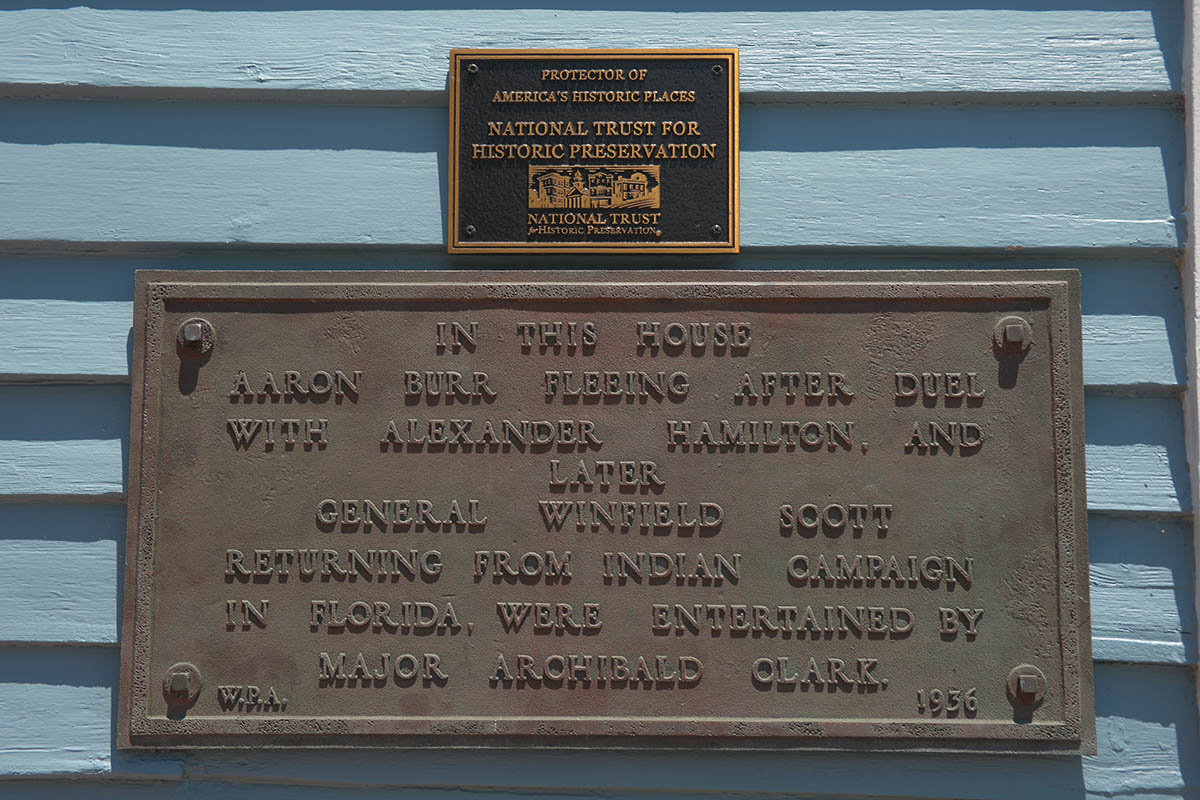
A house in St. Marys, Georgia bears a plaque stating that Aaron Burr visited there in 1804.
Clark lived in the home from 1804 until his death in 1848. He was appointed in 1807 by then-President Thomas Jefferson as customs collector for the Port of St. Marys, a position he held until his death. The year Clark bought the house, he is said to have provided a temporary hideout to Aaron Burr, who was traveling in the South to evade federal authorities holding a warrant for his arrest after he killed Alexander Hamilton in their infamous duel in July 1804.
Verification of Burr’s stay in St. Marys is hard to come by. But it is confirmed that he stayed on St. Simons Island and Cumberland Island late in the summer after he killed Hamilton. That Burr knew Clark is not disputed. The two attended law school together in Litchfield, Conn., but there is no mention in either man’s records that Burr stayed in the home.


Millard Fillmore was sworn in as the 13th President of the United States on July 10, 1850, following the death of President Zachary Taylor.
The United States Army Medal of Honor was created on July 12, 1862 when President Abraham Lincoln signed legislation authorizing the award.
The first U.S. Army soldiers to receive what would become the nation’s highest military honor were six members of a Union raiding party who in 1862 penetrated deep into Confederate territory to destroy bridges and railroad tracks between Chattanooga, Tennessee, and Atlanta, Georgia.
On July 10, 1864, Conferderate forces retreated south across the Chattahoochee and burned the bridge behind them. General Sherman wrote later of the day,
General Garrard Moved rapidly on Roswell, and destroyed the factories which had supplied the rebel armies with cloth for years.
Over General Garrard was then ordered to secure the shallow ford at Roswell and hold it until he could be relieved by infantry, and as I contemplated transferring the Army of the Tennessee from the extreme right to the left, I ordered General Thomas to send a division of his infantry that was nearest up to Roswell to hold the ford until General McPherson could send up a corps from the neighborhood of Nickajack.
General Newton’s division was sent and held the ford until the arrival of General Dodge’s corps, which was soon followed by General McPherson’s whole army.
On July 13, 1865, James Johnson as provisional Governor of Georgia, issued a proclamation freeing slaves and calling an election in October of that year to elect delegates to a state Consitutional Convention. Johnson had previously opposed Georgia’s secession and after the war was appointed Governor by President Andrew Johnson.
On July 11, 1877, a Constitutional Convention convened in the Kimball Opera House in Atlanta to replace the 1868 Reconstruction Constitution.
Savannah, Georgia-born John C. Fremont, who was the first Presidential nominee of the Republican Party in 1856, died in New York City on July 13, 1890.
The Scopes “Monkey Trial” began on July 10, 1925, in which a Tennessee public school teacher was tried for teaching evolution, against state law. Three-time Democratic candidate for President William Jennings Bryan volunteered to help the prosecution, and famed lawyer Clarence Darrow defended John Thomas Scopes.
On July 11, 1916, President Woodrow Wilson signed the Federal Aid Road Act, establishing a federal program of paying for highway development.
President Franklin D. Roosevelt accepted the Democratic nomination for a fourth term on July 11, 1944.
General Dwight D. Eisenhower was nominated for President by the Republican National Convention on July 11, 1952.
On July 13, 1960, John F. Kennedy was nominated as the Democratic candidate for President.
Lt. Frank Reasoner of Kellogg, Idaho died in action on July 12, 1965 and was later posthumously awarded the first Medal of Honor to a United States Marines for action in Vietnam.
July 11, 1969 was an epic day in rock and roll history, with David Bowie releasing “Space Oddity” and the Rolling Stones releasing “Honky Tonk Women.”
On July 12, 1984, Congresswoman Geradine Ferraro (R-NY) joined the Democratic ticket with Presidential nominee Walter Mondale. Ferraro was the first woman and first Italian-American woman nominated for Vice President. Mondale and Ferraro lost the General Election in the largest ever Republican landslide to Republican President Ronald Reagan and Vice President George Bush.
On July 10, 1985, “Classic“ Coke returned, joining the new formula on store shelves.
On July 11, 1985, Astros pitcher Nolan Ryan became the first major league player to strike out 4000 batters.
The Atlanta Committee for the Olympic Games broke ground for Atlanta Olympic Stadium on July 10, 1993; after the Olympics, the stadium was modified for baseball and became Turner Field.
On July 13, 2013, the hashtag #BlackLivesMatter first appeared on Facebook.
Georgia Politics, Campaigns, and Elections
Early voting is open in the Special Election for the Thirteenth Congressional District, but voters are few, according to the AJC.
Fewer than 1% of registered voters cast ballots during the first week of early voting for the special election to fulfill the unexpired term of the late U.S. Rep. David Scott.
That’s because the winner of the special election will be in office only until January. After that, whoever wins the general election in November will take over. Democratic state Rep. Jasmine Clark is the strong favorite to win the general election. She is not running in the special election.
File Under Irony: All 23 discrepancies found in the Secretary of State’s Audit of Primary Runoff results came from handmarked ballots, according to WSAV.
Audited machine marked ballots from Georgia’s primary elections were 100% accurate, Secretary of State Brad Raffensperger announced Friday.
More than a million ballot images were audited, with 23 discrepancies found, Raffensperger’s office reported. The overall accuracy rate was 99.9979%.
Hand-marked ballots had a 99.93% accuracy rate, according to the audit.
“Human beings make human errors,” said Raffensperger, “and the likelihood of a discrepancy between voter intent and what’s marked on a ballot is greatest when that ballot has been marked by hand.”
If the same error rate was applied during a presidential election year with 5 million ballots cast, there would be 3,500 discrepancies, Raffensperger said.
Of the 1,111,856 ballot images audited, 32,448 were hand-marked.
Raffensperger also ordered an investigation into “Ready to Register” and other third-party organizations that have sent voter registration solicitations to dead or ineligible people in Georgia, according to a Thursday press release.
The investigation comes after reports of voter registration mailers being sent to dead Peach State residents, and even one instance where a dead dog received a mailer, his office said.
“Whether intentional or simply reckless, these mail campaigns operate like a grift- raising money and generating activity while shifting the costs onto taxpayers, election officials, and voters,” Raffensperger said. “Georgia taxpayers should not have to clean up the mess created by organizations that prioritize volume over accuracy.”
Georgia voters can verify their registration status at the Secretary of State’s My Voter Page and should ignore unsolicited voter registration mail if they know they are already registered at their current address.
From the Capitol Beat News Service via the Savannah Morning News:
The battle over voter confidence in Georgia’s election machines flared up after the Legislature decided last month to keep them until 2028.
Weeks after lawmakers voted to postpone their prior ban on the machines’ use of QR codes to tally results, the U.S. Department of Justice planned to surge into Atlanta with 260 FBI analysts. They were coming to help investigate the 2020 election, after the agency’s January raid of the Fulton County election warehouse to seize more than half a million ballots.
And the Federal Emergency Management Agency threatened to withhold anti-terrorism funds from states that do not start moving toward hand-marked paper ballots.
But the Trump administration also suffered a serious setback in its efforts to expand the 2020 election probe of Fulton, the most populous county in Georgia and a Democratic bastion.
A federal judge in Atlanta denied the administration’s demand for the personal information of thousands of Fulton election workers and volunteers.
The statute of limitations on any crimes in 2020 had long since expired, U.S. District Judge William M. Ray II ruled on July 7, denying the Justice Department’s grand jury subpoena.
Disclosing addresses, phone numbers and other sensitive information “threatens to chill participation in future elections, which will surely impact Fulton County,” the judge’s order said.
Ray decided the administration’s subpoena was unreasonable, calling it an “arbitrary fishing expedition.”
Fulton Commissioner Dana Barrett said the ruling by a judge who was appointed by President Donald Trump should put the 2020 election to rest.
“The conspiracy theory that the election was stolen and there was wrongdoing, that needs to now recede to the corners of the internet where conspiracy theories live,” Barrett said. “Go into the corner where the Jewish space lasers are and Area 51 and the JFK assassination.”
Barrett, who ran unsuccessfully in the recent Democratic runoff for secretary of state, said the Justice Department, the State Election Board and the “election deniers of the world” were using fictions about 2020 to sow doubts about Fulton and its ability to run clean elections.
She said it was a pretext for intervention in the county elections operations in 2026 and 2028: “It’s about trying to continue the narrative that Fulton County doesn’t know how to run elections and therefore either take that ability completely away from the county and put it in the hands of the MAGA-controlled state election board or put monitors in.”
The election board establishes the rules by which elections operate. Four of its five members are Republicans, and several are critical of Georgia’s electronic voting machines and of Secretary of State Brad Raffensperger, who selected the system.
This week, the board adopted two rules, one banning the use of optical character recognition to tally votes even though the state’s election machines do not use that technology. The other rule would require that Raffensperger allow board members into his election center when county-level vote counts are aggregated on election night.
That rule passed even though Georgia Attorney General Chris Carr told the board it lacked legal authority to implement it, since Raffensperger was elected by voters.
The board also initiated a public comment process on a rule that would disqualify the current voting machines over privacy issues.
Salleigh Grubbs, the author, cited several concerns, including the “huge” displays on the machines.
Sara Tindall Ghazal, the lone Democrat, called it a ruse to force election officials to use the paper ballots they keep for power outages and other emergencies.
Board Chairman John Fervier, a Republican, expressed a similar suspicion.
“This isn’t just about ballot secrecy,” said Fervier, who was appointed by Gov. Brian Kemp. “It’s all part of a larger agenda to get to hand-marked paper ballots.”
Fervier said that if the current machines were disqualified over secrecy concerns, it would cause “massive” problems for election officials, who are already busy recruiting and training poll workers on the current system. Local election leaders have repeatedly said they lack the time to switch systems before the general elections in November.
The measure passed, setting it on course for adoption.
Democrats have been dubious about the ongoing assault on Georgia’s voting machines.
Two years ago, Republican lawmakers pushed through a ban on the use of QR codes to tally votes, which would have made Georgia’s current system illegal effective July 1.
But they failed to approve and pay for an alternative system, so Kemp called them back to the Capitol last month to address the looming deadline.
They postponed the ban until 2028.
Just before the special session, Democratic lawmakers from across the South gathered in Atlanta to strategize ahead of the special session. With them was Rep. Carolyn Hugley, D-Columbus, the minority leader of the state House.
“The QR code is a manufactured issue to begin with because a certain person could not accept the fact that he did not win Georgia,” Hugley said at that event, referring to Trump.
Raffensperger has consistently pushed back against his GOP critics, asserting that his machines are all but flawless.
This week, his office announced the results of a review of all 91 contests in last month’s runoffs. The audit of all 1,111,856 ballot images found 23 discrepancies with hand-marked ballots and none with the digital voting machines.
“We run elections with nearly perfect accuracy, and we will never stop reminding the public their machines are accurate, their counts are accurate, and that elections in Georgia are accurate,” Raffensperger said in a statement.
His office calculated that the hand-marked error rate would create about 3,500 discrepancies in a presidential election year with 5 million ballots cast.
The state Republican Party and many GOP lawmakers, dismiss such audits as window dressing, saying flaws in the system make errors difficult or impossible to detect.
The national fight over elections has taken a toll on voter confidence.
A PBS News/NPR/Marist poll in March found that two-thirds of Americans are confident in fair and accurate elections, down from 76% in late 2024.
Georgia GOP voters had a different take.
A survey in late April of likely Republican primary voters by the firm Cygnal had more than 78% expressing confidence that their votes would be counted fairly in 2026, with 28% “very” confident and more than 50% “somewhat” confident.
The poll was commissioned by the bipartisan Democracy Defense Project, which is trying to counter “false narratives about ‘stolen elections’” that it blames on a “proliferation of politicians” who are trying to bolster their own campaigns.
The project’s Georgia board members include former Democratic Gov. Roy Barnes and former Atlanta Mayor Shirley Franklin. On the Republican side are former U.S. Sen. Saxby Chambliss and former U.S. Rep. Drew Ferguson.
Ferguson and Franklin appeared at the DeKalb County elections center during the runoff last month to push back against doubters.
They pointed to record turnout in recent years.
“What we have found is 80% of voters on a bipartisan level feel very strongly that the elections are being run fairly and safely here in the state of Georgia,” Ferguson said.
But the Democracy Defense Project’s own polling indicates lingering suspicion.
That April survey by Cygnal found that nearly 76% of likely GOP primary voters approved of the FBI raid on the Fulton elections warehouse, more than 61% strongly approving.
The Secretary of State’s Office is investigating a voter registration group, according to WJBF.
Georgia election officials are investigating a third-party voter registration group after receiving hundreds of mailers sent to people who are no longer eligible to vote — including deceased individuals.
Secretary of State Brad Raffensperger says his office has received nearly 400 voter registration mailers linked to Ready to Register and other civic groups. Officials say some of the mailers were sent to deceased Georgians, including one reported case involving a deceased family dog.
Raffensperger says the mailers are creating additional work for election officials who are already conducting routine voter list maintenance ahead of the November election.
“Right now we’re doing list maintenance, so we are already focused on regular list maintenance because the window’s open because we don’t have an active election going,” Raffensperger said. “When I see this, it just really ties up resources.”
The Secretary of State says some of the mailings appeared to come from his office, prompting officials to contact voters and clarify that the solicitations were sent by outside organizations.
Raffensperger says similar issues have been reported in North Carolina, where election officials raised concerns about inaccurate voter registration mailers and outdated information.
“We just want to know who they are, what precipitated this and where they’re getting their information from,” Raffensperger said. “Because it’s totally inaccurate.”
State election officials say inaccurate mailings can confuse voters and place an unnecessary burden on county election offices.
Georgia voters are encouraged to verify their registration information through the Secretary of State’s My Voter Page before the November election and disregard registration solicitations if they are already registered at their current address.
The investigation comes as Georgia continues preparations for the upcoming election. State officials say they are also focused on preventing illegal voting, including double voting, voting from outside the state, and other election crimes. Penalties for voter fraud can include up to 10 years in prison and fines of up to $100,000.
Governor Brian Kemp announced his choices for two agency heads, according to a Press Release.
The Georgia Vocational Rehabilitation Services Board today confirmed Governor Brian Kemp’s nomination of Dr. Kirk Shook as Executive Director of the Georgia Vocational Rehabilitation Agency (GVRA). Dr. Shook succeeds Chris Wells who accepted an opportunity with the Georgia Hospital Association, building on the agency’s successes in expanding employment opportunities and independence for Georgians with disabilities.
“Marty and I extend our thanks to Director Chris Wells for his valued work advocating for the disabled community,” said Governor Brian Kemp. “His commitment to ensuring Georgians with unique challenges have resources for success reflects the mission of GVRA, and our state is better because of his leadership.”
“We are also excited to see Dr. Kirk Shook’s impact on this new role, following his years of service at the Nonpublic Postsecondary Education Commission,” continued the governor. “His expertise in education at all levels will bolster the agency’s work to equip disabled Georgians with the tools they need for quality careers, and Marty and I wish him continued success in this position.”
Governor Kemp has selected Magda “Maggie” Rivers to succeed Dr. Shook as Executive Director of the Nonpublic Postsecondary Education Commission (NPEC). Rivers currently serves as the agency’s Associate Executive Director with over 12 years of experience at the NPEC.
“Marty and I are grateful for Maggie’s committed service to our state and for her willingness to step into this role,” shared the governor. “Having been a part of the NPEC for more than a decade, she deeply understands the mission and goals of the agency, and we look forward to her continued leadership as Executive Director.”
Dr. Kirk Shook was appointed as Executive Director to the Nonpublic Postsecondary Education Commission (NPEC) by Governor Brian Kemp on February 1, 2019. He also currently serves on the Regional Steering Committee of the Southern Regional Education Board (SREB) and the Records Retention Policy committee at the National Council for State Authorization Reciprocity Agreements (NC-SARA).
Prior to his time at the NPEC, Dr. Shook was a high school teacher for twelve years. The State Board of Education appointed him to serve on various committees at the Georgia Department of Education in 2014 and 2015, and former Governor Nathan Deal appointed him to serve on the Governor’s Teacher Advisory Committee in 2016.
Dr. Kirk earned three degrees from the University of Georgia — a Bachelor of Science in Education, a Master of Public Administration in Policy Analysis, and a Doctor of Education in Educational Leadership. He also holds an Associate of Science in Education from Young Harris College, a certificate in Educational Leadership from the University of Georgia, an Executive Education Certificate in Public Leadership from the John F. Kennedy School of Government at Harvard University, and a Certified Public Manager® credential through the University of Georgia’s Carl Vinson Leadership Institute.
Dr. Kirk and his wife, Miriam, have two daughters, whom they adopted from foster care in 2025. They live in Bogart and are members of Oconee Fellowship in Watkinsville.
Magda “Maggie” Rivers currently serves as the Associate Executive Director at the Nonpublic Postsecondary Education Commission (NPEC) and brings a deep and well-rounded understanding of the agency’s work, shaped by a career spent advancing its mission. During her 12 years with the organization, she has contributed across its full scope of programs and operations, supporting implementation, strengthening oversight, building partnerships, and helping guide strategic initiatives.
Rivers’ work extends beyond the state through her service as a board member of the National Association of State Administrators and Supervisors of Private Schools. In this capacity, she collaborates with peers across the country to address regulatory challenges, share effective practices, and contribute to the broader landscape of postsecondary oversight.
Rivers holds a Master of Arts in Teaching and a Bachelor of Science in Business Administration. She and her husband are the proud parents of three children.
United States Senator Lindsey Graham (R-SC) has died, according to Atlanta News First via WTVM.
Republicans and Democrats alike took to social media to share their reflective thoughts and warm regards for Graham, who was 71.
Gov. Brian Kemp said Graham was “a true force to be reckoned with in Washington.”
Rep. Mike Collins, who is facing Democratic Sen. Jon Ossoff in this fall’s U.S. Senate election in Georgia, sent condolences to Graham’s family during this time of “immeasurable grief.”
U.S. Sen. Raphael Warnock, a Democrat, called Graham “a man of great faith.”
Former Speaker of the House Newt Gingrich said that Graham made “major contributions to American national security.”
Rep. Rich McCormick of Georgia’s 7th District said that Graham used his life to serve America.
In a statement, Democratic Sen. Jon Ossoff called Graham “an energetic leader.”
“I join in mourning Senator Lindsey Graham and extend my deepest condolences to the Senator’s family, friends, and staff,” he said. “Senator Graham dedicated his life to the United States, from his service in the U.S. Air Force to his representation of the State of South Carolina in the U.S. House and Senate. Lindsey was an energetic leader who loved South Carolina. May Lindsey’s memory be a blessing.”
Rep. Barry Loudermilk, who serves Georgia’s 11th District, called Graham “a committed public servant.”
Rep. Brian Jack who represents Georgia’s 3rd District, said that Graham had showed resilience and a “sense of duty” after the South Carolina statesman’s parents passed away when he was a teenager.
As a U.S. Senator, Graham had thorough ties to Georgia politics.
It was Graham who called Georgia Secretary of State Brad Raffensperger after the 2020 election to question vote-counting procedures and raise the possibility of throwing out absentee mail-in ballots.
In 2022, Graham testified before a Fulton County special grand jury about efforts to overturn the 2020 election in Georgia.
State tax revenues shrank in June while the state gas tax was suspended, according to the Statesboro Herald.
Net tax revenues for the month fell 6.8% compared with June 2025, according to the Georgia Department of Revenue.
The bulk of it was driven by a nearly $197 million decline in motor fuel excise tax collections, which Gov. Brian Kemp’s office attributed to his executive order extending the suspension of that tax from May 20 through June 3.
The General Assembly had previously suspended it starting March 20, as the war in Iran drove up prices at the pump.
As the expiration date approached ahead of Memorial Day, Kemp called a state of emergency to extend it. He then called lawmakers back to the Capitol for a special session, in part to retroactively approve his decision.
Last month, the state revenue department reported that motor fuel tax collections for May fell nearly $200 million compared with May 2025.
From the Capitol Beat News Service via the Tifton Gazette:
Georgia tax revenues fell in June, driven by a gas tax suspension and helped along by increased income tax refunds.
Net tax revenues for the month fell 6.8% compared with June 2025, according to the Georgia Department of Revenue.
The bulk of it was driven by a nearly $197 million decline in motor fuel excise tax collections, which Gov. Brian Kemp’s office attributed to his executive order extending the suspension of that tax from May 20 through June 3.
The General Assembly had previously suspended it starting March 20, as the war in Iran drove up prices at the pump.
As the expiration date approached ahead of Memorial Day, Kemp called a state of emergency to extend it. He then called lawmakers back to the Capitol for a special session, in part to retroactively approve his decision.
Last month, the state revenue department reported that motor fuel tax collections for May fell nearly $200 million compared with May 2025.
Even without the fuel tax suspension, state revenues lagged in June. Net tax revenues fell just over $215 million from June 2025. Excluding motor fuel tax changes, net tax revenues were down 0.6% for the month.
Another big driver was an increase in individual income tax refunds, up nearly $67 million, or about 71%. That contributed to a nearly $100 million decline in individual income tax collections compared to June last year.
Most eligible taxpayers also benefited from House Bill 1000 this year, which passed the General Assembly unanimously, with an estimated price tag of nearly $1.2 billion. Taxpayers who filed timely state returns for 2024 and 2025 were set to receive one-time rebates of $250 for individuals, $375 for heads of household and $500 for married couples filing jointly.
Republican nominee for Governor Rick Jackson accepted a town hall style debate on Atlanta News First, according to WTVM.
Rick Jackson, the Republican who is seeking to become Georgia’s 84th governor, agreed to a town hall-style debate on Atlanta News First. Jackson is opposed by former Atlanta Mayor Keisha Lance Bottoms, the Democratic nominee for governor.
“We are looking forward to an event that focuses squarely on the future of Georgia and are ready to move forward with a town hall debate format on October 7,” the Jackson campaign said.
U.S. Sen. Jon Ossoff has already accepted an invitation to debate, as Democrats attempt to hold onto the only Senate seat up for reelection this fall in a state won by Donald Trump two years ago. He is facing a Republican challenge from U.S. Rep. Mike Collins.
“We understand [Jackson] may not want to explain why he opposes Medicaid expansion, supports raising the gas tax, or has promised to be Donald Trump’s ‘favorite governor’ instead of fighting for Georgia families. But avoiding voters is not a campaign strategy,” a campaign spokesperson for Bottoms said. “We have already confirmed one televised debate and are working with Atlanta News First and other television stations to finalize the remaining debates.”
Late last month, Bottoms challenged Jackson to three debates ahead of the state’s nationally watched midterm elections on Nov. 3.
“Georgians deserve to hear directly from their candidates for governor,” Bottoms said in a statement. “I look forward to continuing to share my vision for Georgia on the debate stage, and I call on Rick Jackson to join me.”
Several days later, Jackson appeared on the Shelley Wynter show, broadcast on 95.5 WSB, and said, “Of course I’ll debate her. I look forward to it. There’s a clear choice and a difference.”
Georgia Libertarians will end their petition drive aimed at ballot access, according to WABE.
Libertarians will not appear on this year’s ballot in Georgia after a petition drive came up well short of the needed signatures.
Libertarians lost automatic ballot access because they did not get enough votes during the 2024 elections, which necessitated the drive.
Despite collecting only a few hundred petition signatures of the more than 70,000 needed, acting Libertarian Party of Georgia Chair Brian Allen was one of two party leaders who made their way to the Georgia Secretary of State’s office Friday to turn in what they had.
“We promised the people who signed that we would, and we tried to keep our promises,” he said.
Libertarians can file to run as write-in candidates in November. The deadlines to file are in September.
As for what is next for Georgia Libertarians, Allen shared his thoughts Friday before filing the petition.
“I’m suggesting that we switch to focusing on ballot access reform at the legislative level to lower the requirements. Georgia is one of the worst states in the country for ballot access, so that’d be number one,” he said. “In the meantime, we will be focusing on local races — next year is a big nonpartisan year. Nonpartisan races have no petition requirements, so that’s easy enough. And then, in 2028, we can look at state House races, and also in Georgia, because of recent changes in the law, we will be able to field a presidential candidate.”
Allen says they plan on working with other parties on ballot access efforts.
With no Libertarians on the November ballot, that likely means Georgia voters will only be choosing between Democrats and Republicans. It also means there will likely be no runoffs in December.
In 2020, then-Republican U.S. Sen. David Perdue got the most votes in November, but not more than 50%. Democrat Jon Ossoff would go on to win the runoff.
Allen says that the Libertarian Party of Georgia will not endorse candidates this year other than their own.
“Obviously, we can highlight when candidates say something that is good or when they say something that is bad, according to our principles, so we can do that, but again, to be clear, we will not be endorsing any candidate,” he said.
So where could Libertarian voters go?
Former Democratic State Labor Commissioner Michael Thurmond, who has run against a Libertarian for statewide office, shared his thoughts.
“I think it’s unfortunate that we won’t have a Libertarian on the ballot this fall, but just from a practical perspective it increases the importance of the independent voters because many of the Libertarians fell between the Republicans and Democrats, so they may have an even greater influence on the general election and not necessarily the runoff,” he said.
“Those votes now become more important because you’re gonna have a very tight race, what, two to four percentage points — those two to four percentage points will have a significant share of Libertarian voters within that, so they’ll become even more important as we move towards November,” he added.
Former Republican U.S. Rep. Drew Ferguson believes there are more Libertarians on both sides of the aisle than people realize.
“I think that those are the ones that are really gonna be most concerned about the individual freedom and liberty and what that looks like,” he said. “Republicans may have a view of that, Democrats may have a view of that, but I think that they exist on both sides of the aisle, and Libertarian votes may actually be that new independent vote.”
Allen says Republican and Democratic campaigns for Georgia governor and U.S. Senate have not reached out to them.
“I’m always open for a discussion with anybody,” he said. “If they want to discuss our issues to reach our voters, that’s certainly a conversation that we can have.”
The Libertarian Party of Georgia said it can’t submit the roughly 72,000 signatures required by the Tuesday deadline to qualify statewide candidates for the ballot.
It means Georgia voters won’t have a Libertarian option in statewide races in November, removing third-party candidates that have repeatedly forced high-profile contests into overtime elections.
“It is clear that the current law exists simply to advantage Democrats and Republicans, who have never had to petition to get onto the ballot as they were grandfathered in when the law was first written,” said Brian Allen, the party’s acting chair.
State law says third-party candidates must win at least 1% of the vote in a statewide election to automatically qualify for the next election. If they don’t, they have to collect signatures of 1% of active voters. That’s about 70,000 signatures in Georgia.
Libertarian presidential nominee Chase Oliver, also a former Georgia candidate for higher office, received only 0.4% of the Georgia vote in 2024.
It marks the likely end of one of the most unpredictable forces in Georgia politics this election cycle, though Libertarian contenders can still try to run as write-in candidates.
Allen said the last time a third party successfully gathered enough signatures for statewide ballot access was in 2000.
“There is no valid reason why the state should require over 70,000 signatures for a candidate to be on the ballot when research has shown that it only takes a 5,000 signature requirement to prevent ballot crowding,” he said.
State Rep. Chas Cannon (R-Moultrie) won a 2026 Association of County Commissioners of Georgia Legislative Service Award, according to the Moultrie Observer.
Colquitt County Administrator and state Rep. Chas Cannon was awarded the 2026 Association of County Commissioners (ACCG) of Georgia Legislative Service Award at the July 7 county commission meeting.
ACCG Government Affairs Associate Nathan Corbitt made the presentation. He said he was there to honor Cannon because he had been great to work with all session, so he was at the top of his list for the award. He also said anytime he had a question during the session, Cannon was always helpful.
“Also, he had a really good bill this year. It was an audits bill. It said if an audit can’t be filed, due to some external factor, not just any old reason but a list of factors, we’re gonna give you a little bit of an extension and you’re not going to lose your Qualified Local Government status,” Corbitt said.
Qualified Local Government is a designation that makes local governments eligible for state grants, low-interest loans and other economic programs. Certain requirements have to be met for a government to retain the status.
Corbitt further explained, local governments would still have to get the audit done but, in the meantime, citizens wouldn’t be penalized by loss of the status, if circumstances caused the audit to not be filed on time.
“It was a great bill and he moved it very, very well through the House and the Senate,” he said.
Then Corbitt invited County Commissioner Marc DeMott, who is also the Association of County Commissioners of Georgia president, to help him present the award to Cannon.
“It takes a special kind of dedication to serve your community, but it takes an extraordinary level of dedication and commitment to serve it at both the local and state levels,” the Colquitt County Board of Commissioners stated on their Facebook page. “We are extremely proud of Mr. Cannon and are so fortunate that he brings a local voice to the State Capitol and advocates for us, the citizens of Colquitt County, on a daily basis.”
Bulloch County will receive $20 million in state funding from the Georgia Environmental Facilities Authority (GEFA) for infrastructure projects, according to the Statesboro Herald.
Officials revealed last week that Bulloch County will receive $20 million from the Georgia Environmental Facilities Authority, or GEFA, and direct it toward two separate projects, water and sewer system improvements at the airport and “expansion of sewer infrastructure on the south end of the county.”
That wording is from a letter to the county’s state legislative delegation – Sen. Billy Hickman, Rep. Jon Burns, who happens to be the state House speaker, Rep. Lehman Franklin and Rep. Butch Parrish – in appreciation for support of the funding. The Bulloch County Board of Commissioners, during the July 7 meeting, endorsed the letter with a 4-1 vote, and Chairman David Bennett signed it.
“We are grateful for the $20 million investment in water and wastewater projects through the State of Georgia’s GEFA program,” the letter began.
The letter’s second paragraph invoked cooperation with a neighboring county in regard to the sewer project in southern Bulloch. This passage also noted the existence of a previous grant, from the federal Environmental Protection Agency, for one aspect of that project.
“This work is closely tied to the new Bryan County Regional Wastewater Plant located adjacent to the Daniel Defense facility,” the Bulloch commissioners’ letter stated. “An agreement exists between Bryan County and Bulloch County for the purchase of 250,000 gallons of capacity. An EPA grant of nearly $4 million, secured last year, has been approved for that purpose.”
McIntosh County Commissioners voted to revisit zoning on Sapelo Island’s Hog Hammock area, according to WTOC.
McIntosh County commissioners voted Friday to send a revised zoning ordinance for the Hog Hammock community on Sapelo Island to the county’s planning and zoning board for a public hearing.
The special-called meeting came just days after the McIntosh County Planning and Zoning Commission tabled a previous proposal that would have capped homes at 1,800 square feet under roof — a measure critics said contained loopholes that could allow homes far larger than intended.
Hog Hammock is one of the last intact communities of Gullah Geechee descendants — the descendants of enslaved West Africans — on the Georgia coast. Residents have fought since 2023 to prevent large homes and outside developers from driving up property values and displacing the indigenous population.
The dispute began in September 2023, when the commission approved zoning that allowed homes up to 3,000 square feet.
Residents pushed back, launching a petition drive that forced a referendum. In January 2026, 85% of voters chose to overturn that zoning, but the repeal left no zoning in its place, creating a void that the county struggled to fill ever since.
To prevent unregulated construction while a new ordinance was developed, the county enacted a zoning moratorium — a temporary freeze on new building permits in Hog Hammock. That moratorium is set to expire Aug. 10.
Without a new ordinance in place before that deadline, Hog Hammock would have no zoning protections at all, potentially opening the door to unrestricted development.
McIntosh County has spent more than $500,000 in legal fees related to the zoning dispute.
The revised ordinance caps homes at 1,550 square feet under roof, down from the 1,800 square foot proposal that was tabled Tuesday.
Commissioners also voted to remove a residential mixed-use designation from the table of permitted uses and change a provision for gymnasiums and spas from a permitted use to a special use permit.
Building and Zoning Administrator Bryan Boone presented two draft options to the commission Friday.
Both were designed to close loopholes in the previous proposal, including restrictions on habitable space above ceiling joists and strict limits on porch enclosures to prevent them from being converted into additional living space.
During the meeting, the county attorney asked Boone whether the 1,550 square foot under-roof measurement would achieve the commission’s goal of limiting conditioned living space.
“So 1,550 gets you close, am I right?” the attorney asked.
“Yes, sir,” Boone responded. “With that being said, our ability to track the files and plan with you during the permitting process has greatly improved since this became a problem. Staff believes both versions of these represent a viable option.”
Commissioner Roger Lotson also pressed Boone on whether homes built under the new limits would fit within the character of the historic community.
“Will this house fit within what’s there?” Lotson asked.
“I believe so,” Boone said. “I believe it matches the guidelines.”
The zoning board will hold a public hearing on the revised ordinance Aug. 4, giving the public an opportunity to weigh in. The commission must then take a final vote before the moratorium expires Aug. 10.
Josiah Watts, a Gullah Geechee descendant and Sapelo Island resident who attended Friday’s meeting, said the nearly three-year fight has been exhausting, but the community is not giving up.
“We are still here,” Watts said. “And if we are still here, that means there is still opportunity to do the right thing. There’s still opportunity for working together.”
The City of Doerun wants to expand their footprint and asked the Colquitt County Commission for their support, according to the Moultrie Observer.
The City of Doerun has asked to the Colquitt County Commission to support the extension of its city limits on Hwy. 133 North and Hwy. 133 South and on Hwy. 270 East and Hwy. 270 West.
Doerun City Manager Frank Pierce told the commissioners at a meeting on July 7, “I’m sure a lot of you know, we’ve got a lot of construction going on through Doerun.”
He presented a map to them of what he said was coming to Doerun over the next 2-1/2 years. The Georgia Department of Transportation had started the project in October of last year.
“This is what it will look like when we’re done,” he said. “The City of Doerun’s gonna have two roundabouts, one on each end of town, which will connect two one-way pairs going through Doerun.”
Pierce further explained that, when someone came into Doerun from Moultrie, they would go around the roundabout and split off into two one-way pairs going through the city and, then, back into another roundabout headed toward Albany.
“That south roundabout is actually inside the city limits. The northern roundabout is outside the city limits,” he said.
He said, what he and the Doerun City Council were proposing was for the right of way only. The city limits would be extended on Hwy. 133 North to the Worth County Line, Hwy. 133 South to Dona Turner Road, Hwy. 270 West to Mt. Sinai Road and Hwy. 270 East to McCarty Road.
“We’re not proposing any annexation of any homes, businesses or other private property along those corridors,” he added.
Pierce said the City of Doerun already provides water and natural gas outside the city limits to those areas.
Pierce told the commission that the roadway adjustment couldn’t be done through standard annexation methods but would require a local act of the Georgia General Assembly.
“Before pursuing that process, the Doerun City Council wanted to present this proposal to the Board and respectfully requests your support,” he said.
Chairman Denver Braswell asked if the utilities were currently inside of the right of way and Pierce replied that the natural gas and water lines should all be within the right of way of the highway.
Pierce said he was not up on all of the legalities but he and County Administrator Chas Cannon had discussed it with the Doerun city attorney. He said this was the path that the attorney recommended to be able to extend the city limits out.
Cannon said the paperwork needed was a resolution from the City of Doerun approving the request, a resolution from the County approving the request and, then, local legislation that would go through the House and, then, be signed by the governor.
Cannon, who also serves as the area’s representative in the state House of Representatives, said he would get the language for the resolutions to the commission in early January, if that’s what commissioners want to do.
County Commissioner Paul Nagy, who represents Doerun and the surrounding area, said he’s had some people tell him to please get this done.
“The only negative that I would point out would be that it opens up a lot more opportunity for annexation in the future that you do not have right now,” said County Attorney Lester Castellow.
“We don’t collect hardly any property tax. This FLOST that went through doesn’t get us a whole lot. So, the property tax would not be big for us,” he said. “The biggest benefit to the businesses out that way would be the police protection.”
He added that the Doerun Police Department already went out there anyway because they consider those areas a part of Doerun already.
“I’ve always felt like, after being the police chief in Doerun for ten years and, now, city manager for the last year or so, that our city limits are butted right up to the city and I’ve always thought they needed to be at least a litter further out than where they are as far as the roadways go, compared to a lot of other cities we’ve seen,” Pierce said.
Municipalities in Colquitt County received their first funding under the Flexible Local Option Sales Tax (FLOST) passed by voters, according to the Moultrie Observer.
Local municipalities saw the first fruits of the new sales tax collections at a meeting with County Administrator Chas Cannon Thursday.
Each city that participated in FLOST — the Floating Local Option Sales Tax — received its portion of the collections that were made from January 1 to June 30 of this year. All of the monies received must be used to reduce property tax when millage rates are set later this year.
The cities that are participating in the FLOST are Moultrie, Doerun, Norman Park, Berlin and Ellenton.
Cannon gave the representatives from the cities that attended the Thursday morning meeting a quick recap of what the FLOST was and what it was for.
“FLOST is, basically, a one-for-one sales tax. You get in a dollar of sales tax, you get a dollar reduction on property tax,” he said.
He said, unlike SPLOST or TSPLOST, they could not buy stuff with FLOST.
“You’ve got to off-set your property tax with it. It’s not a … something you go out and buy something with,” Cannon said. “So, you get in a dollar, you got to off-set your property tax by a dollar.”
He said the General Assembly created the FLOST to shift local government funding from a property tax base toward a sales tax base.
“The FLOST off-sets all types of property. Ag, industrial, commercial, residential homestead and, then, residential non-homestead. So, your apartments,” he said and added, that all of those get a reduction with the FLOST model.
“We estimate about a 50% reduction in property tax over the next several years that the FLOST is in operation,” Cannon said.
The intergovernmental agreement among the participants determined the division of proceeds based on how property taxes are paid, Cannon said.
“Every city that is here will get a city tax reduction and a county tax reduction,” he said. “And those who do not live in the city, will just get a county tax reduction.”
The City of Funston does not have a city property tax, Cannon said, so it receives no distribution from the FLOST — but the county residents who live in Funston city limits will get a county property tax reduction.
“It looks like we got about a 51% reduction in property tax,” he said. “Based on what we’re getting so far, we’re on pace to achieve that but it won’t be until 2027.”
Because of when the tax started relative to the state’s fiscal year, there were only five months of collections for Thursday’s disbursal. That translates into about a 22% reduction on the property tax due at the end of this year, he said.
“But starting next year, we’ll get a full year of collections that we can off-set property taxes with,” he said. “And that started July 1. So, July 1 through June 30 of next year will be a full year of collections that we use that money to off-set property tax in 2027.”
He said the county tax commissioner collected $16.2 million in property tax across all entities in the county’s cities, county incorporated and county unincorporated, in 2024.
“Next year, we’re expected to collect, based on current revenues, $8.7 million,” Cannon said. “So, that’s more than 50% of the overall tax bill that we see in 2024. So, we should be on target to reduce property tax in the county by 50% or more. That’s the goal. That’s what we told people.”
He added that as long as current receipts maintained, they’ll be on track to reduce the property tax by that much.
“Every month, from now on out, it will be every month before the tenth day of the month,” Cannon said about the distributions to the cities and added that it would be set-up electronically like other optional sales tax distributions were.
“So, y’all are gonna get something every month, from now on out, but you gotta make sure that that money is not used to buy stuff. It’s used to off-set your property taxes with,” he said.
He also told them to put the money in a separate account and let it collect interest because they would have to submit the form to the Department of Revenue to account for the money they received from the FLOST down to the penny.
“We’re on track to knock things down, as long as everybody doesn’t raise their property tax by a bunch of millages. We should be able to reduce property tax by 50% or more,” Cannon said. “That’s what we told people. That’s what we’re planning to do.”
Glascock County Commissioners are considering a Special Purpose Local Option Sales Tax (SPLOST), according to the Augusta Chronicle.
“It’s important the intergovernmental agreement is signed before July 7 so that it is ready to be on the ballot on Election Day in November,” [County Attorney Jordan]Nelson said. [You need to determine the amount and it’s always best to undershoot rather than overshoot because your next SPLOST may have to pay for the last SPLOST if it goes over. It’s also better to be general than specific because you will always need to do work on roads and buying equipment may not be something that needs to be on every SPLOST.”
Once Nelson finished his explanation, Griswell asked for a motion to sign the intergovernmental agreement and all voted in the affirmative.
“As we get ready to sign this agreement with other municipalities, I would like to point out that the municipalities will receive their money first,” Griswell said.
According to the intergovernmental signed, June 30, 2026, the total amount of the SPLOST will be $2,050,000 funded by 1% tax on all sales in the county.
County residents will have an opportunity to vote on the SPLOST on Tuesday, Nov. 3, 2026.
Chatham County Commissioners voted to adopt a moratorium on new short term rentals, according to the Savannah Morning News.
The Chatham County Board of Commissioners approved Friday a temporary moratorium on new short-term vacation rental licenses.
The moratorium applies only to unincorporated Chatham County and does not impact license renewals or those applied for before the vote. Commissioners said the moratorium is aimed at giving the county more time to develop new long-term STVR regulations.
The new moratorium is set to sunset on Nov. 7, although it could be extended or shortened by commission action.
“This gives us the opportunity to come up with something that is workable for Chatham County,” said Board Chairman Chester Ellis. “To do it right the first time so that we don’t have to do it again.”
The City of Savannah advertised a property tax millage rate the same as the prior year, according to the Savannah Morning News.
The city has advertised a proposed millage rate of 11.749 mills, keeping it the same as last year’s rollback rate. Savannah held its first of three millage rate hearings on Thursday and no members of the public spoke.
“It has been our understanding, and really our intent, … that we’re going to do the best we can within this government to live within our means,” said Savannah Mayor Van Johnson at his Tuesday press conference.
Savannah will have two more public hearings before expected adoption of a rate on Aug. 13. The hearings will take place at 11 a.m. and 2 p.m. on Monday, Aug. 13 at Savannah City Council.
The Lowndes County Board of Elections will meet Tuesday, July 14, 2026, according to the Valdosta Daily Times.
Related Posts
 Rep. Ben Harbin: Releases Final Report for Music Industry Study Committee
 Pooler Council awards contract for construction of new city hall | savannahnow.com
 Georgia Politics, Campaigns, and Elections for January 18, 2019
 Courting Republicans, Georgia Democrat Tries To Keep His Seat : NPR
 Bowen makes changes at coroner’s office | The Augusta Chronicle


Comments ( 0 )