
France formally recognized the United States as an independent nation on December 17, 1777.
General Ulysses S. Grant expelled all Jews from his military district, which covered parts of Tennessee, Mississippi, and Kentucky on December 17, 1862. President Lincoln ordered Grant to rescind the order.
President William McKinley visited Savannah, Georgia on December 17, 1898. While there, McKinley attended church at Wesley Monumental Methodist Church and visited Georgia Agricultural and Medical College (now Savannah State University) and the Seventh Army.
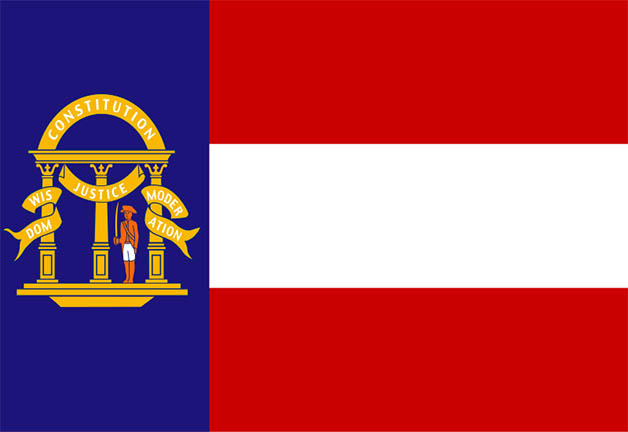
On December 17, 1902, legislation changed Georgia’s state flag changed to include the coat of arms on the blue band.
On December 17, 1944, Major General Henry C. Pratt ordered the end of the imprisonment of American citizens of Japanese descent in prison camps.
WTBS began broadcasting under new call letters on December 17, 1976 and uplinked its programming to satellite to become “America’s Super Station.”
National Politics
Former Florida Governor Jeb Bush announced yesterday that he is considering running for President. From his statement:
As a result of these conversations and thoughtful consideration of the kind of strong leadership I think America needs, I have decided to actively explore the possibility of running for President of the United States.
In January, I also plan to establish a Leadership PAC that will help me facilitate conversations with citizens across America to discuss the most critical challenges facing our exceptional nation. The PAC’s purpose will be to support leaders, ideas and policies that will expand opportunity and prosperity for all Americans.
In the coming months, I hope to visit with many of you and have a conversation about restoring the promise of America.
Kentucky Senator Rand Paul went up almost immediately with Google ads that display when you search for “Jeb Bush.”
Hours after former Florida Gov. Jeb Bush announced he would “actively explore” a run for the White House, the political action committee for Kentucky Sen. Rand Paul, who appears certain to announce a bid for the Oval Office in the coming months, took out a Google search ad on his name, with a not-so-subtle dig at the more moderate Republican.
“Join a movement working to shrink government. Not grow it,” the ad states, with a link to RandPAC, Paul’s longstanding federal leadership committee, and a page asking supporters to give their email address and zip code to “Stand With Rand.” Bush announced Tuesday he would form a similar leadership committee in January. His Facebook announcement didn’t include any attempts to gather data on potential donors or supporters.
Paul’s PAC recently hired on Texas digital strategist Vincent Harris and his firm, Harris Media, in preparation for a 2016 run. Harris had also done work for another likely 2016 contender, Sen. Ted Cruz.
Later Tuesday, RandPAC added a second ad to its digital buy, implicitly attacking Bush’s strong defense of the Common Core education standards. “We need leaders who will stand against common core,” the search ad stated….
Last night, Paul said the former Governor’s support for Common Core would cause trouble in the GOP Primary.
“I think most conservative Republicans think that education should be more at the local and state level. So yeah, I think it will be a big problem,” Paul told The Washington Post in a brief interview in the Capitol.
The Orlando Sentinel has an editorial about Bush that says more about the writer’s view of Republicans than about Jeb.
Jeb Bush is a union-busting, school-voucher-promoting, tax-cutting, gun-loving, Terri Schiavo-interfering, hard-core conservative.
What makes Bush different from a lot of the other candidates is that he’s also sane.
And somehow, in our increasingly extreme society, sane is now mistaken for moderate.
Especially when it comes to Republican presidential campaigns.
If you’ll recall, the 2012 GOP primary was like the Island of Misfit pols. Everyone ran way right and became the front runner for about 15 minutes … until people actually heard them speak.
An ABC News poll released yesterday shows Jeb Bush in first place in a Republican Primary field without Mitt Romney.
Fourteen percent of Republicans and Republican-leaning independents who are registered to vote support Bush for the GOP presidential nomination. In a matchup assuming that Mitt Romney doesn’t run, that puts Bush numerically first, but not by a meaningful margin. Paul Ryan has 11 percent support, Rand Paul 10 percent, and six others have 7 or 8 percent apiece.
Having 14 percent support means that 86 percent of leaned Republicans aren’t Bush backers. Still, he has major name recognition, and some advantages in his support profile.
Chief is the fact that he does better among mainline Republicans, who are most apt to participate in primaries. Bush has 19 percent support in this group (compared to Ryan’s 14 percent). Among GOP-leaning independents, by contrast, Bush’s support declines to 9 percent. Paul has 15 percent among those independents; Christie, 10 percent.
Bush may have challenges in the strongly conservative wing of the party; his support ranges from 18 to 15 to 12 percent among moderate, somewhat conservative and very conservative leaned Republicans, respectively. On either side of him among very conservatives are Ted Cruz, with 14 percent support, and Scott Walker, with 10 percent.
If Romney were to run again, the poll, produced for ABC by Langer Research Associates, finds that Bush would slip to the next tier: When included in the mix, Romney has 21 percent support, vs. 10 percent for Bush, 9 percent for Paul and 8 percent for Ryan.
NewJersey.com suggests that Bush’s early announcement will affect Garden State Governor Chris Christie’s potential bid.
Christie, who’s mulling a 2016 presidential bid, could lose a portion of his expected donor base and faces a tougher challenge putting together a seasoned team if Bush also pursues the Republican Party’s nomination. Not to mention, they say, Bush would cut into Christie’s moderate Republican base.
“I don’t think Christie doesn’t run,” said Ed Rollins, a Republican consultant who led Ronald Reagan’s successful 1984 campaign. “I just don’t think he’s going to get all that Bush money.”
A segment of the same donors expected to line up behind Bush would likely otherwise find themselves in Christie’s camp, said Rollins, arguing Christie and Florida Sen. Marco Rubio — another possible GOP presidential hopeful – stand to be harmed the most by a Bush candidacy.
“The Bush family organization is still a national organization and he can probably put a campaign together quicker than anybody,” he said. “Christie doesn’t inherit anything and he has to prove that he’s a viable candidate.”
“It’s a big deal,” said Julian Zelizer, a professor of political history at Princeton University. “This is the one person who probably worries (Christie) the most.”
Speaking of polls, Mark Blumenthal of Huffington Pollster offers some advice on reading the tea leaves polls of 2016 matchups.
These early readings require many disclaimers: Sample sizes are typically small, with roughly 400 interviews for each party, and the polls often include those who either identify or “lean” to a party rather than trying to nail down the likely primary and caucus electorate. Initial support is also tenuous, reflecting little more than a reaction to the most familiar names listed.
Jonathan Bernstein writes in Bloomberg View that we should “Ignore those [2016] Polls.”
You know my answer: Ignore those polls!
OK … mostly ignore the polls. They are worth paying attention to only to the extent that party actors care about them.
But by themselves early polling numbers are almost useless. Voters aren’t engaged this early. The surveys are measuring only name recognition and, to a lesser extent, vague impressions of the candidates who are well known.
I would also argue that a spate of news stories like the Jeb Bush stories yesterday and today can bounce the numbers simply by reminding folks that a particular candidate exists and juicing name recognition in the short term.
It appears that the CRomnibus bill may have also helped the cause of medical cannabis, via a prohibition on federal interference with state marijuana laws, according to Huffington Post,
Over the weekend Congress passed the “cromnibus,” an end of year federal spending bill designed to fund most of the government through 2015. The bill contains the bipartisan Rohrabacher-Farr medical marijuana amendment prohibiting the Justice Department from spending any money to undermine state medical marijuana laws.
For the first time, Congress is cutting off funding to federal medical marijuana raids and saying no one should be arrested for complying with their state’s medical marijuana law.
Georgia Politics
“Certificate of need.” Remember that term, as it will be a hotly-contested but sometimes under the radar fight at the 2015 Session of the Georgia legislature. From Walter Jones at Morris News,
A lawyer for physicians and the companies argued that a 1979 state law reducing competition between health care providers is outdated and results in monopolies that keep prices artificially high.
“The problem is that if we force all the business to go to that one provider, all of us are paying more money,” said Victor L. Moldovan of McGuireWoods.
Hospital executives say they depend on the law that requires a state certificate of need before any health facility can open. Removing it would jeopardize an estimated 19 rural hospitals that are on the verge of closing, such as Putnam General Hospital in Eatonton.
“You take all the requirements off of hospitals to be open 24/7 and never being able to turn away a patient like these treatment centers enjoy, then our costs will go down,” said Gregory Hearn, the CEO of Ty Cobb Healthcare System in Royston.
“Health care is changing, and hospitals are going to have to change, and physicians are going to have to change,” said Rep. Sharon Cooper, the chairwoman of the House Health and Human Services Committee.
An op-ed by an Orthopedic Surgeon in the Augusta Chronicle discusses the issue in the context of the local community’s healthcare needs.
The Certificate of Need (CON) movementwas started because of a federal mandate in the Health Planning Resources Development Act of 1974. All 50 states were required to have mechanisms in place to review (and if necessary, restrict) hospital capital expenditures for buildings and equipment. The federal mandate was repealed in 1987, and 14 states have dropped their CON programs.
Georgia’s program continues, but not without controversy.
The CON programs were designed in an era of fee-to-service, in which hospitals were on a mission to increase their services with the promise of ever-more profits. The world of medicine changed in the 1980s and payments became prospective in nature with diagnosis-related groups and managed care contracts. Hospitals have been forced to run more like businesses, and the need of protective government regulations of investments and growth have become less relevant.
Virtually everyone agrees that the CON system in Georgia (and everywhere else) is cumbersome, expensive and often unfair. The debate centers around eliminating it or improving it. To date, efforts to reform the system have been ineffectual.
Kyle Wingfield of the AJC puts a libertarian spin on the issue,
It’s yet another way in which there is nothing like a free market, or even market-oriented approach, to health care in Georgia. One presentation to legislators Tuesday described Georgia’s CON law as the fifth-most restrictive in the nation. The incumbents in the hospital industry will fight many changes, but there were some indications of openness to some changes from some industry representatives Tuesday.
Senator-elect David Perdue spoke to The Federalist Society and discussed his view of the balance of powers in our three branches of government.
Perdue focused on themes of debt and spending reduction but also addressed his upcoming role as a member of the Senate Judiciary Committee. The senator-elect said he anticipated at least one U.S. Supreme Court vacancy would arise during his upcoming six-year term.
“I’m not a lawyer, but I hope to bring to that committee just a common-sense approach,” said Perdue, who has spent his career in business and was CEO of Dollar General.
Noting several judges were in the room, Perdue continued, “I believe you go back to the Constitution, and you uphold what our founders had in mind to begin with, not what somebody in 1912 thought it meant or what some judge felt in 1998, but what did the founders really believe. I personally take a very hard stance about an activist judge. I’m sorry, but they shouldn’t create law.”
He added that the president shouldn’t, either, saying “that’s what happening right now with executive orders and regulatory mandate.”
In case you missed it, state officials continue to say that transportation funding will be an important issue this year.
Transportation will be a focal point for the upcoming legislative session, state officials said at meetings in Sandy Springs and Dunwoody on Dec. 15.
“Only 5 percent of our budget goes toward transportation and that’s just not enough in this metropolis that was basically created on the backs of transportation,” Sen. Hunter Hill (R-Atlanta), whose district includes a portion of Sandy Springs, told members of the Rotary Club of Sandy Springs during its legislative roundtable.
Sen. Judson Hill (R-Marietta) said that more money is needed to spend on transportation. “Finding the way to do that is going to be the $64,000 question,” he said.







Comments ( 0 )