
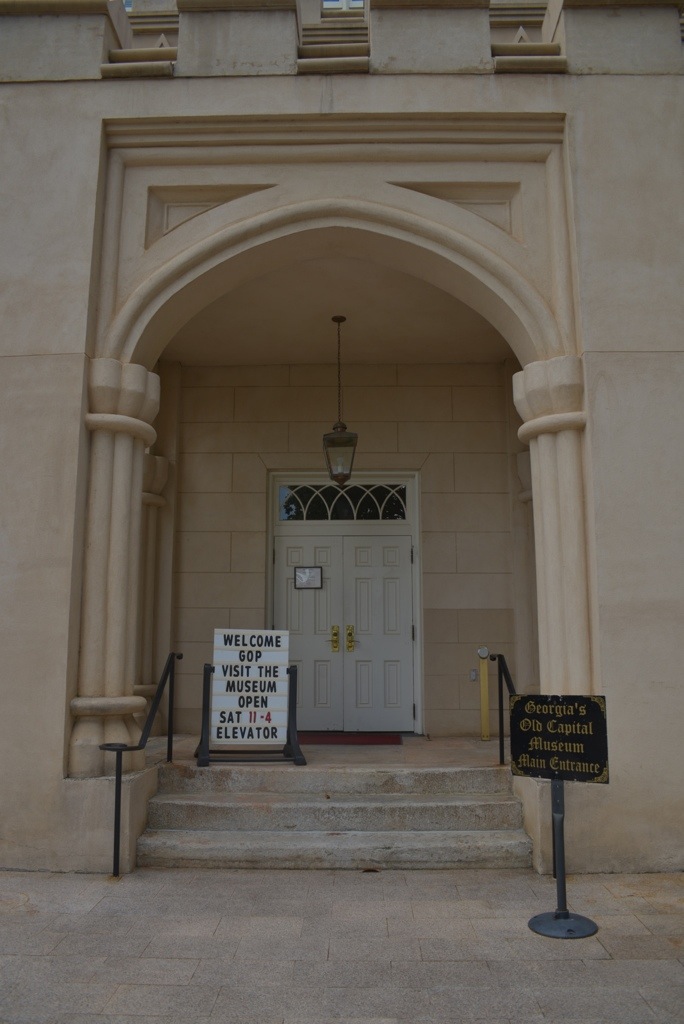
GAGOP State Committee Meets in Milledgeville
 Here’s the short-and-sweet version of the results of voting on 2013 State Convention resolutions.
1. Anti Common Core resolution was introduced by Sherena Arrington and quickly moved to a vote with no discussion and even dispensed with the reading of the resolution.
The AJC’s Greg Bluestein was reporting from the floor of the State Committee Meeting, where only members of the State Committee were supposed to be. He told me he didn’t vote on anything, but that’s the price we pay for not having press flacks at the GAGOP.
Bluestein’s article gives some of the background on Common Core and the current fight in Georgia.
“This is a huge mistake and our students will suffer because of this,” said state Sen. William Ligon, a Brunswick Republican who backs legislation that would free Georgia of “private interests” that he views as threats to the education system. “This debate is something that should have occurred back in 2010 but it didn’t. Now we need to maintain our absolute control over our standards.”
This opposition has led supporters to scramble to devise a defense of the standards, which aren’t mandated by the U.S. Department of Education but are supported by the Obama administration. The state education system calls them an important economic development tool and not a “hidden agenda” from overreaching federalists.
It has also created political headaches for Gov. Nathan Deal, who wasn’t governor when the standards were adopted but has maintained his support of them. He tried to settle dissenters last month when he signed an order that blocks federal curriculum from being imposed in Georgia and bans collection of identifiable student data for the federal government.
But, echoing a common theme among the program’s supporters, he said Common Core is under attack partly because it is misunderstood.
“It simply is an effort to say if we’re going to be compared with students in other parts of the country, we should be teaching to the same standards of what we expect our students to know and be able to do,” he said. “I think that makes good sense and it makes the testing more meaningful.”
2. A resolution to adopt a Georgia Republican Party Platform was defeated by a vote of 74-79.
3. A resolution urging the reform of civil forfeiture reporting laws was postponed to the next State Committee Meeting because of disagreements over how to describe complex legal topics.
4. A resolution against LEED certification, which uses standards for renewable forestry that conflict with generally accepted logging practices for Georgia pine was defeated. The most convinvcing argument I heard for this was that the resolution was an attempt by industry lobbyists to get the State Committee to do their work for them and embroil the GAGOP in a legislative issue.
5. Second District GAGOP Chairman Joseph Brannan offered a substitute resolution to the Nominating Convention resolution aimed at changing the Georgia Republican Party nomination process from primary elections to a nominating convention. Brannan’s substitute called for a study to be performed, and included specific information to be included in the committee’s report. Brannan stated that while he opposed moving to nominating conventions, the GOP would be best-served by learning more about the issue and making any decision on the basis of facts. The substitute was adopted in place of the original resolution, but then failed to pass. Expect to hear about it again.
6. Resolutions passed to honor Sue Everhart, past Chair of the GAGOP; honor American Armed Forces members; support American Laws for Georgia Courts, and oppose regionalism.
7. The 2015 Georgia Republican State Convention will be held in Athens on May 15-16, 2013. Call it a home court advantage for Chairman John Padgett if he seeks reelection. It was explained that most other suitable venues outside Atlanta already had contracts out for the dates in question.
Seeing the Light on Solar Shenanigans
Walter Jones of Morris Newspapers writes about the issue before the Georgia Public Service Commission of whether to enact a renewable energy portfolio standards requiring at least 500 megawatts of solar energy.
A high school in Dublin is being used as an example of solar economics by both sides of the debate. A local government authority leases solar panels, funded by bonds to be repaid from a sales tax.
The annual bond payments of $300,000 for 25 years total $7.5 million, but school officials consider that they are saving the $100,000 annual power bill because the sales tax doesn’t come out of their coffers.
Spending $3 to save $1 looks like a bargain to solar advocates but not to Wise or Georgia Power. And that’s not counting the costs to maintain and replace equipment that breaks or wears out over that quarter-century of financing.
One of the interesting features of that Dublin solar deal is the lengths it goes in order to evade state laws that limit local Board of Education spending. State law prohibits state agencies, including local school boards, from entering lease agreements of terms longer than one year because doing so would have the effect of limiting what a future Board can do.
But the Dublin schools evaded that requirement by exploiting a loophole that allows longer-term leases between different government agencies. In Dublin, the school board is actually leasing the solar installation from the Laurens County Public Facility Authority, which issued bonds and paid the proceeds to the private company to build the solar installation.
The Bonds are to be issued for the purpose of loaning the proceeds to Greenavations Power, LLC (the “Borrower”) to pay and reimburse costs of an approximately 1.2 megawatt solar photovoltaic array electricity generation system and other related facilities equipment and improvements, to be located at 1127 Hillcrest Parkway, Dublin, Georgia 31021 (collectively, the “Project”), and which shall be leased by the Borrower to the Laurens County Public Facilities Authority (the “Lessee”) for sublease to the City of Dublin School District (the “District”)
But don’t take my word for it. Here’s a link to the Standard & Poor’s bond rating documents discussing the structure of the deal, and an excerpt.
The series 2013 bonds are special, limited obligations of the issuer secured by the revenues derived under the lease, sublease, and the loan agreement. The district has pledged its full faith and credit and taxing power for the payment of its obligations under the sublease.
Greenavations will be the owner of the project and will sublet it to Laurens County Public Facilities Authority (PFA) as lessee through an operating lease. PFA, in turn, will sublet the facility to the district as sublessee. All rental payments are assigned and paid directly to the bond trustee. The district is also responsible for all applicable taxes outstanding, insurance, maintenance, and repair costs of the project. The district’s commitment to pay debt service survives termination of the sublease following an event of default. The district’s obligation to make rental payments continues even if the project is damaged, destroyed, or inoperable.State of Georgia law prohibits the district from entering into long-term financial obligations without voter approval.
However, the district is allowed to enter into a contract with another public body. The district has pledged its full faith and credit and taxing power for the payment of its obligations under the sublease. The payments are not subject to annual appropriation. The district is also required under the sublease to pay additional rentals to cover repair, maintenance, and insurance on the project.
See where it says “The district has pledged its full faith and credit and taxing power for the payment of its obligations under the sublease.”? That means that if the E-SPLOST, which was passed in 2012 for five years, is not renewed by Dublin voters or if it does not collect enough money through the sales tax, the Dublin Board of Education has pledged to pay for it from property tax receipts.
In a very real sense, this puts a gun to the head of Dublin citizens when the E-SPLOST is up for renewal, at least four times in the next twenty years. In effect, if they don’t vote for the continual renewal of E-SPLOST, they’re on the hook for the lease payments out of property tax dollars. And it is a shortage of property tax dollars that created the fiscal crisis that led to this boondoggle in the first place.
So again, why should Georgia voters care about what kind of mischief the Dublin Schools get up to? If your county has an E-SPLOST, they could use this kind of financing mechanism to evade state law limitations on their ability to enter into long-term leases, and put you in the position of being coerced to vote for E-SPLOST renewals in the future because the alternative is to force a property tax increase. Do you trust your school board that much?
More on Civil Forfeiture Reform
Greg Bluestein and Willoughby Mariano with the AJC also have a story on Civil Forfeiture Reporting Reform.
Gov. Nathan Deal and House Speaker David Ralston both threw their support behind legislation that could force more transparency after reports detailed the questionable use of the funds by local district attorneys. And head honchos of the state Republican Party are now debating whether to add their influential voices behind an overhaul.
The newfound support has unnerved some law enforcement officials. Howard Sills, who heads the Georgia Sheriffs Association, wants rules that already require law enforcement to submit their spending reports to be enforced. The Putnam County sheriff sees the revived campaign as “propaganda spewed forth by the people who want to enrich criminals.”
Powerful new backers of the changes are trying to portray them as inevitable. Ralston said he plans to build support among “independent-minded sheriffs” and other law enforcement willing to buck their leadership and negotiate a deal.
“We know that there’s going to be something done,” he said. “It’s going to take some muscle – I’m sure it will. But the point is that ultimately the voters are more powerful than any of us.”
The momentum for new restrictions came after an Atlanta Journal-Constitution investigation found Fulton County District Attorney Paul Howard used tens of thousands of dollars of forfeiture funds on things that had little to do with putting criminals behind bars.
I take issue with the statement by Putnam County Sheriff Sills, that supporters of reporting reform “want to enrich criminals.” In my opinion, what they want to do is (a) ensure that law enforcement agencies using civil forfeiture protect the constitutional right of all citizens against unlawful seizure by ensuring true information is reported about the use of less-stringent civil actions to seize money and property from citizens; and (b) ensure that Georgia law enforcement agencies are playing by the rules.
Wall Street Journal on Georgia’s Criminal Justice Reform
An excellent article in the Wall Street Journal looks at how Governor Nathan Deal and State Rep. Jay Neal found common ground based on their experiences with accountability courts and the ineffectiveness of simple incarceration at reducing recidivism.
Mr. Deal says his evolution came about largely on the streets of his hometown of Gainesville, an hour’s drive north of Atlanta. For nearly a decade, his son Jason has presided over a drug court designed to rehabilitate addicts charged with felonies and to keep them out of prison.
The future governor often went to graduation ceremonies where recovering addicts would tell their stories. “They all have their own stories, but a common thread runs through all of them,” Gov. Deal said. “They had lied. They had stolen. They had alienated their spouses, their parents, their siblings. But they were given a second chance, and they had been rehabilitated.”
As a pastor, Mr. Neal came to know recovering addicts in his church. In 2005, he guided into law a measure to crack down on methamphetamine labs, which were plaguing his corner of northeastern Georgia. At the urging of the Georgia Council on Substance Abuse, he later went to a seminar in Philadelphia on the science of drug addiction.
“That was my real ah-ha moment,” he said. “I realized there are so many factors in people’s lives we can’t simply punish away.”
The governor never mentioned a sentencing overhaul during his 2010 campaign. But he had mulled the issue privately, and he agreed to join forces with Rep. Neal and other lawmakers to make a major push in his first term.
He announced his intentions in his first speech before the state legislature in January 2011. “We cannot afford to have so many of our citizens waste their lives because of addictions,” he said. “It is draining our state treasury and depleting our workforce.”
Georgia at the time had the country’s highest rate of people caught up in the criminal justice system, according to Pew, with one in 13 of its residents behind bars, on probation or on parole. The tab to the state: $3 million a day.
Supporters of the changes in Georgia and other states note that elected officials such as Gov. Deal have done little to publicize their efforts, much less campaign on them.
Ben Jealous, president of the NAACP, sees that as a missed opportunity. “This is an area where Republicans can really connect with black voters,” he said. Gov. Deal acknowledges there are risks in championing prison changes. “You always worry about being accused of being soft on crime,” he said. But through a spokesman he said he now “very much wants to be seen as the face of prison reform in this state.”
The Digital Divide: How the Obama Campaign Beat Us Last Year
The New York Times has an article about Obama’s digital operation now moving into the private sector. It gives a great look inside the technologies that allowed the Obama camapign to make far more effective use of even old media like television through data-driven targeting that is unparalleled in modern campaigns.
A couple of weeks before Election Day, over drinks at the Pump Room in Chicago’s Gold Coast, a safe distance away from the re-election headquarters and its press minders, Grisolano and Erik Smith first let on that there was far more happening in the Chicago campaign office than any of us covering it truly understood. Grisolano told me that the campaign literally knew every single wavering voter in the country that it needed to persuade to vote for Obama, by name, address, race, sex and income. What’s more, he hinted, the campaign had figured out how to get its television advertisements in front of them with a previously inconceivable level of knowledge and accuracy.
Wagner dismisses the notion of “romantic war rooms” operating on political gut instinct as outdated and misguided. His is a hard-data system that rejects anything that is not definitively quantifiable. In the Bush era, strategists boasted about how they could predict voter behavior based upon car and sport preferences, a well-publicized bit of political magic that captured the imaginations of politicians and journalists alike. Wagner’s approach, part of a broader move in politics, cut all of that out; why engage in such divination when you have the time and money to just call voters and ask them about their leanings directly? “We’re trying to predict political preference; we’re not trying to predict whether you buy a car,” Wagner says dismissively.
The campaign couldn’t call the more than 150 million registered voters, obviously. But they could call enough of them in swing states (up to 11,000 a night) to figure out how they — and other people who lived near them, looked like them and earned like them — were likely to vote with an increasing degree of accuracy. In 2008, Wagner and his small team combined information from those calls with any other data they could find — census data, state voter lists and the like — and fed it into algorithms that produced support scores. One ranked how likely swing-state voters were to support Obama on a scale of 0 to 100, and another ranked how likely they were to show up at voting booths. Those scores helped the campaign direct resources toward the right voters, and Obama beat John McCain by 7 percentage points.
The campaign didn’t go into much detail, at the time, about exactly how it used Facebook. But St. Clair put it in fairly stark terms when I talked to him at A.M.G.’s temporary offices in Williamsburg, Brooklyn, in April. They started with a list that grew to a million people who had signed into the campaign Web site through Facebook. When people opted to do so, they were met with a prompt asking to grant the campaign permission to scan their Facebook friends lists, their photos and other personal information. In another prompt, the campaign asked for access to the users’ Facebook news feeds, which 25 percent declined, St. Clair said.
Once permission was granted, the campaign had access to millions of names and faces they could match against their lists of persuadable voters, potential donors, unregistered voters and so on. “It would take us 5 to 10 seconds to get a friends list and match it against the voter list,” St. Clair said. They found matches about 50 percent of the time, he said. But the campaign’s ultimate goal was to deputize the closest Obama-supporting friends of voters who were wavering in their affections for the president. “We would grab the top 50 you were most active with and then crawl their wall” to figure out who were most likely to be their real-life friends, not just casual Facebook acquaintances. St. Clair, a former high-school marching-band member who now wears a leather Diesel jacket, explained: “We asked to see photos but really we were looking for who were tagged in photos with you, which was a really great way to dredge up old college friends — and ex-girlfriends,” he said.
By March 2012, Wagner’s team had a workable list of what it deemed to be the most persuadable voters — in total, roughly 15 million of them in the swing states. Messina ordered the campaign to direct a majority of its efforts toward winning them back, one by one if necessary. They could reach many through their Facebook friends and others through more conventional means like e-mail and knocking on doors. But how could the Obama campaign be as targeted and tech-savvy on TV?
The campaign determined that two of the top shows to buy were 1 a.m. repeats of “The Insider” and afternoon episodes of “Judge Joe Brown” — shows that were far cheaper than the evening news or anything being shown on the networks in prime time. “When you’re talking about ‘The Insider,’ that might be shift workers in a state like Ohio, folks who are working class and aren’t getting home until midnight,” said Daniel Jester, the head GMMB buyer, who was aggressively locking in low rates early. “The person watching ‘Judge Joe Brown’ in the afternoon also may be the same viewer watching ‘The Insider’ at 1 a.m.”
The Romney campaign was not pursuing these same voters the same way. If they had been, Davidsen told me, the market would have become competitive, prices would have spiked and the system would have lost some of its advantage. As far as the Obama team was concerned, the optimizer helped it do what most strategists deemed impossible in a campaign between two well-financed opponents — talk to undecided voters through television advertisements on shows on which the opposition was not running a countermessage.
By Election Day, the Obama campaign had done far more to utilize cable and to run ads at odd times of day — who watches “Area 51” on Syfy at 2:30 a.m.? — than Romney had. In all, Obama ran nearly twice as many cable ads as Romney did, 588,006, on more than twice as many channels, 100, according to analysis by NCC Media, which helped both campaigns place spots.
Politics in real life tonight
Dawson County GOP Monthly Meeting from 7 to 8 PM at the Bowen Center for the Arts – Dawsonville, 334 Highway 9 North, Dawsonville, GA, 30534
Related Posts
 Only one state has hiked tuition more than Georgia | savannahnow.com
 Owens running for mayor in Senoia – The Newnan Times-Herald
 ‘Choose ATL’ campaign to market metro ‘digital hub’ | www.myajc.com
 Georgia Politics, Campaigns, and Elections for June 11, 2018
 Governor Deal suspends 6 members of DeKalb Board of Education


Comments ( 1 )