
The British Parliament closed the Port of Boston on March 25, 1774, passing the Boston Port Act in retaliation for the destruction of $1 million worth of tea in the Boston Tea Party.
Horton Smith won the first Masters tournament on March 25, 1934.
On March 25, 1937, Governor E.D. Rivers signed legislation creating the Georgia Department of Labor; in 1945, the Commissioner of Labor was upgraded from statutory office to Constitutional.
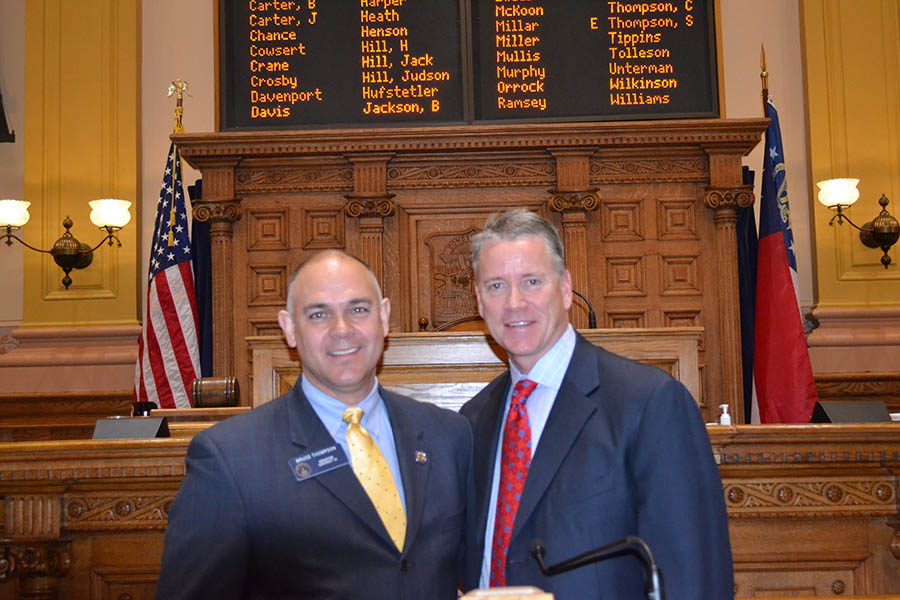
Atlanta Braves Pitcher and new member of the Baseball Hall of Fame Tom Glavine celebrates his 48th Birthday today. Earlier this year, Glavine was the guest of Senator Bruce Thompson at Tom Glavine day at the Georgia Capitol.
Jeff Breedlove, GaPundit Associate Editor, interviewed Glavine and we have two audio clips for you.
Tom Glavine Thanks Sen. Bruce Thompson & State Senate for Tom Glavine Day
Tom Glavine Speaks to GaPundit On The Best Pitchers & Hockey Players, Expanded Instant Replay In MLB, & The 2014 Braves
Flannery O’Connor was born on March 25, 1925 in Savannah, Georgia. She would come to be recognized as one of the greatest American fiction writers. O’Connor graduated from the Georgia State College for Women, now called Georgia College and State University. She returned to Milledgeville in 1951, living at the family farm, called Andalusia, until her death at age 39 in 1964.
At GCSU, the Flannery O’Connor Room is located in the GC Museum, the Flannery O’Connor Collection includes manuscripts, and the College includes a program in Flannery O’Connor Studies.
O’Connor died of Lupus, which also killed her father. This Session, Senator Renee Unterman introduced, and Rep. Sharon Cooper carried in the House, Senate Bill 352, creating the Georgia Council on Lupus Education and Awareness.
Georgia Politics, Campaigns, and Elections
Yesterday, Governor Nathan Deal appointed Suzanne H. Smith to a Superior Court judgeship in the Cherokee Judicial Circuit and Verda M. Colvin to a Superior Court judgeship in the Macon Judicial Circuit.
Sunday evening, the Senate Battleground Fund held a fundraiser hosted in the home of Jeff Sprecher and Kelly Loeffler and featuring Republican presidential candidate Mitt Romney and Republican National Committee Chair Reince Priebus. The events raised more than a million dollars.
“It’s important that Republicans hold on to the Senate seat in Georgia as we look to a year where Republicans have a good chance at taking the Senate majority,” said Eric Tanenblatt, the well-known GOP insider who helped organize the event with Fred Cooper. “And the fact that Gov. Romney and Chairman Priebus joined Sens. Johnny Isakson and Saxby Chambliss at this event, it shows the importance and significance of the Georgia race to winning a Senate majority.”
Nate Silver’s prediction that Republicans will gain control of the United States Senate in this year’s General Election caused backlash among Democratic elites.
In an unusual step, the executive director of the Democratic Senatorial Campaign Committee on Monday issued a rebuttal the famed statistician’s prediction—made a day earlier—that Republicans were a “slight favorite” to retake the Senate. Silver was wrong in 2012, the political committee’s Guy Cecil wrote in a memo, and he’ll be wrong again in 2014.
“In fact, in August of 2012 Silver forecast a 61 percent likelihood that Republicans would pick up enough seats to claim the majority,” Cecil said. “Three months later, Democrats went on to win 55 seats.”
The DSCC memo took pains to compliment Silver, saying his work at newly launched FiveThirtyEight was “groundbreaking.” And the group’s main critique—that Silver’s model relies on a smattering of haphazard early polling in battleground states—is one that he himself acknowledges is a limitation.
Most models that attempt to quantify political predictions rely for robustness upon a deep pool of polling information. One of the problems at this early stage is that the publicly-released data on polling is so thin. As consumers of polling information, this is important to keep in mind not just when assessing the confidence you place in a polling aggregator/analyst like Nate Silver, but when you assess the meaning of any single poll. As I’ve said before, it’s more useful to look at multiple data points over time than to treat any single poll as Gospel.
It’s also helpful to remember Silver’s background as a baseball statistician doing Sabremetric-style statistical analysis. While such analysis can help inform the front office’s player acquisition strategy, and the manager’s tactics, the geeks still don’t suit up and take to field to try their hand at hitting a major league curveball or direct runners from the third base coaches’ box. There’s still a place for experience winning, whether we’re talking baseball or politics.
Once again agreeing with Jay Bookman
Facepalm. Once again, for the second time in a week, I agree with liberal AJC columnist Jay Bookman. On Friday, he wrote:
The entire gun bill is not yet available for public scrutiny — such is the furious chaos of the closing night of the Legislature, when hundreds of amendments are being attached to hundreds of bills, with no one having any real idea of what’s going on and who’s behind it or what they’re voting on. I imagine that on closer inspection we’ll find even more cause for wonderment and bafflement in the bill headed to Deal’s desk.
Yesterday, I was going to write about a specific part of the gun bill, House Bill 60, which allegedly would prevent police from inquiring about a Concealed Weapon Permit if they saw someone with a pistol stuck in his belt.
Sheriffs say one provision will essentially make licensing meaningless.
“If I’m out on patrol tonight, and I see a guy in a high-crime, drug traffic area – a straight thug with a pistol stuck in his back pocket – I will not be able to ask that individual if he has a license to carry a gun,” said Howard Sills, the sheriff of Putnam County.
He added, “If you’re going to have that language in there, there’s no point in even having a license.”
I don’t know if that language is in the bill, because yesterday, I could not find the final version of the bill on the General Assembly website. The only version available when I was writing yesterday began,
Amend the amendment (AM 28 1357) to the House floor amendment (AM 41 0040) to the Senate Judiciary Non-civil Committee substitute to HB 60 (LC 29 6007S) by inserting after line 65 the following:By replacing lines 100 through 121 with the following:
At that point in time, no version of the bill that had 65 lines was available online. Four days after the House and Senate passed a major bill, you couldn’t find it on the legislative website. Doesn’t exactly inspire confidence, does it?
This is as good a point as any to mention the point I made yesterday about Senator Josh McKoon’s Senate Resolution 876, which would have had the effect of slowing down voting on conference committee reports, which is where much of the sausage is made in the legislature. If the legislature is moving too quickly for staff to keep up with the changes and make them available to the voters and citizens of Georgia, perhaps, slowing down the process is a good idea.
GRTL Challenged?
Yesterday, Jim Galloway’s Political Insider column brought us this tidbit:
A rival group, Georgia Life Alliance, based in Rome, will challenge GRTL for membership within the National Right to Life organization. Only one member per state is permitted.
Our information on the new organization is limited. According to the secretary of state’s website, the organization was formed only March 13. Lance Cooper, a well-known Cobb County attorney and former candidate for state Senate, is listed as an officer. Also listed is Emily Joy Matson, a Rome attorney, and Kristin Radtke of Suwanee, who appears to the be wife of Trip Radtke of the Stoneridge Group.
There’s an assumption in these quarters that this has everything to do with the U.S. Senate race. U.S. Rep. Paul Broun, R-Athens, is prominently featured on the current GRTL website, praised for his endorsement of the organization’s aggressive approach – which some critics have described as all-or-nothing.
Likewise, the group’s antipathy toward former secretary of state Karen Handel dates to the 2010 race for governor and beyond.
The major point of contention: The National Right to Life organization allows for exceptions to abortion bans in cases of rape and incest. GRTL does not, and has insisted that no politician who endorses those exceptions can be considered pro-life.
Frankly, much of the criticism of GRTL centers around President Dan Becker. I’m not sure I’ve ever met him, but I would support GRTL if for no other reason than the professional staff that has consistently made them one of the strongest forces in Georgia politics. Three people I’ve never heard of within the Pro-Life movement isn’t even a contest.
Add to that GRTL’s successful championing of Senate Bill 98 by Sen. Judson Hill this session, and I don’t see a reason to change Georgia’s representation on the NRLC.
Emory Professor on the Confederate Flag car tag
Emory Professor of Psychology and Psychiatry Drew Westen offers his suggestions to other liberals for how to spin the issue of Georgia car tags featuring a background image of the Confederate Battle Flag.
Too often, Democrats have dealt with racial issues by avoiding them. Research shows that’s the wrong strategy, particularly in the South. Speaking directly about race allows our conscious values — which tend to be intolerant of racial intolerance, even in the heart of Dixie — to override our unconscious prejudices, which control our behavior when we’re not looking, or when other people aren’t, as in the voting booth. The best way to handle this kind of dog-whistle politics is to expose it for what it is.
A successful political message that addresses race or any other divisive issue tends to have three components. The first is a value-laden statement that connects with most voters, making clear that the candidate cares about people like them and understands their ambivalence. The second is a statement raising a concern that makes the average person anxious or angry enough to want to do something about the issue. The third is a statement of hope, wedded to a solution, which suggests that the problem is solvable in a way that reflects the values and interests of ordinary voters.
If you say something as patently ridiculous as, “Too often, Democrats have dealt with racial issues by avoiding them,” it is clear that you neither have any business talking about politics, nor take the Atlanta Journal-Constitution as part of your morning reading. I might suggest that the Professor make the acquaintance of two other professors: Merle Black in the Political Science Department at Emory, and Vincent Fort, a member of the Democratic Party of Georgia and the Georgia Senate.
Speaking of Spin
Unsuccessful Senate candidate and former State House member Bill Hembree is using a warning from the Georgia State Ethics Commission Government Transparency and Campaign Finance Commission as an excuse to bash the Commission and his opponent in both 2012 and a 2014 Republican Primary, Senator Mike Dugan.
Hembree has $34,985.25 in leftover cash from the 2012 election. He said he plans to use that cash in the rematch despite LaBerge’s warning that by doing so he is breaking the law and could face penalties if a citizen files an ethics complaint against him.
LaBerge said Hembree and other candidates who are out of office must file a new Declaration of Intent (DOI), which allows candidates to begin fundraising. Hembree hasn’t filed a new DOI and said he doesn’t plan to.
Related Posts
 Recommendation to make downtown safer would bring more taxes | The Augusta Chronicle
 Fort Asking Federal Government To Oversee Upcoming Elections | WABE 90.1 FM
 Georgia Politics, Campaigns, and Politics for April 9, 2019
 Welcome centers, rest areas to get spiffed up | savannahnow.com
 Georgia Politics, Campaigns & Elections for October 8, 2013


Comments ( 1 )