
George Washington was inaugurated as the first President of the United States of America in New York City on April 30, 1789. From Washington’s inaugural address:
it would be peculiarly improper to omit in this first official act my fervent supplications to that Almighty Being who rules over the universe, who presides in the councils of nations, and whose providential aids can supply every human defect, that His benediction may consecrate to the liberties and happiness of the people of the United States a Government instituted by themselves for these essential purposes, and may enable every instrument employed in its administration to execute with success the functions allotted to his charge.
In tendering this homage to the Great Author of every public and private good, I assure myself that it expresses your sentiments not less than my own, nor those of my fellow-citizens at large less than either.
No people can be bound to acknowledge and adore the Invisible Hand which conducts the affairs of men more than those of the United States.
On April 30, 1886, former Confederate President Jefferson Davis arrived in LaGrange, Georgia for the unveiling of a monument to Benjamin Hill.
Television Ad War
Senate
Paul Broun’s newest release in the Senate race is less an ad than a web video, as I’ve never seen a 4+ minute ad slot.
Karen Handel’s newest ad, “Principles” is being advertised heavily on YouTube, and I believe it’s on cable and broadcast in limited rotation.
U.S. Chamber of Commerce in support of Jack Kingston
The Chamber is running ads in five races, all for Republicans; the one in support of Kingston was part of a $2.2 million buy than included $681,000 in Georgia. This is part of what Republican National Committeeman Randy Evans called, “Big bucks for television stations.”
Make no mistake, just candidates in the Georgia Senate and gubernatorial races alone will raise and spend over $40 million by the time the general election rolls around. In fact, the various candidates, Super PACS, political parties and independent expenditure committees in the race for Senate and governor have already raised or spent almost $20 million.
The common denominator for all of the candidates, political parties, political action
committees and independent expenditures will be the same – spend lots and lots of money on media to reach voters. After all, many national political pundits in Washington, D.C., see Georgia as a possibly “winnable” state in both the senatorial and gubernatorial race. That purported “purple” status translates into big money and that big money gets spent on media.So, while some candidates will win and others will lose, in 2014, Georgia media outlets, especially local television stations, will win either way.
Eugene Yu, Twelfth District Congress: “A Proud American”
Kenny Powers “A Real American” – warning: might be mildly offensive
https://www.youtube.com/watch?v=Vmh6jzy3TmQ
Georgia Integrity Project – Against State House Speaker David Ralston
This is the second time I can remember a third party running ads against a candidate at the state legislative level. From the Georgia Integrity Project. From their website:
Georgia Integrity Project is a 501c4 non-partisan social welfare organization whose purpose is to educate voters on the issues. Our goal is to increase voter participation in all elections and make sure educated, informed voters dominate the election process.
We are a coalition of tea party activists from Atlanta Tea Party Patriots and over 50 tea parties in Georgia, conservative groups that include Georgia Right To Life, Georgia Conservatives in Action and Chattahoochee Republican Women’s Club.
Polling
Ashley Bell sent out a press release yesterday touting what he called a lead in the polls and “the only candidate in double digits.” His statement is true, but I think the polling is wrong. In fact, I know it’s wrong.
Here’s the release from SurveyUSA, who conducted the poll for 11Alive. The question asked by the company on the Superintendent’s race was:
Georgia will also hold a Republican primary for State School Superintendent. If the Republican primary for State School Superintendent were today, which Republican would you vote for? (candidate names rotated) Allen Fort? Ashley Bell? Kira Willis? Mary Kay Bacallo? Mike Buck? Nancy Jester? Richard Woods? Sharyl Dawes? Or Fitz Johnson?
The reason a polling firm rotates the names sometimes in a ballot question or favorable/unfavorable questions is an attempt to avoid the “ballot order effect,” which elevates candidates who are first on the ballot. This is thought by those pollsters to provide a more accurate assessment of the strengths and weaknesses of candidates.
I disagree with that way of polling. If the ballot order does effect the outcome of an election, even by a few marginal votes, I want it to be part of my polls, so I always order the candidates in the way they will appear on the ballot. This is especially important on down ballot races, with multiple candidates in a primary election. From the Center for Politics at the University of Virginia who state the following based on the political science research:
1. There is an advantage to being listed first on the ballot.
4. Offices in the middle and bottom of the ballot are especially susceptible to the first-listing bias. Many candidates for lower statewide elected office (such as lieutenant governor, attorney general, labor commissioner, etc.) and other localized offices (state legislators, city councilors, and so on) are surprisingly little known by many voters. A voter may have gone to the polls specifically to vote for president or governor, and once in the voting booth be surprised to discover lots of other offices up for election. Some voters just skip these contests (which may be the responsible thing to do if one has not studied them in advance), and this produces a phenomenon called “voter fatigue” or “ballot drop-off.” The number of votes cast for president is almost always much greater than the number of votes cast for any other office, for example. Often, the number of votes cast per office drops consistently as one moves down the ballot. However, other voters feel an obligation to be “good citizens” and cast a ballot even in races where the candidates are unknown to them. First-listing bias can be a major factor for these voters.
7. Primary elections are more susceptible to first-listing bias than general elections. By definition, party primaries do not contain a party identification prompt.
10. Of all these principles that govern the first-listing bias, the most important are the degree of information held by individual voters and the position of the office on the ballot. Elections that draw a disproportionate number of well-informed voters have lower first-listing bias effects. And long ballots that ask voters to cast votes on an extended list of offices and candidates almost certainly exaggerate the first-listing bias for the offices toward the end of the ballot.
In down ballot races like State School Superintendent, where the candidates are not spending large sums of money, and news outlets are not extensively covering the races, low information dynamics predominate. The Superintendent’s race has nine candidates, none of whom are on wide-spread television, and it’s a primary election without an incumbent. Ballot order will likely be a bigger factor in this race, especially on the Republican side, than in any other on the ballot this year. Here’s an approximation of what the listing for State School Super will look like.
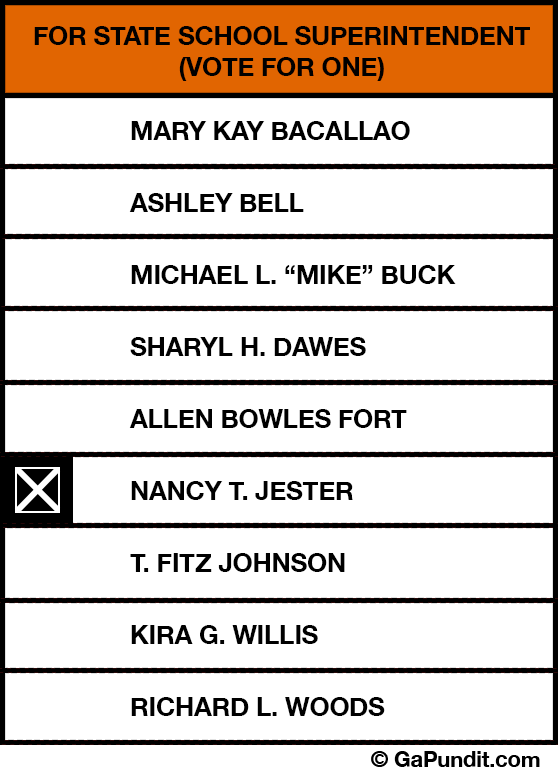
[Disclaimer: I work for Nancy Jester’s campaign.]
In separate polling news, InsiderAdvantage did an exclusive survey for the Atlanta Business Chronicle on the effect the recently signed gun bill has on Georgia’s efforts to attract new businesses.
“Women can’t stand it. Men are more likely to favor it,” InsiderAdvantage CEO Matt Towery said. “Republicans favor it more than Democrats, and independents are evenly split.”
Overall, 25.8 percent of 759 likely Georgia voters surveyed by telephone the evening of April 27 said the gun bill would have a positive effect on the state’s business recruiting prospects, while 35.6 percent said the legislation would have a negative impact. Thirty-one percent said the bill would have no effect, and 7.6 percent were undecided.
Among white voters, the same percentage said the legislation would have a positive effect – 27.2 percent – as said it would hurt the state’s business image. In sharp contrast, 61.4 percent of black voters said the gun bill would have a negative impact on business, while only 17.8 percent predicted a positive impact.
More male voters – 31.9 percent – said expanding gun rights would help business than the 26.2 percent who said it would hurt, while female voters went the other way, with 44.6 percent predicting a negative impact and only 19.8 percent saying the effect would be positive.
But the biggest difference in how the bill’s impact on business is viewed was based on party affiliation. A huge majority of Democratic voters – 71.8 percent – said the Republican-sponsored gun law would be bad for business, while just 11.5 percent of GOP voters said it would have a negative impact.
Towery said the new poll, combined with the February survey that found 52 percent opposition to the gun bill, shows it will be hard for Republicans to turn the legislation into a positive force in the November elections.
He said the only way the legislation will help the GOP is if shootings such as took place April 29 at a FedEx facility in Kennesaw stop happening in Georgia. But even if they do, he said it would be hard to link it to the passage of a strong gun rights bill.
“It’s going to be hard to prove a positive but a lot easier to point out a negative,” he said.
Towery said the only mitigating factor for Republicans in the gun bill is that state Sen. Jason Carter, the Democratic candidate for governor, voted for the measure.
[Disclaimer: I work for InsiderAdvantage as Editor of the InsiderAdvantage website, but have no connection to their polling other than that I read about it in third party media.]
Power Station
If you live or work near the Plant Vogtle nuclear facility, don’t be alarmed to see emergency vehicles this afternoon starting around 4 PM – this is a test, it is only a test.
Plant Vogtle will conduct an emergency drill today using numerous law enforcement and emergency response vehicles, including a helicopter.
During the practice exercise, which will begin about 4 p.m., emergency vehicles may be seen entering and exiting Plant Vogtle, according to a Georgia Power news release.
The utility companies building the new nuclear reactors at Plant Vogtle got some good news from the feds – loan guarantees for $6.5 billion in debt without a credit subsidy fee. If you live in Georgia and are reading this, it’s probably good news for you too, as most Georgians who use electricity will be eventually using some power from Vogtle, and cost reductions will lower you price for electricity.
Atlanta Gas Light is investing $210 million in a new gas pipeline in northwest Georgia.
The pipeline is being built by Williams Partners L.P. to bring Marcellus shale gas supplies to customers in northwest Georgia for electricity generation and growing local distribution.
The pipeline is part of Williams‘ Transco system, the nation’s largest-volume interstate natural gas pipeline system.
AGL (NYSE: GAS) reported that on April 11, it entered into a construction and ownership agreement for what’s known as the Dalton Lateral pipeline. AGL will have a 50 percent ownership interest in the 106-mile pipeline that will be built in Georgia and extend the Transco natural gas pipeline into northwest Georgia. AGL said it will lease its stake in the pipeline once it’s placed into service. AGL said it will receive annual lease payments of $26 million.
“The Dalton Expansion Project is one of six large-volume projects Transco is pursuing to connect approximately 3.4 million dekatherms of natural gas from surging supplies in the northeast to high-value growth markets in the southeast,” said Rory Miller, senior vice president of Williams Partners’ Atlantic-Gulf operating area, in a statement on April 17(NYSE: GAS) .
Capitalist Tool
Steve Forbes, who ran for President in 1996 and 2000 largely on the issue of implementing a federal flat tax, was in Atlanta to support Bob Barr in his bid to return to Congress from the 11th District. The Atlanta Business Chronicle interviewed Forbes.
The flat income tax former Republican presidential candidate Steve Forbes made his campaign theme in 1996 and 2000 is needed now more than ever, Forbes said in Atlanta Monday.
“People have to use a tax preparer or sophisticated software to do their tax returns,” Forbes, chairman and editor-in-chief of Forbes magazine, said after appearing at a luncheon fund-raiser for GOP congressional candidate Bob Barr. “No one believes the system we have now works.”
Barr, who is running in the May 20 primary for the vacant 11th Congressional District seat, said the issues that concern GOP voters are the same as when he served in the U.S. House of Representatives during the 1990s and early 2000s.
“Government is too big,” he said. “It regulates too much. It taxes too much.”
Forbes said Republicans need to take control of the U.S. Senate this fall in order to check the excesses of President Barack Obama. He said Congress has tools it could use to fight back against Obama’s tendency to govern by executive order, if congressional leaders were willing to use them, including attaching riders to spending bills cutting off funding for administration initiatives.
“I think you’re going to see after the election a much more active Congress,” Forbes said.
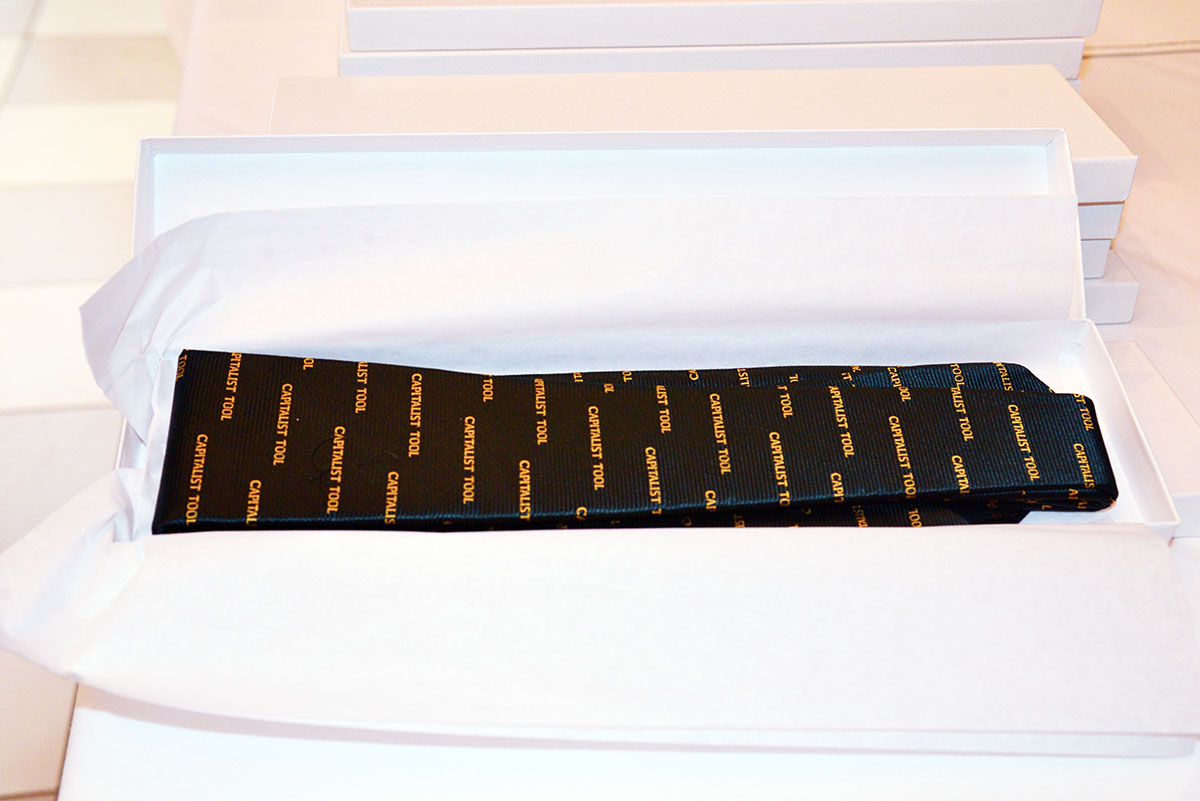
This is the official necktie of Forbes magazine, whose motto is, “The Capitalist Tool.”
[Disclaimer yet again: I’ve done some work for the Barr campaign in voter analytics.]


Comments ( 0 )