
President George Washington gave his farewell address on September 19, 1796.
The period for a new election of a Citizen, to Administer the Executive government of the United States, being not far distant, and the time actually arrived, when your thoughts must be employed in designating the person, who is to be cloathed with that important trust, it appears to me proper, especially as it may conduce to a more distinct expression of the public voice, that I should now apprise you of the resolution I have formed, to decline being considered among the number of those, out of whom a choice is to be made.
I beg you, at the sametime, to do me the justice to be assured, that this resolution has not been taken, without a strict regard to all the considerations appertaining to the relation, which binds a dutiful Citizen to his country–and that, in withdrawing the tender of service which silence in my Situation might imply, I am influenced by no diminution of zeal for your future interest, no deficiency of grateful respect for your past kindness; but am supported by a full conviction that the step is compatible with both.
On September 19, 1863, the Battle of Chickamauga was joined between the federal Army of the Cumberland under Maj. Gen. William Rosecrans and the Confederate Army of Tennessee under Gen. Braxton Bragg.
Thirteen marchers were shot and killed and forty more wounded in Camilla, Georgia at the Camilla Massacre on September 19, 1868 as marchers to a Republican Party rally were gunned down.
President James Garfield died on September 19, 1881, of wounds sustained on July 2d of that year. Garfield is one of seven Presidents born in Ohio – he and William McKinley, were both killed by assassins.
Chickamauga National Battlefield was dedicated September 19, 1895.
Georgia Politics, Campaigns, and Elections
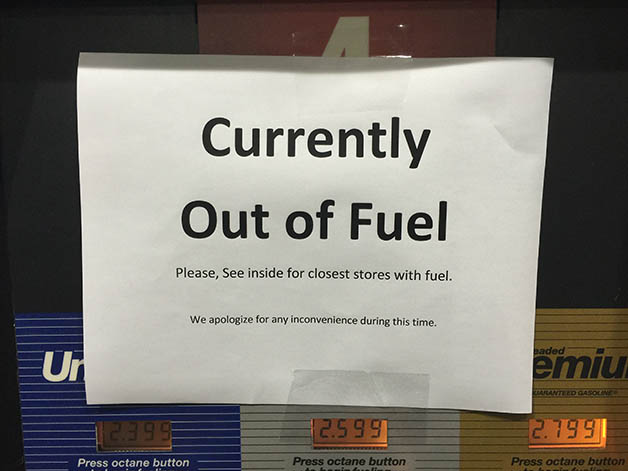
This sign greeted me Saturday at the local gas station and increasing numbers of Georgia motorists are encountering similar signs.
Governor Nathan Deal issued an Executive Order extending hours of service for truck drivers delivering fuel.
“Along with applying for, and receiving, a waiver from the Environmental Protection Agency (EPA) earlier this week, I’ve extended the executive order allowing extended operating times for commercial truck drivers to safeguard against any fuel supply issues in our state. We are confident these measures will help ensure Georgians’ uninterrupted access to motor fuel until Alabama’s pipeline is fixed.”
Governor Deal’s office had not received complaints about gas shortages when reached by the media on Sunday.
The governor of Georgia said Sunday his office hasn’t received any complaints of gas shortages within the state after a pipeline spill in central Alabama but some gas station employees have said they’ve had to close because they’re out.
“As of now … we’ve not received any complaints. If that changes on Monday or at any time in the coming days, the governor’s office will act accordingly,” Gov. Nathan Deal’s spokeswoman Jen Ryan said in a statement Sunday.
Please note that social media is not the same thing as calling or emailing the Governor’s Office.
Colonial Pipeline is working on a bypass for the leak in its pipeline that supplies Georgia.
Colonial Pipeline announced Saturday it is beginning construction of a temporary pipeline that will bypass a leaking section of its main gasoline pipeline in Shelby County, Alabama.
No timetable was given as to when that bypass line would be completed or what path it would take.
The Trump-Pence campaign office grand opening drew hundreds of supporters to their new Sandy Springs location.
Hundreds of Donald Trump supporters showed up to a grand opening Saturday of the campaign’s new Georgia digs. And many walked away as newly-minted volunteers for the businessman’s final push to November.
They left with armfuls of campaign signs, absentee ballot information and pledges to knock on neighbors’ doors and work the phones in the final seven weeks before the election.
Kathy Potts and Becky Love have become something of celebrities in Georgia Republican circles with their T-shirts declaring themselves “deplorables” mocking Clinton’s controversial comments last week. The two have fanned out to GOP gatherings across the state helping to rev up support for Trump in between TV appearances.
At each event, Potts carries her own basket labeled “deplorables.” With its contents, she hopes to make sure Georgia stays in the Republican column: Hundreds of absentee ballots.
“We are trying to make a statement,” she said. “And it’s working.”
In Augusta also, a Trump-Pence campaign office opened this weekend.
“Election Day is right around the corner and Georgia Republicans are working around the clock to ensure victory for Trump-Pence, Senator Johnny Isakson, and the entire Republican ticket,” 12th District GOP Chairman Mike Welsh said in the release.
“The East Regional GOP Headquarters will serve as the hub for volunteer operations in the CSRA. We encourage local conservatives to volunteer their time in the days, weeks, and months ahead. Together, we can stop the Clinton Machine and do our part to make American great again!”
Compare that level of enthusiasm with that of some voters to whom the Gainesville Times spoke.
The old philosophy of choosing the “lesser of two evils” in the voting booth isn’t working for some Hall County residents and students during this presidential election season.
“Not only am I not excited, I am disgusted,” resident Terry Wright said. “I’ve never voted anything but a straight Republican ticket, but there is no way I could vote for (Donald) Trump and still like who I see in the mirror. I will vote but I will write in someone else.”
On the Republican side is a candidate many believe to be a demagogue and racist. The Democrats chose a nominee who many believe is politically corrupt and compromised.
“I think so many students have no faith in (Hillary) Clinton or Trump for many reasons,” said Douglas Young, a political science professor at the University of North Georgia in Gainesville. “Since both candidates are pushing 70, they each have a long record of statements and actions to defend.”
Student Jessica Swords said she considers herself a “little ‘L’ libertarian,” but she’s not sold on that party’s nominee.
“Perhaps the better question is, ‘Why am I not supporting Hillary Clinton or Donald Trump?” Swords said. “Both are not constitutional candidates … and Hillary is too corrupt to even qualify. While I would prefer Trump over Hillary, I do not think that he truly understands the importance of the Constitution and limited power of the executive branch.”
Speaker of the House David Ralston told the Statesboro Herald that he supports passage of all four Constitutional Amendments on the November ballot.
The Voter Participation Center in Washington, DC, which we’ve been following since June, is now targeting non-registered potential voters.
Some locals have already reported receiving the mailers — part of a batch of 11 million sent out recently by the Voter Participation Center in D.C.
Interim Director of Voter Registration Sabrina German said she’s heard that as many as 25,000 Chatham County residents will receive a form from the agency, which uses the Georgia Secretary of State’s master voter registration list, along with other commercial databases to locate unregistered voters.
The goal, according to a statement from VPC President Page Gardner, is to reach the demographics most underrepresented on Election Day — people of color, millenials and single women. She said so far, it’s been successful. During the past 12 years, the VPC has registered 3 million people to vote.
But some of these registration forms have and will miss their mark. Already in Chatham County, mailers have reportedly been sent to the wrong addresses. And representatives of the Georgia Secretary of State’s office have gotten complaints about other issues — including mailers sent to someone who has died.
“Unfortunately, no state makes available a list of individuals who are unregistered to vote,” Gardner said in her statement. “As a result, VPC must use commercially available residential databases and match them to the state’s voter file to determine who is unregistered and otherwise eligible. … VPC uses many ‘protocol improvements’ that are designed to make these lists more accurate, and to reduce mailings sent to people and addresses that should not receive them.”
The 2017 Session of the Georgia General Assembly is likely to be deja vu all over again with a repeat of the 2015 fight over religious liberty legislation.
State Sen. Josh McKoon, R-Columbus, a leader of the push for religious liberty legislation, dismissed the veto of HB 757 as a deciding factor in major jobs announcements. He said the bill was misrepresented as discriminatory and included protections previously sought by the business and pro-LGBT community.Opponents of religious liberty bills, he said, “are desperate to get something in print to say there’s a positive economic impact to squelching people of faith.”
North Carolina Department of Commerce spokeswoman Kim Genardo scoffed at any suggestion her state’s bathroom law stunted growth, saying “North Carolina’s economic development pipeline is certainly full.”
North Carolina’s jobless rate, 4.7 percent in July, remains lower than Georgia’s figure, which ticked down to 4.9 percent in August.
Georgia added 116,000 jobs in the 12 months ended in July, compared to 94,000 in North Carolina in that time, according to Bureau of Labor Statistics data, though how much political factors contributed is impossible to know. From April through July, Georgia added 25,700 public and private sector jobs, while North Carolina performed slightly better in the face of controversy with 30,100.
Reducing the number of polling places may disproportionately affect African-American voters, according to a story by Reuters.
Georgia has been an epicenter for efforts to reduce polling places since the Supreme Court decision [eliminating the pre-clearance requirement for voting changes]. And in that state, which has not backed a Democrat in a presidential election since 1992, polls show Republican Donald Trump and Hillary Clinton in a close battle for the presidency that could be decided by turnout of minority voters.
“If you want to restrict voter turnout in minority and disadvantaged communities, a good way is to move a polling place somewhere they can’t get to,” said Stacey Abrams, Democratic leader in the Georgia state legislature.
Hans von Spakovsky, a senior legal fellow at the conservative Heritage Foundation, said race was being unfairly inserted into the debate on polling place changes.
“It’s election officials making adjustments based on the changing ways people are voting,” he said.
Georgia Life Alliance gave awards to Congressman Doug Collins (R-Gainesville), State Senator Renee Unterman (R-Buford), and Lt. Governor Casey Cagle.
The Georgia Life Alliance awarded Collins the Federal Legislator of the Year award, noting the congressman has “a 100 percent pro-life voting record with every pro-life organization in Washington D.C.” according to a news release.
Cagle was awarded the organization’s Champion for Life Award, for “actively supporting pro-life legislation at the state capitol.”
Unterman was awarded the State Senator of the Year Award, most notably for her work with S.B. 308, which established the Positive Alternatives for Pregnancy and Parenting Grant Program.
“Senator Unterman is one of the most effective advocates for life at the state capitol,” said Matson.
The Marietta Daily Journal stakes out a position in opposition to the Opportunity School District.
But if you think this question appears on the ballot as a well-intentioned effort to improve childhood education, please reconsider. This has nothing to do with the 1.7 million public school students in Georgia.
It has everything to do with money.
The amendment would allow an unaccountable education czar to seize a local school from the locally elected school board if that school scored 60 or below on Georgia’s College and Career Readiness Index for three consecutive years.
Rescuing students from failing schools, as this amendment purports to do, is an admirable action to take, but it bears mentioning Georgia’s governor already has the power to intervene in problem school systems.
Meanwhile, the Dougherty County School Superintendent advises local Board of Education members against opposing the Amendment.
Superintendent Butch Mosely is taking a neutral stance.
“As far as we are concerned, three out of four members of our local legislative delegation voted for SB133 (which is the foundation of the proposed amendment) and we will not have an official position on the referendum,” Mosely said. “My suggestion to the board of education is to not get involved in politics and let the state’s voters decide the issue in November.”
Dougherty County currently has four flagged schools on the list of 127 schools state-wide that would be impacted if the referendum passes — Southside Middle School, and Alice Coachman, Morningside and Northside elementary schools.
“We have a plan in place and if it works, the amendment should have no impact on us.” Mosely said. “We have put benchmarks in place for each school, each grade level and those that are at the 60 percent level, we expect them to make from three to five percent improvement every year.
“I am hopeful we can get all of our schools to the 90 percent level and we think that’s doable. This plan will work with good leadership at the school level with help from the administration.”
Gwinnett County Sheriff Butch Conway is on-board with the re-election of Senator Johnny Isakson.
Gwinnett County Sheriff Butch Conway is among 70 law enforcement officials who announced their support of U.S. Sen. Johnny Isakson’s re-election campaign.
The group, which calls itself Law Enforcement for Isakson, is made up of sheriffs, police chiefs and Georgia Department of Corrections Board member Wayne Dasher.
“I am proud to have earned the support of law enforcement officials from across our great state who have dedicated their lives to help ensure the safety of Georgians,” Isakson said in a statement. “I applaud their work, appreciate their families and depend upon their expertise.”
Conway joins a list of local officials endorsing the senator that includes Commission Chairwoman Charlotte Nash, Commissioner Jace Brooks, local GOP officials, mayors and several members of the county’s legislative delegation.
Retroactive property tax refunds for disabled veterans may be an issue gaining some traction heading into the 2017 Session. We noted a related issue in Fayette County last week, and now this from the Gainesville Times.
An uphill battle is nothing new to Russell Rego, but the Hall County resident keeps pushing like the 21-year Marine veteran he is.
When the U.S. Department of Veteran Affairs declined to declare him 100 percent disabled several years ago, he appealed the decision and won.
And now, Rego, whose disability stems from his service years, is trying to change state law so that veterans can get a retroactive property tax break based on their lengthy wait to get full disability through the VA.
He’s motivated by his own unsuccessful attempt to claim such a break earlier this year in Hall County.
“Use me as an example of what I tried to do,” said Rego, who served from 1972 to 1993.
State Rep. Lee Hawkins, R-Gainesville, is preparing legislation on the matter, which could come up when the General Assembly, which convenes in January.
“Our veterans are running into a problem with tardiness of the VA and moving issues along, especially health issues,” he said.
Opioid Abuse
The Associated Press and Center for Public Integrity have tallied political campaign donations from pharaceutical manufacturers.
Makers of prescription painkillers have spent $880 million nationwide on lobbying and campaign contributions from 2006 through 2015, more than 200 times what those advocating for stricter policies spent, according to a 50-state review.
In Georgia, state lawmakers received more than $1.2 million and were lobbied each year by an average of 41 people representing drug makers and related advocacy groups.
Members of the Pain Care Forum, a coalition of companies and advocacy groups that meets to discuss opioid-related issues, gave more than $1.2 million to state lawmakers, candidates and parties from 2006 to 2015. That total put Georgia eighth in the nation when painkiller producers’ contributions are ranked using a ratio that factors in all campaign contributions.
Pfizer Inc. spent the most in Georgia among all drug companies and advocates – at least $622,686 from 2006 through 2015. The company’s contributions in 2012 were the highest for a single year, totaling $91,550.
The company has several locations in Georgia, including a manufacturing plant in Albany.
In the meantime, nearly 8 million prescriptions were issued in Georgia last year for opioid medications.
Opioids, which can also help patients suffering from fatal illnesses, are contributing to an overdose crisis that killed about a thousand people a year in Georgia between 2006 and 2014. Those deaths involved drugs of all kinds, though most were tied to heroin and prescription painkillers such as fentanyl, the powerful synthetic opioid that killed Prince in April.
Mike Morrison, a Gwinnett assistant district attorney, prosecuted the man who supplied the drugs that killed Futrell and two others. All three plus their dealer were addicted to pain pills. Some of the roots of the problem are clear to Morrison.
“We had a number of these pain clinics pop up in Gwinnett. There would be lines out the door to get prescriptions for opiates,” he said, adding that phenomenon has faded amid enforcement. “And from that addiction, it was cheaper to go to heroin.”
Doctors and dentists in Georgia said they are fighting the opioid epidemic through educational campaigns and by providing patients with safe places to dispose of unneeded or expired medications. They are also using a state database that helps identify “doctor-shopping” patients. And they are helping police get more supplies of a life-saving drug called naloxone, which reverses overdoses.
Dr. Ben Jernigan Jr., president of the Georgia Dental Association, said: “The root of the problem is far deeper than prescribing pain killers. Patients have a responsibility to use opioid painkillers only as prescribed and to keep their unused medications from getting into the wrong hands.”
Garden clubs in Macon dedicated a Blue Star marker and a Gold Star marker honoring Georgia veterans last week.
Rotarians in Perry heard about efforts to fight sex trafficking in Georgia.
Watson shared some facts that included the city of Atlanta has been named one of the top 14 cities by the Federal Bureau Investigation for child sex trafficking.
“It doesn’t just happen in Atlanta it’s all across the state,” said Watson. “Children are being raped for profit everywhere. In 2015 there were 155 active cases for minors in 78 counties across Georgia. This includes 26 cases in Bibb County. And just two weeks ago a man from Warner Robins was charged in trafficking minors in two different hotels. He placed an ad online which included a video of the teenagers he engaged in sexually explicit conduct.”
Related Posts
 Gwinnett Daily Post | Kingston speaks to Indian crowd about trade, military
 Adoptable (Official) Georgia Dogs for May 16, 2019
 Activists enjoy public’s embrace of social media | www.myajc.com
- Georgia Politics, Campaigns, and Elections for June 7, 2016
 Sunday sale for county won’t make May 20 ballot – Times-Georgian: Local News


Comments ( 0 )