
On October 2, 1789, President George Washington signed a resolution transmitting the (then-twelve) amendments constituting the Bill of Rights to the states that had ratified the Constitution. Click here for the letter from Washington to Governor Charles Pinckney of South Carolina that accompanied the amendments.
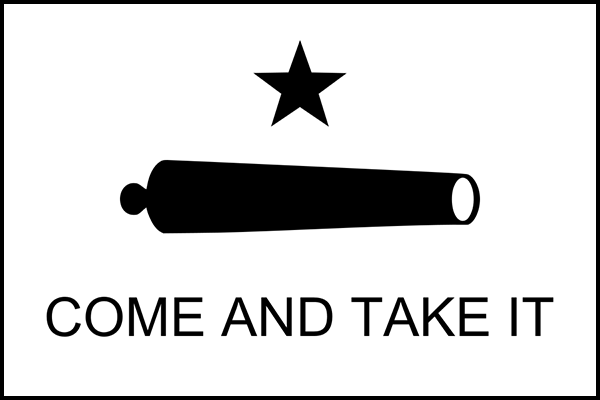
On October 2, 1835, Texans and Mexicans met in the first military battle of the Texas Revolution, the Battle of Gonzales.
In 1831, Mexican authorities gave the settlers of Gonzales a small cannon to help protect them from frequent Comanche raids. Over the next four years, the political situation in Mexico deteriorated, and in 1835 several states revolted. As the unrest spread, Colonel Domingo de Ugartechea, the commander of all Mexican troops in Texas, felt it unwise to leave the residents of Gonzales a weapon and requested the return of the cannon.
When the initial request was refused, Ugartechea sent 100 dragoons to retrieve the cannon. The soldiers neared Gonzales on September 29, but the colonists used a variety of excuses to keep them from the town, while secretly sending messengers to request assistance from nearby communities. Within two days, up to 140 Texians gathered in Gonzales, all determined not to give up the cannon. On October 1, settlers voted to initiate a fight. Mexican soldiers opened fire as Texians approached their camp in the early hours of October 2. After several hours of desultory firing, the Mexican soldiers withdrew.
On October 3, 1863, President Abraham Lincoln proclaimed a national day of Thanksgiving to be observed on November 26, 1863 and on the fourth Thursday in November every succeeding year.
This announcement harkened back to when George Washington was in his first term as the first president in 1789 and the young American nation had only a few years earlier emerged from the American Revolution. At that time, George Washington called for an official celebratory “day of public thanksgiving and prayer.” While Congress overwhelmingly agreed to Washington’s suggestion, the holiday did not yet become an annual event.
Thomas Jefferson, the third president, felt that public demonstrations of piety to a higher power, like that celebrated at Thanksgiving, were inappropriate in a nation based in part on the separation of church and state. Subsequent presidents agreed with him. In fact, no official Thanksgiving proclamation was issued by any president between 1815 and the day Lincoln took the opportunity to thank the Union Army and God for a shift in the country’s fortunes on this day in 1863.
On October 5, 1864, the Battle of Allatoona Pass was fought in Bartow County, Georgia.
On October 2, 1879, Wallace Stevens was born. Stevens would become a renowned poet and insurance industry lawyer. My favorite poem of his is “Connoisseur of Chaos.”
A. A violent order is disorder; and
B. A great disorder is an order. These
Two things are one.
President Woodrow Wilson suffered a stroke at the White House on October 2, 1909.
On October 4, 1918, President Woodrow Wilson sent a telegram to the Georgia Democratic Party Convention delegates in appreciation for their support of his administration.
On October 3, 1922, Rebecca Latimer Felton was appointed to the United States Senate from Georgia following the death of Senator Tom Watson. After initially being rebuffed by the Senate, Felton was sworn-in on late in November, becoming the first woman to serve in the United States Senate.
The Savannah River Bridge opened on October 4, 1925.
The first televised Presidential address from the White House was broadcast on October 5, 1947.
At the time of Truman’s food-conservation speech, Europe was still recovering from World War II and suffering from famine. Truman, the 33rd commander in chief, worried that if the U.S. didn’t provide food aid, his administration’s Marshall Plan for European economic recovery would fall apart. He asked farmers and distillers to reduce grain use and requested that the public voluntarily forgo meat on Tuesdays, eggs and poultry on Thursdays and save a slice of bread each day. The food program was short-lived, as ultimately the Marshall Plan succeeded in helping to spur economic revitalization and growth in Europe.
The Soviet Union launched Sputnik, the first artificial satellite, on October 4, 1957.
Thurgood Marshall was sworn-in as an Associate Justice of the United States Supreme Court on October 2, 1967.
Betty Talmadge, then wife of Senator Herman Talmadge, hosted a fundraiser with Rosalynn Carter and Joan Mondale on October 2, 1976.
Ground was broken for The Carter Presidential Center in Atlanta on October 2, 1984.
Beverly Hills, 90210 debuted on October 4, 1990.
On October 3, 1995, O.J. Simpson was acquitted of murder.
The Georgia Supreme Court outlawed use of the electric chair as “cruel and unusual punishment” on October 5, 2001.
The last Braves game at Turner Field was played on October 2, 2016, with the Detroit Tigers besting the Braves by 1-0.
Fort Pulaski National Monument in Savannah is closed due to the federal government shutdown, according to WTOC.
The Fort Pulaski National Monument is now temporarily closed as a result of the government shutdown.
Via the monument’s automated service line, the landmark is closed due to the ‘current lapse of federal government appropriations’.
The monument says they will reopen and respond to calls/voicemails as soon as government funding is restored.
The Jimmy Carter National Historic Park in Plains is without many services due to the government shutdown, according to WALB.
Jimmy Carter National Park services have closed due to a government shutdown. That means the Plains High School Visitor Center, Carter’s Boyhood Farm and the Carter Gardens are all closed.
Wednesday, Oct. 1, 2025 would have been Jimmy Carter’s 101st birthday. Wednesday was also the first birthday since Carter has passed.
Visitors on Thursday, Oct. 2 came to the small town of Plains, some not knowing that the National Park sites would be closed.
Although the national park services around Plains are closed, small independent shops are still open. Some shop owners explained that the lack of visitors is really depressing for this small town that thrives on tourism.
There has not been any official comment from Jimmy Carter National Historical Park, just a post on their Facebook page directing people to a National Park Service link that explains operations while the government is shut down.
Georgia Politics, Campaigns, and Elections
Police Blotter: Reynold City Council Post 5 member Timishea Price was arrested, according to 13WMAZ.
A Reynolds city council member was arrested Wednesday for delaying the arrest of a suspect wanted for a double-homicide in Florida, according to a Facebook post from the Reynolds Police Department.
The police department says Timishea Price, the city council member for Post 5 in Reynolds, was arrested on Tuesday for hindering the search for a murder suspect from Florida.
The Facebook post said US Marshals contacted Reynolds PD about the search for James Daniels, 60, who was wanted for a double homicide that happened in Florida.
“We had information from the U.S. Marshal that we believe that the Daniels had connection between Timishea Price, and they believed that he was in her household,” said Reynolds Police Chief Lonnie Holder. “At that time, of course, we said set up a perimeter and we approached her, went to her house, knocked on the door.”
A South Florida news station said he was convicted and sentenced to life in prison for a double-murder in 2020, but was set free due to a “procedural error” by the Turner Guilford Knight Correctional Center.
The police department said Price was suspected of being in contact with Daniels, and was taken into custody by the Reynolds Police Department. Daniels was apprehended by the US Marshals, according to the Facebook post.
The police department says they are seeking warrants to charge Price with felony hindering the apprehension of a criminal.
“Crime is crime,” Holder said. “Nobody is above the law, and we’ll do our job to the fullest. If someone commits a crime, we’ll deal with it.”
The search is over for a convicted killer who was mistakenly released from a Florida jail.
James Edward Daniels was recaptured by law enforcement in Georgia on Wednesday.
The 60-year-old convicted murderer was mistakenly released Saturday from the Turner Guilford Knight Correctional Center in Miami-Dade County.
Investigators called his release a “procedural error” and initially warned Daniels could have been armed and dangerous.
Daniels had been sentenced to life in prison earlier this year for his role in the December 2020 kidnapping and torture of three men from an Opa-locka tow yard.
Prosecutors said Daniels then took the victims to an abandoned house and executed two of the victims; the third survived.
He was convicted by the U.S. Attorney’s Office Southern District of Florida and sentenced, but Daniels was moved last week from federal custody to the county jail.
Daniels only spent three nights in the county jail before mistakenly being allowed to walk free, sparking the intense manhunt.
On Wednesday, detectives say they learned Daniels was in communication with Tamea Price, a councilwoman in Reynolds, Georgia.
After making contact with Price, U.S. Marshals found them both at a home and took them into custody.
Price now faces a felony charge of hindering the apprehension of a criminal. Daniels is awaiting extradition back to Florida.
Baldwin County opened a new SkyNet AI-driven crime center, according to 13WMAZ.
Baldwin County unveiled a $650,000 real-time crime center that uses artificial intelligence and advanced camera systems to track suspects and assist law enforcement agencies across the region.
The facility, which took two years to develop, combines an upgraded 911 call center with an intelligence unit equipped with AI-powered surveillance tools including Flock Safety license plate readers, facial recognition software and criminal records databases.
Evelyn Johnson, the center’s director, said the technology addresses critical gaps in modern policing.
“Law enforcement is understaffed. Our agency is just like every other,” Johnson said. “Also, technology these days is underutilized, in my opinion.”
Johnson, who developed the center with Sheriff Bill Massee, said intelligence work has been a passion throughout her career.
“Knowing that my intelligence that we gather is going to help not only make our officers safer but our community safer is a huge thing for me,” she said.
The center demonstrated its capabilities during Thursday’s opening by tracking a vehicle in real time through Flock Safety cameras positioned throughout the county. Operators can search license plates, access jail and court records through a system called Flock Nova, and use Clearview AI to match faces against images from social media and other online sources.
The new system allows dispatchers to pinpoint caller locations, track moving cell phones and receive emergency text messages.
The project was funded through a combination of county tax dollars, special purpose local option sales tax revenue and $40,000 from the state of Georgia. County officials said they plan to expand the center’s technology and eventually operate the real-time monitoring unit 24 hours a day.
Bibb County speed cameras will begin issuing tickets, according to the Macon Telegraph.
Speeders in the school zones at Northwoods Academy, Bruce Elementary, James H. Porter Elementary, John R. Lewis Elementary and Martin Luther King Elementary will start getting tickets once the warning period ends, which will be Oct. 4. However, the ticket cameras will only be active during school hours when the lights are flashing, the Bibb County Sheriff’s Office said.
These cameras were used for enforcement starting in early September, according to the sheriff’s office. But they initially only issued warnings to speeders.
Qualifying closed for the November 18, 2025 Special Election to fill the Senate District 35 vacancy, according to Georgia Recorder.
Four Democrats, a Republican and an independent have all thrown their hats into the ring to represent a metro Atlanta district in the state Senate.
Senate District 35, which includes parts of Cobb and Fulton counties, was vacated after former Sen. Jason Esteves, an Atlanta Democrat, stepped down to focus on his run for governor.
Gov. Brian Kemp set the election for Nov. 18 – just two weeks after voters statewide will head to the polls for a pair of Georgia Public Service Commission races.
The district was drawn to favor a Democrat, and the party establishment has coalesced behind former state Rep. Roger Bruce. Bruce formally announced his candidacy Tuesday at the law offices of former Gov. Roy Barnes, the last Democrat to occupy Georgia’s governor’s mansion.
Bruce, who was first elected to the House in 2003 and served until retiring in 2024, touted Barnes’ endorsement along with support from a slew of other Democratic leaders. Bruce said he was inspired to return to politics in large part because of the political climate coming from Washington.
“I just feel like I can either sit around and hope that it goes away or I can become the hope that people are looking for and go out there and do my part to make sure the state does not go down the path of Washington DC,” he said in a phone call. “I’ve got a granddaughter that’s three years old. I kept thinking about what kind of world am I going to leave for her?”
But Bruce is not the only former elected Democrat eyeing the open seat.
Former Cobb County School Board member Jaha Howard qualified to run Tuesday. Howard is a dentist by profession and served on the school board between 2019 and 2022.
He ran unsuccessfully for state Senate in 2017 and has also been a candidate for state school superintendent and county commissioner.
Fulton County consultant and former Atlanta journalist Erica-Denise Solomon and John Daryl Williams of Cobb County qualified to run for the seat Wednesday.
In a statement, Solomon pledged to prioritize legislation including to boost affordable housing, education and infrastructure.
“Throughout my career, I have told the stories of communities that are too often overlooked or misrepresented,” she said. “This campaign is about honoring our story, protecting our history, and building the future our families deserve.”
Republican Joshua Tolbert, a professional engineer from Cobb County, is the only Republican candidate seeking election in the seat. No GOP candidate attempted to compete for the seat last year.
Corenza Morris, a business owner and Georgia Army National Guard veteran, qualified to run as an independent, pledging on his campaign website to prioritize improving the economy and reducing crime.
Attempts to reach the other candidates for comment by phone or email were not immediately successful Wednesday, which was the final day of qualifying for the special election.
The election is set for Nov. 18 with a runoff scheduled for Dec. 16 if no candidate wins the majority of the vote. Early voting begins Oct. 27, and the last day to register to vote in this election is Oct. 20.
Some local officials have expressed worry that turnout could be lowered because the special election dates come alongside the statewide election for the Georgia Public Service Commission.
The Cobb County Board of Elections and Registration requested the date for the special election be moved to coincide with the PSC election, but Kemp in a Sept. 26 letter denied the request, arguing that doing so would shorten the time for candidates to campaign.
Democrat Geoff Duncan campaigned for Governor in Savannah, according to the Savannah Morning News.
Georgia gubernatorial candidate Geoff Duncan made his first trip to Savannah Wednesday since announcing his bid for the seat, hosting a table discussion with two local healthcare professionals about challenges facing the industry.
On the state of healthcare in the U.S., Duncan offered a clear assessment.
“We’ve got a crisis on our hands, and I don’t have to say that. I think the folks at home feel that.”
Duncan touted policies such as doubling the Georgia Rural Hospital Tax Credit program and expanding Medicaid, the government health program for low-income individuals and families. He also said he would use a portion of the state’s $17 billion “rainy day” fund to support Medicaid expansion in light of federal cuts to the program.
Chatham County, anchored by deep blue Savannah, is also a traditionally Democratic stronghold outside of the Metro Atlanta area. And while in Savannah, Duncan also faced questions about his party switch and record as a Republican.
“I’m now a Democrat, a proud Democrat that’s focused on three issues. We have an affordability crisis, we have a healthcare crisis, and we have a Donald Trump crisis, and I’m going to use every opportunity I have to figure out solutions for those issues,” Duncan said Wednesday.
Wednesday, Duncan took part in a health care roundtable where he promised to bring health care costs down and protect local hospitals as governor. He says he also wants to expand health care to rural communities.
“I am laser focused on affordability, health care and Donald Trump. And that’s what I believe most Georgians are concerned about,” said Duncan.
Duncan’s “Protect Georgians’ Health Care” Tour will also hold events in Homerville, Clarkston, Macon, Albany and Augusta.
State Senator John F. Kennedy (R-Macon) spoke about his campaign for Lieutenant Governor, according to the Albany Herald.
“Being president pro tem, you really have to look at issues as they affect the state and look at them from a bigger picture rather than your own senate district,” Kennedy said. “Of the different people in the race, I’m the person that has a consistent track record of conservative legislation and someone who has a vision for Georgia.”
Kennedy said his platform is focused on “keeping Georgia growing.”
“We’ve been fortunate to have Gov. (Brian) Kemp guiding the economy and our state for the last 6 1/2 years,” he said. “If we don’t elect the right leaders who understand business, understand how the state economy works … if we have a good economy and folks can have good jobs and take care of their family, a lot of social ills … get taken care of.”
Kennedy’s strong support of Georgia’s economic growth saw him leading the state’s 2025 tort reform battle, which sought to reform the state’s civil litigation system. He said Georgia had an unfair civil justice imbalance that forced insurance companies to leave the state.
“You can pick just about any sector in the economy,” Kennedy said. “For example, the medical sector: You have a lot of desirable medical professionals, doctors and other professionals that want to come to the state of Georgia but are electing to go elsewhere because the malpractice premiums are so high.”
Senate Bill 68 makes it harder to sue businesses for things that happen on their property, a concept known as premises liability.
“It is really a significant measure to bring fairness back to the whole process and maintain a good environment for our job creators in Georgia,” Kennedy said.
Kennedy said his small-town background in south Georgia means he understands the unique challenges in bringing industry to rural Georgia. He said he believes in “good, conservative budgeting” at the state level so taxpayer dollars are spent wisely and funneled into areas that need it most.
“As lieutenant governor, I would certainly make sure that those that want to bring opportunities are businesses that are already in Georgia that want to expand, know that there’s a big beautiful state outside of the Atlanta area and that the people there are great, hard-working folks who want those opportunities,” he said.
As far as health care access concerns, Kennedy said he wants to work with state organizations like Mercer University to make recruiting health care professionals in the state a priority.
The lieutenant gubernatorial election will take place, Nov. 3, 2026. Other Republican candidates who have qualified for the seat are Sen. Greg Dolezal, Senate Majority Leader Steve Gooch, Sen. Blake Tillery, House lawmaker David Clark and Georgia Department of Veterans Services board member Takosha Swan. Sen. Josh McLaurin is the most high-profile Democrat in the race.
The AJC looks at five state legislative seats where Republicans may be vulnerable in 2026.
House District 105 (Dacula and Buford)
Incumbent: Republican Sandy Donatucci
2024 margin: 80 votesHouse District 99 (Duluth, Suwannee, Sugar Hill)
Incumbent: Republican Matt Reeves
2024 Margin: 2 percentage pointsHouse District 53 (Buckhead, Roswell, Sandy Springs)
Incumbent: Republican Deborah Silcox
2024 Margin: 4 percentage pointsSenate District 48 (Johns Creek, Sugar Hill and parts of Forsyth County)
Incumbent: Republican Shawn Still
2024 Margin: 7 percentage pointsHouse District 48 (Johns Creek, Peachtree Corners, Roswell)
Incumbent: Republican Scott Hilton
2024 Margin: 10 percentage points“We see a lot of great pickup opportunities for Republicans,” said Carmen Bergman, the executive director of the Georgia House Republicans. “We’re on the offense.”
In the Georgia House those include Democrats Mack Jackson of Sandersville, who won by just 45 votes last year, and Tangie Herring of Macon, who won her race by less than 1 percentage point. Both Jackson and Herring supported Republican-led priorities this year, which could court swing voters.
Patty Marie Stinson from Butler and Floyd Griffin from Milledgeville also won close races.Finally, Jasmine Clark won reelection last year by 8 percentage points over her Republican competitor. But Clark has announced plans to challenge U.S. Rep. David Scott for his seat in Congress, leaving that Lilburn-centered state House race wide open.
13WMAZ covers local elections in middle Georgia.
Bibb County
Education SPLOST voteWarner Robins
Mayor: LaRhonda Patrick vs. Fabian VelazquezPerry
Mayor: Christopher Smith vs. Randall Walker
Council, Post 1-1: Amy Fouse vs. Phyllis Bynum-Grace
Council, Post 301: Eugene Triplett vs. Darry AlbrittonCenterville
Council, Post 1: Tenesha Brown vs. Robert Bird
Council, Post 3 (open): Logan Cowperthwaite, Velicia (Lisa) Lowe, Timothy McEady, Scott Rorie vs Larry Word Jr.Fort Valley
Mayor: Andrew Kim, Shakeena Reeves, Anthony Clark vs. Jefferey Lundy
West Ward Council: Marcus Agostino vs. Donald J. Williams
East Ward Council: Juanita Plant Bryant, Carson L. Brooks. Jr. vs. Sheniqua Freeman
At-Large Council: Alton Howard, Ralph L. Davis II vs Talisha Carter-MoodyMilledgeville
Mayor: Walter Reynolds vs. Mary Parham Copland
Council, District 2: Arlene Simmons, Shidonna Solomon vs Brooks Snider
Council, District 6: Kayla Brownlow vs. Jeffrey WellsForsyth
Council, Post 2: Chris Hewett vs. Walter Goodson
Council, Post 6: Michael Dodd vs. Glynn Holmes Sr.Monroe County
Education SPLOST, funding a new Mary Persons building.Dublin
Council, three seats available (At-Large): Sara Kolbie, Tess Godfrey, Richard Mascaro, John Hall, Mitchell Whittington, Rae Bloodworth, Ben Lanier, Brandon Chain vs J. Roy Rowland IV.Eastman
Council, District 1: Battle vs. ThomasCrawford County
Transportation SPLOST voteGray
District 1: Richard Tipton vs. David Tufts
District 2: Ikea Simmons vs. Lehman R. Woods
District 3: Natalie A. Lurie vs. Terrell Fulford
District 4: Terry Favors vs. James W. HorneCochran
Mayor: Carla Coley (unopposed, poised to becomes first woman mayor)
Council, District 3: Cassandra Stanley vs. Dianne Lawson LesterGordon
Mayor: Terry Eady, Chancey Allen, Mary Lue vs. April Adside Smith
Three council seats: Barbara Towles, Rodney Evans, Harold Whipple, Kyle Swicord, Yyacheeko Veal, Victoria Whipple, Debra Horton, Patricia Dupree vs George Wynn.Toomsboro
Mayor: Joyce Denson vs. Vince SmithIrwinton
Two council seats: Roger Bacon, Harvey Curry vs Deborah OsborneEatonton
Council Ward 3: Fredrick L. Lowe Jr. vs Janie ReidMarshallville
Mayor’s race: David Bryant vs. Al Lane
Council: George Rumph, David Johnson, Tim Gerard vs. Carl RuckerVienna
Council: Walter F. Brown, Shatarra Lundy, Babette Lewis, Angela Childs vs. Jaroskey BullardDanville (Twiggs County)
Mayor: Michael Jackson vs. Jimmy SmithMontezuma:
Council: Cleveland Hobbs, Marvis Brown, Daniel Power vs Charlie CarrIdeal:
Mayor: Samuel Jenkins vs Jimmie Ogburn
Council: Gwendolyn Nelson vs Melissa Joiner
Milledgeville City Council District 2 candidate Arlene Simmons defeated an eligibility challenge to keep her place on the November ballot, according to WGXA.
A Milledgeville city council candidate was declared eligible to run for her district Friday after facing legal challenges from her competitor.
“I’m ready to roll,” District 2 hopeful Arlene Simmons told WGXA Monday. “I’m ready to put those signages out, continue on this journey for my town, for my district.”
One of her competitors, Brooks Snider, challenged she did not meet the residency requirements for the election in late August.
Both Georgiaand Milledgeville code require a candidate to have lived in the area for 12 months prior to being on the ballot, according to documents from Milledgeville’s election supervisor, Courtney Chavers.
Documents from the city say Snider presented a court filing of a name change from 2023 showing Simmons as a resident of Gwinnett County.
Simmons had claimed a homestead exemption on the property since 2008, which, by Georgia code, would deem it a “person’s residential address.”
She testified her ex-husband lives at the address and told WGXA by phone Monday she made the name change “years ago” though did not explain the reasoning.
Her listed address in Milledgeville sparked more controversy.
A notice of candidacy filed in August showed her parents’ former home on South Elbert Street as her legal address, and on other official documents like her April driver’s license – per city documents.
However, she submitted a lease and rent receipts from a house on 201 Staley Street – just across the road.
“Because of the time frame, I wouldn’t have had time to change it,” Simmons explained. “I stayed in that address across the street from that address [Elbert Street], so I was pretty much in the same district and the information I received was to continue using that address on my license.”
Indeed, Chavers says Simmons’ explanation for the use of the Elbert Street address as her legal residence was because she was advised by a staff member of the State Ethics Commission that she should use the address on her Georgia Driver’s License as her legal residence.
Although both houses are in District 2, Chavers found it “troubling” Simmons did not use the correct address for filing on sworn affidavits and candidacy notices
Simmons says she’s ready to put this behind her and move forward with her campaign – focused on public service and giving back.
“I have proven that for the last 20 years for my city and my district,” Simmons said. “Please get out and vote, it’s time for change.”
WGXA also reached out to Brooks Snider for comment Monday; we did not receive a response at the time of publication, though our request remains open.
Mayor khalid “Kobi” kamau faces eight challengers in his reelection campaign, according to the AJC.
Mayor khalid “Kobi” kamau, a former South Fulton City Council member, faces eight challengers on the Nov. 4 ballot. They include council member Carmalitha Gumbs and two other familiar faces in South Fulton politics — former council member Mark Baker and the city’s first mayor, Bill Edwards.
Edwards, like kamau, faced controversy in his time as mayor.
In 2019, when Baker, Gumbs and kamau all were on the City Council, the body voted to investigate then-Mayor Edwards, who was accused of directing a development deal to Fulton County instead of the city. An effort to remove Edwards and a councilwoman from office over the matter was unsuccessful.
Of the nine people running for South Fulton mayor this year, only kamau did not respond to questions The Atlanta Journal-Constitution emailed to each candidate asking about their experience, why they are running and what they hope to accomplish if elected.
But the AJC asked kamau after a community meeting Sept. 3 to explain his decision to qualify for the election after claiming in April he would not seek reelection. The mayor suggested the city needed his leadership, giving as an example the millage cap issue being discussed during the feedback session that night.
Earlier this year, the City Council called for a forensic audit of his public spending, temporarily barred him from city buildings and seized some items that council members allege he purchased improperly, including a pool table for the mayoral suite that cost $1,830.
The council also stripped kamau of access to the mayoral budget and garnished his wages to pay back the city more than $5,000 for a large, vinyl mural installed in the mayoral suite in City Hall. For his part, kamau has described himself as frugal and brushed aside the criticism, calling it political mudslinging.
Garden City voters will elect City Council members for District 5 and At-Large seats, according to the Savannah Morning News.
Michael W. Bruner is running unopposed for District 1.
The race for District 5 is a bit of a rematch from the race in 2021 with incumbent Kim Tice running for reelection and Christopher Figiel once again throwing his hat in the ring.
At-Large
Gwyn L. Hall was born and raised in Garden City and has served on council for a total of 19 years. He served on the planning and zoning commission before winning the election to his seat. He’s running again because he said he wants to continue what he’s started in protecting the safety of the residents and businesses. One of the projects he wants to continue momentum on is the building of the new recreation complex, and exploring building a new station.
Gary Monroe was born and raised in Garden City and is on his fifth run for a position in city government. The last four times, he ran for mayor, including a campaign in 2023 that he lost to Bruce Campbell. He said previously that he would not run again. He’s also run for Chatham County Commissioner District 8.
The Georgia Chamber of Commerce hosted a Rural Prosperity Summit, according to the Tifton Gazette.
Representatives of rural communities across the state gathered in Tifton Oct. 1 to take part in the Rural Prosperity Summit, an annual conference recognizing the growth and achievements of the state’s smaller communities and discussing programs and plans to help those areas grow and thrive.
Hosted by the Georgia Chamber of Commerce and held at the University of Georgia Tifton Campus Conference Center, the summit saw participation from local organizations and institutions like the Tifton-Tift County Chamber of Commerce and Abraham Baldwin Agricultural College, leaders of other communities across Georgia, and representatives of larger organizations and companies that support those communities, such as Georgia Power, all eager to come together and push for prosperity in Georgia’s rural areas.
Seminars held throughout the conference examined a number of issues commonly faced by rural communities, including maintaining a strong workforce amid changing labor trends and shifting populations; preparation, response, and recovery from natural disasters; grappling with housing shortages; and providing easy access to affordable healthcare.
“The reason that rural Georgia is more prosperous today than it was five or ten years ago is because of great leadership,” Clark said. “It’s because of the Tyler Harpers of the world, the Brian Kemps of the world, but quite frankly, there’s lots of unsung heroes — it’s the men and women in this room, that are in communities doing the hard work every day to make Georgia a better place to live, work, play, and pray.”
The Port of Savannah’s container volume increased in August, according to the Savannah Morning News.
The Port of Savannah saw its third busiest month in Georgia Ports Authority history in August, handling 534,037 container units.
That number of 20-foot equivalent container units, or TEUs, represented a 44,000 TEUs increase – 9 percent – over August 2024.
“Georgia has been recognized as the No. 1 state for business for over a decade in part because we’re also the best state for reliable infrastructure,” said Gov. Brian Kemp. “As powerful economic drivers, the Ports of Savannah and Brunswick are a key part of the pro-job creator environment we’ve fostered to ensure every part of our state can thrive.”
Port activity in Georgia now supports nearly 651,000 full- and part-time jobs across the state, according to an economic impact study by the University of Georgia’s Terry College of Business. The statewide number has grown by 41,770 jobs or 7 percent compared to fiscal year 2023, the period covered by the previous study.
Georgia Ports now help sustain 12 percent of total state employment, according to the study.
The Georgia Port Authority’s Board approved approximately $614 million in infrastructure improvements for Ocean Terminal civil works in the container yard, terminal and maintenance and operations building.
“Our port master plan is designed to deliver the capacity our customers need to grow their business in Georgia,” said GPA Board Chairman Alec Poitevint. “As part of that overall plan, Ocean Terminal will play an important role in growing our capabilities and providing the most competitive port operations in the nation.”
The first half of the Ocean Terminal container yard renovation will be completed in 2027 and the second half in 2028. The $1.54 billion overall project will allow the 200-acre facility to serve two large container ships simultaneously.
Related Posts
 Curb sought on last-minute lawmaking in Georgia | Online Athens
 Georgia Politics, Campaigns, and Elections for June 20, 2019
 Deal signs $19.9 billion budget for fiscal 2014 | www.ajc.com
 As Prisons Squeeze Budgets, GOP Rethinks Crime Focus – WSJ.com
 Adoptable (Official) Georgia Dogs for January 27, 2017


Comments ( 0 )