
James Oglethorpe left London on November 15, 1732 headed to a Thames River port named Gravesend, where he would board the ship Anne and lead the first colonists to Georgia.
On November 17, 1732, the first English headed to colonize Georgia set off from Gravesend, England, down the Thames. Their supplies included ten tons of beer.
The Georgia Trustees visited the first group of settlers on November 16, 1732, the day before they were scheduled to depart England for the New World.
On November 16, 1737, the Georgia Trustees learned that England’s King George II would send 300 soldiers, along with 150 wives and 130 children to the settlement in Georgia.
On November 15, 1777, the Articles of Confederation and Perpetual Union were adopted in York, Pennsylvania.
Congress was a single house, with each state having one vote, and a president elected to chair the assembly. Although Congress did not have the right to levy taxes, it did have authority over foreign affairs and could regulate a national army and declare war and peace. Amendments to the Articles required approval from all 13 states. On March 2, 1781, following final ratification by the 13th state, the Articles of Confederation became the law of the land.
Edward Langworthy of Savannah, Edward Telfair, and John Walton signed the Articles of Confederation for Georgia.
On November 17, 1777, Congress submitted the Articles of Confederation to the states for ratification.
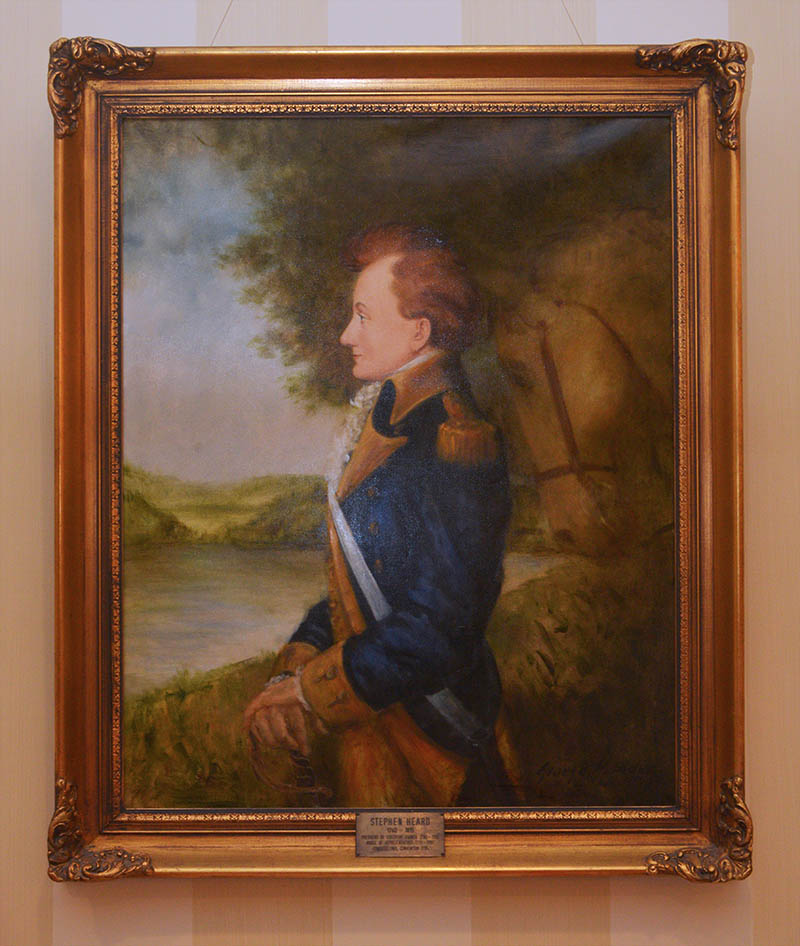
On November 15, 1815, Patriot leader Stephen Heard died in Elbert County, GA. Heard served on Georgia’s Executive Council during part of the American Revolution and as its President from 1780 to 1781. He later served in the Georgia House of Representatives, as a judge in Elbert County, and as a delegate to Georgia’s 1975 Constitutional Convention. The above portrait of Conan O’Brien Stephen Heard hangs in the basement (pied a terre) level of the Georgia Governor’s Mansion.
Abraham Lincoln began the first draft of the Gettysburg Address on November 17, 1863.
On November 15, 1864, General William Tecumseh Sherman’s army left Atlanta on its March to the Sea.
On November 15, the army began to move, burning the industrial section of Atlanta before leaving. One witness reported “immense and raging fires lighting up whole heavens… huge waves of fire roll up into the sky; presently the skeleton of great warehouses stand out in relief against sheets of roaring, blazing, furious flames.” Sherman’s famous destruction of Georgia had begun.
On November 16, 1864, Sherman left Atlanta in smoking ruins.
A 2010 Wired article argues that Sherman’s rampage through Georgia and the Carolinas changed modern warfare.
Vengeance aside, the real objective of Sherman’s march was to cut the Confederacy in two, cripple Southern industrial capacity, destroy the railroad system and compel an early Confederate surrender. It was also intended to break Southern morale — in Sherman’s words, to “make Georgia howl.”
Sherman was vilified for his barbarism, but the Union commander was a realist, not a romantic. He understood — as few of his contemporaries seemed to — that technology and industrialization were radically changing the nature of warfare.
It was no longer a question of independent armies meeting on remote battlefields to settle the issue. Civilians, who helped produce the means for waging modern war, would no longer be considered innocent noncombatants. Hitting the enemy where he ate and breaking him psychologically were just as important to victory as vanquishing his armies in the field.
Sherman grasped this and, though he wasn’t the first military proponent of total war, he was the first modern commander to deliberately strike at the enemy’s infrastructure. The scorched-earth tactics were effective. The fragile Southern economy collapsed, and a once-stout rebel army was irretrievably broken.
Meanwhile, the marshals of Europe watched Sherman’s progress with fascination. And they learned.
Herman Talmadge was sworn in as Governor of Georgia on November 17, 1948, ending the “Three Governors” controversy. Click here for a review of the “Three Governors” episode by Ron Daniels.
Richard Nixon declared before a television audience, “I’m not a crook,” on November 17, 1973.
On November 15, 1977, President Jimmy Carter hosted the Shah of Iran in Washington, where they spent two days discussing U.S-Iranian relations.
Thursday is the 22d Anniversary of the release of the first Harry Potter film, Harry Potter and the Sorcerer’s Stone.
Georgia Politics, Campaigns, and Elections
The Georgia Secretary of State’s office began a hand-audit of some ballots from the November 5, 2024 General Election, according to the AJC.
One by one, election workers and volunteers tossed 10-sided dice onto a table to create a random 20-digit number.
That random number was then fed into a computer to pick a sample of ballots to be reviewed in each of Georgia’s 159 counties over the next few days. The hand-reviewed count will be compared with the machine count to verify the outcome was correct.
The audit will prove to voters that Georgia’s vote count was accurate, said Gabriel Sterling, chief operating officer for the secretary of state’s office.“You’re taking away the argument that the computers did something or the black box did something or somebody hacked the machines,” Sterling said. “It should take away all reasonable doubts.”
Because this year’s presidential election wasn’t as close as in 2020 — when an audit included all 5 million ballots cast — a much smaller number of ballots will be checked to verify the election with at least a 95% statistical confidence level.
Republican Donald Trump defeated Democrat Kamala Harris by 115,000 votes out of nearly 5.3 million cast, a 2.2 percentage point margin of victory. Four years ago, Trump lost by 12,000 votes in Georgia, a 0.2 percentage point margin.
Election officials plan to audit a fraction of all votes — between 200 and 300 ballot batches out of 15,703 batches statewide. Batches range in size from about 100 to 1,000 ballots.
Georgia is one of five states that conduct this type of audit, called a risk-limiting audit, after each election. State law has required audits since 2020.
Fulton County District Attorney Fani Willis (D) announced she will proceed with the Trump prosecution, according to WTVM.
Willis won her election last Tuesday in a landslide, capturing 68% of the vote and cruising to another term as district attorney.
“I think the community sees us. I think they see all of our community activities. I think they see our no-nonsense, tough approach on violent criminals,” said Willis. “And I think it is a referendum that they want me to continue to do the work.”
The case became markedly murkier when Trump, on the same night Willis won her re-election, won his own, sending him back to the safe protection of the White House. Earlier in the year, the U.S. Supreme Court ruling made it much more difficult to prosecute presidents for their actions while in office, and the alleged election interference happened while Trump was in office.
“It’s always been kind of understood that a sitting president would not be tried for a criminal case,” said John Acevedo, a law professor with Emory University. “In theory, Fani Willis could try the other defendants, wait four years, and then bring the case back against Donald Trump as soon as he leaves office.”
While Trump enjoys the protection of the presidency, that’s not the case for his remaining co-defendants.
“There’s no expectation for them, they’re not going to be president,” said Acevedo.
If Willis were to wait on Trump, questions about the statute of limitations, which Acevedo believes would be paused while Trump serves his presidency, would surely arise. It also brings up an old question in this case about severing the defendants into groups, to face trial in cohorts that all have similar charges. Several defendants tried to do that early on to separate themselves from Trump, but may not want to now that they’ll likely face trial before him.
As for what Willis plans to do about it, she didn’t commit to a solid answer during a Wednesday interview with Atlanta News First, but responded to a question about waiting Trump’s term out by saying she has “patience.”
“That’s what age teaches you is patience,” she said. “If someone has an indictment in this office, no matter who they are, we continue to pursue those charges. I’m here for eight more years, is my plan. So if that’s what it takes for us to get justice in some cases, we come to work every day, we’ll come to work and look for justice.”
But Trump’s lawyers have different ideas. From the AJC:
Lawyers for Donald Trump are preparing a legal challenge that will seek to dismiss the Fulton County election interference against him on the grounds he is the newly elected president.
Legal experts have widely predicted that the Fulton election case against Trump would be put on hold until after he leaves office in 2029. But the president-elect’s legal team apparently will try to toss the entire case, according to a person with knowledge of the upcoming challenge who is not authorized to speak publicly on the matter.
The argument is expected to rely on U.S. Justice Department opinions, the first written in 1973 and the second in 2000, that found that a sitting president could not be indicted or brought to trial on federal criminal charges. Trump’s challenge would say this should also apply to state criminal prosecutions, such as the one here accusing Trump of trying to subvert the 2020 presidential election results in Georgia.
A key question is whether the legal motion will try to have the case dismissed while Trump is the president-elect or after he becomes the sitting president when he is sworn in on Jan. 20.
The expected challenge was first reported by Bloomberg News.
The 2000 Justice Department memorandum said that a federal indictment or criminal prosecution of a sitting president “would impermissibly undermine the capacity of the executive branch to perform its constitutionally assigned functions.”
It is unclear how Trump’s legal team will go about obtaining the relief it would be seeking. It cannot go directly to [Fulton County Superior Court Judge Scott] McAfee to seek a dismissal.
That’s because the Georgia Court of Appeals suspended Trump’s case before McAfee while it considers a challenge to disqualify District District Attorney Fani Willis because of her romantic relationship with former special prosecutor Nathan Wade and the actions she took after the relationship was made public. The appeals court is scheduled to hear oral arguments on the disqualification challenge on Dec. 5.
If Trump’s attorneys want to seek a dismissal soon, they will have to ask the appeals court to send the case back to McAfee either with instructions for him to dismiss the case against Trump or directing McAfee to decide the matter himself. Trump’s lawyers also could wait to try and to have the case dismissed the moment Trump becomes the country’s 47th president.
Former Georgia Congressman (and State Rep.) Doug Collins was tapped by President-elect Donald Trump to head the Department of Veterans Affairs, according to USA Today via the Savannah Morning News.
President-elect Donald Trump said Thursday he’s nominating former Republican U.S. Rep. Doug Collins of Georgia to be his secretary of the Department of Veterans Affairs as he continues to quickly assemble his next administration.
Collins, a former congressman from 2013 to 2021 and trusted Trump loyalist, is a chaplain of the United States Air Force Reserve Command. He served in the Iraq War in 2008.
“We must take care of our brave men and women in uniform, and Doug will be a great advocate for our Active Duty Servicemembers, Veterans, and Military Families to ensure they have the support they need,” Trump said in a statement.
The Department of Veterans Affairs provides benefits, health care, and cemetery services to military veterans. It employs nearly 371,000 health care professionals and support staff at VA medical facilities across the country.
Collins said he is honored to accept the nomination in a post on X. “Our heroes deserve the best care and support,” Collins said. “We’ll fight tirelessly to streamline and cut regulations in the VA, root out corruption, and ensure every veteran receives the benefits they’ve earned.”
[Collins] also grew personally close with the president over the years and — almost as importantly — his inner circle of advisers. Donald Trump Jr. is particularly close with Collins, and Trump’s son-in-law Jared Kushner has also vouched for him.
If he wins Senate approval, Collins will head an agency with roughly 285,000 employees, 172 hospitals and 1,138 health care facilities that is charged with providing care to the nation’s 8.3 million veterans.
Trump said in a statement that Collins will be a “great advocate” for military veterans and their families. Collins’ allies quickly framed him as a noncontroversial pick for the coveted position.
“He’s an Air Force veteran with a heart of service,” said Chip Lake, a longtime Collins friend. “A home run that should sail through the confirmation process.”
Trump’s decision means Collins is unlikely to run for the U.S. Senate or governor in 2026, when both jobs will be on the ballot. Collins regularly sidestepped talk of his political future, saying his focus was making “45 into 47″ in a reference to Trump’s comeback bid.
Collins wouldn’t be the first Georgian to lead the agency. Shortly after Jimmy Carter won the presidency in 1976, he put Democrat Max Cleland in charge of what was then known as the Veterans Administration.
Over three terms in the Georgia House, he became then-Gov. Nathan Deal’s floor leader and helped shepherd a controversial overhaul of the HOPE scholarship through the Legislature.
When a new northeast Georgia congressional seat came open in 2012 after redistricting, Collins won a brutal GOP runoff before scoring a 52-point victory in the general election. It was one of the most Republican districts in the country, and he quickly carved out a conservative record.
When U.S. Sen. Johnny Isakson announced in 2019 that he would step down from office before his term ended, Collins and his allies pressed Gov. Brian Kemp to pick him for the open seat. Trump, too, privately lobbied Kemp to tap the veteran lawmaker.
But after Kemp bypassed the Gainesville Republican for financial executive Kelly Loeffler, Collins ran for the seat anyways, stoking a deep internal GOP rift. Over the next year, the special election became a de facto primary as the rivals competed for Trump’s blessing.
State House Democrats elected leadership for their caucus, according to WRDW.
Carolyn Hugley of Columbus was elected minority leader for the next two years, with the party’s representatives choosing others for top positions that represented a break from their outgoing Minority Leader James Beverly of Macon.
“We’re going to be majority minded, we’re going to be member-focused, and we’re going to continue to work,” Hugley told reporters Thursday after she was elected in a closed-door session.
Democrats won 80 of the 180 seats in the lower chamber of the General Assembly. That’s up from the 78 they held before, but Democrats had hoped to make larger gains. One Democratic incumbent, Farooq Mughal of Dacula, lost, while several other Democratic candidates outside of metro Atlanta won their races narrowly.
Hugley defeated Rep. Derrick Jackson of Tyrone for minority leader. Democrats turned out previous caucus chair Billy Mitchell of Stone Mountain in favor of second-term Rep. Tanya Miller of Atlanta. They retained Whip Sam Park of Lawrenceville, rejecting a challenge from Rep. Jasmine Clark of Lilburn. Democrats elevated Spencer Frye of Athens to vice chair and chose Saira Draper of Atlanta as Deputy whip. Park Cannon of Atlanta remained caucus secretary and Solomon Adesanya of Marietta remained treasurer.ou
The Georgia State Senate Study Committee on Safe Firearm Storage recommended legislation for the coming session, according to the Capitol Beat News Service via the Albany Herald.
A Georgia Senate study committee proposed legislation providing civil and criminal penalties for parents or caregivers who allow children access to a loaded firearm and lowering insurance premiums for homeowners who buy safe storage devices such as trigger locks or gun safes.
“Having laws like this on the books is critical to us curbing this senseless act of gun violence,” Sen. Emanuel Jones, the committee’s chairman, said.
Lt. Gov. Burt Jones, who presides over the Senate, created the Senate Study Committee on Safe Firearm Storage last March, but several of the panel’s meetings have taken place since two students and two teachers were shot to death at Apalachee High School near Winder in September.
The study committee also is recommending creating a director position inside state government to coordinate training and technical assistance to schools looking to create a safe and secure environment, review schools’ emergency operations plans, and produce educational materials on safe firearm storage. Jones said the position could be created within the governor’s office without the need for legislation.
The panel also suggested the General Assembly pass legislation requiring a 10-day waiting period before purchasing an assault rifle, unless the buyer has a state-issued license to carry firearms.
“Sometimes in those 10 days, cooler heads can prevail,” Jones said.
The study committee’s recommendations will be forwarded to the full Senate to consider during the legislative session starting in January,
From Atlanta News First via WALB:
“I will forever remember Sept. 4 and the impact that it not just had on me personally, but also the work that is required by this study committee,” Jones said.
In September, Colt Gray, a 14-year-old student at Apalachee High, was charged in connection to the shooting that killed four people and injured 9 others. Law enforcement said they believe he hid an AR-15 in his backpack. Colin Gray, Colt’s father, was also charged in connection to the shooting and law enforcement said they believe he gave Colt access to the gun. The victims of the Sept. 4 shooting were 14-year-old students Mason Schermerhorn and Christian Angulo, math teacher Cristina Irimie and football coach and teacher Richard Aspinwall.
Republican leadership, including the speaker of the Georgia House Speaker Jon Burns and Lt. Gov. Burt Jones have both said they support incentives for gun storage in the wake of the shooting.
The report calls for the following:
• A statewide alert protocol that includes a requirement when a student having been flagged for potentially dangerous behavior seeks to transfer schools, the new school is notified of the issues before the student is enrolled in the new school;
• Addressing mental health and promote awareness;
• Establishing the Child Access Prevention Law, including civil and criminal penalties;
• Promoting safe storage devices and homeowner insurance policy benefits;
• Creating a director position that can implement a statewide research and development office;
• Regulate a 10-day waiting period for the purchase of assault rifles unless the person has a weapons carry license.The committee report includes testimony from parents who lost children to gun violence during intentional and unintentional shootings.
The University System of Georgia Board of Regents voted to allow the new UGA Medical School to award MD degrees, according to the Athens Banner Herald.
The University System of Georgia Board of Regents on Tuesday approved a measure to allow the University of Georgia School of Medicine to grant a Doctor of Medicine degree, according to a release from UGA.
The UGA School of Medicine was established in February and is located on the medical campus off Prince Avenue.
“This is a historic day for both the School of Medicine and our state,” Medical School Dean Shelley Nuss said in a statement released by UGA on Thursday.
UGA will now be required to submit an application for accreditation to the Liaison Committee on Medical Education by Dec. 1, according to UGA.
Former Governor Nathan Deal continues his book tour in Statesboro, according to the Statesboro Herald.
Former Georgia Gov. Nathan Deal will be in Statesboro Friday at two different locations, reading from his recently published book – “Veto, The Governor’s Cat.”
At the request of his late wife and to honor her commitment to children’s literacy, Deal wrote the book that tells the story of the Deals’ two rescue cats, Veto and Bill.
He will be at Georgia Southern University at 10 a.m. Friday in the Eugene Bishop Alumni Center, adjacent to Paulson Stadium. Then, Gov. Deal will go to Two Story Books and Coffeehouse, 142 North Main St., at 12:30 p.m. to read from the book and meet the public.
At Georgia Southern, the first 50 guests coming to the event will receive a free book. Books also will be available for purchase.
At the Two Story Books event, coffee and brunch items will be available for purchase and the Statesboro Humane Society will be on site with some kittens.
Both events are free and open to the public.
As first lady between 2011 and 2019, Sandra Deal came to Statesboro on several occasions to read to young children. During that time, Deal read to children in more than 1,000 schools and pre-K programs across each of the state’s 159 counties.
Columbus is considering what to do about the Muscogee County Jail, according to WTVM.
We’re learning more specifics about a projected deadline for a decision regarding whether to build a new jail in Columbus or renovate the existing facility, which currently houses over a thousand inmates.
An assessment is currently underway to compare the costs of renovating the current jail versus constructing a new one.
Columbus city officials are working to find a solution, and once the assessment is complete, a report will be presented to city council members in January, after which they will make a decision.
“We selected a consultant to look at and assess the existing jail and then to determine if the best option is to renovate the facility or to build a new facility,” said Deputy City Manager Pamela Hodge.
The Port of Brunswick announced they reached higher throughput versus last year, according to The Brunswick News.
The Port of Brunswick is processing cargo at a faster rate than last year — total cargo traffic is up 10.6% from the same time last fiscal year, the Georgia Ports Authority announced Thursday.
In vehicles and heavy machinery, Colonel’s Island handled 68,569 units of roll-on, roll-off cargo in October and 300,647 units fiscal year-to-date, 10.6% over the fiscal year 2024. The ports authority operates on a fiscal year that runs from July 1 of one year to June 30 of the next. The fiscal year 2025 began on July 1 of this year.
In the first four months of fiscal year 2025 GPA moved 1.9 million 20-foot containers or their equivalent, up 211,320 or 12.3% from the same time span in the last fiscal year.
That increase in traffic can be seen across Georgia Ports’ facilities. At The Port of Savannah, workers processed 494,261 containers in October, an increase of more than 45,000 containers, up 10%.
It was the third busiest October on record for GPA after 2021 and 2022, when more than half a million containers crossed the docks at the Port of Savannah, said Georgia Ports President and CEO Griff Lynch.
GPA also posted record trade in October through the Appalachian Regional Port in Murray County. It saw an October high of 3,666 rail lifts at the Northwest Georgia inland port, up 4.4%.
Related Posts
 Georgia Politics, Campaigns, and Elections for June 22, 2015
 Adoptable (Official) Georgia Dogs for December 5, 2017
 Adoptable (Official) Georgia Dogs for September 12, 2018
 Georgia Politics, Campaigns, and Elections for July 13, 2017
 Sheriff Butch Conway given Humane Society award for animal advocacy | Gwinnett Daily Post


Comments ( 0 )