
On May 6, 1789, the Constitutional Convention in Augusta, Georgia adopted a new Georgia Constitution.
Jefferson Davis spoke in Savannah, Georgia on May 6, 1866.
Davis … defend[ed] the South’s cause in the Civil War, stating, “In 1776 the colonies acquired State sovereignty. They revolted from the mother country in a desperate struggle. That was the cause for which they fought. Is it a lost cause now? Never. Has Georgia lost the State sovereignty which … she won in 1776? No, a thousand times no.” Davis’s fiery remarks were captured by reporters for the New York Times and other northern newspapers.
Because of the national attention generated over his visit to Alabama and Georgia, Davis took a more conciliatory tone in a speech that evening, noting, “There are some who take it for granted that when I allude to State sovereignty I want to bring on another war. I am too old to fight again, and God knows I don’t want you to have the necessity of fighting again… . The celebration today is a link in the long chain of affection that binds you and the North together. Long may it be true.”
Roger Bannister became the first person to break the four-minute barrier for running the mile.
For years, so many athletes had tried and failed to run a mile in less than four minutes that people made it out to be a physical impossibility. The world record for a mile was 4 minutes and 1.3 seconds, set by Gunder Hagg of Sweden in 1945. Despite, or perhaps because of, the psychological mystique surrounding the four-minute barrier, several runners in the early 1950s dedicated themselves to being the first to cross into the three-minute zone.
At 6 p.m., the starting gun was fired. In a carefully planned race, Bannister was aided by Chris Brasher, a former Cambridge runner who acted as a pacemaker. For the first half-mile, Brasher led the field, with Bannister close behind, and then another runner took up the lead and reached the three-quarter-mile mark in 3 minutes 0.4 seconds, with Bannister at 3 minutes 0.7 seconds. Bannister took the lead with about 350 yards to go and passed an unofficial timekeeper at the 1,500-meter mark in 3 minutes 43 seconds, thus equaling the world’s record for that distance. Thereafter, Bannister threw in all his reserves and broke the tape in 3 minutes 59.4 seconds. As soon as the first part of his score was announced–”three minutes…”–the crowd erupted in pandemonium.
A “sub-four” is still a notable time, but top international runners now routinely accomplish the feat. Because a mile is not a metric measurement, it is not a regular track event nor featured in the Olympics. It continues, however, to be run by many top runners as a glamour event.
On May 6, 1984, Spinal Tap played a “comeback show” at CBGB’s in New York.
On May 6, 1996, the Atlanta Journal-Constitution reported that Atlanta was the most dangerous city in America.
Parliament-Funkadelic were inducted into the Rock and Roll Hall of Fame in Cleveland, Ohio on May 6, 1997.
Georgia Politics
Rachel’s Law
Yesterday, Governor Nathan Deal signed Senate Bill 8, called “Rachel’s Law”.
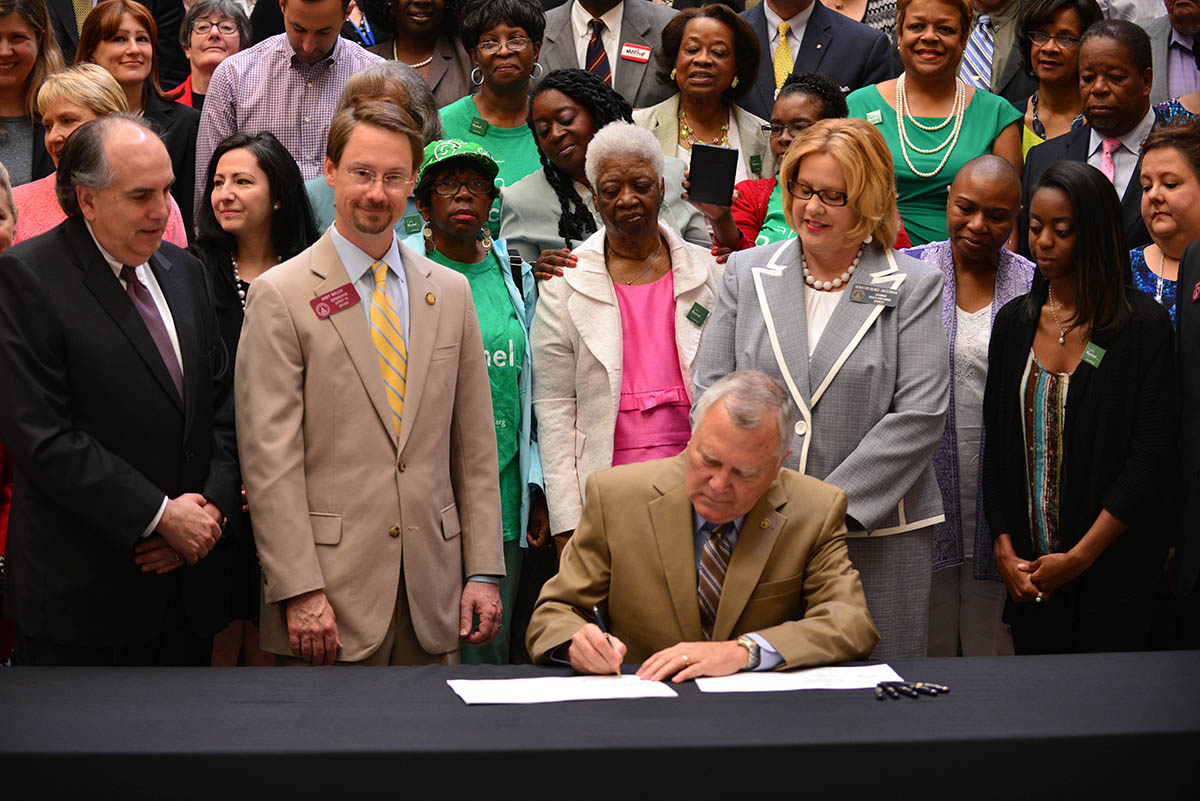
The legislation focuses on ending the sexual exploitation of Georgia minors and establishes more severe punishments for those found guilty of this crime. Sen. Renee Unterman (R – Buford), the bill’s sponsor, has been a long-time supporter of stricter laws and punishments intended to keep human traffickers from operating in Georgia. The new law will allow children who have been victimized by sex trafficking to be treated as victims—not criminals.
“This is a remarkable day for our state. Georgia will be able to better assist the victims of sex trafficking through measures that rehabilitate and heal, and offenders will hear—loud and clear—that we will not allow them to profit off of innocence. I would like to thank Governor Deal, Lt. Governor Casey Cagle, Rep. Tom Weldon (R – Ringgold), and the diligent advocates who supported Senate Bill 8 throughout the 2015 legislative session. After working for six years in the General Assembly to create a safe harbor for children, this is by far the best day of my 17 years of legislative service,” said Sen. Unterman.
Senate Bill 8, also known as the Safe Harbor/Rachel’s Law legislation, extends the statute of limitations for child sex trafficking victims from the age of 23 to the age of 25 for actions committed on or after July 1, 2015. The legislation also outlines the operation of the Safe Harbor for Sexually Exploited Children Fund and Commission, including the remittance of fees for criminal penalties and the operation of adult entertainment establishments. The Fund will be a separate entity of the state treasury, and will be used to provide care, rehabilitative services, residential housing, health services, and social services to sexually exploited children through persons or programs. The legislation will also require offenders to register with the State Sexual Offender Registry.
A companion resolution to Senate Bill 8 will go straight to voters for approval in November 2016. Senate Resolution 7 the framework for a constitutional amendment that would allow the Georgia General Assembly to set additional penalties or fees in cases where a person is found guilty of severe sex crimes. These crimes include keeping a place of prostitution, pimping, pandering, trafficking of persons for sexual servitude, or sexual exploitation of children.
Unterman thanked Deal, Lt. Gov. Casey Cagle and state Rep. Tom Weldon (R-Ringgold) after the signing for helping bring about what she called the “best day of my 17 years of legislative service.” Cagle presides over the Senate while Weldon sponsored the bill in the House of Representatives.
Rachel’s Law sets strict punishments for anyone found guilty of human trafficking, including a $2,500 penalty for offenders if the victim was 18 or older. Adult entertainment businesses who break the law face annual fees of either $5,000 or one percent of the previous year’s gross revenues, depending on which amount is higher.
Hidden Predator Act
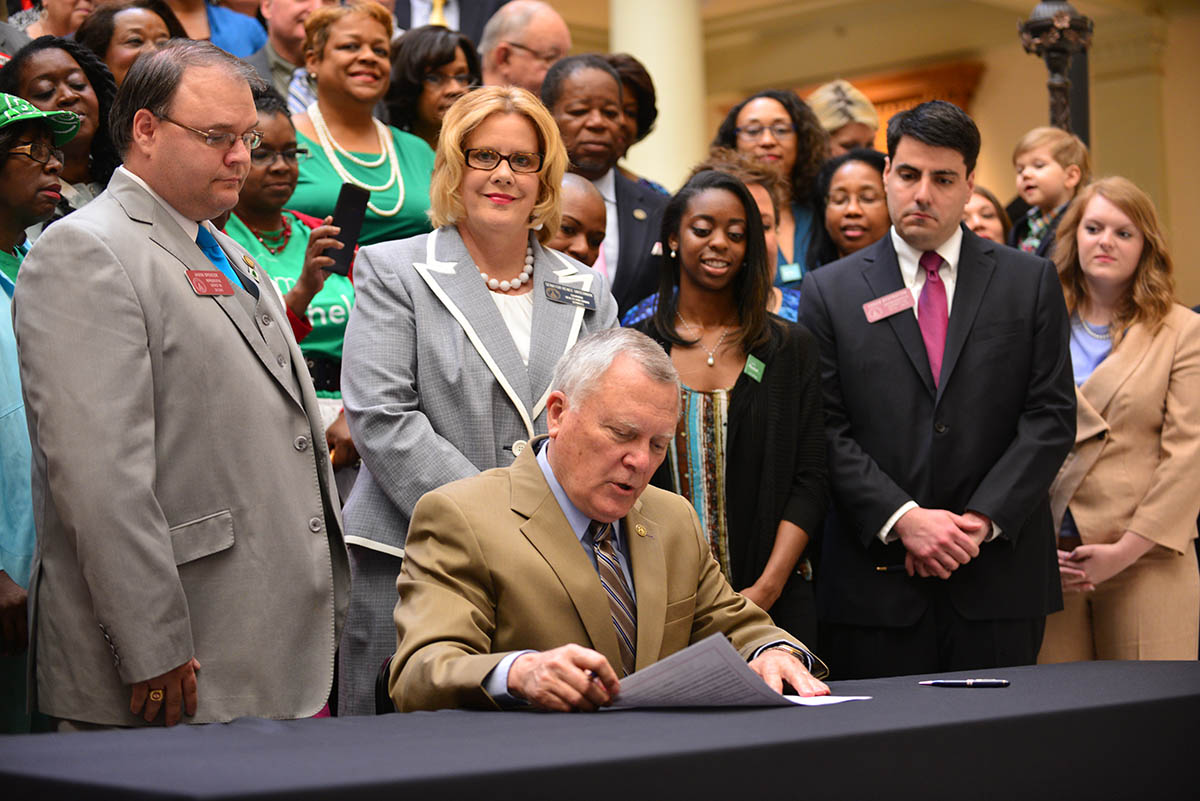
Gov. Deal also signed House Bill 17, the “Hidden Predator Act,” by State Rep. Jason Spencer. HB 17 changes Georgia’s statute of limitations for child sexual abuse cases.
“As a result of Governor Nathan Deal’s signature, Georgia will no longer be the worst state in the country in providing justice to victims of childhood sexual abuse,” said Rep. Spencer. “The courthouse doors are now unlocked. For too long, our laws protected pedophiles and the institutions that harbored them. The Hidden Predator Act will reverse this and empower the victims to confront their perpetrators and their accomplices in the court room. When victims come forward, this law will expose these child sexual predators in the communities where they are hiding and enhance child protections. Today, the children of Georgia won, and child sexual predators will no longer be able to easily hide in Georgia.”
The following is a summary of HB 17:
• HB 17, the ‘Hidden Predator Act,’ extends the statute of limitations for civil actions for childhood sexual abuse under certain circumstances.
• Currently, an action for childhood sexual abuse must be filed before the plaintiff’s 23rd birthday. As to childhood sexual abuse committed on or after July 1, 2015, HB 17 allows for an action to be brought against an individual alleged to have perpetrated such abuse either: by the plaintiff’s 23rd birthday; or within two years from the date the plaintiff knew or had reason to know of such abuse and that such abuse resulted in injury to the plaintiff, as established by competent medical or psychological evidence. If an action is filed under the second option above, the judge must determine within six months of the filing of the case when the plaintiff knew or had reason to know of the alleged childhood sexual abuse.
• If an action is filed before the plaintiff attains the age of 23 and the alleged perpetrator of the childhood sexual abuse was a volunteer or employee of an entity that owed a duty of care to the plaintiff or if the alleged perpetrator and the plaintiff were engaged in some activity over which the entity had control, the entity may only be found liable for damages to the plaintiff if the entity is found to be negligent by a preponderance of the evidence.
• If an action is filed after the plaintiff attains the age of 23 pursuant to the discovery rule and the alleged perpetrator of the childhood sexual abuse was a volunteer or employee of an entity that owed a duty of care to the plaintiff or if the alleged perpetrator and the plaintiff were engaged in some activity over which the entity had control, the entity may only be found liable for damages to the plaintiff if the entity is found to be grossly negligent by a preponderance of the evidence (that the entity knew or should have known of the alleged conduct giving rise to the civil action and failed to take remedial action).
• The bill provides a two-year retroactive window to allow revival of civil cases that have been time-barred by Georgia’s current five-year statute of limitations for child sexual abuse cases. Such actions may only be filed against the individual alleged to have committed the abuse; no claim may be brought under the revival window against an entity. A revival action may not be brought if any claim has already been litigated to finality on its merits or if a written settlement agreement has been entered into between the plaintiff and defendant.
• The bill also allows access for victims of child abuse or their guardians to investigation files after criminal cases have been closed.
“I would like to thank Senators Renee Unterman and Tommie Williams, as well as Representatives Mary Margaret Oliver, Greg Morris and Chad Nimmer for their hard work and dedication in helping pass this reform legislation through the General Assembly,” added Rep. Spencer. “I would also like to thank Governor Nathan Deal for recognizing the importance of empowering victims of childhood sexual abuse and unlocking the courthouse doors with the signage of HB 17, the Hidden Predator Act.”
“Georgia has now abandoned the laws that kept pedophiles safe and children at risk,” said Professor Marci Hamilton, a national advocate for legislative reform of statutes of limitation reform expert on statute of limitations reform. “It is inspiring to see a state move up the ranks of child protection so decidedly. There is still more to do for Georgia’s children but every Georgian should be proud of your government for taking this large step today.”
Child Welfare System Reform
Gov. Nathan Deal signed into law Senate Bill 138, legislation that improves communication within and among child welfare groups, such as state agencies and foster parents.
“There is perhaps nothing more harmful to a child than an abusive father or a neglectful mother,” Deal said. “But if there was, it would be a community that watched in silent disapproval, doing nothing. Georgia is doing something.”
The new law codifies an executive order giving the director of the Division of Family and Children Services a more direct line to the governor, while also creating district- and state-level advisory boards that will facilitate rulemaking and delivery of services within DFCS. The legislation further grants foster parents and other care providers access to appropriate medical and educational records, allowing them to better serve in their roles, and it supports the sharing of relevant data between agencies to give caseworkers a more complete picture of a child’s or family’s interaction with the state.
In addition, SB 138 re-establishes the Child Abuse Registry, which will handle cases with sufficient evidence indicating that abuse has occurred, while meeting the constitutional requirements of due process.
This legislation supplements Georgia’s other recent work in this area, which includes adding over 450 caseworkers in two years and funding several recommendations by the Child Welfare Reform Council.
“When we help improve the safety, capabilities and morale of our caseworkers and foster parents, we directly elevate the services provided to our children in need,” Deal said.
Alcohol legislation goes both ways
Craft beer good, powdered alcohol bad – that about sums it up.
Gov. Deal signed legislation allowing craft beer brewers to send tour customers home with some of their wares.
[T]he new law will allow breweries to charge for a tour and, depending on how much someone pays, the tour could include the beer as a free souvenir — up to the limits.
Those limits allow 36 ounces of beer to be consumed “on-premise” of a brewery and up to 72 ounces of beer — the equivalent of a six-pack — to be taken home. Patrons would also be able to take home up to 750 milliliters of liquor from a local distillery.
The bill’s sponsor, state Sen. Hunter Hill, R-Smyrna, has said the state’s nearly 40 craft breweries — nearly double the number of just a few years ago — deserved a chance to make a little extra money to reinvest in their business and the local economy.
Deal also signed legislation banning powdered alcohol.
Local Politics
A disagreement over pension plan reform between Macon-Bibb Mayor Robert Reichert and the Macon-Bibb Commission resulted in Reichert’s veto being upheld.
The keynote speaker at the Robins Regional Chamber’s Outlook Annual Membership Meeting and Economic Forecast 2015 said middle Georgia’s prospects are bright, according to the Macon Telegraph.
The Palmetto Pipeline to serve to gasoline and diesel from the Gulf of Mexico and ethanol from South Carolina to North Augusta, S.C., Savannah and Jacksonville drew opposition at a meeting in Savannah.
The current route runs through the property of about 400 Georgia landowners across 12 counties as the pipeline parallels first the Savannah River then the coast to Florida. On Feb. 13 Kinder Morgan applied to the Georgia Department of Transportation for a needs certificate, the first of two steps to give it the right to condemn property. A decision is expected May 19.
GDOT has been criticized for mishandling the process by allowing the private company to run public meetings before finally scheduling a state-sponsored hearing and for failing to demand enough information to properly determine whether a public need for the pipeline exists.
Savannah-based Colonial Oil Vice President Ryan Chandler started the discussion with an overview of the project, which his company has vocally opposed.
Meanwhile, surveyors for the pipeline were arrested for criminal trespass.
GDOT’s final public hearing on the pipeline will be held Thursday in Waynesboro, according to the Augusta Chronicle.
Kinder Morgan is planning a 360-mile pipeline that will transport up to 167,000 barrels of oil per day from Belton, S.C., to North Augusta, Savannah, Ga., and Jacksonville, Fla.
The Palmetto Pipeline would run through 210 miles of public and private land in Georgia, which Kinder Morgan will have the right to condemn through eminent domain if it is granted state approval.
State law requires pipeline companies first obtain a certificate of need from the Georgia DOT and then a permit from the Environmental Protection Division at the Georgia Department of Natural Resources to initiate eminent domain proceedings.
Spokesman Kyle Collins said Georgia DOT will take the public comment at Thursday’s hearing, and the feedback from the state’s first official public hearing April 21 in Richmond Hill, into consideration before making a decision by the May 19 deadline.
Congressman Rick Allen (R-Augusta) says major infrastructure improvements are need to Fort Gordon to cope with additional jobs being added on-base.
The Lowndes County Democratic Party says its members favor more transit, according to the Valdosta Daily Times.
Tom Hochschild, LCDP chairman, said members have consistently steered conversation towards transportation in recent meetings.
“In response, our committee members have put together a meeting solely on the issue of transportation,” Hochschild said.
“Unless you have a reliable automobile, which many Lowndes employees lack, you are more likely to miss or be late for work,” Hochschild said, noting that one of the biggest complaints among employers was lack of reliable transportation for employees.
Public transportation is also better for the environment, our health and our safety because it reduces the number of automobiles on the road, the carbon emissions in the air and the growing traffic congestion we are seeing in Lowndes,” he said.
Hochschild said while public transportation would primarily be based within the city, a study could reveal the rest of the county may also benefit from public transportation.
Tom Crawford write that the passage of the Transportation Finance Act marks a paradigm shift for Republicans in the State Capitol.
Georgia has long ranked near the bottom in public spending on transportation infrastructure, which left the state weighed down by crumbling highways and structurally unsound bridges.
Deal made a strong point here: “It would be a great tragedy if we had an accident with a school bus on a deteriorating bridge.” He was right; you only have to think back to the collapse of the Interstate 35W bridge in Minneapolis in 2007, which killed 13 people and injured 145, to understand what the consequences could have been for Georgia.
In all the commentary about the adoption of HB 170, something that hasn’t been noted much is this: The bill marks a real turning point in the ongoing debate about how much people should pay for the services they expect from their government.
For the past decade or more, the fundamental argument of GOP legislators has been that taxes should never be raised and government spending must always be cut. Dozens of lawmakers signed a pledge with Washington anti-tax activist Grover Norquist that they would never vote for a tax hike.
In the real world, of course, the free market won’t magically find a way to fix everything. There will be times when governments have to do it, which means raising taxes to pay for addressing these problems. There are even times when businesses will have to be told they can’t have a tax break. That’s how politics works.
The adoption of HB 170 was a sign those realities are hitting home with many of those who serve at the Gold Dome. It was refreshing to see them finally acknowledge it and get on with the process of addressing the issue.
Victor Hill Shooting
Gwinnett County District Attorney Danny Porter cast some doubt on statements made by Clayton County Sheriff Victor Hill about a shooting in Gwinnett County that Hill was involved in.
Gwinnett District Attorney Danny Porter says he believes Hill may have been acting negligently with a firearm when he shot 43-year-old real estate agent Gwenevere McCord, who remained in critical condition Monday. Hill told a 911 operator he and the victim had been “practicing police tactics” when he shot shot her in the side, Porter said.
Exactly what the phrase — “practicing police tactics” — means isn’t clear, as Hill has reportedly declined to cooperate with police while they consider whether to file charges. The district attorney said charges could result if Hill is found to have been negligent with his firearm.
“There are circumstances of this that…make me question the idea that it was purely an accident,” Porter told the Daily Post.
Hill was allowed to leave the scene due to uncertainty authorities had about detaining a sitting sheriff. Porter initially questioned if a special process was required to charge a sitting sheriff, but has since researched and determined that an off-duty sheriff, as Hill was Sunday, can be charged and arrested by like any resident.
Elections

Texas senator and presidential candidate Ted Cruz will keynote the Victory Dinner at the 2015 Georgia Republican Party State Convention in Athens.
Sen. Cruz, the former Solicitor General in Texas, was elected to the United States Senate in 2012. He serves on the Committee on Armed Services, Committee on the Judiciary, Committee on Commerce, Science, and Transportation, Committee on Rules and Administration, and the Special Committee on Aging.
The Victory Dinner is Friday, May 15, at 7PM. Tickets are $65 and are available online.
Georgia Secretary of State Brian Kemp spoke in Savannah about the importance of the SEC Primary on March 1, 2016.
Next march, Georgia will team with several southeastern states to have the same primary date.
Usually the other states go earlier, but are waiting until March. Kemp says will force the presidential candidates to stump in Georgia.
“By having the candidates come here, they’re having to learn about what’s going on in Georgia,” Kemp said. “You know who are the political leaders, what’s the big issues down here. You know right here in the Savannah area, nothing is bigger than the deepening of the Savannah port.”
With Chris Christie, Marco Rubio, and now Ted Cruz all slated to speak at the Georgia Republican State Convention this month, it appears Kemp’s strategy is paying off for Georgia voters.
Meanwhile, Kemp told WTOC the investigation into the Democratic New Georgia Project continues,
Fifteen Georgia counties are now reporting voter registration fraud to the Secretary of State’s Office, including three counties in our area: Effingham, Toombs and Tattnall counties.
Secretary of State Brian Kemp said his office continues to investigate the New Georgia Project. The voter registration group is accused of forging signatures and providing false information.
Kemps said if you signed up through this group, you may want to make sure your registration form was processed.
“They can ask their local registrar right here in Chatham County or the surrounding counties to see if they are on the rolls, and if they are not, then they can use the online voter registration process or the traditional ways that we’ve done in the past, just filling out a paper form,” Kemp said.
The Georgia Votes app will also let users know via push notification about the opening of early voting, according to Kemp.
State Rep. Jon Burns spoke to the Effingham Herald about his quest for the Majority Leader position vacated by former State Rep. Larry O’Neal.
“I have a lot of good friends and have some great support,” Burns said Thursday morning. “It’s all part of public service, and you want to make sure you help develop good policy.”
Burns’ bid for House majority leader drew quick support from his fellow Effingham County member of the Legislature.
“I think it would be great for all of us,” said state Rep. Bill Hitchens (R-Rincon), “and would be great for the coastal area and south Georgia.”
With O’Neal’s departure, there are 118 Republicans in the 180-member House. Former state Senate majority leader Eric Johnson said Burns would be a good fit in the House’s No. 3 post, behind the speaker and speaker pro-tem.
“The fact that Jon is even in the running says a lot about his personality and the respect he has from his colleagues,” said Johnson. “Jon has the personality and the wisdom and the experience to be a great majority leader. But more importantly, it would be just awesome for this end of the state.”
He said Burns has the demeanor for the position.
“I think the job of majority leader is herding cats,” Johnson alluded, “so having somebody who can work well with people who is not a bomb-thrower (is key).”
The Athens Republican Party will host a 2015 Legislative Review featuring Senate Majority Leader Bill Cowsert, Senator Frank Ginn, Representative Regina Quick and Representative Chuck Williams at their meeting on May 11th at 6 PM at the Country Inn and Suites located at 236 Old Epps Bridge Road in Athens.
Elections for three City Council seats in Gainesville are again spotlighting the use of at-large voting districts, according to the Gainesville Times.
“If we don’t have a council that’s willing to work with us, then we need to elect a council that is,” Jerry Gonzalez, executive director of the Georgia Association of Latino Elected Officials, told The Times in an interview last week. “… It disrespects our community in such a profound way that it must come to an end.”
Gonzalez was joined by several dozen Latino residents at the City Council meeting Tuesday night, with speakers urging elected officials to do away with a system they said is prejudicial to minority voters by diluting Latino and black participation and representation.
Opponents of at-large voting, wherein voters across the city cast ballots for all candidates, want to replace this method with a district voting system, whereby only voters in a particular geographic area select a candidate from their ward to represent them.
Proponents of district voting say it is more equitable, and will ensure that a Latino is elected to the council.
An estimated 42 percent of Gainesville’s population is Latino or Hispanic, and Gonzalez said there are 3,200 registered Latino voters in the city.
Related Posts
 Neighbor Newspapers – Lawmakers appear to want compromise on Douglas elections board hotel motel tax changes
 Why the best data in the world won’t win you an election | Campaigns & Elections
 Five Macon-Bibb candidates qualify Tuesday | Elections | Macon.com
 Georgia Politics, Campaigns & Elections for November 23, 2012
 Adoptable (Official) Georgia Dogs for March 5, 2024


Comments ( 0 )