
On June 29, 1565, Pedro Menéndez de Avilés sailed from Cadiz, Spain to invade Florida.
Johan De Kalb was born on June 29, 1721 in Germany. In 1777, De Kalb joined the Marquis de Lafayette in supporting the Americans against British forces, dying in Camden, South Carolina in 1780. In 1822, the Georgia General Assembly created DeKalb County.
On June 29, 1767, the British Parliament passed the Townshend Acts, levying a tax on glass, paint, oil, lead, paper, and tea in order to raise funds from the colonies.
The United States Supreme Court released its 5-4 opinion in Furman v. Georgia on June 29, 1972, holding that the death penalty violated the Constitution’s ban on cruel and unusual punishment.
On June 29, 1993, Governor Zell Miller bought the first ticket in the Georgia Lottery.
Georgia Politics, Campaigns, and Elections
Among the laws going into effect on July 1, 2016 are new restrictions on fireworks. From the Savannah Morning News,
The use of fireworks are more regulated that this time last year. It’s lawful to use fireworks only between 10:00 a.m. and 9:00 p.m. on most days of the year. The only exceptions are July 3 and July 4 and Dec. 31 and Jan. 1 when the deadline is extended until 1 :00 a.m. Chinese Lantern- styled fireworks and fireworks that float on water are prohibited in Georgia.
Although its legal to purchase fireworks in Georgia, a person can only light fireworks on property that the individual owns. That prohibits people from setting off fireworks in apartment complexes, public roads, parks or recreational areas, said Savannah-Chatham Police Lt. David Owens.
Under the new law it is also illegal to use fireworks within 100 yards of any public use air facility, 100 yards of a hospital, nursing home or other health care facility, and within 100 yards of any jail or prison.
11Alive gives a different end time for fireworks on July 3 and 4 and notes that impaired individuals shouldn’t be monkeying with fireworks.
Fireworks can be set off until midnight on July 3rd and 4th. Those are special provisions for the 4th of July holiday. That deadline is 1:00 am for New Year’s Eve. Every other day of the year, the hours are restricted to allow fireworks between 10:00 am and 9:00 pm. Local governments are allowed to pass ordinances that extend those limits.
It’s illegal to use fireworks while impaired by drugs or alcohol or if you’re under the age of 18. The law doesn’t set a specific BAC, but sets the limit at “where a law enforcement officer has probable cause to believe that it is unsafe for such person to use or explode fireworks”. Under the law, 16 and 17-year-old can transport fireworks is working for a licensed fireworks distributor, but only those 18 and older can ignite fireworks. And no one under the age of 16 is allowed to possess consumer fireworks.
Georgia Insurance and Fire Safety Commissioner Ralph Hudgens also gave some safety tips for the use of fireworks.
Last year, when the use of such fireworks had just become legal, there were 59 fireworks-related incidents across Georgia, according to the Department of Insurance.
“The safest way to enjoy fireworks, is to attend a public fireworks display,” Hudgens said in a statement. “Each year in the U.S., around 8,000 people are treated in hospital emergency rooms for fireworks-related injuries.”
Randy Evans says that Newt Gingrich has a 1 in 3 chance of being Trump’s running mate in the VP slot, according to the AJC Political Insider.
“There are two big assets that Newt would bring to bear: He’s got a track record of working with Congress,” said Evans, Gingrich’s longtime lawyer and an influential member of the Republican National Committee. “And if you put Gingrich on the ticket, everyone will breathe a sigh of relief — you’re going to bring the party home.”
The Georgia State Elections Board met in Savannah and referred several issues to the Attorney General’s office.
The state Board of Election, at a meeting in the city of Savannah on Tuesday, determined that enough information was presented to continue the case filed this year against Tybee resident Stephen Friedman, who ran for City Council on the small island town last fall but withdrew his candidacy after it came to light he had voted in an election in Cobb County, Ga., one day short of a year before the 2015 general election.
Ultimately, the state election board voted to continue the investigation at hand.
Governor Nathan Deal has proclaimed July as “Ex-Prisoner Reentry Awareness Month.”
In the state of Georgia, July 2016 has been declared Re-entry Awareness Month, to highlight the plight of people released from prison.
The month-long observance is the brainchild of Waleisah Wilson, founder and director of NewLife-Second Chance Outreach Inc., a Columbus-based nonprofit that provides job readiness and referral services to formerly incarcerated residents.
Proclamations have been approved by Columbus Council and Gov. Nathan Deal….
Gordon, Georgia Mayor Mary Ann Whipple-Lu survived a court challenge to her continuation in office.
“I’ll just like to say I’m very pleased with the judge’s ruling, And with all that’s transcribed and the legal proceedings…I just want to leave it at that and rest. I just want to rest please,” said Mayor Mary Ann Whipple-Lue.
The request was part of a civil action suit executed by Gordon City Council members Terry Eady and Freddie Densley and members of a group called Concerned Citizens of Gordon that alleged that Whipple-Lue, the first African American mayor of the city, repeatedly violated the open records act and had threatened to fire all white city employees with African American ones.
Whipple-Lue contended that the suit was racially-motivated, though the plaintiffs maintain that it had nothing to do with race.
The final opinion in the suit, written by Judge Robert S. Reeves of the Ocmulgee Judicial Circuit, states that “she has not been a good mayor, but not being an effective leader is not sufficient under the standard established by our Supreme Court.”
The judge went on to quote Thomas Jefferson, writing, “The government you elect is the government you deserve.”
Cobb County Commission Chair Tim Lee moved to lower further the proposed property tax millage rate.
Lee told the MDJ on June 21 that he would propose a general fund millage rate of 6.82 mills — down from the current 7.12 mills — while the fire service rate and debt service rate would each go down by 0.1 mill to 2.96 and 0.23 mills, respectively. The decreases, he said, were due to the county’s projected growth in the 2016 tax digest, which was estimated to be 8.5 percent higher than 2015’s digest.
At Tuesday’s meeting of the Cobb Board of Commissioners, Lee announced he was to propose an even lower general fund millage of 6.66 mills. That would bring the millage to the current “rollback” rate, which is the rate the county would have to levy in order to collect the same amount of revenue as it did the previous year.
Whitfield County Magistrate Judge Kay Cope resigned from office after being charged with DUI after allegedly “adjudicating under the influence.”
Whitfield County Magistrate Judge Kay Cope’s resignation announcement came amid the release of the Georgia State Patrol arrest report indicating Cope was drunk Saturday while performing her judge duties at the Whitfield County jail, and revelations of a complaint that Cope was drunk at work in 2015 that the chief magistrate filed with the state Judicial Qualifications Commission.
Cope was at the jail Saturday for first appearance hearings for people arrested overnight on Friday, and Whitfield County Sheriff’s Office personnel could smell alcohol on Cope’s breath, according to the report. After leaving the jail, a sheriff’s deputy pulled her over for failure to maintain a lane on North Thornton Avenue near the jail. Since Cope is a county employee, the WCSO called in the GSP to take over the case, according to the report.
Cope, 60, and a magistrate judge for the past 32 years, was charged with DUI after failing a field sobriety test and admitting to a GSP officer to drinking “Seagrams” before taking the bench that afternoon. GSP was called in to assist at 2:55 p.m., and Cope said she had been drinking approximately one to two hours earlier, according to the report.
Two people — Shana Byers Vinyard and John Lofty — are in the July 26th non-partisan runoff for Cope’s seat. Townsend said he could find someone to fill the remainder of Cope’s term until January, but if the winner of the runoff is able to begin their duties right away, he would more than likely appoint the runoff winner to the seat.
“My thoughts right now would be just going on ahead and appointing whoever wins that runoff and start immediately,” Townsend said. “It has all kind of happened all of a sudden, but it is up to me to appoint someone with the approval of the four Superior Court judges. I will consider that more on the way home and will address it when I come back home.”
In DeKalb County, Commission District 4 challenger Steve Bradshaw met incumbent Sharon Barnes Sutton at a community forum.
It was the first debate in advance of an election that could swing the county’s balance of power. Bradshaw received the most votes in last month’s primary election but fell short of a majority needed to win the three-way race outright.
Bradshaw said during the candidate forum at The Water’s Edge subdivision he would heal county government and collaborate with his colleagues.
“I’m sick and tired of this county being torn asunder — north-sound, black-white. It’s holding us back,” said Bradshaw, an Army veteran and businessman. “I’m for working together, across racial lines, across party lines, and serving the interests of this district. … We can do better than this.”
Sutton, who was first elected in 2008, said she has delivered results despite a commission that has split 3-3 on several votes for how and where to spend government money.
She said pending claims of unethical behavior are unsubstantiated. Sutton has sued the DeKalb Board of Ethics to prevent it from considering allegations that she received free YMCA memberships, misused her county charge card and spent public money to pay her boyfriend for consulting services.
“If I had done all those things they said that I did, I’d be in jail right now,” said Sutton, a former teacher. “I’m not one of the ones who’s been indicted. I’m not one of the ones who went to prison. I’m still standing here.”
Hopefully one of the top agenda items for the new Commissioner when he takes office will be helping to find $70 million dollars the County has misplaced.
Contractors with GS Construction are some of the most dependable on the job in DeKalb County. They’ve been called on about a dozen times to make repairs for the Public Works Department since 2010.
So why do county records show that more than $72 million was paid to GS Construction to make sidewalk improvements on South Hairston Road when the company only received $1.2 million?
“I am going to request that we have an audit look at this. That we have that level of detail for these series of transactions here,” DeKalb County Commissioner Nancy Jester said.
CBS46 contacted the FBI to see if they’re investigating the matter and while they don’t typically discuss issues like this, they would not deny an investigation.
Oops!
Allegiant Air announced new flights from Newark to Savannah/Hilton Head Airport.
Attorney General Sam Olens announced the settlement for Georgia owners of VW diesel cars.
Attorney General Sam Olens today announced a settlement requiring Volkswagen to pay more than $570 million for violating state laws prohibiting unfair or deceptive trade practices by marketing, selling and leasing diesel vehicles equipped with illegal and undisclosed defeat device software. This agreement is part of a series of state and federal settlements that will provide cash payments to affected consumers, require Volkswagen to buy back or modify certain VW and Audi 2.0-liter diesel vehicles, and prohibit Volkswagen from engaging in future unfair or deceptive acts and practices in connection with its dealings with consumers and regulators.
“Volkswagen’s deliberate circumvention of federal emission standards deceived consumers,” said Attorney General Olens. “This settlement brings justice to affected Georgia consumers.”
Under the settlements, Volkswagen is required to implement a restitution and recall program for more than 475,000 owners and lessees of 2.0-liter diesel vehicles, of the model year 2009 through 2015 listed in the chart below at a maximum cost of just over $10 billion. This includes 17,157 vehicles in Georgia.
Once the consumer program is approved by the court, affected Volkswagen owners will receive restitution payments of at least $5,100 and a choice between:• A buy back of the vehicle (based on pre-scandal NADA value); or
• A modification to reduce NOx emissions provided that Volkswagen can develop a modification acceptable to regulators. Owners will still be eligible to choose a buyback in the event regulators do not approve a fix. Owners who choose the modification option would also receive an Extended Emission Warranty; and a Lemon Law-type remedy to protect against the possibility that the modification causes subsequent problems.
The State of Georgia will receive $18.87 million from the settlement.
If you own one of the cars covered by the settlement, here’s a helpful guide to how much you’ll get.
While the settlement includes complex calculations across more than 200 pages of legal documents, the website for the U.S. District Court’s Northern District of California helpfully includes tables that show compensation ranges for each of the affected cars. Owners and lessees can also look up their vehicles on Volkswagen’s court settlement website.
The tables include not just the buyback value of the cars but the restitution payments, which range from $5,100 to around $9,800, depending on the year and make of the vehicle.
Lessees will be compensated as well, and will be given the option to have their leases terminated at no cost.
According to Reuters, owners must submit a claim to www.VWCourtSettlement.com by Sept 1, 2018. They can start doing so by July 26.
The Atlanta Regional Commission has released an interesting study of how many current Georgians were born in another state.
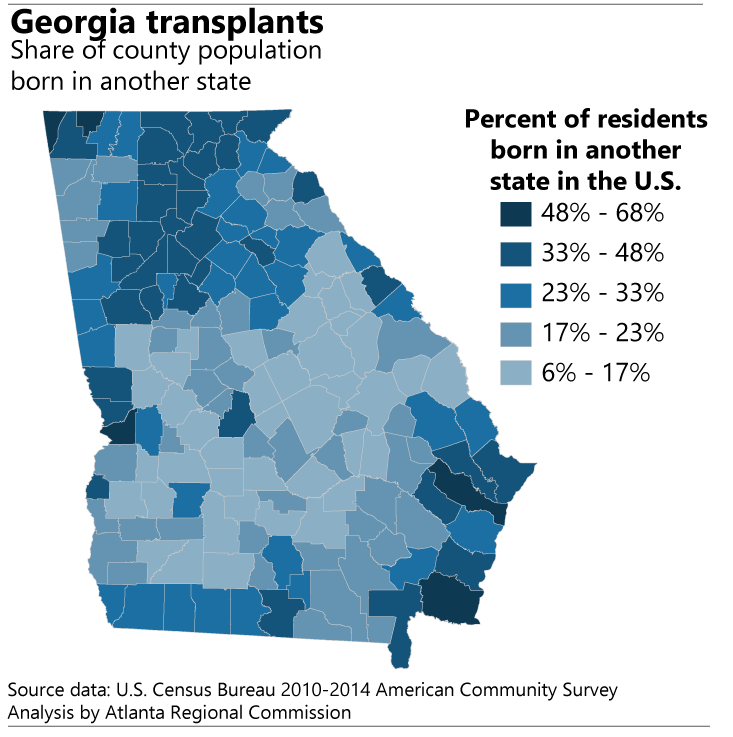
When looking at the whole state of Georgia by county, we can see that the counties in metro Atlanta and those along the coast or state borders have higher percentages of residents born in another state (37% in metro Atlanta). For Georgia as a whole, 34% of residents were born in another state, but when you exclude the metro counties, this share drops to 23%. Since Atlanta is a major employment destination, it makes sense that there are a higher number of “transplants” that have moved to Georgia from another state. Rural counties in central/south Georgia have some of the lowest shares of residents born in another state.
For the entire state, the top 5 counties with the highest percentages of residents who were born in another state are Dade (68%), Chattahoochee (64%), Catoosa (62%), Camden (61%), and Liberty (52%). The counties with the highest percentages of residents born in Georgia are Twiggs (93%), Glascock (89%), Baker (89%), Webster (88%), and Warren (88%).
In the metro Atlanta counties, Gwinnett County has the highest percentages of residents that are foreign-born (almost 1 in 4 residents). Nearby areas in Forsyth, North Fulton, and Hall counties also have pockets with high densities of foreign residents.
Dick Yarbrough writes about two State Senators he thinks are doing things for the right reasons.
One, Sen. Lindsey Tippins, R-Cobb, is chairman of the Senate Education and Youth Committee, the go-to committee for public education issues among other things. The other is Sen. Jack Hill, R-Reidsville, chairman of the powerful Senate Appropriations Committee.
What sets these two men apart from many in the political arena is that neither seems interested in running for higher office and, thus, anxious to get their mugs on the nightly news hoping to dazzle you with their pontifications.
Neither senator, I suspect, has to be doing this at all. Both are senior citizen status, with successful business backgrounds — Tippins, a pipeline contractor and Hill, a retired grocer.
Lindsey Tippins came to the state Senate in 2010 after the incumbent in that district got too big for his britches and thought he was more important than did the voters. Previously, Tippins had served 12 years on the Cobb County Board of Education, including three as chairman. I would dare say he knows as much about public education issues as anyone in the Legislature and has been a good buffer to the ideological bark lickers who seem intent on dismantling public education the first chance they get.
As chairman of the Senate Appropriations Committee, Sen. Hill, now in his 13th term, has helped the state of Georgia maintain a Triple-A bond rating from the national rating agencies. This while representing a widespread senatorial district that covers Bulloch, Candler and Effingham counties, as well as parts of Emanuel, Evans and Tattnall counties. He even managed to show up at the Effingham County Chamber’s annual meeting recently to sit through the ramblings of a modest and much-beloved columnist and laughed in all the right places.
In Cobb County, a gang member pled guilty to drug trafficking and armed robbery charges and was sentenced to 30 years in prison.
Related Posts
 New Macon-Bibb Consolidated Government Officials Sworn In
 Adoptable (Official) Georgia Dogs for March 31, 2026
 Georgia Politics, Campaigns, and Elections for November 1, 2022
 11th Circuit rules in favor of Muscogee County School District in racial discrimination lawsuit | Education | Columbus Ledger Enquirer
 Adoptable (Official) Georgia Dogs for May 21, 2025


Comments ( 0 )