
On July 2, 1776, the Second Continental Congress adopted a resolution by Richard Henry Lee (father of Robert E. Lee) calling for independence from Britain. The delegations of twelve colonies voted in favor, while New York’s abstained, not knowing how their constituents would wish them to vote.
On July 2, 1826, representatives from Georgia and Alabama met to begin surveying the border between the two.
On July 2, 1861, Georgia voters approved a new state Constitution, which had been adopted by the state’s Secession Convention.
July 2, 1863 saw day 2 of the Battle of Gettysburg, with Lee’s Army of Northern Virginia attacking Meade’s Army of the Potomac.
On July 2, 1898, the first pot of delicious Brunswick Stew was made in Brunswick, Georgia. I think I’ll celebrate with a bowl for lunch today.
Construction of USS Augusta, a cruiser, began on July 2, 1928, according to the Augusta Chronicle.
She would be completed and launched in February 1930, “sponsored” by Evelyn McDaniel, of Augusta, who would later become the wife of a Superior Court judge.
Augusta saw service in the Pacific and later became a command ship during Operation Overlord and the D-Day invasion. Presidents Franklin D. Roosevelt and Harry Truman traveled aboard her during wartime treaty endeavors, and the latter would publicly announce the nuclear bombing of Hiroshima from his office aboard the ship.
President Lyndon B. Johnson signed the Civil Rights Act of 1964 on July 2, 1864. Major provisions included outlawing discriminatory application of voting laws, prohibiting racial discrimination in public accomodations, allowing the Attorney General to join lawsuits against states operating segregated public schools, and prohibiting discrimination by state and local governments or agencies receiving federal funds.
Martin Luther King, Jr. was a witness to Johnson’s signature, standing behind the President in the Oval Office. Johnson presented King with one of the 72 pens used in signing the legislation.
Occasionally, pens from the Civil Rights Act signing come onto the collectors’ market. A collection of 50 pens used to sign legislation by Presidents Kennedy and Johnson went across the block in November 2013. This pen went unsold.
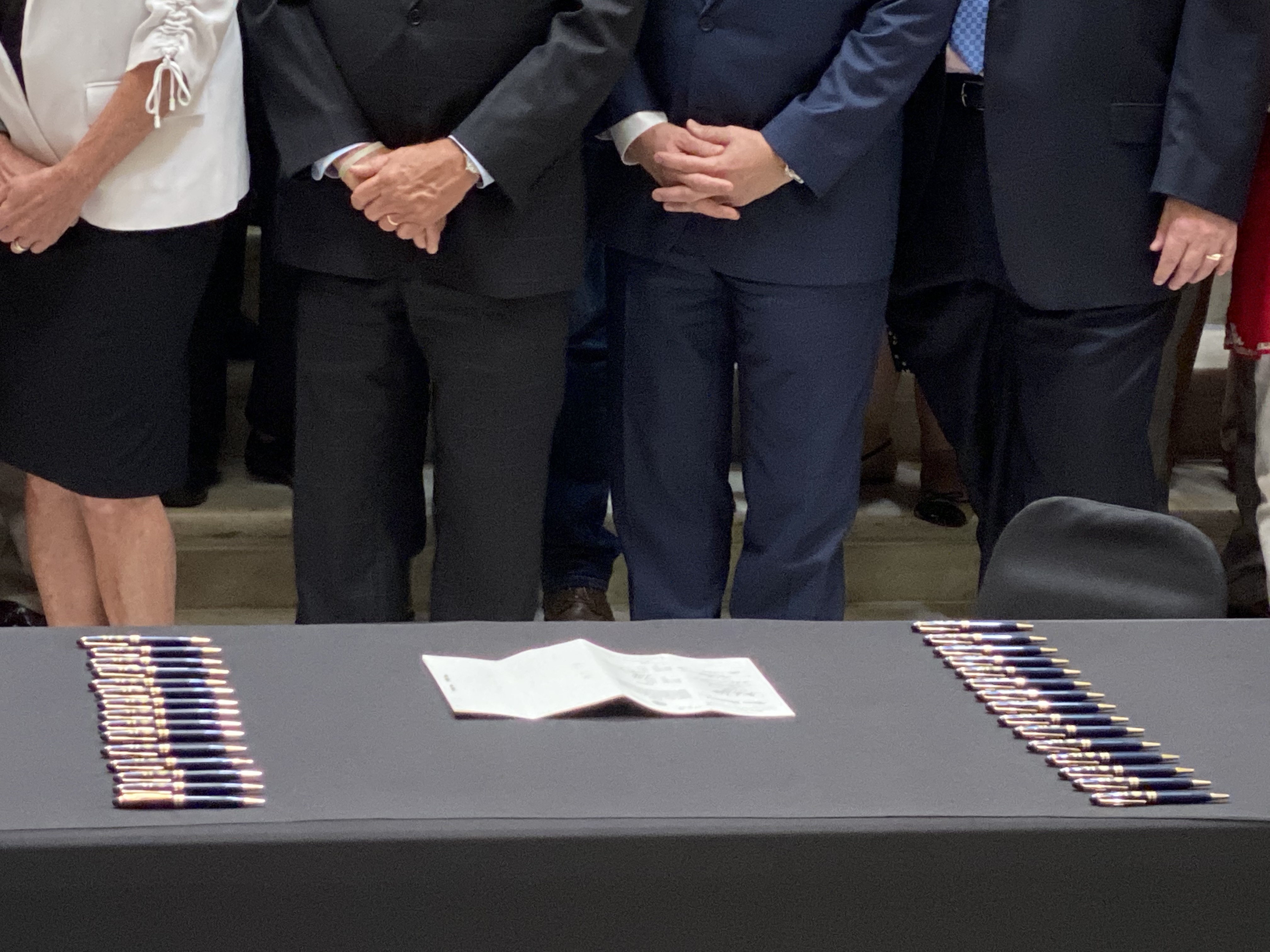
For what it’s worth, I count 30 pens laid out for the signing of House Bill 426, the hate crimes bill, last Friday. 
As a student of Dr. Merle Black in the political science department at Emory, we began our study of Southern politics from the premise that race relations and the legacy of racial discrimination shaped Southern politics. One book we read every year was The Longest Debate: A Legislative History of the 1964 Civil Rights Act, which belongs on the bookshelf of any serious student of American politics, political history, and legislative process.
Georgia Politics, Campaigns, and Elections
Governor Brian Kemp toured Georgia yesterday promoting mask-wearing, according to The Covington News.
“We shouldn’t need a mask mandate for people to do the right thing,” Kemp said at a press conference Wednesday.
Dr. Kathleen Toomey, the state’s public health commissioner, joined Kemp on his “Wear A Mask” tour this week. She continued to promote the state’s ongoing contract-tracing initiative, which is designed to help locate and shut down outbreaks within Georgia.
“We’re concerned about the upticks,” Toomey said, “but we can work together to stop this.”
“Thankfully, [hospitalizations] are not going up exponentially,” Kemp said. “It’s worrisome but not alarming at this point. And we don’t want it to get alarming.”
“The whole mask issue right now, in my opinion, is being over-politicized,” Kemp said. “And that’s not what we should be doing.”
Between June 19-29, the state set a new record in daily case increase in five out of 10 days. As the governor pushes for the public to wear a mask as a critical component in reversing that trend, pleading with people to “do the right thing,” he is resistant to making it a legal requirement.
“Regardless of what legal action may or may not happen, we shouldn’t get to that I think,” Kemp said. “We shouldn’t need a mask mandate for people to do the right thing.”
“We don’t have time for politics right now. The message we are sending is the one I hope Georgians would adhere to. I haven’t been critical of other governors’ orders, whether they went too far or didn’t go far enough. Everybody’s in a tough spot, an unprecedented situation, and we are doing the best that we can in our state based on science and data and advice from Dr. Toomey and her team on the ground, and that’s what we’re gonna continue to do.”
“As you know this is a big weekend,” the governor said at PDK airport Wednesday morning before departing on the tour. “I’m traveling the state to encourage all Georgians to do the right thing. Practice social distancing, wash your hands, and wear a mask.”
Gov. Kemp is headed to Columbus, Albany, and Valdosta on Wednesday and then he’ll visit Dalton, Augusta, and Brunswick on Thursday. While on the tour, he’ll be urging Georgians to follow the guidelines of health officials to stop the spread of the coronavirus.
“Recent upticks throughout our country and state are clear reminders that we are not in the clear yet,” Kemp said Wednesday morning. “We cannot grow complacent or weary.”
Gov. Kemp has not yet discussed whether to take action over Savannah Mayor Van Johnson’s mask mandate, according to the Savannah Morning News.
Kemp said Wednesday he had not talked yet with his legal team about whether to consider overturning Savannah’s mask mandate under his emergency executive powers, which supersede any local rules imposed during the pandemic.
He criticized the outcry from some elected officials and leaders for mask mandates as political distractions.
Lewin, of Emory, also dismissed any partisanship involved with masks. He argued universal mask-wearing would bolster both public health and the state’s economic recovery.
“Whatever our elected leaders can do to increase the compliance with masking, whatever our elected leaders can do to decrease the partisanship that’s currently seen around masking, the more likely we are to get through this without seeing more economic damage,” Lewin said.
Gov. Brian Kemp offered Albany as “a good model for the entire state” in its battle against the coronavirus pandemic Wednesday as he and State Department of Public Health Commissioner Kathleen Toomey brought their “Wear a Mask Tour” to Albany.
“I’d like to first personally thank the people on the front lines here: Scott Steiner and his staff at Phoebe (Putney Memorial) Hospital, all the health care workers and the first responders,” Kemp said. “They did heroic work during this pandemic. I’d also like to thank companies like this one located behind us (Pretoria Fields, which converted its brewing equipment to making hand sanitizer during the early stages of the pandemic), businesses that pivoted to help their fellow citizens at a critical time in the state.”
“Pretoria Fields was granted a permit to make hand sanitizer in a couple of days instead of the weeks it usually takes. That’s the way government should work.”
During remarks before the press briefing, the governor singled out Steiner, Dougherty County Schools Superintendent Ken Dyer, Dougherty County Coroner Michael Fowler — who, he said, “at one time had the toughest job in the country” — the local legislative delegation, and “community leaders like Barbara Holmes, Mayor (Bo) Dorough and Chris Cohilas who have fought to rebuild our economy.”
Cohilas praised Kemp and his staff for “answering our every request” and bringing masks, “helicoptering in” personal protective equipment and bringing in the National Guard to help clean nursing home facilities where the virus was particularly active.
“I haven’t talked to the legal team about what the Mayor of Savannah (Van R. Johnson II) is doing,” Kemp said, standing outside of Piedmont Columbus Regional with other state officials. “But we both agree, everyone should wear a mask if they are out in public and can’t socially distance themselves. …What I’m encouraging mayors to do is show public support for people wearing a mask and socially distancing themselves. That’s the best thing to do.”
“We don’t need a government mandate to do the right thing,” he said. “We’ve got a government mandate on speed limits and people break it every day. …We’ve got to be reasonable.”
“(Mayors and I) may have disagreements about how we would tackle a problem. There’s nothing wrong with that,” he said. “We all agree people need to wear a mask. We can disagree on whether we need a mandate to be able do that or if it needs to be enforced.”
Before Wednesday’s press conference, Columbus Mayor Skip Henderson said the city’s legal team doesn’t believe it has the authority to implement a mask requirement, but they are watching the events in Savannah closely.
“We want to watch and see how that’s gonna work in practical application and from an enforcement aspect,” he said. “But yeah, absolutely. It’s something that we would consider if we thought it was going to help keep our community safe.”
Then he brought out the big gun. College football. From the AJC:
Wear a mask or risk no college football this year.
That’s the message Gov. Brian Kemp, a die-hard Georgia fan, delivered Wednesday as he launched a statewide “Wear A Mask” tour.
“If people, especially our young people, don’t start wearing a mask when they’re going out in public and our numbers keep rising, that’s going to be a tall task,” he said of the prospect of a college football season.
“But if we all hunker down right now, and dig in the next two or three weeks, we can get this turned in the right direction.”
“People had let their guard down. We were moving in a very positive direction” Kemp said. “Summer hit, people were itching to get out after weeks and months of shutdown, not only in our state but across the country. And, quite honestly, people got lackadaisical.”
From the Valdosta Daily Times:
For college football season to happen this fall, Georgians need to wear their masks, Gov. Brian Kemp said Wednesday during a South Georgia stop.
“We know how successful Valdosta State has been on the gridiron and I told my two daughters at (the University of) Georgia the other day, ‘if you want to have football in the fall, you got to get your friends to start wearing their masks,’” he said.
On the same day Georgia experienced a record-high of nearly 3,000 new COVID-19 cases, the governor visited South Georgia Medical Center’s Smith-Northview location Wednesday afternoon as part of his two-day “Wear a Mask” tour.
“We are traveling this state … to encourage all Georgians to simply do the right thing,” Kemp said. “We know what works. We’re asking you to continue to practice (public health guidelines).”
Young people, such as Kemp’s daughters, should avoid the urge to shirk guidelines in order to prevent further spread of the virus, he said.
The governor noted that 53% of the positive tests from SGMC’s drive-through testing location at Smith-Northview are people between the ages of 18 and 30. While not more than half, Lowndes residents ages 11-24 have contracted the virus more than any other age bracket at 30.81% of local COVID-19 cases.
“At this moment, the only discussion we’ve had is simply whatever Gov. Kemp has mandated – whatever guidelines he’s put in place – to simply follow those guidelines,” Valdosta City Councilman Andy Gibbs said. “… If anything changes on the governor’s end, it’ll change on our end.”
“If you want to have college football with fans in the stadium, if you want to go to a Braves game, if you want to go to your kid’s game and watch them on the field,” Kemp said, “I would urge you to wear a mask over the next two to three weeks, especially over this busy July Fourth weekend. …It will help and it will work.”
Goldman Sachs economists report that mandated mask-wearing could help reduce the economic damage of COVID-19, according to MarketWatch.
A team of economists lead by Jan Hatzius, chief economist at Goldman, makes the case that a national face-mask mandate could partially substitute for renewed lockdowns, as COVID-19 inflections flare up in a number of southern and western states in the U.S., that would “otherwise subtract 5% from gross domestic product.”
“We start by showing that a national mandate would likely increase face mask usage meaningfully, especially in states such as Florida and Texas where masks remain largely voluntary to date,” the Goldman researchers write in their 11-page report.
Their data showed that countries that fail to reach widespread masking usage see both infections and deaths increased[.]
From the Valdosta Daily Times:
Jonathan Lewin, chief executive officer of Emory Healthcare, said Wednesday it “is very concerning” to see state and national case totals rising at a pace similar to the start of the outbreak. The Emory health system, he said, doubled its number of COVID-19 positive inpatients in the last week.
No one wants to see Georgia shut down the economy and go into another lockdown, Lewin said. Universal use of masks is the “simplest thing” that can be done to prevent a lockdown moving forward.
“Whatever our elected leaders can do to increase the compliance with masking, whatever our elected leaders can do to decrease the partisanship that is currently seen around masking, the more likely we are to get through this without seeing more economic damage,” he said.
A recent rise in COVID cases is straining the testing system, according to the AJC.
Georgia officials stress the state has the capacity to accommodate testing for all who want it, a far cry from the early weeks of the pandemic when tests were rationed. Generally, public health officials say, residents can get an appointment within a day or so and results are available within a few days to a week.
But a half-dozen patients who spoke to The Atlanta Journal-Constitution said they had to wait upward of a week to book appointments in some areas, and patients and doctors told the AJC that lab results sometimes take a week or longer, leaving undiagnosed people in limbo.
The Georgia State Elections Board voted to allow counties to continue using ballot drop boxes for Absentee ballots, according to the Athens Banner Herald.
The board voted unanimously to extend that rule as well as another that lets counties begin processing but not tallying absentee ballots before election day.
Those rules were initially approved before the state’s June 9 primary elections in order to help counties deal with a wave of mail ballots as voters sought to avoid voting in person because of the coronavirus pandemic.
Wednesday’s decision extends the rules so they stay in effect for primary runoffs in August and the general election Nov. 3.
The move is a sign that absentee ballots are likely to play a substantial role in Georgia elections moving forward — at least during the coronavirus pandemic. It’s also the latest sign the state is trying to salvage what lessons it can from the June 9 election fiasco that drew national condemnation.
“We want to let Georgians know that we are all going to work together to make the elections in August, November and January a success,” Secretary of State Brad Raffensperger told the election board.
On Monday, Fulton County approved State Farm Arena as an early voting site. The mammoth site could accommodate many more voters than a typical precinct and still allow for social distancing.
Former Governor Nathan Deal writes about ongoing criminal justice reform in an op-ed for the Gainesville Times.
Right now, more people than ever before are discussing the sweeping reforms necessary to begin building a more just and equitable society, and I believe that reimagining America’s prisons must be a central piece of those efforts.
Specifically, I believe that lifting the federal ban on Pell grants for people in prison is the next step necessary in order to ensure all incarcerated individuals have the opportunity to access life-changing education.
COVID-19 has illustrated in deadly fashion the weaknesses of our criminal justice system and the vulnerabilities of those who live and work within it.
I strongly believe that one of the areas in which we can make the greatest impact is making sure that all incarcerated people have access to postsecondary education. Nearly 60% of people who serve time do not complete an educational program while in prison, and only 9% complete a postsecondary education program during their incarceration. One key reason for this gap is a lack of funding.
As our report outlines, prison-based education can substantially improve the prospects of people returning to society.
As I watch my fellow Georgians and Americans rise up to confront both a global pandemic and the crisis of racism in America, I hope we can use this profound sense of urgency to sharpen our focus on criminal justice reforms that are anchored in facts, evidence and fundamental principles of justice.
Reform won’t be easy, but we can and must use this pivotal moment in time to work for a more fair and effective federal system that provides safety and justice for all.
The University System of Georgia Board of Regents adopted a budget for FY 2021, according to the Gwinnett Daily Post.
Watkinsville Mayor (and former State Rep.) Bob Smith vetoed the 2021 budget passed by City Council, according to the Athens Banner Herald.
Smith, in a news release, reported he had asked for a 12-percent decrease in the budget due to a projected $146,000 drop in the city’s sales and ad valorem taxes.
Prior to asking the council for this reduction, Smith also asked that his pay as mayor for June be transferred to the city’s general fund.
“I am fully aware the council may override this veto, but I ran on a platform of fiscal responsibility,” Smith said. “Draining our reserves and counting on taxpayer money from the federal government is not fiscally responsible.”
The Burke County Sheriff’s Office and District Attorney’s Office held a forum on race and policing, according to the Augusta Herald.
The Glynn County Republican Party will host a forum for candidates in runoff elections, according to the Brunswick Times.
The Glynn County GOP will host a forum at 10 a.m. July 18 for candidates in the Aug. 11 run-off.
The event will take place at the Holiday Inn Conference Center in Brunswick. Registration will begin at 9 a.m.
The Northwest Georgia Regional Library System has received grant funding from federal COVID relief funds, according to the Dalton Daily Citizen News.
The Northwest Georgia Regional Library System recently received a Georgia Humanities CARES Act emergency operations grant. The funding comes from the federal Coronavirus Aid, Relief and Economic Security (CARES) Act economic stabilization law that was signed by President Donald Trump in March. The grant is administered by the nonprofit Georgia Humanities.
Kathryn Sellers, a library system board member, said the grant is for $15,000 and will be used at all three libraries. She said books that are returned must be quarantined for a certain period of time. She said the grant will be used to cover the expenses of those quarantines.
Dougherty County will receive a $100,000 private grant to work on improving residents’ health, according to the Albany Herald.
The Gwinnett County Transit agency will receive a federal CARES Act grant for nearly $15 million dollars, according to the Gwinnett Daily Post.
The Chickamauga and Chattanooga National Military Park will receive additional federal funding, according to the Times Free Press.
The Chickamauga and Chattanooga National Military Park is expected to receive $15.4 million for deferred maintenance projects.
The money to fund the projects will not cost taxpayers anything. The funds come from drilling royalties paid to the federal government.
U.S. Sen. Kelly Loeffler, R-Georgia, celebrated the bill passing the Senate this week, saying it successfully invests in Georgia’s infrastructure, will create jobs and support local economies.
“Georgians of all ages have long looked to our state parks to enjoy fresh air, preserve natural treasures, honor state history and promote Georgia tourism,” Loeffler said in a statement. “The Great American Outdoors Act will help to ensure both current and future generations can enjoy the pristine beauty of our natural resources in Georgia and across the county.”
I question the accuracy of the Chattanooga newspaper that spending funds from drilling royalties doesn’t cost taxpayers.
Rome is considering appointing a panel to consider local Confederate monuments, according to the Rome News Tribune.
Dozens of residents turned out for a special called meeting on June 12 to debate — pro and con — the fate of the Nathan Bedford Forrest statue in the historic cemetery.
Myrtle Hill Cemetery in South Rome was established in 1857 and now contains the graves of over 20,000 people — including more than 300 Civil War soldiers.
A monument to local Confederate soldiers was removed from public space in Conyers, according to the Gwinnett Daily Post.
A monument honoring Rockdale County’s Confederate soldiers was placed at the corner of the county courthouse on Main Street on April 26, 1913. On June 30, 2020, just over 107 years later, the monument was removed following an executive order from Rockdale County Commission Chair Oz Nesbitt Sr.
Nesbitt said he had received numerous emails, phone calls and texts from people wanting the monument removed and wanted to follow the “letter of the law” in doing so. But, Nesbitt said, after receiving word about possible threats to the monument, he made the decision to take it down.
Nesbitt said he is in talks with the city of Conyers about placing the monument in the city cemetery. Nesbitt said the monument will be kept in an undisclosed location for it safety until it can be put in a new location.
Related Posts
 Georgia Politics, Campaigns, and Elections for March 18, 2016
 Georgia Politics, Campaigns, and Elections for September 1, 2015
 Gwinnett Daily Post | Peachtree Corners votes to use inmate labor
 Court orders new trials because of judge’s affair | www.myajc.com
 Call for Special Grand Jury to Probe Fulton Jail Problems | WABE 90.1 FM


Comments ( 0 )