
On July 11, 1782, British colonists including British Royal Governor Sir James Wright, fled Georgia.
Wright had been the only colonial governor and Georgia the only colony to successfully implement the Stamp Act in 1765. As revolutionary fervor grew elsewhere in the colonies, Georgia remained the most loyal colony, declining to send delegates to the Continental Congress in 1774.
Congress ordered the creation of the United States Marine Corps on July 11, 1798, after the Corps was inactive for a period following the Revolutionary War. From 1799 to 1921, Marine Corps Day was observed on July 11, but is now celebrated on November 10, the date of it’s Revolutionary War establishment.
On July 11, 1804, Aaron Burr shot Alexander Hamilton in a duel in Weehawken, New Jersey. Burr was the sitting Vice President of the United States and Hamilton a former Secretary of the Treasury.
After he shot Hamilton, Aaron Burr quickly fled the nation’s capitol, making his way to St. Simons Island, Georgia, spending a month as a guest of Pierce Butler at Hampton Plantation.
Burr was a fugitive, but his killing Hamilton in a duel held a certain justifiable reasoning since dueling was not illegal, though morally questionable, to be sure. According to H. S. Parmet and M. B. Hecht in their Aaron Burr: Portrait of an Ambitious Man, after the duel, he immediately completed, by mid-August, plans which he had already initiated, to go to St. Simons, “an island off the coast of Georgia, one mile below the town of Darien.”
Jonathan Daniels’ “Ordeal of Ambition” handles the situation this way: “With Samuel Swartwout and a slave named Peter (‘the most intelligent and best disposed black I have ever known’), Burr secretly embarked for Georgia. There on St. Simons Island at the Hampton Plantation of his friend, rich former Senator Pierce Butler, he found refuge…” As Georgia Historian Bernice McCullar, author of “Georgia” puts it, Burr was “fleeing the ghost of Alexander Hamilton” when he arrived on the Georgia island.
“Major Pierce Butler,” she relates, “had fought in the British army and remained in America after the war.” He had married a South Carolina heiress, Miss Polly Middleton, and acquired two Georgia Coastal plantations, which he ran like a general storming after the troops. In fact, he was so strict that none of his slaves could associate with any of the others. He also required anyone who visited his plantations to give his or her name at the gate. With this tight security, Burr should have felt safe..
Actually, Butler’s invitation to visit the island fitted the escapee’s plans nicely. Not only was the Hamilton affair a bother, but also Burr needed to get away from a lady by the name of Celeste; however, the real reason, aside from being near his daughter, who was also in the South, was the nearness of the Floridas. No real purpose is given why the Vice-President wanted to spend “five or six weeks on this hazardous and arduous undertaking.”
Daniels underscores that from this St. Simons point Burr could “make any forays into Florida he wished to make. He traveled under the name ‘Roswell King.” After his Florida odyssey, he planned to meet his South Carolina son-in-law “at any healthy point.”
Parts of the Hampton Plantation survive in the form of tabby ruins on St Simons.


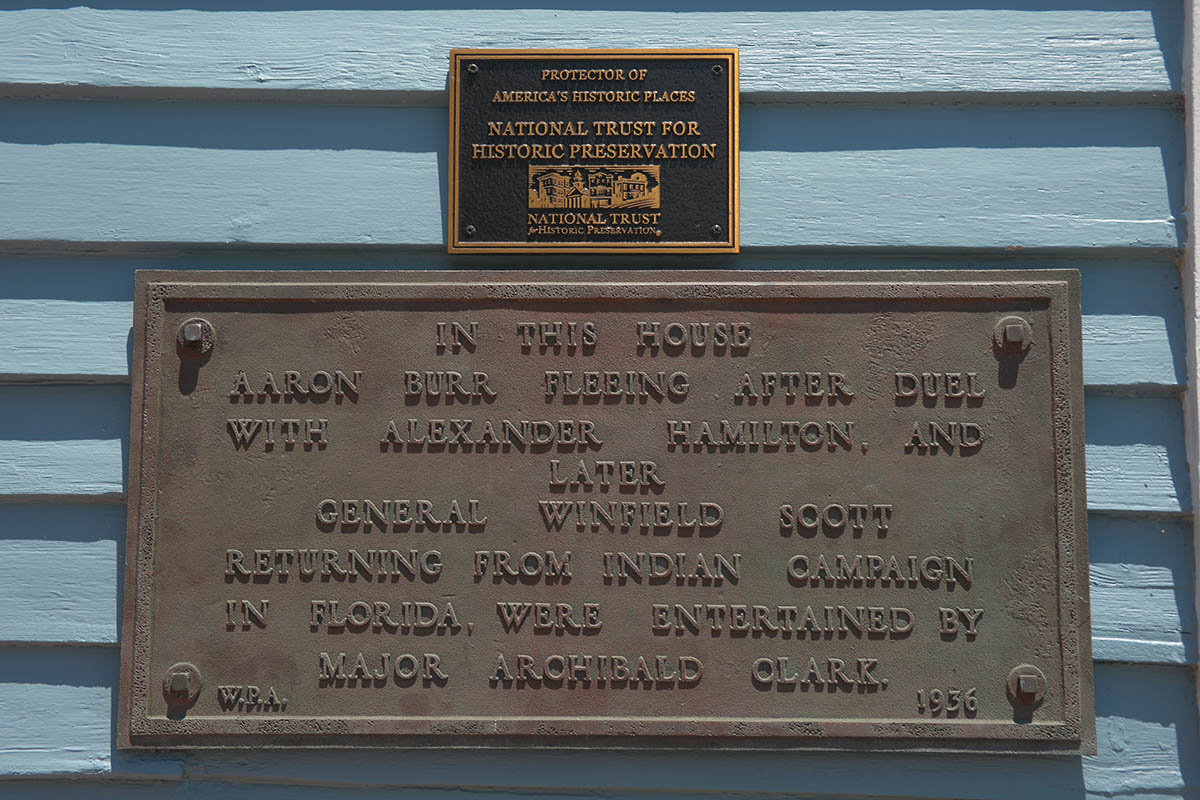
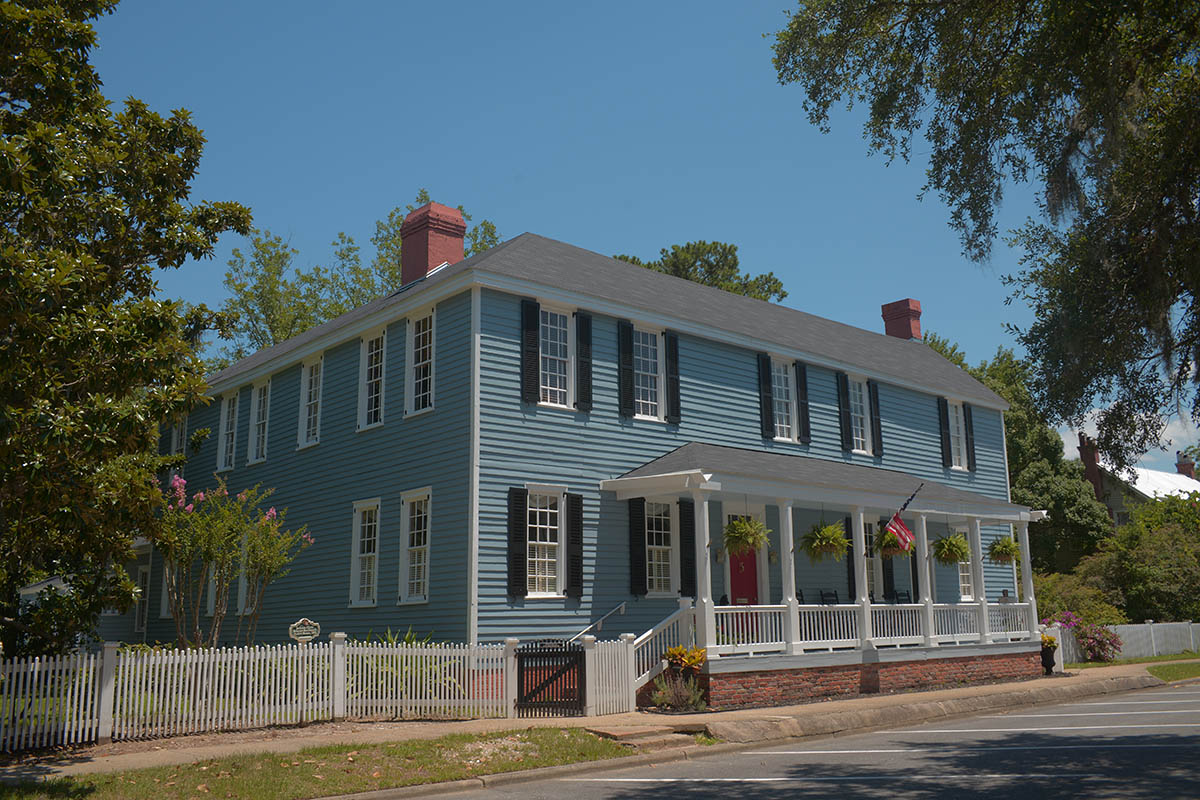
A house in St. Marys, Georgia bears a plaque stating that Aaron Burr visited there in 1804.
Clark lived in the home from 1804 until his death in 1848. He was appointed in 1807 by then-President Thomas Jefferson as customs collector for the Port of St. Marys, a position he held until his death. The year Clark bought the house, he is said to have provided a temporary hideout to Aaron Burr, who was traveling in the South to evade federal authorities holding a warrant for his arrest after he killed Alexander Hamilton in their infamous duel in July 1804.
Verification of Burr’s stay in St. Marys is hard to come by. But it is confirmed that he stayed on St. Simons Island and Cumberland Island late in the summer after he killed Hamilton. That Burr knew Clark is not disputed. The two attended law school together in Litchfield, Conn., but there is no mention in either man’s records that Burr stayed in the home.

On July 11, 1877, a Constitutional Convention convened in the Kimball Opera House in Atlanta to replace the 1868 Reconstruction Constitution.
On July 11, 1916, President Woodrow Wilson signed the Federal Aid Road Act, establishing a federal program of paying for highway development.
President Franklin D. Roosevelt accepted the Democratic nomination for a fourth term on July 11, 1944.
General Dwight D. Eisenhower was nominated for President by the Republican National Convention on July 11, 1952.
July 11, 1969 was an epic day in rock and roll history, with David Bowie releasing “Space Oddity” and the Rolling Stones releasing “Honky Tonk Women.”
On July 11, 1985, Astros pitcher Nolan Ryan became the first major league player to strike out 4000 batters.
On July 21 at Morehouse College, the United States Postal Service will begin selling stamps featuring the late Congressman John Lewis (D-Atlanta), according to the AJC.
On the same day a commemorative stamp honoring the late Congressman John Lewis will go on sale, the community is invited to a public celebration of his life and legacy as a political and civil rights leader.
The July 21 event at Morehouse College is open to anyone who wants to attend, as long as they RSVP.
“In his passing during COVID, we weren’t able to have a true celebration of his life in the way that he would have liked to have had,” said Michael Collins, who was Lewis’ right-hand man up until his death three years ago. Collins is among those who played a key role in planning the first-day-of-issue event with the U.S. Postal Service.
Postmaster General Louis DeJoy, who last month unveiled the stamp’s design during a ceremony at the U.S. Capitol, will also be on hand. During the event in Washington, DeJoy said the stamp will help keep alive the memory of Lewis and all that he accomplished.
“John Lewis lived a life of consequence,” DeJoy said. “He was a passionate leader of America’s civil rights movement throughout his life and a voice for his generation. Our nation certainly benefited from his fearlessness and his unfailing willingness to get into good trouble.”
Georgia Politics, Campaigns, and Elections
State Rep. Mesha Mainor held a press conference this morning by the statue of Martin Luther King, Jr., according to a press release.
Fox News reports that Rep. Mainor has switched to the Republican Party from the Democratic Party.
Mesha Mainor – a Democrat who has represented District 56 in the Georgia state House since January 2021 – will announce shortly before noon Tuesday that she will switch her party registration to Republican.
“When I decided to stand up on behalf of disadvantaged children in support of school choice, my Democrat colleagues didn’t stand by me,” Mainor explained of her decision in a statement to Fox News Digital. “They crucified me. When I decided to stand up in support of safe communities and refused to support efforts to defund the police, they didn’t back me. They abandoned me.”
“For far too long, the Democrat Party has gotten away with using and abusing the black community,” she added. “For decades, the Democrat Party has received the support of more than 90% of the black community. And what do we have to show for it? I represent a solidly blue district in the city of Atlanta. This isn’t a political decision for me. It’s a moral one.”
Asked whether she believes she will face pushback from Democrats over her decision, Mainor said, “The most dangerous thing to the Democrat Party is a black person with a mind of their own. So, it wouldn’t surprise me.”
“Education and the importance of school choice has been – and will continue to be – a key focus of mine,” she said. “But outside of education, I look forward to working with my colleagues in the Georgia General Assembly to tackle the most pressing issues facing our state and to help grow the Republican Party, helping us not focus not just on preaching to the choir but growing the congregation.”
“I support school choice, parent rights and opportunities for children to thrive, especially those that are marginalized and tend to fail in school,” Mainor said at the time. “The Democrats at the [Georgia State] Capitol took a hard position and demanded every Democrat vote against children and for the teachers union. I voted yes for parents and yes for children not failing schools.”
“It’s ironic. I’ll say every election year, I hear ‘Black Lives Matter.’ But do they? I see every other minority being prioritized except Black children living in poverty that can’t read,” Mainor argued.
Georgia Republican Party Chair Josh McKoon emailed afterwards.
Georgia Republican Party Chairman Josh McKoon welcomes, Representative Mesha Mainor of Atlanta, to the Republican Party following an announcement from the state house this morning.
Mainor, who represents a heavily democratic district, said her decision to join the GOP comes after months of thoughtful prayer and consideration in realization that the Democratic Party does not have her community’s best interest at heart. Mainor states in part, “As a lifelong democrat…I blindly followed a vision that is far from reality. It is time to put people and sound policy above politics and false narratives.”
Chairman Josh McKoon states, “This is a historic day for Georgia Republicans. We are delighted to welcome Rep. Mainor to the Georgia Republican Party and look forward to collaborating with her to advocate on behalf of hard working Georgians. Our Party stands for empowering parents to be advocates for giving their children the best education possible, that every Georgia deserves to feel safe at home, at work, and in school; and to have the economic opportunity to build better lives.”
Mainor will continue her service in the General Assembly as the newest member of the House Republican Caucus effective, immediately.
The Richmond County Board of Elections called a Sales Tax referendum for November 7, 2023, according to WRDW.
The Richmond County Board of Elections unanimously agreed to call a November special election on a sales tax for the arena.
This follows a vote in late June by the Augusta Commission to call an election Nov. 7 on the half-cent sales tax.
The plan comes after passage of special state legislation, House Bill 230, to allow the public to vote on the tax.
First Lady Jill Biden will visit Augusta in August, according to WRDW.
First lady Dr. Jill Biden will travel to Augusta for the Biden-Harris Administration’s Investing in America Tour.
During the tour, Biden will travel to Ohio, New Jersey, Georgia and Pennsylvania as part of the tour to highlight how Bidenomics is delivering investments and jobs to communities across the country.
The America Workforce Hubs meeting is on July 18.
According to The White House Website, Augusta is highlighted because:
“Augusta and the surrounding region form a diverse community that is home to Fort Gordon, the Medical College of Georgia, and the Savannah River Nuclear Power Plant. The Augusta area is on the forefront of the Administration’s sustainable domestic production agenda, with $1.4 billion in recently announced private-sector investments, including in batteries. The Administration’s efforts will focus on preparing and creating pathways for people in Augusta and the surrounding areas to access the good-paying jobs created in the clean energy industry, among others.”
Fulton County District Attorney Fani Willis (D) may present her findings about Donald Trump to a grand jury being empaneled, according to the Associated Press via the Valdosta Daily Times.
A grand jury being seated Tuesday in Atlanta will likely consider whether criminal charges are appropriate for former President Donald Trump or his Republican allies for their efforts to overturn his 2020 election loss in Georgia.
Fulton County District Attorney Fani Willis has been investigating since shortly after Trump called Georgia Secretary of State Brad Raffensperger in early 2021 and suggested the state’s top elections official could help him “find 11,780 votes,” just enough needed to beat Democrat Joe Biden.
The 2 1/2-year investigation expanded to include an examination of a slate of Republican fake electors, phone calls by Trump and others to Georgia officials in the weeks after the 2020 election and unfounded allegations of widespread election fraud made to state lawmakers.
Willis, a Democrat, is expected to present her case before one of two new grand juries being seated Tuesday. She has previously suggested that any indictments would likely come in August.
The selection of two Fulton County grand juries will be made Tuesday, with one of the panels expected to decide whether to hand up an indictment for alleged criminal interference in the 2020 presidential election.
One set of jurors is likely to be asked to bring formal charges against former President Donald Trump and other well-known political and legal figures. In a letter to county officials almost two months ago, District Attorney Fani Willis indicated the indictment could be obtained at some point between July 31 and Aug. 18.
Superior Court Judge Robert McBurney, who oversaw the special purpose grand jury, will preside over Tuesday’s selection of the two grand juries for this term of court.
Each panel will have 23 grand jurors, plus three alternates. One panel will meet Mondays and Tuesdays, the other Thursdays and Fridays. Both will work in secret and are expected to decide whether to hand up indictments in hundreds of cases. It is unclear which one will consider the much-anticipated election-meddling case.
If Trump is charged here, it will mark the third indictment against him. In April, a grand jury in Manhattan indicted the former president for allegedly falsifying business records involving payoffs to porn star Stormy Daniels. Last month, a federal grand jury in Florida indicted Trump for 37 counts over his alleged mishandling classified government documents and obstruction of the Justice Department’s investigation.
Georgia ranked #2 in the nation for early voting in 2022, according to the Capitol Beat News Service via the Dalton Daily Citizen News.
The Peach State ranked second in the nation for early voting last November, according to a new study released by the U.S. Election Assistance Commission. The report found that 58% of Georgia voters cast their ballots before Election Day, up from 48% in 2018.
The new study found that Georgians voted early last year more than any other state except Texas. At the same time, only 6% of Georgia voters cast their ballots through the mail, returning to pre-pandemic levels.
Only about one-third of voters waited until Election Day to cast their ballots in person, which kept lines at the polls short or nonexistent in most precincts.
The U.S. Census Bureau in May named Georgia as the Southeast’s leader in voter turnout, as Georgia saw its highest voter registration count in 20 years for a congressional election.
Additional studies by MIT’s Election Data and Science Lab, along with the School of Public and International Affairs at the University of Georgia found 98.9% of Georgia voters had “no issue casting a ballot.” What’s more, 89.7% of the state’s voters reported feeling confident about the election process.
Those statistics were produced through surveys polling 1,253 registered voters in Georgia who voted in the 2022 midterm election.
The Peach State was the first state in the nation to implement a combination of automatic voter registration, 17 days of early voting and no-excuse absentee voting. The press office reports the state is seeing the “largest increase in average turnout of any other state in the 2018 midterm election and record turnout in 2020 and 2022.”
In-person voter turnout in the 2022 midterm election was reportedly the largest in Georgia midterm history.
Georgia ranks #1 in the nation in Electric Vehicle production subsidies and next-to-last in actual buying of EVs, according to the Macon Telegraph.
The Peach State leads the nation in electric vehicle (EV) manufacturing subsidies but is second to last in the national scorecard in the state’s efforts to incentivize Georgians to transition to EVs.
The American Council for an Energy-Efficient Economy (ACEEE) released its latest edition of the state transportation electrification scorecard last week, and Georgia ranked 32 out of 33 states the group analyzed.
“Georgia has made some progress in overall transportation electrification outcomes, although the state has declined in rank (from 27 to 32) since our last edition two years ago,” Peter Huether, the lead author of the report of the council wrote in an email.
The nonprofit used five categories to calculate a state’s transportation and electrification score: planning and goals, incentives, system efficiency, grid optimization, and outcomes. Georgia’s highest score was in outcomes at 8/9.5 and its lowest was planning and goals which earned a zero out of a possible 15 points and three out of 21.5 for incentives.
“In 2015, at the time the individual rebate ended, Georgia was No. 2 in the nation for EV adoption, just behind California,” Sydney Roberts, director of technology and market solutions and Justin Brightharp, senior program manager of SEEA, wrote in an email. “Georgia Power also encouraged a lot of early sector growth by building public fast-charging infrastructure, especially along interstates.” There are 282 EVs per 100,000 Georgians, higher than the national average of 280, Heuther wrote.
Georgia is No. 1 in the nation among EV manufacturing subsidies and leading the way in bringing jobs and investment to the EV economy.
“The state has pursued job creation opportunities along the entire supply chain, resulting in more than $22.7 billion in investments and the creation of over 28,400 jobs since 2020,” Gov. Brian Kemp said in June.
EV manufacturer subsidies in Georgia total $3.6 billion as of October 2022, the highest of any state by over a billion (North Carolina is second at $2.1 billion). Meanwhile, there is no Georgia-state tax credit for buying an EV, only a federal tax credit of $7,500. Additionally, there is an annual licensing fee of $210.
In Muscogee County, there are nearly 50 public EV stations and 467 EVs, just 1% of all of Georgia’s electric vehicles.
“Supportive state policies are needed to ensure that the electric grid is ready and that all households and businesses, including those in underserved communities, can use EVs and have adequate access to charging,” Heuther wrote.
The Governor’s Office of Highway Safety says that distracted driving causes fewer accidents than before passage of “Hands-free” legislation, according to 13WMAZ.
Five years after Georgia’s “hands-free” cell phone restrictions for drivers took effect, the latest numbers available show that fatal traffic crashes across the state caused by distracted drivers are fewer than before the law took effect.
Robert Hydrick with the Georgia Governor’s Office of Highway Safety said Monday that the law is the reason. “The law is saving lives,” Hydrick said. “That is a really encouraging sign. It’s not good news because we still have people dying in crashes caused by distracted driving. Yes, there are fewer fatalities than before the law, but our goal is to get to zero.”
According to research compiled by his office, in 2017, the year before the current law took effect, 11,505 people were convicted in Georgia of distracted driving.
In 2021, after the stricter, hands-free phone law took effect—and 2021 is the latest year, so far, for which data are available—there were 43,846 distracted driving convictions, nearly four times more than there were in 2017, mostly due to people simply driving with cell phones in their hands, which the stricter law bans.
As a result of the law and the enforcement, Hydrick said, in 2021, 3.1% of all traffic deaths in the state were caused by distracted drivers—most of whom were using cell phones—compared with 5.3% in 2017.
GPB News looks at Georgia’s Maternal Mortality crisis.
Earlier this year, Georgia’s Maternal Mortality Review Committee reported just over 100 cases of pregnancy-related deaths from 2018 to 2020. Almost 90% could have been prevented.
According to national estimates, Georgia’s rate of 30.2 pregnancy-related deaths per 100,000 live births is almost double that of states that rank near the top for maternal outcomes.
While cardiac complications were the leading cause of pregnancy-related death among Black mothers — whose maternal mortality rates are already twice as high — it was mental health crises for white mothers.
More than half of deliveries which resulted in a pregnancy-related death were insured by Medicaid. Geographically, central Georgia counties saw the highest ratios of pregnancy-related deaths by residence.
Georgia lawmakers will use recommendations from the Maternal Mortality Review Committee to inform future decisions on maternal health care. Last year, Georgia expanded Medicaid coverage for up to one year postpartum as part of previous recommendations.
Fewer Georgians applied for concealed carry permits since they became optional, according to WABE.
Roughly half as many Georgians applied for permits to carry handguns in the year since they became optional.
According to state data from the Georgia Crime Information Center requested by WABE, 61,547 Georgians were granted licenses since the law took effect last July. That’s compared to 122,207 the year prior.
“I’ll just say, yes, it’s certainly lightened the load,” says Kevin Holder, executive director for the Council of Probate Court Judges of Georgia.
Local probate courts handle weapons permits, along with marriage licenses and probate estate filings.
Holder says some of the dropoff in weapons permits is explained by a return to normal levels after record applications during the pandemic.
“Anytime there’s a mass casualty event, anytime there’s a presidential election, anytime there’s a natural disaster,” he says. “We had pretty much a mixture of all three.”
Probate judges insist these licenses remain useful, even though they are no longer mandatory.
Licenses allow gun owners to carry firearms in other states that require licenses and have reciprocity with Georgia. Thirty-two states have reciprocity with Georgia.
And because receiving a permit requires passing a background check, permit-holders can purchase firearms from retailers without having to undergo a new background check each time.
“Even the sponsors of the bill were encouraging those who had licenses to consider continuing to get a license because it still holds utility,” Holder says.
Midway, Georgia is a cute little community dating to the 1700s and located in Liberty County. Current residents are up in arms after the firing of their police chief, according to WSAV.
When their police chief was fired last week, they told News 3 that was the last straw.
“We’re trying to rally for our police department and get rid of city hall,” resident Buddy Clark said. “If you’ve ever been to one of the meetings then you know it’s a joke. Been in there plenty of times. They don’t care about their citizens so, you know, we don’t particularly care about them.”
On Monday, they’re holding a protest at city hall in the hopes that they can have a new election for mayor and council.
Resident Louis Wilson said, “I think that they’re corrupt, I think that they’re corrupt.”
We reached out to Mayor Levern Clancy on Wednesday about why police chief Kelli Morningstar was fired. He said the city attorney advised him not to speak about it.
A petition started last week to remove the mayor and council now has 188 signatures.
Clark said, “I’ve been here 20 years and I’ve never seen anything like this. They don’t wanna help the community. They’re worried about truck stops, they’re worried about warehouses, and stuff like that. These people here they’re worried about their front yard.”
“Our Chief of Police who has been here for 17 years has done a wonderful job. I think she needs to see that we support her,” said Midway resident, Emily Barrientos.
The city terminated Chief Morningstar last Thursday. The city has not yet given the public a reason for her firing. Her job has already been posted to the city’s website.
Despite police officers’ efforts to diffuse the situation, people still raised their voices at the council. Eventually, police had to tell residents to leave the council chamber. Those residents left the building still upset over the firing of the chief.
“She does not play political games and I have just found a whole bunch of information that has been going on with our city council that I never knew, but I am going to become more involved in our city council now,” Barrientos said.
Governor Brian Kemp’s state leadership committee socked away $5 million dollars and has $3.7 million cash on hand, according to the AJC.
The Republican reported amassing about $5.2 million in his account through a powerful new type of committee, according to financial records released this week that show the fund has $3.7 million on hand and another $1.5 million in investments.
The Georgians First Leadership Committee was created by a Kemp-backed law that is reshaping state politics by letting the governor and a limited number of others create funds that can raise unlimited contributions and coordinate directly with campaigns.
Over roughly two years, Kemp has raised more than $50.4 million through the committee, which he continues to maintain even after his second victory over Democrat Stacey Abrams.
The records show much of the money Kemp collected during the latest reporting period, which spans from February through June, came from a $3.7 million transfer from the governor’s official campaign.
He also collected about $1.2 million during a three-day retreat in May in Sea Island that brought together some of his top donors and allies, according to his aides. At the retreat, Kemp pointedly said he hadn’t yet ruled out a White House bid.
The state GOP’s clout has waned considerably under former Chair David Shafer, who infuriated key leaders and activists by openly siding with Donald Trump-backed challengers to Kemp and other Republican incumbents last year.
Nick Ayers was bumped off the Department of Natural Resources Board, which had too many members from the Fifth Congressional District, according to the Capitol Beat News Service via the Gwinnett Daily Post.
Gov. Brian Kemp has removed veteran Republican political operative Nick Ayers from the state Board of Natural Resources, citing an oversupply of board members from Georgia’s 5th Congressional District.
In an executive order Kemp issued late last week, he pointed to a provision in Georgia’s Constitution that no more than two members of the board can come from the same congressional district. Including Ayers, three of the 19 board members were from the 5th District, which includes the heart of metro Atlanta.
In a second executive order, the governor named Lesley Chandler Reynolds of Greene County to replace Ayers. Reynolds is the wife of Harold Reynolds, chairman of the University System of Georgia Board of Regents and founding partner of the company that developed Reynolds Plantation on Lake Oconee.
More on the arrest of City of South Fulton Mayor Khalid Kamau, from the AJC.
The arrest affidavits by a South Fulton police officer show discrepancies between Kamau’s account and that of the property owner.
Kamau is accused of entering a lake house in the 6000 block of Cascade Palmetto Highway, about 12 miles southwest of his own home. According to the affidavits, the property owner said he received a phone notification shortly before 7 a.m. Saturday that “some unknown subject was walking onto his property.”
The owner lives in another house on the same plot of land, so he dressed quickly and drove to the lake house — which he uses for furniture storage — watching video of a person later identified as Kamau walking up the driveway and into the house, the affidavit says.
The owner said he called 911 and waited outside, and that Kamau emerged about five minutes later. The owner said he yelled “Stay put!” twice, but Kamau continued walking toward him and said “I don’t have to listen to you, and you can’t give me orders.”
The owner then “placed his firearm down by his side,” and using an expletive, Kamau said: “Do you know who … I am? I’m the mayor and I’ll wait for my police force to get here and see what happens then,” according to the affidavits.
Kamau’s version of the story differed in key ways.
The mayor told police that as he walked outside, the property owner swore at him and said: “No, … you stay right there.” As Kamau tried to introduce himself, the property owner cocked his gun, saying “If you take another step I’m going to shoot you,” Kamau said in the affidavits.
Rome City Commissioners are fighting amongst themselves. From the Rome News Tribune:
A rift among Rome City Commissioners expanded during Monday’s caucus meeting, called in part to hear the potential next steps in the ethics investigation of Ward 1 incumbent Mark Cochran.
It ended after nearly an hour of fiery, occasionally profane debate with one clear path: a Floyd County Superior Court review set for 9 a.m. Aug. 21.
What happened in between was perhaps one of the ugliest exchanges among the city commissioners in recent memory.
Glynn County Sheriff Neal Jump says the county needs to expand the jail, according to The Brunswick News.
Until then, Jump said deputies and detention officers will continue dealing with mental health challenges among the growing inmate population, working with other local agencies to combat violent crime and gangs and patrolling Glynn County’s homeless population.
Jump addressed the issue at the Golden Isles Republican Women luncheon Monday at Bennie’s Red Barn on St. Simons Island.
He said there are around 530 inmates currently at the Glynn County Detention Center. The jail has space for 612 inmates.
“In the five-year plan, we will have to build onto that jail,” Jump said, ensuring the county commissioners in attendance heard him.
Jump said a significant percentage of the approximate 530 inmates needs mental health treatment, which is not something his jailers and deputies are trained to provide. But with daily suicide attempts at the jail and other challenges presented by mental illnesses, detention center staff has no other option.
“Jail is not the place for mental health treatment,” Jump said.
He and his staff have brought in more mental health help through community partnerships, but the strain of the issue still weighs heavily on detention officers, Jump said.
That leads to overtime and soaring medical costs at the jail that regularly exceed $1 million annually, he said.
Domonique Cooper announced she will run for Gwinnett County Board of Education District 3, according to the Gwinnett Daily Post.
Domonique Cooper officially announced her candidacy for the school board’s District 3 seat over the weekend. The nonpartisan seat, which is currently held by board member Mary Kay Murphy, will be on the ballot for Georgia’s 2024 local and state primary election.
“I am running for the school board because I believe that every child deserves a quality education,” Cooper said. “I am committed to ensuring that our schools are providing our students with the best possible opportunities to succeed.”
The state has not posted the full 2024 election cycle calendar — other than announcing the state’s presidential primary election will be held in March — but the primaries for local and state offices, also known as the general election primary, are typically held every other May. In 2022, the Georgia General Assembly moved Gwinnett to nonpartisan school board elections that must be held at the time of the general election primary.
In 2024, school board Districts 1, 3 and 5 will be on the ballot.
Valdosta’s City Manager and Assistant City Manager will host a coffee for the public, according to the Valdosta Daily Times.
City Manager Richard Hardy and Assistant City Manager, Catherine Ammons will host Coffee Conversations, 7:30-9 a.m., July 27, at GUD Coffee.
Coffee Conversations is an “opportunity for the community to meet the new leadership, discuss and enjoy coffee in a relaxing atmosphere,” city officials said in a statement. “Citizens will learn about what is happing in the city and are welcome to ask questions. No RSVP is needed and this is an informal come-and-go event.”
Related Posts
 For Georgia peanut farmers, sales to China a bonanza that may not last | Online Athens
 Adoptable (Official) Georgia Dogs for April 17, 2020
 Georgia Politics, Campaigns, and Elections for June 14, 2023
 Georgia Politics, Campaigns, and Elections for January 3, 2018
 Georgia Politics, Campaigns, and Elections for January 25, 2022


Comments ( 0 )