
The Supreme Court of Georgia held its first meeting on January 26, 1846 at Talbotton, Georgia.
John Sammons Bell was born on January 26, 1914 in Macon, Georgia. He would go on to serve as Chairman of the Democratic Party of Georgia, as a Judge on the Georgia Court of Appeals, and as chief judge of the appellate court. He is today best known as the designer of the state flag featuring the Confederate battle flag, which was adopted by the General Assembly in 1956.
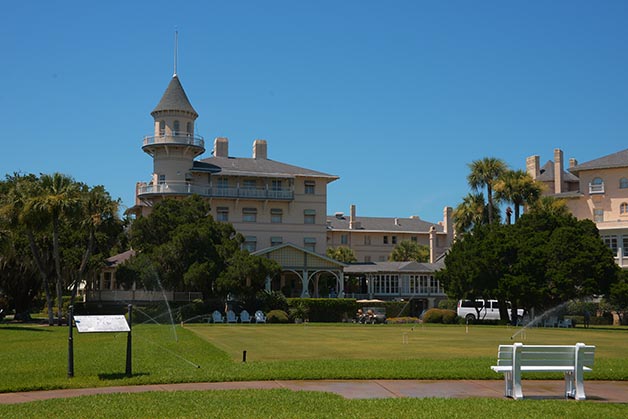
On January 24, 1915, the first transcontinental telephone call was placed from Jekyll Island, Georgia.

On January 25, 1915, a charter was issued in DeKalb County Superior Court to Emory University.
January 24, 1933 saw the first sales tax in Georgia proposed to fund schools and aid for farmers.
On January 25, 1943, Georgia Gov. Ellis Arnall signed legislation eliminating the governor as an ex officio member of the State Board of Education, State Board of Regents, Department of Public Safety, and State Housing Authority, as part of a proposal to reduce the Governor’s power over education.
On January 24, 1960, Martin Luther King, Jr. became co-pastor of Ebenezer Baptist Church, sharing the pulpit with his father.
On January 25, 1961, President John F. Kennedy held the first live televised press conference.
On January 24, 1987, some 12,000 to 20,000 civil rights protesters marched in Forsyth County, a week after a smaller protest. From the New York Times reporting:
CUMMING, Ga., Jan. 24— This small town in Forsyth County was overwhelmed today by civil rights marchers, members of the Ku Klux Klan and their sympathizers and an army of National Guardsmen and law-enforcement officers who kept the opposing groups separated.
Guarded by what a spokesman for the Governor’s office called ”the greatest show of force the state has ever marshalled,” a crowd of marchers estimated at 12,000 to 20,000 funneled slowly into Cumming, where a week earlier counterdemonstrators, throwing stones and bottles, disrupted an interracial ”walk for brotherhood” prompted by the all-white county’s racist legacy.
As the marchers headed into Cumming, which has a little more than 2,000 people, they found waiting for them, behind a stern-faced force of 2,300 guardsmen and police officers, a group of hundreds if not thousands of white, mainly young, rural men and women, repeatedly shouting, “N[*****], go home!”
Whatever the final figure, the march was one of the largest civil rights demonstrations since a 1965 rally that followed a march from Selma, Ala. to Montgomery. The rally, led by Dr. King, drew 25,000 people.
Seriously, read the Times report.
On January 24, 2001, the Georgia House of Representatives approved legislation changing the state flag to the Barnes design with the state seal on a blue background and a banner depicting five previous flags that flew over Georgia.

On January 26, 2001 a new state flag, first designed by Atlanta architect Cecil Alexander, passed out of committee in the General Assembly by a 4-3 vote and would be voted on later that week. Click here to view the floor debate from 2001.
Georgia Politics, Campaigns, and Elections
Qualifying for a Special Election for Tifton Judicial Circuit District Attorney was postponed due to weather, according to the Tifton Gazette.
The Office of the Secretary of State elected this afternoon to extend the qualification period for candidates seeking to run for the position of district attorney for the Tifton Judicial Circuit to 5 p.m. Jan. 24, as compensation for the unexpected snowfall that has swept across South Georgia.
Candidates seeking to qualify were required to do so in person at the Secretary of State Office at 238 East 2nd St from Jan. 21 until 1 p.m. Jan. 23, a task made more difficult with the dangerous driving conditions caused by the winter storm.
This extension, the Office of the Secretary of State hopes, will provide potential candidates additional time to qualify.
As of now, only Patrick Warren, acting district attorney, has qualified for the election.
Qualifying for a Special Election to Albany City Commission was also postponed due to weather, according to WALB.
Scheduling was set to begin today, Jan. 23, however due to office closure, dates and times of qualifying have bee changed.
The following is the updated schedule.
Friday, Jan. 24 from 9 a.m. to 4 p.m.
Monday, Jan. 27 from 9 a.m. to 4 p.m.
Tuesday, Jan. 28 from 9 a.m. to noon.
The location will remain the same at the Dougherty County Elections Office, located at 222 Pine Ave 2nd floor of Suite 220. There is a qualifying fee of $684.
Governor Brian Kemp outlined his budget priorities introducing his proposed budgets for FY2025 (Amended) and FY2026, in a Joint Appropriations hearing yesterday.
Following the disruption of Thursday’s Joint Appropriations committee hearing schedule due to the inclement winter weather affecting much of Georgia, Governor Brian P. Kemp shared a copy of the below prepared remarks with the committee members to provide further context on his budget proposals currently before the legislature. Although scheduling disruptions prevented him from delivering them in person, Governor Kemp also asked that Office of Planning and Budget director Rick Dunn be available to answer any questions committee members may have regarding the amended and fiscal year budgets.
View the AFY25 and FY26 budget proposals here.
“This is the seventh time I’ve presented a budget proposal to you, and as I noted in my State of the State address last week, we have used our annual budgets – in part – to address the unprecedented challenges we’ve faced, together.
“This year is no different, as we work as a team to overcome challenges facing our farmers and small businesses in the wake of Hurricane Helene, provide further relief to hardworking Georgians dealing with sky-high prices, invest in community-level infrastructure to meet the needs of a growing economy and population, strengthen our education and workforce development programs, fortify our public safety and corrections system, grow the number of healthcare workers in our state and support these heroes, and many other strategic investments that ensure we meet our obligations without growing government.
“My top priority in the budgets before you is one that we all share – relief for those devastated by Hurricane Helene last September. Hundreds of thousands of Georgians – from Valdosta to Augusta and far beyond – suffered losses in its wake, and we continue to mourn for the 34 Georgians lost to this terrible storm.
“To assist our state agencies in vital recovery efforts, I am requesting over $614 million in the Amended Fiscal Year budget for hurricane relief.
“This includes:
“$300 million for the Department of Transportation for debris cleanup, road repair, and signage replacement, and to ensure ongoing projects are not negatively impacted by the suspension of the motor fuel tax following the storm,
“$100 million to replenish funds used for immediate financial relief for the agricultural and timber industries,
“$50 million to ensure the health of the state’s property insurance risk pool as we repair state facilities, and
“$150 million for the Governor’s Emergency Fund for the state’s share of FEMA’s reimbursement of ongoing debris removal, temporary shelter expenses, and direct aid to Georgians.
“I appreciate your prompt consideration of this proposal as we work to support these Georgians and ensure they come back even stronger than before!
“We can, should, and will do this, because our approach to budgeting allows us to be ready for the difficult times. Our conservative fiscal management has kept us a AAA-rated state for nearly three decades, and the No. 1 state to do business for an unprecedented 11th year.
“Because we maintain those coveted distinctions and don’t put them at risk by listening to those who would rather grow government than trust our citizens, job creators know that Georgia is a safe and reliable state in which to invest. That’s a big reason we were also recently named the top state for business environment as a whole by the site selectors who actually make those decisions.
“They know that we put our citizens first, which is why we need to put more taxpayer money in the hands of those who know how to use it best – hardworking Georgians!
“And – again – because we’ve budgeted carefully and wisely, we can do that while still fully meeting our fiscal obligations as a state.
“As you know, we’ve already provided some relief to families who face too-high prices at the grocery store, the gas pump, and everywhere else they go each day. Since 2021, we have put $7.6 billion back in the hands of taxpayers!
“In each of the last four legislative sessions, we have prioritized tax relief to Georgians. That is a major reason why they have returned us to these positions, and we are not taking our foot off the gas this year.
“Last week, I called for another tax cut acceleration of 20 basis points, which will save Georgians an additional $7.5 billion over the next decade.
“While the federal government continues to run up massive deficits and states like California and New York are raising taxes on their already overburdened citizens, we are showing the nation how a state lives within its means, meets its budget priorities, and gives families back their hard-earned money.
“In short, while they’re tax and spend, we’re save and give back, without negatively affecting our revenues or our people.
“And as a result, we’re able to make one-time investments in communities that will have a generational impact, meeting the needs of a growing economy while lowering future costs, both for ourselves and our children.
“That’s why my budgets include nearly $2.2 billion in direct investments in our water and transportation infrastructure, as well as local economic development projects that will address growing capacity needs.
“We also know that our ability to move freight safely, efficiently, and reliably across the state is a major reason why Georgia remains competitive. That’s why nearly half of that $2.2-billion infrastructure investment will go to the Department of Transportation to construct and maintain our network and advance freight infrastructure projects.
“The other $1.1 billion in infrastructure investment will be available for community-level projects across the state with direct, local economic development benefit. The Amended budget includes:
“$250 million for local road assistance grants, more than doubling our annual investment this year to local governments for transportation needs,
“$60 million for the Georgia Transportation Infrastructure Bank to provide low-interest loan and grant opportunities for local governments to enhance transportation and mobility in their areas,
“$250 million for the Georgia Environmental Finance Authority for water infrastructure grants and loans to support future economic growth, something we’re prohibited from investing federal monies in,
“$501 million for surface water investments in our coastal region to support that area’s long-term growth, and
“$48 million in the OneGeorgia Authority to continue our overwhelmingly successful Rural Workforce Housing and Rural Site Development Programs.
“I especially appreciate your support in prior budgets for that last item, because like so many of you, I strongly believe Georgians should be able to live in the same community where they work.
“That’s why I’m happy to report that since 2023 we have announced 21 projects through the Rural Workforce Housing Program that will provide support for up to 1,607 additional housing units.
“And just as we’re investing in communities to set them up for continued success, we must do the same for our children, so that they’re ready to one day step into those well-paying, secure jobs we’re bringing to Georgia.
“Combined, my budgets invest more than $1 billion in new funding to support students at every stage of our educational system – from Pre-K to higher education. Yet again, we are fully funding education in Georgia, and these investments will:
“Reduce class sizes for our Pre-K students,
“Meet the record enrollment needs of our university system, a great byproduct of the Georgia MATCH program,
“Provide additional financial support to our technical schools to grow enrollment in high-cost, in-demand career fields,
“Maintain support for our HOPE scholarship and grant recipients, and
“Provide additional school security grants to K-12 schools to protect our students and teachers.
“This additional billion dollars in investment also includes $141 million to fund the first year of Georgia’s new Promise Scholarship program. I want to commend the legislature, again, on passing the bill that made this program possible and better empowers families to make the right choices for their child’s educational needs.
“Our commitment to quality education in Georgia also includes investing in our teachers and fulfilling our obligations to those who have served in the classroom. That means keeping our school health and retirement systems on sound financial footing, which is why my budget includes $174 million for the State Health Benefit Plan and $115 million for the Teachers Retirement System to cover the employer share of healthcare and retirement benefits.
“We’re also committed to meeting the needs of our growing state, including expanded healthcare needs. As I highlighted last week, Georgia Access and Georgia Pathways are ensuring families across our state have affordable access to care today, but we know one of the major challenges facing Georgia is the need for more healthcare workers.
“We must grow the pipeline of physicians within our state while also attracting great medical minds to Georgia. Therefore, my amended budget commits $150 million between the medical schools at Mercer, Morehouse, and Augusta to grow that physician pipeline and invest in research on cutting-edge medical technologies that can translate to lifesaving new treatments for patients.
“A great example of those advancements are the recently approved gene therapy treatments for sickle cell disease. As a state with one of the highest rates of this condition in the country, these therapies are the answer to the prayers of many. They dramatically improve health outcomes and help patients live full lives, free of the pain and long-term complications from this challenging disease. With that in mind, my Fiscal Year 2026 budget includes over $36 million for our state’s Medicaid programs to cover the costs of lifesaving medications like these for patients in need!
“And just as we’re keeping the health of Georgians in mind with this year’s budget proposal, we’re also prioritizing their physical well-being by investing in public safety.
“Thanks to the best first lady in the country – Marty Kemp – as a state, we have aggressively pursued those who go after vulnerable Georgians and profit from them through human trafficking and gang activity. This year, we will further build on that work by expanding our prosecution units for human trafficking to our Macon and Augusta regions to get more of these violent predators off the streets and behind bars where they belong.
“We’re also building on our prior work to strengthen our corrections system, so offenders aren’t able to victimize Georgians from behind bars. This is an issue every correctional system in the nation is facing, and I appreciate your support in our ongoing efforts to assess how we can best approach this challenge over the past year.
“Despite the Atlanta Paper ignoring our efforts and meaningful improvements in this area, all of you know how strongly we’ve gone after tackling these issues. We’ve raised Corrections Officer pay multiple times over the past several years, provided greater opportunities for advancement, and aggressively gone after recruiting new officers and equipping them with the skills and resources needed to keep Georgians safe. And last year, we engaged an outside, independent firm to conduct a comprehensive analysis of the needs and strengths of our corrections system.
“Based on their careful and thorough recommendations, my two budgets include a combined 603 million additional dollars for the Department of Corrections!
“This new funding will help recruit and retain staff, reinforce and strengthen prison facilities, improve population management, and meet the rising costs associated with inmate health and mental care.
“I recognize that there will be additional needs as we continue to examine our corrections system, but I also know that these critical investments will increase security within our system, protect our brave men and women in law enforcement, and further prevent criminal and gang activity in our state.
“Finally, I want to say again how appreciative I am for your support last year on measures that reflect our shared commitment to conservative fiscal management. They included investments in good governance that are already paying dividends, and I ask for your continued support for those items this year.
“In the prior budget, we provided a $500-million infusion into the Employees’ Retirement System (ERS) to reinforce this asset after it was significantly impacted by the Great Recession, like many other retirement systems around the country. The ERS estimates this infusion will increase the funded ratio for the system from 72 percent to 75 percent.
“To keep that upward momentum going, I am asking you to support an additional $500-million investment for the system. This will give our retirement Board greater flexibility in establishing cost-of-living-adjustments for state retirees who gave years of service to the people of Georgia.
“Additionally, for the second year in a row, you will see a recommendation to fully fund our state’s capital needs through our existing operational budget, rather than issuing new debt that our children and grandchildren will have to pay. If approved, we will have reduced our state’s annual debt burden as a proportion of state revenues to its lowest level ever and saved our taxpayers more than $3 billion in the process.
“I’ll close by simply saying thank you for your continued leadership and partnership.
“Over the past six years, we have worked together to overcome unprecedented challenges and invest in the economic future of our state in ways that will benefit generations of Georgians, all while reducing taxes and empowering our citizens. What I have put before you this year builds on that good work, and I look forward to working with each of you this session to keep Georgia the best place to live, work, and raise a family.
“Thank you, and God bless.”
Among the Governor’s budget priorities is a request for $615 million dollars for Hurricane Helene recovery, according to the AJC.
Kemp’s proposed amended fiscal year 2025 budget includes $50 million to cover insurance costs for damage to 282 state buildings in September. It’s a portion of the $614.7 million for hurricane-related costs included in the budget.
“This, obviously, is a significant catastrophic event,” Rebecca Sullivan, commissioner of the Department of Administrative Services, told lawmakers at a budget hearing Thursday.
Hurricane Helene swept across the Southeast in September, causing billions of dollars of damage. In Georgia, it cost the agricultural and timber industries an estimated $5.5 billion in losses. It also damaged 212,747 homes across the state, and 34 Georgians lost their lives.
The damage to buildings is just part the financial toll for the state. Kemp’s budget also includes $200 million to cover the Georgia Department of Transportation’s cost for debris removal, infrastructure repairs and sign replacement, plus another $99 million to make the agency whole from a motor fuel tax holiday Kemp imposed in the wake of the storm.
The budget also includes $100 million to replenish funds used for immediate financial relief for the agricultural and timber industries, $150 million to cover the state’s share of federal disaster aid and $15.8 million for Georgia Forestry Commission expenses.
Kemp called the hurricane spending his top priority and asked legislators for “prompt consideration” in a statement released Thursday.
House of Representatives appropriations subcommittees began hearings on Kemp’s amended ’25 budget Thursday. Those hearings will continue next week.
Governor Kemp also issued three Executive Orders appointing review Commissions to make recommendations on how to address elected officials who were indicted.
EO #01.23.25.01 on the indictment of Newton County Commission Chair Marcello Banes
EO #01.23.25.03 on the indictment of Newton County Commissioner Stephanie Lindsey
EO #01.23.25.03 on the indictment of Cordele City Commissioner Royce Reeves
Five Georgia voters are appealing the decision of a federal trial court in a lawsuit challenging redrawn legislative districts, according to the Capitol Beat News Service.
A lawyer for the state of Georgia Thursday defended congressional and legislative maps the Republican-controlled General Assembly drew in 2023 in a lawsuit charging the new districts violate the Voting Rights Act.
Georgians have elected Republican majorities in the state legislature and Georgia’s congressional delegation based on party affiliation rather than race, Georgia Solicitor General Stephen Petrany argued before the Atlanta-based 11th Circuit U.S. Court of Appeals. GOP candidates have been winning their elections whether they are Black or white, Petrany said.
“That’s just partisan politics,” he said. “(The plaintiffs) have to show the majority is voting differently somehow connected to race.”
Five Georgia voters are appealing a ruling by U.S. District Judge Steve Jones in December 2023 that upheld new legislative and congressional maps Georgia lawmakers had drawn during a special session a few weeks earlier.
The special session was called following a decision Jones handed down in October 2023 ordering the General Assembly in October 2023 to redraw congressional and legislative district lines after voting rights and civil rights groups filed lawsuits claiming the maps violated Section 2 of the Voting Rights Act.
While the maps created a new Black-majority district in western portions of metro Atlanta and some new Black-majority districts in the Georgia House and Senate, lawyers for the plaintiffs argued Thursday that the maps didn’t go far enough.
“Racial polarization is leading to dilution of minority voting strength,” said Sophia Lin Lakin, director of the American Civil Liberties Union’s Voting Rights Project. “There is less opportunity for minority voters.”
Petrany pointed to the two election victories by U.S. Sen. Raphael Warnock, D-Ga., in 2021 and 2022 as evidence that Black candidates can win statewide in Georgia.
But Abha Khanna, another lawyer for the plaintiffs, said Warnock’s statewide victories were an anomaly and that few Blacks have won statewide elections in Georgia. She noted that of the five Black members of the state’s congressional delegation, four represent Black-majority districts.
“Secretary (of State Brad Raffensperger) says Black voters have done enough winning in Georgia,” she said. “That’s wrong.”
From the Associated Press via WALB:
The state of Georgia is seeking another Supreme Court showdown over the Voting Rights Act, asking a federal appeals court on Thursday to interpret the 1965 law in a way that could make it much harder to prove minority votes have been illegally diluted.
A lawyer for the state on Thursday asked a three-judge panel of the 11th Circuit U.S. Court of Appeals in Atlanta to overturn a lower court that required lawmakers to draw more Black-majority electoral districts.
Georgia’s Republican Secretary of State Brad Raffensperger argued in court filings that the Voting Rights Act is being misused to bolster Democratic election chances and that white voters prefer Republicans for nonracial reasons.
Representing the state in its appeal, Georgia Solicitor General Stephen Petrany said the evidence failed to prove white people vote the way they do because of race in the electoral districts Republicans drew.
“It is not covered when the majority simply outvotes the minority based on political polarization,” Petrany said.
But lawyers for the federal government and the groups who sued to redraw Georgia’s congressional and legislative maps say Georgia is trying persuade the judges to make up a new, harder-to-prove standard that could hobble Voting Rights Act lawsuits, less than two years after the U.S. Supreme Court turned back a separate challenge from Alabama to the landmark law.
Abha Khanna, a lawyer for some of the groups that sued to overturn the maps, said that in Georgia, Black voters overwhelmingly support Democrats and white voters overwhelmingly support Republicans.
“The secretary cannot muster any nonracial explanation for why Black and white voters in Georgia have separated so neatly into separate political parties,” Khana said.
Among those defending the lower court’s decision was Noah Bokat-Lindell, an attorney with the U.S. Department of Justice’s Civil Rights Division, who continued federal government involvement in the case Thursday despite the department’s new leadership under President Donald Trump ordering a freeze on certain civil rights litigation.
The Voting Rights Act was passed to outlaw racial discrimination in elections, including the drawing of districts in ways that effectively blocked minority groups from electing their preferred candidates. In the South, when the lines are redrawn every 10 years to reflect population changes, litigation has followed over whether legislative and congressional districts are fair to Black people.
In Georgia, those suits produced an order to redraw Georgia’s 14 congressional districts to create one more Black-majority district on the west side of metro Atlanta, as well as orders to draw additional Black-majority state Senate and state House districts.
Some Democrats had hoped the federal court order would result in more gains for their party But Republicans redrew maps that preserved their 9-5 advantage in congressional districts and 33-23 advantage in state Senate districts. Democrats picked up only two seats in the state House, cutting Republicans’ majority in that chamber to 100-80.
Raffensperger argues the case was wrongly decided because the judge didn’t determine that the reason for white voters’ behavior was racial. He pointed to the Republican nomination of Herschel Walker, who is Black, for the Senate in 2022.
“The evidence is virtually undisputed that when you change the race of the candidate, the majority votes virtually the same,” Petrany said. “When you change the party of the candidate, the majority voting behavior changes drastically.”
That brought agreement from Circuit Judge Barbara Lagoa, a Donald Trump appointee who asked “Isn’t this the best evidence that it’s partisan and not racial?”
But Sophia Lakin, a lawyer for the American Civil Liberties Union, said Walker’s nomination was an isolated case “that just cannot overcome the weight of the evidence.”
Petrany argued that much of that evidence is outdated and that Georgia’s segregationist history no longer applies. “It can’t be that the sins of the past forever taint what Georgia is doing today,” he said.
But at least one of the judges on the panel said what happened in the past remains important.
“That just ignores the history of what’s happened over 200 years in Georgia,” said Judge Robin Rosenbaum, a Barack Obama appointee.
U.S. District Court Judge William Ray (ND-GA) ruled against a proposal to settle a lawsuit that alleges Cobb County had discriminatory hiring procedures, according to the AJC.
Cobb County’s plan to fix race bias in its firefighter hiring practices is itself racially discriminatory, according to a federal judge who refused to approve the plan unless the county admits its past practices were problematic.
As part of the settlement, Cobb County promised to ensure its hiring practices comply with federal law, provide $750,000 to be shared among eligible Black candidates and prioritize the hiring of up to 16 qualified Black applicants.
On Jan. 16, U.S. District Judge William Ray shut down the proposal.“At the outset, the court notes that the relief proposed by the parties is arguably a form of intentional discrimination based on race — only those claimants who are African American are entitled to seek relief,” Ray wrote in his order. “Further, the proposed relief would allow for disparate treatment because it provides for priority hiring of the affected African American claimants over other applicants, as well as retroactive seniority and possible promotions over other employees who may have been hired before the African American claimants.”
Ray said federal law allows an employer to engage in intentional discrimination to remedy allegations of race bias, but only if the employer believes it will otherwise be held liable. He said Cobb County has “steadfastly denied that its hiring or selection process had any impermissible disparate impact based on race or that it has violated the law in any way.”
“The court will not approve of an agreement which may violate the rights of others without a sufficient evidentiary basis to show that such race-based action is warranted,” Ray wrote.
Jury selection resumes in the prosecution of former Brunswick Judicial Circuit District Attorney Jackie Jones, according to the AJC.
After a 2½-day delay brought on by a rare winter storm along Georgia’s coast, prospective Glynn County jurors returned to the courthouse Friday in the trial of their former district attorney.
Jackie Johnson, who spent a decade as DA of the five-county Brunswick Judicial Circuit, stands accused of hindering the police investigation into Ahmaud Arbery’s February 2020 murder.
Johnson’s trial formally began Tuesday morning, but more than 200 prospective jurors were sent home ahead of Wednesday’s ice storm that toppled trees and led to widespread power outages across Glynn County.
The United States Senate Veterans’ Affairs Committee voted to recommend confirmation of former Georgia legislator Doug Collins (R-Gainesville) as Secretary of the Department of Veterans Affairs, according to Atlanta News First via WALB.
The committee approved Collins’ nomination Thursday by a vote of 18 to 1, setting him up for a confirmation vote by the full U.S. Senate.
Collins was first nominated for the position by President Donald Trump in November, and will oversee the VA in its mission to provide the healthcare benefits earned by U.S. veterans.
U.S. Sen. Kevin Cramer (R-ND) introduced Collins at his confirmation hearing and described him as his “former colleague, friend, Navy veteran, military chaplain, and accomplished attorney.” Cramer served in the U.S. House with Collins for six years.
As a member of Congress, Collins was one of Trump’s defenders during the 45th president’s 2019 impeachment. Collins later resigned his House seat to mount an unsuccessful campaign for Senate, losing to incumbent Kelly Loeffler. Democrat Raphael Warnock would go on to defeat Loeffler in 2020.
Earlier this week, Collins told the committee he’ll reexamine whether the VA should provide abortions. He repeatedly said in his confirmation hearing he believes a 1992 law bans the VA from performing abortions.
“The law specifically stated that the VA is not to be doing abortions‚” Collins said. “The situation came up in 2022, in which they were told to look at a rule that would get around that.”
Senate Bill 9 by State Senator John Albers (R-Alpharetta) would criminalize AI-generated simulated child pornography, according to the AJC.
Senate Bill 9 aims to criminalize the distribution of sexually explicit, AI-generated content involving children. The bill, sponsored by state Sen. John Albers, R-Roswell — who chaired a Senate study committee on artificial intelligence — would punish anyone found in possession or distributing the deepfakes with up to 15 years in prison. The children depicted would not have to exist in real life.
“Ever since the release of AI models that can generate images, we’ve seen an explosion in the generation of sexually explicit images, and a not-insignificant portion of those are images depicting children,” said Kate Ruane, the director of the left-leaning policy nonprofit Center for Democracy & Technology’s Free Expression Project.
Deepfakes — AI-generated videos, images or audio of a person that alter their appearance — have been used to fabricate realistic depictions of actual people. In some instances, these creations have been used by bad actors to create and circulate false sexually explicit content online with the intention of damaging someone’s reputation, which is illegal in Georgia.
But what isn’t clear in state law is whether that AI-generated child sexual abuse material is illegal if the depicted people only appear to be children.
Albers told the Atlanta Journal-Constitution the law would provide a clear legal definition for AI and enhance the penalties associated with crimes committed involving the technology. Also under the state legislation, anyone using AI to help commit other misdemeanor and felony crimes would face additional punishment.
California passed a similar measure last year banning sexually explicit deepfakes of children, with the bill drawing broad bipartisan support.
“I think a lot of states wrote their child sexual abuse material laws to fit into what the Supreme Court said they could regulate versus what they couldn’t,” Ruane said. “And now, we are experiencing a change in technology that is enabling the creation of child sexual abuse images at a tremendous scale.”
For Ruane, the next question at a federal level is, “To what degree does the First Amendment apply to images depicting real children engaged in sexual conduct, even if the conduct they’re engaged in isn’t real?”
The Georgia Senate Study Committee on Artificial Intelligence made recommendations ahead of the legislative session after hearing from experts about the rapidly advancing technology. Among the recommendations were suggestions to adopt data privacy and deepfake laws.
Another sponsor of SB 9, Sen. Sheikh Rahman, D-Lawrenceville, said that guardrails are essential to protect children from dangerous uses of the emerging technology.
Albers said he intends to file several other AI-related measures this session.
I’m glad Senator Albers is working hard to protect us against SkyNet. I think another issue related to this is how it would make it harder for prosecutors to prove cases involving child pornography if they have to prove whether something in a “photo” actually happened, especially since it seems most prosecutions involve thousands of images.
Georgia Public Service Commissioners voted to require large-scale electricity users to pay more, according to the Capitol Beat News Service.
Georgia energy regulators voted Thursday to put some guardrails around the proliferation of power-hungry data centers cropping up across the state.
The state Public Service Commission (PSC) unanimously approved a rule that allows new large-load Georgia Power customers using more than 100 megawatts of electricity to be billed based on the risks associated with their projects.
Data centers would pay the transmission and distribution costs incurred as construction of data centers progresses.
Also, any new Georgia Power contracts with such large-load customers must be submitted to the PSC for review.
Consumer advocates have complained that the rapid growth of data centers in Georgia is driving up electric rates paid by residential and small business customers.
“The amount of energy these new industries consume is staggering,” PSC Chairman Jason Shaw said Thursday. “By approving this new rule, the PSC is helping ensure that existing Georgia Power customers will be spared additional costs associated with adding these large-load customers to the grid.”
“We want to keep Georgia the best place to do business, but data centers will need to bear the cost of their electricity acquisition,” commission Vice Chairman Tim Echols added.
Commissioner Lauren “Bubba” McDonald said data center power usage will be among the issues addressed when Georgia Power files a new Integrated Resource Plan (IRP) later this month. IRPs, typically updated every three years, outline the mix of energy sources the Atlanta-based utility intends to rely on for power generation during the next two decades.
And the commission likely isn’t finished. Public Service Commissioner Lauren “Bubba” McDonald said the agency will take up more actions linked to data centers to “protect ratepayers” this year.
Georgia has become a magnet for data centers, with more than 50 already calling the state home. More are on the way. Amazon announced plans this month to spend $11 billion on data center projects in Butts and Douglas counties to feed metro Atlanta’s demand for computing power.
The data center industry says it provides the infrastructure that powers the modern economy. An industry-funded study says data centers added $2.1 trillion to the U.S. gross domestic product between 2017 and 2021, noting sector employment jumped 17% during that time.
But there’s also growing angst from politicians and regulators about the new data centers popping up around the state. Former Public Safety Commissioner Robert Baker has warned this will increase electricity rates for everyone as utility companies rush to spend billions of dollars building more power plants to meet demand.
That’s one reason why state lawmakers last year tried to revoke a lucrative tax break for data centers — a tax break lawmakers had voted to extend just three years ago.
Former Atlanta Mayor Keisha Lance Bottoms is considering losing running for Governor in 2026, according to the AJC.
She told The Atlanta Journal-Constitution on Thursday she’s seriously weighing a 2026 campaign for Georgia’s top job after serving three years as an adviser to President Joe Biden.
“I said from the moment I left the mayor’s office that I was not saying goodbye to politics,” she said in an interview. “I was saying goodbye to that season, and I’m keeping all of my options open. And there are a lot of options in 2026.”
Bottoms would be a formidable contender in the wide-open contest. She’s a well-known figure in metro Atlanta, where the bulk of the state’s Democratic electorate lives. And she won her office with the resounding support from Black women, the most important and loyal constituency in her party.
But Bottoms would also have to reconcile her surprise decision in 2021 she wouldn’t seek a second term as mayor. The shocking announcement came months after her advisers said she turned down a Cabinet post – and weeks after Biden helped launch her reelection bid.
She also faced blistering pushback from some Atlantans during her tenure for a surge of violent crime that fueled a failed breakaway movement to split the city into two.
The Republican side of the ticket got off to an early start, with Attorney General Chris Carr launching his campaign just weeks after the November 2026 election. Lt. Gov. Burt Jones is expected to enter the race later this year, and other Republicans could join the fray.
Bottoms heralded her administration’s work on social justice and affordable housing issues. Months into her term, City Hall was hit with a massive cyber attack, all while a corruption probe of members of former Mayor Kasim Reed’s administration widened.
Should she mount a campaign, Bottoms told the AJC she would center it on pledges to enact a full-scale expansion of the Medicaid program, boost the state’s healthcare system and improve Georgia’s public education.
Hall County School Superintendent Will Schofield spoke about House Bill 581’s homestead exemption, according to AccessWDUN.
HB 581 was passed in April of last year and provided homestead exemption that would limit annual assessment increases to the rate of inflation.
It is important to note that there were local homestead exemption measures on the ballot that are not eligible for opt-outs that lock in property values to their 2023 valuations and then a 3-percent increase annually.
“We not only had to deal with the state legislation, 581 that everybody talks about, but we had local legislation that was passed for both the city and the county,” Schofield said on WDUN’s “The Martha Zoller Show.” “Which was significantly … more severe in terms of homestead exemptions than the state passage.”
Schofield added that Hall County schools will see lost revenue due to the local legislation.
“Just for the Hall County School District, probably somewhere in the neighborhood of $3-4-million of immediate lost revenue,” Schofield said.
Schofield did say the local legislation will be more advantageous for almost everyone, which is part of the reason for the opt-out.
“We ought to be looking at some sort of a flat tax to pay for local services, and not looking at something like property tax,” Schofield said. “It affects people so differently depending on what house you’re living in that it’s hard for me to think of that as fair and sustainable.”
Brunswick Judicial Circuit District Attorney Keith Higgins asked Glynn County Commissioners to disburse funds allocated to his office, according to The Brunswick News.
Higgins told the Glynn County Commission he needs to fill key vacancies, including a receptionist and assistant District Attorney Two as soon as possible. He also wants to hire a District Attorney One on June 1.
Higgins said all the positions he wants to hire are within the budget approved for his office by county officials. He is asking the county to release $1.3 million budgeted for his office so he can hire staff.
The request does not enable Higgins to repay money owed to Glynn County for exceeding his budget last year.
“Discussions are ongoing with regard to that,” Higgins said.
He told commissioners he wants to ensure his office can do its job prosecuting cases and he can’t do it without a fully staffed office to move cases in a more timely manner.
“The slower it moves, the higher the cost goes up,” he said. “We are severely understaffed.”
Valdosta City Council canceled a scheduled meeting due to weather, according to the Valdosta Daily Times.
Related Posts
 Isakson grills VA leaders at field hearing after Ch. 2… | www.wsbtv.com
 Georgia Chamber Urges Congressional Action on Transportation Issues
 Adoptable Georgia Dogs for September 17, 2014
 The Local Agenda: Segars to join Gainesville’s City Council on Thursday
- Lawmakers make P-card abuse a felony | www.myajc.com


Comments ( 0 )