
On January 22, 1733, James Oglethorpe arrived at Yamacraw Bluff, where the colony of Georgia would be founded.
Lieutenant William T. Sherman was ordered to Georgia for the first time in his military career on January 21, 1844.
On January 22, 1861, following the passage of Georgia’s Secession Resolution, six delegates, including both from Gwinnett County, signed a statement protesting the decision to secede. On January 23, 1861, Georgia’s members of the United States House of Representatives resigned following passage of the Secession Ordinance; her Senators had resigned earlier. The next day, the secession convention in Milledgeville elected ten delegates to a conference of Southern states in Montgomery, Alabama.
On January 22, 1866, Georgia Governor Charles Jenkins signed a resolution by the legislature asking for federal troops to be removed from Georgia.
On January 22, 1959, Atlanta buses were integrated after a federal court decision.
United States Senator and former Georgia House Speaker and Governor Richard B. Russell, Jr. died on January 21, 1971.
On January 22, 1973, the United States Supreme Court issued its 7-2 decision in the case known as Roe v. Wade.
Georgia Politics, Campaigns, and Elections
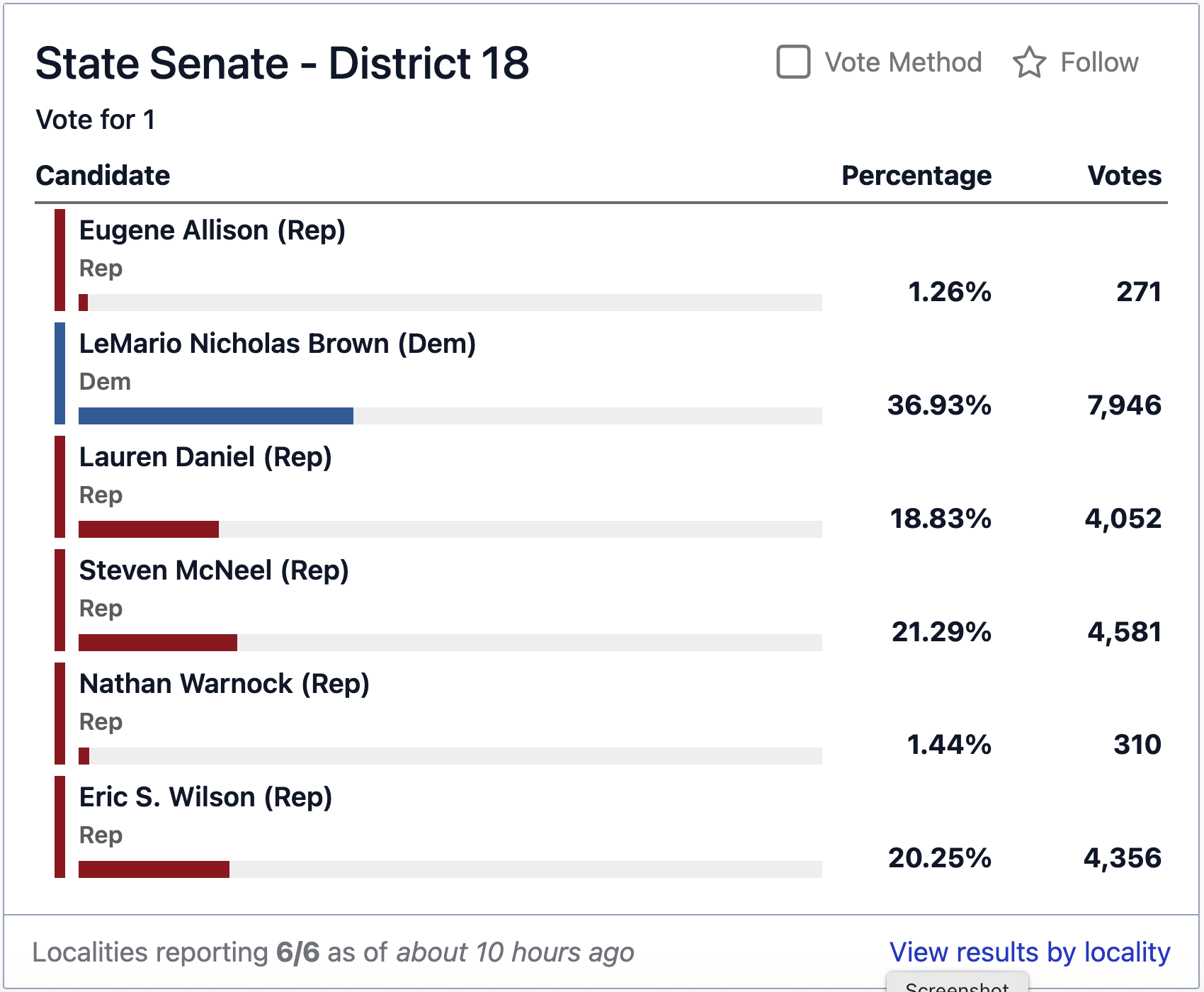
Voters in Senate District 18 went to the polls yesterday in a Special Election. From 13WMAZ:
District 18 — which includes Crawford, Monroe, Peach, Upson, Bibb and Houston Counties — opened up suddenly after incumbent John F. Kennedy resigned to focus on his bid for lieutenant governor.
Five Republican candidates and one Democratic candidate entered the race for District 18, which concluded with election day on Tuesday.
Here’s how Central Georgia voted, per the Georgia Secretary of State website.
ResultsLeMario Brown (D): 7,946 votes, for 36.93% of the vote
Steven McNeel (R): 4,581 votes, for 21.29% of the vote
Eric Wilson (R): 4,356 votes, for 20.25% of the voteLauren Daniel (R): 4,052 votes, for 18.83% of the vote
Nathan Warnock (R): 310 votes, for 1.44% of the vote
Howard Allison (R): 277 votes, for 1.26% of the voteBecause none of the candidates received a majority of the vote, the Senate District 18 race will head to a runoff election on Feb. 17 between Brown and McNeel. During their campaigns, both candidates spoke with 13WMAZ.
Brown, the lone Democrat on the ballot, spent the final weekend before the election moving between campaign stops while volunteers canvassed neighborhoods across the district.
Brown received a boost in the final days of the campaign from U.S. Sen. Mark Kelly (D) of Arizona, a former astronaut, who stopped in Forsyth on Saturday to rally supporters for a canvass launch. He has framed his campaign around affordability, health care access, and economic development, pitching himself as an advocate for working families, farmers, and small business owners.
“I wanna make sure they have a voice in the Georgia Dome that’s looking out for them, that’s making sure that they have sensible legislation being passed,” Brown said after the special election results came in.
Steven McNeel, a Republican, said his campaign was focused on cost-of-living concerns, particularly for seniors, people on fixed incomes, and farmers. McNeel cited his background in construction, law, and farming as shaping his views on taxes and regulation.
He and his family spent the past few days canvassing across Houston, Peach, and Bibb counties, knocking on doors and urging voters to head to the polls.
“If elected and if given the honor to do that, that would be my full intention is to further the people’s interest in the Middle Georgia’s values at the Capitol,” McNeel said.
13WMAZ spoke with both Brown and McNeel during their campaigns for the special election. Those interviews can be found below.
It appeared as if Steven McNeel, a Republican, received the second-highest amount of votes, a little more than 21%,in Tuesday’s special election for Senate District 18 and will face Brown in a runoff election next month.
The race was close between McNeel, an attorney and timber farmer, and former Forsyth Mayor Eric Wilson, also a Republican, according to the unofficial results. Wilson received just over 20% of the vote. If the numbers hold when certified and made official, Wilson will have finished a little more than 1 percentage point behind McNeel.
Georgia law allows a candidate to call for a recount when they finish 0.5 percentage points or less behind another candidate.
Democrats have made it a point to challenge every race for the past year’s several special elections, overperforming in districts routinely held by Republicans.
In most cases where a runoff was required, the Democrat narrowed the point spread with the Republican candidate, but ultimately lost. A Democrat flipped an Athens-area House seat last year.
Democrats poured money and resources into the race and brought in national figures to campaign on Brown’s behalf, including an appearance from U.S. Sen. Mark Kelley, D-Ariz., on Saturday.
Georgia GOP Chairman Josh McKoon said Republicans “stepped up” after initial early voting figures had them underperforming expectations.
“Democrats threw everything they had at this race — pouring in money from California and New York and even calling in national figures like Senator Mark Kelly — but in the end, they still couldn’t close the deal,” McKoon said.
McIntosh County voters overwhelmingly approved a ballot measure to rescind an earlier zoning ordinance by the County Commission, according to The Current GA.
The long-awaited referendum on zoning changes for Sapelo Island’s Hogg Hummock community is over, and the ordinance passed in 2023 is repealed. The zoning change would’ve increased the allowed structure sizes to 3,000 square feet.
Tuesday’s vote saw a 19% voter turnout, with voters choosing “yes” by a more than 5-to-1 margin in unofficial and incomplete results.
Josiah “Jazz” Watts, one of the main organizers of Tuesday’s referendum, went to the McIntosh County Board of Elections Tuesday to hear the unofficial results as they were made public.
“The Gullah Geechee community on Sapelo has spoken,” said Watts, a multigenerational Sapelo descendant and community member who also serves as a Justice Strategist for One Hundred Miles. “But I think the people that are here in this county have resoundingly, clearly, produced a mandate for the McIntosh County Board of Commissioners that they are mandated to protect, preserve the culture, the community, the people, the heritage of Hogg Hummock.”
It took more than two years of organizing and litigation to get to Tuesday’s vote. After the county passed Hogg Hummock zoning changes, the “Keep Sapelo Geechee” coalition collected enough signatures to force a referendum, a little-used avenue of redress for voters outlined in the Georgia Constitution. In summer 2024, a probate judge approved the referendum and originally scheduled it for Oct. 1, 2024.
Early voting was already underway in September, 2024 —, and more than 800 ballots cast — when a Superior Court judge granted the county’s request to shut down the special election. When that decision was appealed, the Georgia Supreme Court in September 2025 sided with the residents, putting the referendum back on the calendar for Tuesday’s vote.
Watts said he’s grateful to and proud of his county.
“Sometimes people tend to forget that there are real people that have to constantly wage and fight these battles,” he told The Current GA. “I feel like the voters, the county, the people are clearly saying ‘enough’. They’re saying ‘enough’.”
He noted that two commissioners are new to the board since the 2023 vote, making it easier for the board to change direction.
“The entire county is sending a message to them, and we need them to hear it, and we need them to act accordingly,” Watts said.
It may be clear by the end of the week if county officials are in step with voters. The county commission on Tuesday announced a special called meeting for 10 a.m. Thursday at Darien City Hall, 106 Washington St. in Darien, to consider the adoption of a moratorium “pertaining to certain activities on Sapelo Island.”
Watts said a temporary moratorium on permits and construction on the island would be a positive step.
“That means that they at least recognize that there should be nothing going on until we resolve this,” he said.
The vote sets up a potential clash over what zoning laws, if any, now regulate the island. Lawyers for the Gullah Geechee assert the referendum repealed the action that changed the ordinance — a County Commission vote — and not the zoning itself, meaning the preexisting rules remain in place.
But Commission Chairwoman Kate Pontello Karwacki has argued the referendum results remove all development restrictions in Hogg Hummock. Karwacki spearheaded the introduction of a revised ordinance for passage ahead of the referendum, but public backlash over what one Gullah Geechee leader labeled “sneaky stuff” tanked that effort.
McIntosh Commissioners will address Sapelo’s zoning future in a special meeting scheduled for 10 a.m. Thursday. An agenda posted in the county’s legal organ, The Darien News, states the commission will consider a moratorium “pertaining to certain activities on Sapelo” but does not offer details.
A moratorium on Sapelo building permits for homes larger than 1,400 square feet is already in effect in the form of a court injunction. Superior Court Judge Gary McCorvey issued that order in November 2024, saying that without it larger-scale development could move forward and render an eventual ordinance repeal “hollow.”
The referendum result does not void that injunction.
McIntosh’s government has spent more than $500,000 defending its zoning change in court, according to records obtained and first reported by The Current, an online news outlet that covers the Georgia coast. In a 2024 court hearing, county officials estimated the cost of holding a special election for the referendum at more than $20,000.
Governor Brian Kemp issued Executive Order #01.20.26.01, calling a Special Election for Senate District 53 to fill the vacancy created by the resignation of the incumbent. The Special Election for District 53 will he held March 10, 2026.
Karen Gordon announced she will run for the House District 180 Special Election also being held March 10, 2026, according to WJBF.
Community leader Karen Gordon announced Tuesday her intent to run for the Georgia House of Representatives District 130, following the scheduling of a special election to fill the vacant seat.
That seat was held by Lynn Heffner (formerly Gladney) who resigned January 5, 2026 due [to] rebuilding uncertainty.
“I’m announcing my intent to run because District 130 deserves steady, prepared leadership during a time of transition,” Gordon said. “I’ve spent years working alongside our community to turn ideas into action, and I’m ready to bring that experience to the Georgia House.”
The special election for Georgia House District 130 is expected to take place on March 10, 2026.
Gordon plans to continue meeting with residents and community stakeholders in the weeks ahead as she prepares for the qualifying process.
Karen Gordon is seeking the District 130 seat in the Georgia General Assembly’s House of Representatives. The district hugs the Savannah River and spans the eastern part of Richmond County from downtown to the Burke County line.
The House seat was vacated by Lynn Heffner, who resigned in early January, after publicly disclosing that a recent change of address moved her outside the district, making her ineligible to serve.
Gordon perhaps is best known in the area as the founder of Garden City Jazz, a management agency that promotes and books locally based musical acts. She also organized and runs Growing Augusta, a collaborative that produces programs to cultivate community empowerment through agriculture and art.
She also publishes Urban Pro Weekly, a twice-monthly newspaper focused on Augusta’s Black community.
Gordon said she wants to leverage the energy fueling her community successes into representing the 65,000-plus people in District 130, about one-third of Richmond County’s population.
“Our challenges don’t exist in silos,” she said in a statement. “When small businesses, creatives, growers, and community developers work together, we create stronger neighborhoods and a more resilient local economy. Collaboration is how we move forward.”
Governor Kemp announced he will lead an economic development mission to Europe, according to a Press Release.
Governor Brian P. Kemp today announced that he and First Lady Marty Kemp will lead an international mission this week to reinforce economic relationships in Belgium and the United Kingdom.
“Companies from Belgium and the U.K. support jobs in manufacturing and technology in communities across the state,” said Governor Brian Kemp. “As Marty and I have throughout my time in office, we are proud to meet directly with companies at their global headquarters and tell them why Georgia is the best place for them to invest their dollars and grow their workforce. Job creators value that commitment and personal approach, which has yielded incredible results for communities statewide.”
The Governor and First Lady, joined by representatives from the Georgia Department of Economic Development (GDEcD), will conduct meetings with companies already operating or under construction in Georgia during their trip.
“With more than 50 years of representation in Europe and more than 20 years of additional U.K.-focused support in-market, Georgia remains committed to lasting partnerships in international markets,” said GDEcD Commissioner Pat Wilson. “European companies are innovators in key industries including life sciences, manufacturing, and technology that support high-quality jobs in Georgia.”
Belgium and U.K. Connections at a Glance
The State of Georgia has had continuous representation in Europe since 1973, with expanded representation focused on the U.K. market added in 2002. Both Belgium and the U.K. ranked among Georgia’s top 15 trade partners by dollar value in 2024.
Belgium first established a consular presence in Georgia in 1834. In 2024, Georgia’s total trade with Belgium exceeded $4.8 billion. In June 2022, Georgia welcomed a delegation of high-ranking Belgian officials, diplomats, and business leaders led by Her Royal Highness Princess Astrid of Belgium. The visit was the largest international trade mission to Georgia since the 1996 Olympics.
The British Consulate General has maintained a consular presence in Georgia since 1804. In 2024, Georgia’s total trade the United Kingdom exceeded $5.7 billion.
Gov. Kemp proposed allocating $325 million dollars for need-based financial aid, according to the Capitol Beat News Service via the Savannah Morning News.
Financially strapped college students in Georgia often must drop out for want of money for food and shelter, but their prospects could improve under a new initiative from Gov. Brian Kemp.
The Republican governor, nearing the end of his second and final term amid an uproar over rising costs, wants to put $325 million of taxpayer funds into a scholarship program for students with limited means.
Georgia’s HOPE and Zell Miller scholarships are generous but require students to earn high grades. Georgia is one of just two states that do not offer scholarships solely for financial need.
If the General Assembly adopts Kemp’s proposal, then New Hampshire will stand alone as the only state that does not offer need-based funding.
“I’m really excited about it,” said Sam Aleinikoff, a former math teacher who created and runs College AIM, an organization that helps metro Atlanta students access higher education. “I think it’s a huge step in the right direction.”
Kemp’s gesture comes after a Senate study committee recommended that Georgia spend $126 million a year on need-based financial aid for 98,000 students, potentially pulling money from the same source that funds the HOPE and Zell scholarships and pre-kindergarten. The committee noted that the funding source, the Georgia Lottery Corporation, had nearly $2 billion in reserves.
Students and other advocates who testified to the committee described the plight of poor students who had to hold jobs to pay their bills. The time away from studies undermined their grades, eventually making them ineligible for the HOPE money that got them to college. That loss led to even longer hours at work and an academic downward spiral until they dropped out.
“By the end of their freshman year, 40% of those young people are no longer qualified to get that HOPE scholarship,” said Sen. Nan Orrock, D-Atlanta, who led the study committee. “In many cases that is tied to the fact that they are out working one or two — in some cases we had students testify that they had three jobs,” she said. “Surprise, surprise they are challenged on keeping their grades up.”
Meanwhile, other states have been attracting Georgia students with larger financial aid packages.
Georgia has the lowest home state college attendance in the region, according to testimony before the committee, with 78% of high school graduates staying here versus the 91% who stay in Mississippi, 86% in Florida and 85% in South Carolina.
The committee cited a 2019 report by the Selig Center for Economic Growth, a business think tank at the University of Georgia, that said Georgia could eventually suffer a shortage of skilled labor if it did not create a need-based financial aid program. Without one, “Georgia is leaving potential economic growth on the table and shortchanging its citizens,” the report said.
Orrock’s study committee was authorized by Lt. Gov. Burt Jones, a Republican running for governor. The committee’s recommendations passed unanimously, with bipartisan support.
Orrock speculated that her Republican colleagues were compelled by the facts unearthed by her committee and by the upcoming elections “where voters are saying affordability is the issue of the day.”
Kemp’s proposal would pour money into the DREAMS Scholarship Program, which was founded recently by the University System of Georgia Foundation under the leadership of Chancellor Sonny Perdue.
It had $4 million in need-based scholarship funding to distribute last fall. Kemp’s proposal would expand that significantly, offering $25 million in scholarships initially. The remaining $300 million would be used as seed money to attract private donations.
While advocates are excited about the promise of the program, they have questions about some of its stipulations. The DREAMS (Dedicating Resources to Educationally Advance More Students) website says students must work part time to earn a scholarship.
That requirement could undermine the very purpose of helping them maintain high academic achievement, said Ashley Young, an analyst with the Georgia Budget and Policy Institute, which promotes equitable access to higher education.
“We feel this eligibility factor could be more of a barrier than an access point for students who actually need the money the most,” she said. She and other advocates are also concerned by vague language about the distribution of the funding. The website says DREAMS money will be distributed to more than two dozen schools and that the amounts will “vary by institution.”
It does not say how.
Young and other advocates suggested that the money be allocated based on eligibility for federal Pell grants, which are income-based. Otherwise, students at highly ranked schools, such as Georgia Tech and the University of Georgia, which already have a healthy alumni donor base, could wind up with more support than students at lower ranked colleges and universities that contend with a higher ratio of low-income students.
Some also said students attending private colleges and universities should be eligible.
However, the biggest concern initially is the funding.
Annual allocations must grow fivefold from that initial round of $25 million to meet the study committee’s $126 million goal. Yet Aleinikoff, the former teacher turned advocate, said the larger figure was offered as a “paired down” and more affordable target.
“The need far exceeds even that $126 million number,” he said. “The need is expansive.”
To produce $126 million a year using investment income, the endowment would have to grow to around $1.8 billion, estimated Sen. Max Burns, R-Sylvania. As a member of Orrock’s study committee, he advocated for the endowment idea.
Georgia’s lottery program has about that much in reserves, and the committee suggested tapping that fund for DREAMS. But that would be a non-starter for Burns, who as chairman of the Senate Higher Education Committee, was a key voice in Republican support for the study committee’s recommendations.
HOPE is a sacrosanct national model, Burns said, and the reserves are needed to keep it funded through economic rough patches.
Burns, who said he worked his way through college, rising to become president of Gordon State College in Barnesville until 2017, agrees with the work requirement so long as it is limited. He cited statistics that say students lose half a letter grade for each 15 hours per week of employment during college.
He also praised Kemp for the downpayment to the program and Perdue for setting it up in the first place. He said businesses and “community partners” need to donate to the fund, and he said he is confident that will happen since they stand to benefit from an educated workforce.
“This initiative will support thousands of Georgians — thousands of Georgians — in perpetuity if we do it correctly,” he said.
Georgia State Economist Dr. Robert “Bob” Buschman discussed Georgia’s economy in a presentation to yesterday’s Joint Appropriations Committee hearing, according to Georgia Recorder.
Georgia’s economy is showing signs of strength, but persistent inflation and slow job and wage growth have left consumers feeling sour about their finances.
And the state economist, Robert Buschman, told lawmakers Tuesday that he expects that slow growth and higher inflation to continue.
Buschman’s presentation to legislative budget writers put charts and graphs to the unease lawmakers are hearing from their constituents back home as affordability concerns take center stage under the Gold Dome.
“Reluctance by businesses to hire suggests fewer opportunities to change jobs for better pay, and that those between jobs or entering the workforce will remain unemployed for longer, dragging on consumer confidence,” Buschman said.
“Consumers also still feel squeezed by inflation. Incomes have not really kept up for the average worker. So consumer sentiment is weak,” he said.
Inflation had been falling from the recent highs seen in 2022 but has crept back up to 2.7%.
Buschman highlighted some bright spots for Georgia’s economy, like its low unemployment rate. But he said there are also worry-inducing factors at play, like the tariffs that have become a central element of President Donald Trump’s economic policy in his second term in office. Trump has issued new tariff threats in recent days in his pursuit of Greenland.
The bulk of the cost of these tariffs fall on consumers and businesses, depending on much of the cost companies are willing to absorb to avoid losing sales in the short term, Buschman said.
“As time passes, businesses, both domestic and foreign, have to pass more of the cost on to consumers to remain profitable, so we’ll see continuing upward pressure on consumer prices,” he said.
There’s also the risk of other countries placing retaliatory tariffs on American exports.
“Large exporting states like Georgia are the ones harmed the most by that,” Buschman said, noting that Georgia is the 12th largest export state.
Buschman’s presentation was part of the kick-off for this week’s budget hearings at the state Capitol. The hearings continue Wednesday morning with agency heads who oversee social and health care services in Georgia.
The state economist’s outlook also provides context for the words of caution Gov. Brian Kemp has been weaving into his public comments on the budget. As he wraps up his last year in office, the governor has been touting his administration’s conservative approach to the budget.
“It has allowed us to store up strategic reserves for the next economic downturn, ensuring you all or future legislators won’t be forced to cut critical services for Georgians when, not if, the next economic crisis hits,” Kemp said to lawmakers Tuesday.
Kemp has proposed accelerating another incremental income tax rate decrease at a time when some legislative leaders are pushing for more aggressive steps toward eliminating it entirely. He has proposed cutting the rate to 4.99%, down from today’s 5.19%, and built his budget proposals on the assumption those revenues will be foregone. The already-planned cuts would happen three years faster than originally planned.
He’s also proposing another round of bonus tax refunds for this year, paid for by funds from the state’s $14.6 billion reserves. With those payments to taxpayers and one-time infrastructure spending boosts, the state is still set to have about $10 billion left in reserves when Kemp leaves office next January.
Buschman, who was appointed by Kemp, expressed skepticism about talk of eliminating the state’s income tax. A special Senate committee unveiled a plan earlier this month that would end the tax by 2032.
“I think what the governor has been doing in lowering income tax rates slowly over time, as we were able to evaluate how much of our surpluses were structural surpluses, is the better way to go,” he said.
Kemp told reporters Tuesday that he is optimistic about Georgia’s ability to weather any economic storms that may await.
“We have been cautiously budgeting since we came out of the pandemic, because nobody really knew what this was going to look like,” he said. “So we’re prepared to deal with what’s going on in the world right now.”
It was also announced Tuesday that Kemp and first lady Marty Kemp would lead an economic development mission this week to Belgium and the United Kingdom. He will be there at a time of rising tensions between the Trump administration and America’s allies.
“We cannot rest on our laurels. We’ve got to finish strong. We’ve got to keep finding people that want to grow jobs in our state so, God forbid, if somebody does lose their job, they’ve got other opportunities that pay just as well or better,” he said.
Senate Bill 389 by State Senator Kim Jackson (D-Pine Lake) and others would prohibit federal law enforcement from masking and require them to wear visible identification, according to AccessWDUN.
A bill introduced in the Georgia State Senate and [co-]sponsored by a Gwinnett County legislator would require Immigration and Customs Enforcement agents to remove face coverings and wear visible identification.
State Senator for District 7 Nabilah Parkes (D-Duluth), who cosponsored the bill, said Senate Bill 389 aims to build accountability.
“There have been a lot of trust issues right now with immigration enforcement, and the fact that we can’t see their face, or there’s no identification on them, we don’t know who they are,” Parkes said. “The communities are living in fear right now, because there’s risk for impersonation, and people feel like there have been folks that have taken advantage of the fact that ICE has been masking themselves and impersonating themselves as agents when they were not.”
She added that it is an important piece of legislation because it would require ICE agents to follow the same accountability standards as other law enforcement agencies. Parkes said she has received reports of ICE conducting activities in Gwinnett County.
“I have heard from constituents, and they are concerned about masked agents showing up in their communities, and them just not knowing who these people are. It undermines public trust when people can’t tell who you are, and you’re showing up in unmarked vehicles with weapons drawn,” Parkes said. “I just think it’s very important to at the very least be able to tell who these law enforcement agents are, the same way we were able to identify our police officers.”
Parkes herself proposed Senate Bill 391, which would require ICE agents to obtain a judicial warrant before entering sensitive places.
“ICE would need a judicial warrant if they were to go to a school, a place of worship, hospitals, or violent shelters,” Parkes said. “That just creates a process so that we don’t cause disruption in these places, where people are seeking care and learning facilities.”
Parkes said public trust has eroded after the recent ICE activity across the country, and these bills aim to rebuild that trust.
Senate Bill 389 has been read and referred by the State Senate to the Senate Committee on Public Safety as of Jan. 20.
Democrat Geoff Duncan (R) campaigned in Augusta, according to WJBF.
Georgia candidate for governor Geoff Duncan toured the Carpenters Local Union 283 in Augusta on Tuesday to discuss job training for workers.
Duncan said while he served as Georgia’s lieutenant governor, he worked to expand access to health care in rural communities and if elected, will focus on lowering costs in other areas.
“So I think we’ve got to do a better job of educating through our public schools. I also think we’ve got to expand Medicaid,” Duncan said. “I think we’ve got to create an environment where folks can show up to work, not just work from check to check, but actually be able to have benefits and to be able to have health care. We also got to tackle some of the affordability issues there. There’s folks listening to this right now that would love to go back to work, but they can’t afford child care. There are things that we can do as a state to better effect that.”
Duncan will go against former Atlanta mayor Keisha Lance Bottoms, former state senator Jason Esteves, former labor commissioner Michael Thurmond, Derrick Jackson, Olu Brown and Representative Romman,
Election Day is Nov. 3.
Police blotter: City of Pearson deputy city clerk and municipal clerk for the police department Ladowell Williams was arrested for alleged DUI, according to WALB.
A City of Pearson official has been separated from her position following a DUI arrest over the weekend, according to Mayor Jason Joyner. The employee was also facing charges from 2024 for allegedly firing a gun at a vehicle.
According to the Georgia State Patrol (GSP), just after 5:30 p.m. on Saturday, January 17, 2026, a trooper initiated a traffic stop involving Ladowell Williams (27).
Williams, who served as the city’s deputy city clerk and the municipal clerk for police department, was arrested and charged with:
• DUI
• Adult restraint law/seatbelt violation
• Window tint violationCity officials confirm Williams was served a separation notice following the arrest.
According to the arrest report, Williams did not pass field sobriety tests. A state trooper also reported finding marijuana inside the vehicle. The car was released to her father, former Mayor Pro Tem Tony Williams, who currently serves as a city councilman in Pearson.
Williams was booked into the Atkinson County Jail and later released on bond. Records show she was already out on bond in connection with a separate 2024 case at the time of this arrest. In 2024, investigators allege she fired a gun at a vehicle with her child’s father and child inside.
Pearson Mayor Jason Joyner emphasized accountability as a priority, stating that progress in Pearson begins with restoring trust and making changes within city leadership.
Mayor Joyner described the city’s decision to separate Williams from her position as “part of a broader effort to restore confidence and accountability in Pearson’s local government.”
This push for restored confidence in Pearson’s leadership comes after a tumultuous 2025, with other city leaders being arrested and charged by the GBI in what they called a “City of Pearson Corruption Investigation.”
Both then-mayor Robert “Buster” Johnson (49) and then-city clerk Patricia Ballard (67) were arrested during that GBI operation.
Warner Robins City Council members voted to place a “Floating Local Option Sales Tax” (FLOST) on the ballot, according to 13WMAZ.
If you live in Houston County, a new penny sales tax could soon be on the ballot.
On Tuesday night, Warner Robins City Council unanimously approved moving forward with the Floating Local Option Sales Tax, or FLOST, a measure designed to reduce residential property taxes if voters approve it later this year.
The vote does not create a new tax right away. Instead, it allows the question to move forward to voters, who will decide whether to adopt the one-percent sales tax.
The goal of the FLOST is to shift part of the property tax burden away from homeowners and onto everyday spending within the city, according to city officials.
Shoppers in Warner Robins including residents, visitors, and commuters would pay the additional penny on purchases at places like stores, restaurants, and entertainment venues. That revenue would then be used to offset residential property taxes.
“They’ll actually be paying less for their property tax bill,” Mayor LaRhonda Patrick said.
Patrick explained that even small percentages could make a difference for homeowners.
“If those laws come in and it covers 1%, 2% of what their bill would have been, that means the property owner, the residential property owner pays 1 or 2% less,” Patrick said.
The authority for the tax comes from House Bill 581, a state law passed in 2024. The legislation allows cities and counties to adopt a special sales tax, but only for one specific purpose: residential property tax relief.
State law restricts how the money can be used. The revenue cannot fund roads, salaries, or other government projects. Instead, it must go directly toward reducing property tax bills for residential homeowners. The Georgia Department of Revenue oversees and audits how the money is collected and spent.
Patrick said one of the biggest challenges will be making sure voters understand how the tax works.
“The biggest misunderstanding is people thinking this is another tax on them, without realizing this is something designed to help them, not harm them,” Patrick said.
While Warner Robins has taken the first step, the tax cannot move forward without additional approvals and a public vote. Other cities in Houston County and county leaders must also sign off before the referendum can appear on the ballot.
If voters approve the measure, homeowners could see property tax relief tied directly to local shopping activity.
Long County Commissioners heard from homeowners about rising property taxes, according to WTOC.
Residents in Long County say they are tired of taxes increases, despite a one million dollar gap in the current budget. Residents and county department leaders shared their concerns during Tuesday’s third and final public tax hearing.
New County Manager Shane Richardson shared 2026 budget numbers during Tuesday’s public hearing and commission meeting. Richardson said county commissioners have tentatively adopted the 2025 millage rate of 18.707 mills. This is considered a 20.72% property tax increase under Georgia law. Even with this tax increase, Richardson says there is still a budget shortfall. He also proposed cuts to department positions[.]
Both taxpayers and county department leaders spoke out against the proposed budget changes.
During the meeting, the Long County Commission did vote to approve an inter-governmental agreement with the Long County Development Authority to meet payroll for the next 30 days.
The county manager says tax bills should go out February 4th, and Long County should generate $3.5 million in revenue.
The budget challenges come after the 2025 GBI raid and arrests of former Long County Chairman Robert Parker and businessman Tony Fowler. Warrants claimed Parker spent thousands of dollars in county funds on shotguns, personal clothing and shoes.
Documents also show he used county equipment on his personal property.
Savannah Mayor Van Johnson discussed Senate Bill 204, passed this month, according to WSAV.
Savannah Mayor Van Johnson shared his thoughts on Tuesday about Senate Bill 204 that would conflict with a city of Savannah gun storage ordinance, if signed by Governor Brian Kemp.
Last Tuesday, Senate Bill 204 was passed by a vote of 31-21 and would ban local gun storage laws, like the one in Savannah.
Senate Bill 204 was amended to include language from Senate Bill 163, according to the NRA-ILA.
The Savannah city ordinance, originally passed in 2024, requires firearms left in unoccupied vehicles to be securely stored, or the gun owner would face penalties up to a $1,000 fine or 30 days in jail.
Sylvia Washington was sworn in as Mayor of Bainbridge, according to WALB.
Sylvia Washington is the first African American woman to become mayor in Bainbridge.
In 2019, Washington also made history when she became the first African American woman to serve as a city council member.
She says she is overjoyed and humbled to be elected as mayor and is looking forward to serving Bainbridge, with one of her priorities being the budget.
“I would like to look more closely at the budget to see if maybe there are some line items that we can kind of switch around to see where actually our funding is. Sometimes we overlook things, so that will be my first short term, is to just really look at that budget to see where our money is,” Washington said.
Mayor Washington’s goals include looking for industries to come to Bainbridge, more recreational activities for youth and seniors, looking into homelessness issues and more affordable housing.
Related Posts
 Governor Deal signs executive order creating digital learning task force, panel to recommend replacements for Miller County School Board
 University System of Georgia taking a closer look at MOOCs | www.ajc.com
 Adoptable Georgia Dogs for April 4, 2015
 Adoptable (Official) Georgia Dogs for August 24, 2018
 Crossover Day casualty list – Atlanta Business Chronicle


Comments ( 0 )