
Georgia History
On January 18, 1776, James Wright, Royal Governor of Georgia, was arrested by John Habersham, a member of the Provincial Congress.
L.Q.C. Lamar, born near Eatonton, Georgia, was sworn in as an Associate Justice of the United States Supreme Court on January 18, 1888.
Georgia Politics, Campaigns, and Elections
Committee Meetings Today
10:00 AM Joint Budget Hearings 341 CAP
1:00 PM Joint Block Grant Hearing 341 CAP

Dentons Atlanta office last week hosted Kentucky Senator Rand Paul, who spoke about the current state of healthcare reform in Washington.
Here are my notes:
“I don’t want to replace obamacare with another government program – I want to replace it with the marketplace.”
1. Allow more insurance plans to be sold, including plans like high-premium catastrophic – “I want to legalize the sale of cheap insurance; Obamacare made it illegal”
Paul said that if part of the goal with the ACA was to bring younger buyers into the insurance marketplace, a better way is to allow cheap insurance plans, such as ones that have higher deductibles but provide mainly for catastrophic injuries. A smaller number of higher-priced plans has priced many younger folks out of the market.
Get rid of mandates and let insurance companies sell whatever they want.
2. Help people save for insurance – expand HSAs. Tax credits may work, but not refundable tax credits, which are subject to fraud.
3. Let individuals band together to buy insurance through associations – the individual market is artificial and would not exist without government intervention.
“Nobody should be left out in the cold to buy insurance in the individual market.”
In response to a question about Medicaid:
“Most people say 85-90% of new people covered by ACA are through Medicaid.”
“I like the idea of block grants because Ga can do what they want to.”
“Part of the answer to Medicaid and insurance is a robust economy.”
“If you block grant [Medicaid] the states will have to economize.”
“The fundamental problem with medicine is that prices are fixed due to Medicare.”
“There is no marketplace [under ACA] where prices go up and down.”
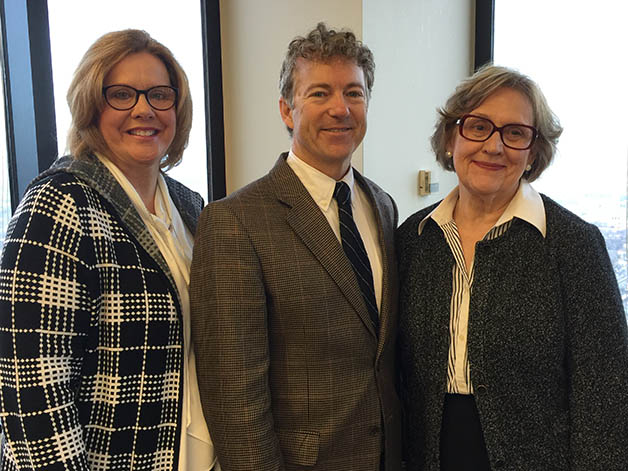
Sen. Renee Unterman, Sen. Rand Paul, Rep. Sharon Cooper
My other takeaway from the morning is that Atlanta has a small but feisty group of Libertarian ophthalmologists.
Speaking of Dentons, Atlanta partner Stefan Passantino, head of the firm’s political law practice, has been tapped by the Trump Administration to assist in the Office of White House Counsel.
Passantino, who maintains offices in Washington, D.C., and Atlanta, advises businesses, interest groups and politicians on state and federal election laws, campaign fundraising, lobbying and ethics. He represented former Republican House Speaker (and Dentons senior adviser) Newt Gingrich in his 2012 White House bid and related campaign finance matters. In the most-recent election cycle, he reportedly helped to set up so-called super PACs for the 2016 campaigns of Ted Cruz and Rick Perry.
A familiar name in Georgia Republican politics, Passantino currently serves as chief deputy general counsel to the Georgia Republican Party and has represented other Republican groups in the state. He was a partner at McKenna Long & Aldridge before the firm merged with Dentons in 2015.
In addition to being asked to serve in the incoming Trump administration, Passantino has been added to the list of individuals serving on agency “landing teams” for the president-elect’s transition.
Congressman Tom Price begins the first of two confirmation hearings as the prospective Secretary of Health and Human Services today.
Price, a conservative Republican orthopedic surgeon from Atlanta, was elected to Congress in 2004. In addition to his opposition to the Affordable Care Act, Price has pressed for significant policy changes in Medicare, Medicaid, the Children’s Health Insurance Program and other Democratic-favored programs. On the personal side, there’s been renewed scrutiny of past campaign contributions from the health care industry and Price’s history of investing in health care stocks. A controversial CNN piece earlier this week on the latter issue earned a sharp rebuke from the Trump transition team.
The HELP committee won’t take a confirmation vote on the nomination. That will be left to Finance, which oversees Medicare and Medicaid and thus most federal health care spending. However, HELP does have jurisdiction over many HHS programs and agencies including the FDA, CDC, NIH, as well as many aging and mental health programs. Plus – given that its members include Bernie Sanders and Elizabeth Warren – expect a lively hearing with some sharp exchanges about drug costs, and overall HHS priorities.
Price, 62, studied at the University of Michigan but settled in Atlanta following his medical training at Emory University. He became politically activate through his deep opposition to the Clinton health plan of 1993-94, which he saw as a government intrusion in medicine. He became more active and influential within the Georgia branch of the American Medical Association and successful ran for the state legislature. In 2004 he was elected to the U.S. House of Representatives to represent a district that by then overlapped Newt Gingrich’s old stomping grounds. Once in the House, he made his name as a conservative doc and fiscal hawk, rising to the powerful chairmanship of the House Budget Committee.
He is the author of one of several potential replacement plans for Obamacare. It’s not the most conservative plan out there, but is to the right in most respects from Paul Ryan’s plan (though Price also has endorsed Ryan’s approach). Price is a strong advocate of Ryan’s “premium support” plan for Medicare, and wants its consideration to be a House priority following ACA repeal and replacement. Price has strong anti-abortion views, is opposed to expansion of the Children’s Health Insurance Program and has made capping malpractice awards one of his signature issues.
Price faces scrutiny and call for an ethics investigation over his stock trading.
President-elect Donald Trump’s nominee to lead the Department of Health and Human Services bought shares in a medical device company last year and then introduced legislation in the House to help the company less than a week later, CBS News has confirmed.
The new revelations about Rep. Tom Price, first reported by CNN on Monday evening, raises new ethics concerns and questions about whether Price engaged in insider trading. This comes just days before he’s slated to testify at his Senate confirmation hearing on Wednesday.
According to House records, Price, R-Georgia, bought between $1,000 to $15,000 worth of shares in the company Zimmer Biomet last March.
Days later, he introduced a bill that would have delayed a regulation until 2018 that industry analysts said would financially hurt Zimmer Biomet. Records show that after the introduction of the measure, the company’s political action committee donated to Price’s reelection campaign.
“Zimmer Biomet had no knowledge of Congressman Price’s purchase of Zimmer Biomet stock. As is common practice, the Zimmer Biomet PAC regularly makes donations to various political campaigns, all of which are disclosed as required by law,” she said. “These actions are not connected. Zimmer Biomet has supported the Comprehensive Joint Replacement (CJR) program developed and implemented by the Centers for Medicare and Medicaid Services. Zimmer Biomet was not involved in the Healthy Inpatient Procedures (HIP) Act, which was introduced by Congressman Price to delay CJR implementation.”
Price’s former Press Secretary, Ellen Carmichael, provided a point-by-point refutation:
Dr. Price’s personal investment portfolio is managed by a Morgan Stanley financial adviser who directs all trade transactions conducted on his behalf. Pursuant to his agreement with the investment firm, he is not involved in the decision to buy or sell any stocks. His portfolio contains both health care and non-health care related stocks.
On March 17, 2016, his adviser conducted a periodic rebalancing of his portfolio. At this time, Morgan Stanley purchased 26 stocks of Zimmer Biomet, totaling $2,697.74, on behalf of Dr. Price, in addition to other financial products as a part of routine management.
Dr. Price first learned of the purchase of this stock on April 4, 2016, when he received notification of all trades to be disclosed on his House Periodic Transaction Report. On April 15, 2016, Dr. Price submitted a filing of all transactions, in accordance with federal laws and Congressional rules governing disclosure compliance.
The legislation to which CNN refers regarding Zimmer Biomet’s potential interest concerned a comprehensive joint replacement demonstration project. For many years, Dr. Price has expressed opposition to Obamacare and thus, he has an extensive record of communicating with various government agencies throughout his time in Congress on specific pieces of health care policy.
It’s a desperate time for Democrats in D.C. If they can’t defeat a good man on his ideas, his experience or his character, they’ll just conjure up a corruption narrative without any facts to support it. And they almost got away with it.
Bill Barrow of the Associated Press looks at Price’s Congressional District and how it affects his approach to healthcare.
The realities of Price’s district explain his approach in Congress. The district comprises Republican-leaning suburbs along the northern ring of metro Atlanta, dynamics that leave Price invulnerable to any Democratic Party challenger. The district has a median household income of more than $83,000 — about $30,000 more than the national mark and $34,000 higher than the Georgia as a whole. The poverty rate is 8.6 percent, compared to 17 in Georgia and 13.5 nationally.
That affluence means that about 650,000 out of 730,000 people in Price’s district have health insurance, according to the Census Bureau. About 575,000 have private insurance policies. That number includes 40,600 consumers who bought individual policies in ACA exchanges.
That’s comparable to 41,500 in a neighboring district that includes the city of Atlanta and less affluent suburbs. And it means that Price serves many constituents like Jonathan Junkins, an IT manager who says he’s always had “good insurance” from his employer. Junkins, 36, says he pays about $150 out of pocket each month for premiums, with his employer paying the rest. Asked whether he see the health insurance debate affecting him, he said, “Not really. My company is pretty good.”
Still, the district has almost 80,000 people without health insurance of any kind. Most of those, according to Purdy, are the working-poor who “fall through the cracks” because Georgia chose not to expand Medicaid as part of the Affordable Care Act. They make too much to qualify for the existing Medicaid program, but not enough to qualify for the subsidies to buy private insurance on the exchanges.
Three Georgians co-signed a letter to Senator Lamar Alexander, Chairman, U.S. Senate Committee on Health, Education, Labor and Pensions, supporting Betsy DeVos as President-elect Trump’s nominee for Secretary of Education.
Dear Chairman Alexander,
As one of the most critical issues impacting the future of our nation, we must have a Secretary of Education committed to the needs of all of our nation’s children. Betsy DeVos has made it her life’s mission to find, support and push for education solutions in her home state of Michigan and across the country. She is an advocate and ally for all children, and we write to you today to express our support for her nomination to this important position as her confirmation hearing approaches.
We represent elected state offices from all 50 states, and as such, we each know the impact of an overgrown federal government reaching into the states to push a one-size-fits all approach to education. No two states, localities or school districts are the same, nor are the needs of the children who reside there. Betsy DeVos understands this distinction and for years has embraced a variety of education solutions to meet this need.
Her support for an all-of-the-above approach to K-12 education – from charter schools, to public, private and online education – defines the school choice movement that has helped countless children across many of our states. By advancing these innovative solutions from the Department of Education, Betsy DeVos will put children first and empower not only states to lead the way in making critical education decisions, but also empower parents to choose what type of education is best for their children.
Together we applaud President-elect Donald Trump for selecting Betsy DeVos as his Secretary of Education nominee. We encourage the U.S. Senate Committee on Health, Education, Labor and Pensions to ensure a swift confirmation process so that we together can get to work making classrooms a place for all children to thrive.
Georgia signers include Secretary of State Brian Kemp, Senate President Pro Tem David Shafer, and former State Rep. BJ Pak, all Republicans.
Dr. Kenneth Heaghney, Georgia State Fiscal Economist, said Georgia’s economy is outperforming the nation as a whole, according to Dave Williams at the Atlanta Business Chronicle.
The Georgia economy grew by 2.3 percent to 2.4 percent between November 2015 and last November, compared to 1.7 percent for the nation as a whole, Kenneth Heaghney told members of the General Assembly’s appropriations committees.
“Unemployment is low. … Consumers are spending,” he said. “It’s been a long road back from 2007 and 2008.”
Heaghney said Georgia’s economy tends to outperform the nation’s during good times and fall behind the national economy during economic downturns.
He said that trend is being reflected by job growth. Nearly 99,000 jobs were created in Georgia last year, putting the Peach State on a slightly stronger footing than the nation, he said.
Gov. Nathan Deal yesterday released the second video in the “Real Teachers Real Voices” campaign.
Deal also made personnel changes yesterday, moving Bert Brantley from Commissioner of the Georgia Department of Driver Services, where he served since March 2016, to Chief Operating Officer, Georgia Department of Economic Development. Replacing Brantley at DDS is Gwinnett County Resident Spencer Moore, who has served as Deputy Commissioner since 2012 and previously spent 14 years at Governor’s Office of Highway Safety.
Gwinnett County residents formed a line out the door at yesterday’s County Commission meeting, waiting to address comments by Commissioner Tommy Hunter.
Gwinnett Commissioner Tommy Hunter came under fire from residents and civic leaders during the county commission’s meeting on Tuesday as they demanded he resign over disparaging remarks he made about U.S. Rep. John Lewis.
Several speakers, including leaders of local and state civic and political groups, rejected Hunter’s effort to apologize for the remarks during the meeting.
Several speakers said Hunter not only showed disrespect for Lewis in his posts, but also for people who live in his district.
“I and other Democrats are calling on Mr. Hunter to resign as this kind of behavior is not fitting for a County Commissioner,” state Rep. Dewey McClain, D-Lawrenceville, wrote in an email to constituents on Tuesday.
On Tuesday, Hunter apologized for the comments at the beginning of the meeting, prompting audience members to say it was too late. He also called accusations of racism made against him “baseless,” and said Lewis should be commended for his work in the Civil Rights movement.
Commission Chairwoman Charlotte Nash distanced herself and the rest of the board from [Hunter’s original] comments, however, as she read a letter that she sent to Lewis earlier in the day.
“I would like to offer my sincere apologies and regrets for the disrespectful comments about you posted on social media by a Gwinnett County commissioner,” Nash said. “I would further welcome the chance to apologize to you face to face if you are willing to give me a chance to do so.
Polling
Yesterday, I spoke to someone who had received a survey phone call testing potential Republican candidates for Governor in 2018, including Casey Cagle, Burt Jones, Brian Kemp, Jack Kingston, David Perdue, and Lynn Westmoreland, as well as various matchups.
Georgia Healthcare
Andy Miller with Georgia Health News writes about a severe nursing shortage in Georgia.
A shortage of nurses is gripping Georgia, and all hospitals are looking for RNs, she says. One key factor fueling Georgia’s nursing shortage, Fort adds, is that the state’s population “is growing fairly rapidly, and our elderly population is growing fairly rapidly.”
Hospital systems across Georgia confirm to GHN that there’s a shortage of RNs in the state.
“There is absolutely a nursing shortage in Georgia, and a larger shortage is looming on the horizon,’’ says Ninfa Saunders, president and CEO of Navicent Health in Macon. “This shortage seems to be one of the most significant and continues to worsen.’’
There is not an equivalent nationwide shortage, says Peter Buerhaus, a health care workforce expert at Montana State University. He says there are scattered reports of local shortages, “but not a uniform overall national outbreak as we used to see back in the ‘70s, ‘80s, ‘90s and early 2000s.’’
Expect to see legislation this session aiming to address parts of the nursing shortage.
A healthcare IT network connecting Navicent Health in Macon and AU Health in Augusta and other systems is seeing results.
A regional health information network that links hospitals in Augusta and Savannah with providers locally and across the state is having some interesting effects, such as reducing needless scans and catching life-threatening illnesses in the Savannah jail.
It covers nearly 1.9 million patients and averages 3,900 active users a month, Cramer said. The system is linked to others in the state and is close to being able to connect with the Department of Veterans Affairs nationally and is on a wait list to connect with the Department of Defense health system, she said.
The information included on each patient can vary, but it can include diagnoses and patient histories, medications, allergies and past tests. The information is secure and can only be accessed by authorized users. But the way the information is being employed is interesting, Cramer said.
For instance, after a rash of deaths from pre-exisiting medical problems, a nurse at the jail in Savannah is using the system to check each new person admitted to the jail for medical issues, she told the Greater Augusta Healthcare Network on Tuesday.
A health information network has been shown to reduce the length of time patients spend in the hospital and could help avoid unnecessary tests, such as repeated imaging scans, Marion said.
“If you go from one place to the next, and they don’t have any information, they are going to repeat these over and over again,” she said. At places such as Hope House, which treats women with substance abuse and mental health issues, those women could have an undisclosed medical problem and “we’ll never know until it is an issue,” said development director Paige Miller.
Getting more of the relevant information, particularly with behavioral health, into the hands of more providers would be helpful, Williamson said.
Related Posts
 Jimmy Carter steps on to the campaign stage for his grandson —… | www.myajc.com
 Georgia’s voting backlog battle – Sarah Wheaton – POLITICO.com
 Georgia panel urges reforms in state child welfare system | Gwinnett Daily Post
 State Senator Buddy Carter on Savannah Harbor Deepening Project
 Missing South Georgia banker arrested | www.ajc.com


Comments ( 0 )