
On January 14, 1639, representatives of three cities in Connecticut adopted the “Fundamental Orders,” the first written Constitution in an American colony and one of the first founding documents to cite the authority of “the free consent of the people.”
On January 14, 1733, James Oglethorpe and the rest of the first colonists departed Charles Town harbor for what would become Savannah, and the State of Georgia.
An elected Provincial Assembly first convened in Georgia on January 15, 1751. The Assembly did not have the power to tax or spend money, but was to advise the Trustees.
The state of New Connecticut declared its independence of both Britain and New York on January 15, 1777. In June of that year they would decide on the name Vermont. Vermont would be considered part of New York for a number of years, finally being admitted as the 14th state in 1791.
The Continental Congress ratified the Treaty of Paris to end the Revolutionary War on January 14, 1784. The Treaty was negotiated by John Adams, who would later serve as President, and the delegates voting to ratify it included future Presidents Thomas Jefferson and James Monroe.
On January 14, 1835, James M. Wayne took the oath of office as an Associate Justice of the United States Supreme Court. A Savannah native, Wayne had previously served in the Georgia House of Representatives, as Mayor of Savannah, on the Supreme Court of Georgia, and in Congress. His sister was the great-grandmother of Juliette Gordon Low, founder of the Girl Scouts, and his home is now known as the Juliette Gordon Low house. When Georgia seceded from the Union, Wayne remained on the Supreme Court.
On January 14, 1860, the Committee of Thirty-Three introduced a proposed Constitutional Amendment to allow slavery in the areas it then existed.
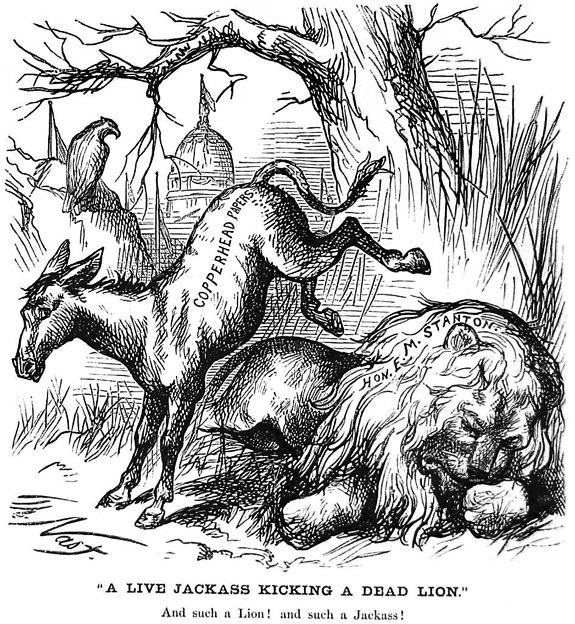
The donkey was first used as a symbol for the Democratic Party on January 15, 1870 by cartoonist Thomas Nash.
Martin Luther King, Jr. was born on January 15, 1929 in Atlanta, Georgia.
Julian Bond was born on January 14, 1940 in Nashville, Tennessee, and was one of eleven African-American Georgians elected to the Georgia House of Representatives in 1965. After his election, on January 10, 1966, the State House voted 184-12 not to seat him because of his publicly-stated opposition to the Vietnam War. After his federal lawsuit was rejected by a three-judge panel of the U.S. District Court for the Northern District of Georgia, the United States Supreme Court ordered Bond seated.
True story: Julian Bond was the first Georgia State Senator I ever met, when I was in ninth grade and visited the state Capitol as part of a school assignment.
On January 14, 1942, Franklin D. Roosevelt issued Presidential Proclamation No. 2537, requiring Japanese-Americans, including American-born citizens of Japanese ancestry, as well as Italians and Germans to register with the federal Department of Justice. The next month, Roosevelt would have Japanese-Americans interned in concentration camps in the western United States.
Georgia Politics, Campaigns, and Elections
Under the Gold Dome Today
Wednesday, January 14 . . . . . . . . . . . . . . . . . . . . . . . . . . . . convene for legislative day 3
10:30 AM Senate Floor Session (LD 3) Senate Chamber
11 AM HOUSE FLOOR SESSION (LD3) House Chamber
Thursday, January 15 . . . . . . . . . . . . . . . . . . . . . . . . . . . . . . convene for legislative day 4
1 PM HOUSE WAYS AND MEANS 606 CLOB
Friday, January 16 . . . . . . . . . . . . . . . . . . . . . . . . . . . . . . . . convene for legislative day 5
Governor Brian Kemp discussed his administration’s priorities at the Georgia Chamber’s Eggs & Issues breakfast this morning, according to the AJC.
Gov. Brian Kemp rolled out a sweeping infrastructure proposal Wednesday anchored by multibillion-dollar improvements to some of Georgia’s most congested highways, new rural roadwork and a $50 million initiative addressing homelessness.
Kemp revealed the plan at the Georgia Chamber’s annual “Eggs & Issues” breakfast, telling business leaders and state lawmakers his budget plan would devote $1.8 billion to ease one of Georgia’s most clogged corridors — I-75 South in Henry County — by building dedicated express lanes in both directions. Currently, the corridor has only a single 12-mile reversible express lane.
The proposal also includes $200 million to continue upgrades along Ga. 316, the perpetually busy route linking metro Atlanta to Kemp’s hometown of Athens. The funding would help convert intersections into interchanges and build more overpasses.
“It shouldn’t take you a full afternoon to get from Athens to Atlanta, or vice versa,” he said.
It was the first glimpse of the Republican governor’s 2026 agenda, which he has kept as a closely guarded secret ahead of his final legislative session in office. The new projects would be funded in the amended budget for this fiscal year, though it must clear the General Assembly, where lawmakers will press their own priorities.
Kemp has directed state agencies to prepare for tight budgets as Georgia braces for the impact of federal spending cuts, though he’s also been reluctant to dig deep into a nearly $15 billion surplus.
Defendants in the Fani Willis Trump case are seeking millions of dollars in lawyers’ fees, according to the AJC.
The office of Fulton County District Attorney Fani Willis may have to pay around $17 million to President Donald Trump and a dozen of his co-defendants under a new Georgia law.
Trump alone is seeking just over $6.2 million in attorney fees and litigation costs tied to his defense in Willis’ criminal election interference case that was dismissed after she was disqualified from it.
Most of the president’s co-defendants are similarly seeking compensation under a 2025 Georgia law designed with the case in mind. It allows criminal defendants to recover their attorney fees and litigation costs from prosecutors who have been disqualified, if the prosecution is dismissed.
All but two of the 15 defendants considered to be eligible to receive compensation have sought reimbursement, totaling more than $16.9 million. They include attorney and former New York Mayor Rudy Giuliani, former White House chief of staff Mark Meadows and former Georgia Republican Party Chairman David Shafer.
The Georgia Senate voted to pass Senate Bill 204 to address a Savannah ordinance, according to the Capitol Beat News Service via the Savannah Morning News.
The Georgia Senate voted along party lines Tuesday to ban cities from requiring gun owners to lock up their guns in cars, the first bill approved in this year’s legislative session.
The bill is a response to a Savannah ordinance that outlawed leaving handguns, rifles or shotguns in unattended vehicles unless they’re securely stored. A Chatham County judge ruled in November that the ordinance is unconstitutional.
The legislation now heads to Gov. Brian Kemp for his signature or veto. The Senate approved the bill 32-21 on Tuesday after it passed the state House on the final day of last year’s legislative session.
State Sen. Colton Moore, a Republican from Trenton, said the bill would protect the rights of gun owners. In Savannah, 41 people received citations under the city’s ordinance, which comes with a maximum penalty of a $1,000 fine and 30 days in jail.
“You can travel the state freely knowing you’re not going to be a victim of a crime and then be made a criminal as we’ve seen in Savannah,” Moore said during the Senate debate on Senate Bill 204. “We’re putting freedom back into the hands of the citizenry.”
Savannah’s ordinance required guns left in vehicles to be securely stored in a glove compartment, console, locked trunk, or behind the last upright seat of a vehicle without a trunk. The ordinance also mandated that unoccupied vehicles must be kept locked when there’s a gun inside.
State Sen. Derek Mallow, a Democrat from Savannah, said the ordinance reduced gun thefts in Savannah by 30% in the year since the city enacted it in 2024.
“The city overwhelmingly supports the Second Amendment, but they also believe that public safety is at risk when guns are stolen from unlocked cars,” Mallow said. “They can fall into the wrong hands very easily.”
The bill also allows weapons carriers who receive citations to sue local governments for $25,000 plus attorney fees.
The city’s ordinance requires firearms left in unoccupied vehicles to be securely stored or the gun owner would face penalties. The ordinance was made to regulate the car, not the gun or the gun owner, State Sen. Derek Mallow told WSAV News 3.
“We want to safeguard the citizens of this state by just regulating unlocked vehicles,” Sen. Mallow said. “[The City of Savannah] has not even issued citations. They’ve only been warnings. Those warnings have in turn produced 30% reduction in firearms that have been stolen from unlocked vehicles.”
WSAV acquired records that showed 41 citations have been issued from the law’s inception to Nov. 1, 2025, with 30 of them coming from 2025. There were 106 guns stolen from unlocked cars and 47 from locked cars in over the past year alone.
The maximum penalty under this ordinance is a $1,000 fine or 30 days in jail, however Mallow doesn’t believe Chatham County judges would consider such penalties.
Savannah Mayor Van Johnson did not speak to WSAV on camera about this bill, but he did send us the below statement.
“We’re considering all options, and we will continue doing everything we can to make sure our citizens are safe,” Johnson said.
The bill’s author, Republican State Sen. Colton Moore of Trenton, said Savannah’s laws make the people who had their gun stolen the criminal.
“We are the supreme lawmaking authority in this state, not some liberal municipality,” Moore said. “We already understand that we have preemptive powers as a legislature. What this legislation does is it gives those preemptive powers to the citizenry.”
The new bill is headed to Gov. Brian Kemp’s desk and could further limit Savannah’s ability to enforce those laws.
“I think the governor’s probably going to sign it into law,” Mallow said. “I don’t think he’s going to veto it. I would just urge my colleagues, let’s do something. Let’s do something on sensible gun storage. Let’s prevent tragic deaths from occurring from unsecured firearms.”
Other bills that did not pass both chambers last year are being considered, according to 13WMAZ.
Georgia lawmakers wrapped up the second day of the 2026 legislative session Tuesday, breathing new life into dozens of bills that failed to advance last year.
Some measures have been officially recommitted and sent back to committees for review as legislators prepare for Gov. Brian Kemp’s State of the State address Thursday.
Among the revived proposals is HB 79, which would offer gun owners a tax credit for firearm safety measures. The bill allows credits for purchasing gun safes or completing certified safety courses, though participants would need state pre-approval and face yearly caps.
HB 200 would establish a pilot program for second-grade writing instruction. Select classrooms would receive state-funded lessons with results tracked over three years. Initially, only a few districts would receive grants, with potential statewide expansion based on success. Rep. Bethany Ballard co-sponsored the measure.
Rep. Dale Washburn co-sponsored HB 34, which would create a state database to verify continuing education hours for license renewals. The system would replace the honor system for professionals including nurses, contractors and real estate agents, allowing the state to check training records in real time.
Lawmakers also filed new measures this week. HR 1000, co-filed by Rep. Dickey, calls for a constitutional amendment to eliminate local taxes on timber sales and harvests. The proposal would use state funds to reimburse counties, cities and school districts for lost revenue. If advanced, voters would have final say.
SB 214, which had its first House reading Tuesday, would overhaul Georgia’s voting system by replacing touchscreen ballot markers with hand-marked paper ballots and optical scanners, marking one of the state’s biggest voting infrastructure changes in years.
HB 947 would tighten rules for federal SNAP benefits by banning purchase of specific junk foods and drinks. The bill argues the measure addresses nutrition and accountability in public assistance spending.
Several polarizing measures from last year haven’t yet been recommitted, including HB 397 on hand-counting ballots, SB 74 targeting explicit library materials, and House Bills 225 and 651 limiting automated school-zone cameras.
Lawmakers will spend coming weeks determining which issues take priority on the legislative agenda.
The Savannah Morning News writes about legislative priorities for the 2026 Session.
In the House, Speaker Jon Burns is expected to propose an end to homestead property taxes for Georgians. Taxing rental homes and residential properties would be up to local entities.
Burns said he doesn’t believe homeowners should “pay rent to the government,” according to The Center Square, and said “I don’t think any of us in Georgia should ever face the possibility of losing that home,” because they can’t afford the property taxes.
Senate Republicans are also hoping to reduce the tax burden on Georgia families, instead through the elimination of state income tax.
The proposal would slowly phase out income tax over the coming years, starting with annual incomes under $50,000 for individuals and $100,000 for couples. The tax would eventually be fully eliminated in 2032.
Another tax bill, SB 34, will address tax incentives for the rapid expansion of data center development in the state, hoping to take the burden of cost off power customers. The bill will direct the Public Service Commission on how rate changes can be applied for power companies building new data centers.
In Georgia, it is currently legal to access “low-THC oil” that can contain up to 5% THC for medical purposes only. Registered patients are only allowed to possess up to 20 fluid ounces.
A bill was passed by the Senate, SB 220, and is being carried over to the House for a vote this year. The bill would raise the THC limit from 5% to 50% and remove the ban on vaping medical cannabis oil. It would also allow patients to possess 2 ounces of THC material rather than 20 fluid ounces to accommodate more product types.
It would also add Lupus as a qualifying health condition and removes the requirement that conditions be in the severed or end stages before medical cannabis can be used. The change would also acknowledge reciprocity for out-of-state medical cannabis patients.
Other efforts to change cannabis policy, from regulating hemp to preventing police searches based solely on the scent of marijuana, will also be considered.
Cannabis advocates continue to push for full legalization of marijuana, following the trend across the country and as the drug has been reclassified nationally, but it is unlikely to be changed this session.
More on the push by cannabis advocates, from Atlanta News First via WALB.
Cannabis advocates are hoping bills for expanded cannabis use and possession will advance in this year’s legislative session.
“Here we are, my third year in a row, the first day in session, and we’re begging for just sensible cannabis legislation,” said Omari Anderson, the CEO and founder of The Best Dirty Lemonade.
“And basically, we’re tired of waiting. We’re tired of waiting for Georgia to go ahead and get off their butt because we’ve been here, we shared the stories about the patients who are sick,” said Yolanda Bennett, the co‑founder of the Georgia Medical Cannabis Society.
Bennett said cannabis saved her life.
“A few years ago, I was in a wheelchair and I was on high dose steroids, and that’s the only thing that weaned me off of those high dose steroids. Right now, I’m suffering from Cushing syndrome due to those high dose steroids,” said Bennett. “I went through the steroid crisis, and I know that cannabis heals, and I know cannabis saved my life and got me out of that wheelchair, because I know with opioids, even then, with the pain that I was experiencing, they made you feel like a criminal.”
Angela Weston, another co‑founder of the Georgia Medical Cannabis Society, said she also relies on cannabis for medicinal purposes.
“It should be up to the provider how much a patient needs to have, and not a lawmaker,” Weston said. “And our motto is patience over profits, and that’s what we basically live by. It’s more of us looking at what the patient basically needs, and we need a more robust program here,” Weston said.
Georgia is a medical cannabis state, meaning only eligible patients can purchase and possess 20 ounces of low‑THC oil and products. Georgia does not allow the sale or possession of marijuana plant material.
Advocates have a unified front to decriminalize weed, to make access equitable for all, and to make the whole marijuana plant legal.
“It’s not said as people think. So that stigma definitely has to be broken,” Weston said.
“And I think it’s blown out of proportion. I think everyone who wants to get high is getting high,” said Aviva Vuvuzela, with the Georgia Hemp Economic Revival Organization.
“It’s not going to be easy. But if enough of you care about this plant and come out and speak for it, I don’t see why it can’t happen,” said Vuvuzela.
House Bill 496, which provides limitations on searches and arrests based on the scent of marijuana, is one of more than a dozen laws cannabis advocates are pushing for.
“Because indeed, if we don’t do sensible cannabis legislation, we’ll continue to be here fighting this time,” said David Raudabaugh, the founder of Grassroots Association.
This comes as President Donald Trump’s recent executive order reclassified marijuana as a low‑risk drug, Schedule III. This classification includes ketamine and Tylenol with codeine.
Georgia state Rep. Derrick Jackson spoke with some of the cannabis advocates at the opening day of the legislative session.
“It was promising, because you have citizens of Georgia that were waiting to speak to their lawmakers and give them a perspective about how the legislation, the things we do under this gold dome negatively impacts them,” said Jackson.
Jackson said he hopes to draft cannabis bills that would decriminalize weed in the state and define medical, retail and recreational uses.
“And if we do this properly, not only we’re going to have we’re going to mitigate the law enforcement subjectivity that places young, black men and women in jail, but we’re going to have a state bill that reflects, all, you know, 159 counties and 536 cities,” said Jackson.
House Bill 947, called the “Georgia SNAP Healthier Choices Act of 2026” and sponsored by six Republicans, would restrict SNAP beneficiaries’ purchases, according to Atlanta News First via WTVM.
A bill currently going through the Georgia legislature looks to restrict what those with Supplemental Nutrition Assistance Program (SNAP) benefits can buy at the grocery store.
Sponsored by seven Republicans, the Georgia SNAP Healthier Choices Act of 2026 argues the bill doubles down on the federal program’s intent to support low-income families’ nutritional needs.
“The purchase of low-nutrient, high-sugar, and artificially sweetened foods undermines the public health objectives of the program,” the bill text says.
About 1.4 million Georgians, or 1 in 8, receive SNAP benefits, according to the Center on Budget and Policy Priorities.
The bill outlines the following restrictions for benefits:
• No more than four beverages or packs of beverages containing carbonated soft drinks, including diet sodas, per household per calendar month
• No more than four beverages or packs of beverages containing artificial sweeteners per household per calendar month
• No candy, including chocolate, gum and “sugar-based confections”
• No energy drinks or other stimulant beverages
• No juices containing less than 50% fruit or vegetable juice
• No packaged desserts with more than 10 grams of added sugar per serving
• No made-to-order beverages or foods in retail grocery stores, such as coffee shops or smoothie counters — even if the retailer is SNAP-eligible
• Under the bill, SNAP recipients would also recertify their eligibility once every 12 months on their birthday month, starting in 2027.According to the bill, the Georgia Division of Family and Children Services would give recipients resources on where to find healthy food and expand SNAP options at farmers’ markets.
The bill comes as five other states — Indiana, Iowa, Nebraska, Utah and West Virginia — enacted similar restrictions on Jan. 1. Health Secretary Robert F. Kennedy Jr. has urged states to reform their food stamp benefits, eliminating foods deemed unhealthy.
“We cannot continue a system that forces taxpayers to fund programs that make people sick and then pay a second time to treat the illnesses those very programs help create,” Kennedy said in a December statement.
Republican state senators will prioritize “affordability” and education, according to the Capitol Beat News Service via the Augusta Chronicle.
The Republican leaders of Georgia’s Senate will push to reduce both income and property taxes while targeting other cost-of-living issues during a legislative session that will be influenced by election-year politics.
Senate leaders gave a brief outline of their priorities at the Capitol Tuesday, the second day of their 40-day session.
Last week, a high-priority Senate study committee wrapped up its work, issuing a recommendation to eliminate the state income tax by 2032, with gradual cuts starting in 2027. And on that same day, House Speaker Jon Burns, a Republican from Newington, announced his plans to pare back local property taxes.
On Tuesday, the Senate majority leader, Dallas Republican Jason Anavitarte, said his chamber’s caucus “can and will do everything in our power” to embrace both approaches to bring down costs for taxpayers.
He also said Republican senators would target institutional investors who “gobble up” houses then resell them, driving up prices for regular homebuyers while “Wall Street billionaires” profit.
The Senate will also consider ways to expedite building permits, he said. Developers criticized local building departments for causing expensive delays during a hearing in November, but local officials said developers were filing sloppy plans that slowed the review process.
Both the Senate and the House are also interested in improving literacy. Burns said last week that he wanted to see literacy coaches in every elementary school, and Anavitarte said Tuesday that the Senate wanted to provide resources to address the concern.
Anavitarte also mentioned resources for foster children and to combat chronic absenteeism, also the subject of a Senate study committee last year. Also on the agenda are “guardrails” around technology accessible by children including artificial intelligence, he said.
The senators did not offer much detail about how they would accomplish their goals. Property taxes fund about half the cost of public education, so curbing school districts’ authority to raise tax revenue could result in service cuts.
Anavitarte said some school districts were flush with money while others were broke, and “we have to figure out what is that right balance.” He had a similar answer about how to curb institutional residential investors: “I think we have to address the balance and there will be more to come on that.”
From Atlanta News First via WRDW:
Lawmakers are back at the Georgia Capitol for the 2026 legislative session, and it’s clear what their priorities are.
The nature of the bills being introduced and discussed focus squarely on affordability.
“We’re going to focus on kitchen table, pocketbook issues,” said Sen. Larry Walker III, a Republican who just hours earlier was elected to the role of Senate speaker pro tempore. “It gets back to the cost of living and affordability issues and we’re going to do what we think is best for Georgians. And I think we’ll reach a good balance.”
An immediate battle is brewing between the two chambers on taxes. The state Senate, days before session began, rolled out a plan to gradually eliminate Georgia’s income tax by 2032. The House wants to drastically lower the state’s property taxes.
The state is the sole collector of income tax, while property taxes fund services like sewer and water at the municipal level. Some Democrats are worried about what a potential loss in property tax revenue could mean for cities and counties in Georgia.
“I’m very concerned with respect to ensuring we’re not handcuffing our local governments,” said Rep. Sam Park, a Democrat and minority whip.
“We’re talking about two different pots of money,” said State Sen. Blake Tillery (R-Vidalia), who chairs the budget committee and a special committee on eliminating the state’s income tax. “This isn’t a joke, it’s not a gimmick, it’s not $20 you find in the back pocket or in the seat cushion. This is real relief.”
House Speaker Jon Burns, whose married to a retired school educator, said literacy will by far be his biggest focus this year. Burns said one-in-three Georgia children are not proficient readers by the all-important third grade benchmark. He wants to increase testing for dyslexia and put reading coaches in every Georgia elementary school.
It’s an area where Democrats and Republicans could see eye to eye.
“I think the big challenge with respect to literacy is funding,” said Park. “And that, at least last year, was a fight between the House and the Senate. We’ll see how that plays out this year.”
Some bills that passed one chamber but not the other last session are still on the table, like a bill that would ban cell phones in all Georgia high schools and one that would dictate how automated speeding cameras are used in school zones.
Democrats in the General Assembly want to limit ICE in Georgia, according to the Capitol Beat News Service via the Athens Banner Herald.
Democrats in the state Senate fired a political volley at President Donald Trump Tuesday, with a package of bills aimed at the way his administration has enforced the laws, particularly for immigration.
Labeling his administration “rogue” and a “regime,” they called on state Republicans to back legislation that would limit the president’s authority to deploy military reserve units and rein in Immigration and Customs Enforcement officers, one of whom shot and killed a mother in Minneapolis last week.
“We have seen ICE physically assault people who are just protesting or lawfully observing, and we just saw in Minneapolis ICE murder Renee Good,” Sen. Josh McLaurin, D-Sandy Springs said. “We’ve all seen the video. Obviously, the officer did what he was not trained to do, which was step in front of the car, escalate.”
The Trump administration has defended the action, saying the officer feared for his life after previously being injured by a vehicle during an enforcement action. Minnesota sued the Trump administration to block ICE deployments.
McLaurin, who is running for lieutenant governor, introduced Senate Bill 397, which would allow citizens to sue ICE officers for alleged violations of civil rights.
Another bill, Senate Bill 391, would require authorities to obtain a judicial warrant before taking immigration enforcement actions at certain locations, including churches, hospitals, libraries and schools. A third, Senate Bill 390, would require the Georgia governor’s permission for entry of National Guard forces from other states. Finally, Senate Bill 389 would require ICE officers to wear a badge and remove their masks.
Federal officials say the masks are necessary to protect officers against personal threats, such as “doxxing” when personal information is maliciously distributed online and “swatting” when police are called to homes on false pretenses.
That last bill was by Sen. Kim Jackson, D-Stone Mountain, who noted that lawmakers do not wear masks despite having been doxxed and swatted. And brimmed hats are the only apparel on Georgia State Patrol officers’ heads.
“If our brothers in their gray hats can stand up and show their face, then so can ICE,” said Jackson, the Senate’s minority whip. “It is cowardice. And it’s time to unmask ICE.”
Democrats tried to link their anti-ICE campaign to the increasingly charged political issue of affordability, saying immigration enforcement was disrupting local economies while costing taxpayers billions.
But their salvo was apparently charged with blanks. The likelihood of these bills becoming law is vanishingly small, judging from the reaction of Sen. Jason Anavitarte, a Republican from Dallas and the Senate’s majority leader.
“They want the state to regulate the federal government when that’s not necessarily the role of the state,” he said.
From Atlanta News First via WRDW:
With the legislative session barely begun, Georgia Democratic lawmakers have introduced a package of bills aimed at limiting how Immigration and Customs Enforcement operates in the state.
The move drew swift pushback from Republican leaders.
The proposals would require ICE agents to identify themselves, restrict National Guard deployment without state approval, make ICE agents liable for violations and restrict enforcement in sensitive locations like schools, churches and hospitals.
The bills come after families shared stories of traumatic encounters with federal agents. Mildred Pierre, whose husband Rodney Taylor is currently in ICE custody at Stewart Detention Center, described officers arriving in unmarked vehicles, most wearing masks.
“The gentlemen did not have any markings on their bulletproof vests. It was scary because they all had their guns. And my kids were in the car,” Pierre said.
Pierre said officers took her husband into custody without a warrant, leaving her children terrified.
“We have PTSD as a result,” Pierre said.
Republicans dismiss concerns
Less than two hours after Democrats announced their proposals, Republican Senate leaders pushed back on the steps of the Georgia Capitol.
State Sen. Randy Robertson, R-Ga., said existing protections are sufficient.
“ICE agents already face civil liability if they knowingly violate the law,” Robertson said.
Robertson defended ICE tactics, saying decisions about protective gear are made by supervisors, not legislators.
“As far as wearing tactical gear—whether it’s a mask or a helmet—that’s a decision made case by case by supervisors, not legislators sitting in an air‑conditioned room in Atlanta,” Robertson said.
Lawmakers pointed to a recent incident in Minneapolis, where an ICE agent fatally shot a local woman, an event that has drawn national scrutiny and renewed calls for oversight.
State Sen. Kim Jackson said the bills aim “to end the terror, to end the fear.”
The bills face long odds in the Republican-led legislature, but Democrats say families like Pierre’s should appeal to lawmakers across party lines.
Georgia Senate Democrats unveiled a raft of proposed bills Tuesday that they say will protect Georgians from what they characterized as a rogue federal government using immigration enforcement to terrorize citizens.
“As this regime has sought to build a wall against progress, the progress of achieving America’s values and ideals, we must build a wall against (President Donald Trump),” said Senate Minority Leader Harold Jones. “And the legislation presented here today is a step towards protecting all of Georgia’s citizens and making sure that we continue to pursue America’s ideals and goals.”
The bills seek to restrain the operations of U.S. Immigration and Customs Enforcement and the National Guard in Georgia.
ICE, which is tasked with enforcing immigration laws, has been subject to increased scrutiny since sharply increasing the scale of its operations under the Trump administration. On Jan. 7, an ICE agent shot and killed 37-year-old Minneapolis resident Renee Good in her car, sparking widespread protests of the federal agency’s tactics nationwide, including in Georgia.
Identifying ICE agents
Stone Mountain Democratic Sen. Kim Jackson’s Senate Bill 389 requires ICE agents to display badges and bans them from wearing face coverings while on duty other than for medical or safety reasons or while conducting covert operations.
“We have men who are unidentifiable roaming our streets, snatching up people and taking them and then they are able to commit crimes and hide because we don’t even know their identity,” Jackson said. “So my bill will call for ICE agents to take off their mask to show their face.”
Critics of ICE’s tactics say agents wear masks and cover their badges to avoid being identified and held accountable for violence or illegal behavior.
Supporters of the agency like Savannah Republican Rep. Jesse Petrea say masking has become a necessity because agents and their families have had their personal information published and received threats after their faces have appeared on social media.
“Clearly the reason the masks are out there is the progressive left has been doxxing them and endangering their families and threatening their families and threatening them in a very personal way. That’s unacceptable,” Petrea said. “So if they want to mask themselves, that’s perfectly fine with me.”
Petrea said ICE agents have experienced steep increases in threats and attacks since Trump took office last January, which Petrea calls politically motivated. The Trump administration has pursued a mass deportation campaign.
National Guard deployments
Senate Bill 390, which was sponsored by Jones, aims to codify that National Guard troops cannot be stationed in Georgia without the permission of the governor unless the deployed troops are “in the service of the United States and are acting under authority that is validly invoked by the President of the United States.”
Trump has deployed National Guard troops to cities including Los Angeles; Washington, D.C.; Portland, Oregon; Chicago and Memphis. The Trump administration has argued that the deployments are necessary to prevent crime, while Democrats argue they are illegal shows of force.
The bill would have no effect on the Georgia National Guard deployment to Washington announced by Gov. Brian Kemp in September.
ICE out of schools, churches
Duluth Democratic Sen. Nabilah Parkes’ SB 391 would require a judicial warrant for any state, local or federal agency to conduct immigration operations at a school, college campus, public place of worship, hospital, public library or family violence shelter.
“Kids should be focused on learning, not fear, and parents should be able to drop their children off at school knowing it is a place of stability and not disruption, and no one should get dragged out of their home or workplace without a judicial warrant,” said Parkes, who is running for Georgia insurance commissioner. “That’s basic constitutional due process.”
Suing ICE
Sandy Springs Democratic Sen. Josh McLaurin said he introduced SB 397 to allow Georgians to bring civil action against federal officials who violate Georgians’ constitutional rights.
McLaurin said the bill’s passage would make ICE agents face the same potential legal consequences as state and local law enforcement officers for violating Georgians’ rights.
“ICE does not currently face that threat in Georgia, which means they know that if they act unchecked, nothing will happen to them,” he said. “A personal lawsuit against ICE agents under Georgia law is essential to deterring ICE agents from ever committing these crimes in the first place.”
A difficult road
Jackson acknowledged that bills restricting ICE operations will have a tough time achieving passage in a Republican-dominated state during an election year.
“We understand that the road to the governor’s desk is quite limited, that path is narrow, but we also stand here and hope that common sense and good policy might persuade a few of our colleagues on the other side of the aisle to stand up and to resist and to be a part of good policy making on behalf of the good people of Georgia,” she said.
But Petrea argued that the good people of Georgia already have good immigration policy.
Petrea said Georgia has not seen major ICE activities as in states like Minnesota in part because of state law requiring local law enforcement agencies to cooperate with ICE.
In 2024, Kemp signed Petrea’s “Criminal Alien Track and Report Act.”
In an interview Tuesday, Petrea said that cooperation makes immigration enforcement safer for everyone.
“They’re going straight to ICE when they’re requested, so ICE is just picking them up and taking the bad guys out,” he said. “You don’t have to go into the community and break down doors when the bad guys, in this instance, are handed over to you by law enforcement.”
Some state legislators discussed their priorities with the Faith & Freedom Coalition, according to Atlanta News First via WALB.
Lawmakers, lobbyists and faith leaders met Tuesday for the annual Georgia Faith and Freedom Coalition luncheon to discuss faith-based policy for the now-underway legislative session.
In the burgeoning legislative session, faith leaders hope for an expansion of the state’s school choice program for parents that want their child to receive a faith-based education, as well as a discussion about the right to contraception.
In 2025, lawmakers passed the Religious Freedom Restoration Act, legislation that guarantees protection of religious beliefs from state and local government. It mandates that governments implement “the least restrictive means” of governing faith.
Tuesday’s event featured a slate of conservative lawmakers, many running for higher office, including Attorney General Chris Carr and Lt. Governor Burt Jones — both gubernatorial candidates — as well as Gov. Brian Kemp and former University of Georgia football coach Mark Richt.
In the ongoing session, faith policy will likely play a front-and-center role. Two bills await lawmakers when they arrived for the first day of the General Assembly on Monday.
One, House Bill 441, would grant personhood to fetuses in Georgia. A hearing on the bill in 2025 drew hundreds of protestors and onlookers to the Capitol, packing hallways and corridors. It didn’t pass, but will be available for lawmakers to consider this year.
The same is true for a bill, sponsored by Republicans, to guarantee women access to contraception in Georgia.
House Bill 872, largely supported by Republican leadership in the House, also failed to pass but is still on the table for lawmakers this year.
State Senator Drew Echols (R-Gainesville) will Chair the Senate Economic Development Committee, according to AccessWDUN.
State Senator for District 49 Drew Echols announced on Tuesday that he has notified Governor Brian Kemp he would be stepping down as Senate Floor Leader.
The news comes as Lieutenant Governor Burt Jones and the Senate Committee on Assignments have appointed Echols to be the new Chairman of the Senate Economic Development and Tourism Committee.
“I want to thank Governor Kemp for the trust he placed in me to carry his administration’s legislative priorities in the Senate,” Echols said. “It has been one of the greatest honors of my public service to help advance his vision for a stronger, freer, and more prosperous Georgia. I also want to thank Lt. Governor Burt Jones for his confidence in me to lead this committee as we continue building on that record of success.”
Echols served as Chairman of the Senate Study Committee on Making Georgia the No. 1 State for Tourism this past year.
“As Chairman, my focus will remain on expanding economic development, supporting existing Georgia businesses, and ensuring our state continues to be the best place in the nation for tourism, entrepreneurship, and job creation,” Echols said. “I am deeply honored by this appointment and will not take for granted the trust placed in me to help grow Georgia’s economy and support hardworking families.”
State Rep. Matt Reeves (R-Duluth) will work for legislation to allow voters to decide to allow online betting, according to WSB News.
Georgia lawmakers are once again pushing to legalize online sports betting as the new legislative session gets underway under the Gold Dome.
Gwinnett County Representative Matt Reeves says he plans to push for a vote on a measure that stalled last year, which would put the question before voters on the November ballot through a constitutional amendment.
“You’d have a constitutional amendment, you’d have a statewide referendum, and you’d have the funds going to the lottery, they’d be available for pre-K, for literacy, and for educational needs,” Reeves said.
Reeves says the proposal would include guardrails, with regulation through the state lottery and transparency for law enforcement.
“I think having the lottery regulated, having law enforcement transparency would be a benefit in Georgia in addition to education funds,” he said.
According to Reeves, as much as $2 billion could flow into Georgia’s education programs over the next decade if voters approve the amendment. He says online sports betting is already happening in the state and that legalization would regulate the activity.
“We’re not talking about casinos, we’re not talking about other in-person gambling, we’re talking about online sports betting which is already occurring here in Georgia; this would regulate it,” Reeves said.
Opponents argue the downsides of allowing online sports betting outweigh any potential benefits for education funding.
Online sports betting is expected to be back under discussion this legislative session, with advocates believing this could be the year Georgia legalizes the practice.
At least sixteen current or recent state legislators have announced campaigns for higher office, according to the Capitol Beat News Service via the Savannah Morning News.
At least 16 Georgia legislators say they’re running for higher office during elections later this year, making this session of the General Assembly their last chance to burnish their credentials before facing voters.
Senators and representatives can use the legislative session that began Monday as an opportunity to pass bills and attract attention ahead of elections for Congress, governor, lieutenant governor, attorney general, secretary of state and insurance commissioner.
“I’m hoping for a session where we’re actually going to put the people of Georgia first instead of politics,” said state Rep. Jasmine Clark, a Democrat from Lilburn who is running for Congress. “I dread that, with it being an election year, there will be a little bit of trickery and people posturing in order to make for great campaign mailers, even if it’s not great for Georgia.”
Nine out of 56 state senators have said they’ll campaign for higher office, along with Lt. Gov. Burt Jones, who is running for governor and presides over the Senate.
Two former state senators — Republican John F. Kennedy and Democrat Jason Esteves — resigned to run for lieutenant governor and governor. Georgia law prohibits state legislators and statewide officeholders from raising money during the legislative session.
“There’s going to be a tendency to see some of that competitiveness in the Senate chamber,” said state Sen. Steve Gooch, a Republican from Dahlonega who is running for lieutenant governor. “I don’t intend to be playing any of those games that you may expect, or you may have heard from other people. I just think everything’s going to work. There may be some bumps in the road from time to time, but it’s not going to interfere with the priorities of the Senate.”
In the 180-member state House, seven representatives say they intend to seek statewide offices or seats in the U.S. House.
More lawmakers could join the fray — or decide not to run — before the state’s candidate qualifying deadline on March 6. Every seat for state House and state Senate will also be on the ballot this year.
Here’s a look at the Georgia legislators planning to run for higher office:
U.S. House: Rep. Jasmine Clark, a Democrat from Lilburn; Rep. Houston Gaines, a Republican from Athens; Sen. Emanuel Jones, a Democrat from Decatur; Sen. Colton Moore, a Republican from Trenton.
Governor: Rep. Derrick Jackson, a Democrat from Tyrone; Rep. Ruwa Romman, a Democrat from Duluth.
Lieutenant Governor: Rep. David Clark, a Republican from Buford; Sen. Greg Dolezal, a Republican from Cumming; Sen. Steve Gooch, a Republican from Dahlonega; Sen. Josh McLaurin, a Democrat from Sandy Springs; Sen. Blake Tillery, a Republican from Vidalia.
Attorney General: Sen. Bill Cowsert, a Republican from Athens; Rep. Tanya Miller, a Democrat from Atlanta; Sen. Brian Strickland, a Republican from McDonough.
Secretary of State: Rep. Tim Fleming, a Republican from Covington.
Insurance Commissioner: Sen. Nabilah Parkes, a Democrat from Duluth.
Dublin Judicial Circuit District Attorney Harold McLendon asked the GBI to investigate the Dublin City Schools’ budget deficit, according to 13WMAZ.
According to a press release from McLendon’s office, he sent the GBI a letter earlier this week. He asked the agency to investigate whether the school district broke any laws while budgeting and using taxpayer money.
McLendon cited state reports showing Dublin City Schools owes millions of dollars in back payments to the state health system.
So far, McLendon said there is no proof that any crimes were committed. He said he wants the GBI to handle the case to avoid a possible conflict of interest.The request comes as Dublin City Schools faces a projected $13.4 million budget deficit for fiscal year 2026. The district has already made significant cuts, including eliminating 46 positions and cutting 10 days from the school calendar.
Earlier this week, the Georgia Department of Audit and Accounts released a special examination that found the district used temporary COVID-19 relief funds to cover ongoing expenses like salaries and operations, masking budget problems that have now resurfaced.
Floyd County Commissioners elected Rhonda Wallace as Chair, according to WRGA News.
The Floyd County Commission has elected a new chair for the coming year.
On Tuesday, commissioners selected Rhonda Wallace for the job.
Wallace moves up from the vice-chair job.
“I wanted to say what an honor it has been for the last three years to serve with Allison [Watters] being our chair,” Wallace said. “Her guidance and courage over the past few years have been awesome and have been a tremendous help to this group. I thank each of you for voting for me to be chair. I promise to lead with integrity, wisdom, and compassion.”
Wallace is a lifelong resident of Floyd County and has served on the commission since 2012. She has spent over 40 years in the banking industry and serves as Senior Vice President and Commercial Relationship Manager at River City Bank.
Scotty Hancock, who is serving his final year on the commission, was chosen as vice chair.
The Rome Board of Education elected a Chair and Vice Chair, according to WRGA News.
No change of leadership on the Rome City School Board.
On Tuesday, the board reappointed Faith Collins as chair and Will Byington as vice-chair.
Columbus Mayor Skip Henderson named Ola Terrell as Human Resources Director for the City of Columbus subject to City Council confirmation, according to WTVM.
Henderson will go before the Columbus Council for approval of his appointment on Tuesday, January 27, 2026, during the next scheduled business meeting.
Since 2023, Terrell has served as the Human Resources Director for the City of Americus, Georgia. Her prior leadership roles include Chief Human Resources Officer at Albany State University, Human Resources Director for the City of Germantown, Tennessee, and Human Resources Director for the Ware County, Georgia Board of Commissioners.
“With her people-centered leadership, ability to navigate sensitive employee matters with integrity, and dedication to fostering a culture of engagement, transparency, and service, I am confident Ola will serve employees and citizens well,” Henderson said.
Michelle Reaves was sworn in as Mayor of Louisville, according to WJBF.
The event took place on Jan. 13 at Louisville City Hall. Reeves defeated incumbent Jenny Smith in the November election.
Reaves becomes the first Black mayor of Louisville. She said it was the people who made her run in the election.
“I love to serve people. I have a background, I worked for DFACS, I now work for the prison system, but what really made me run for mayor was the citizens kept telling me that they wanted change,” Reaves said. “Change is very needed in the City of Louisville, and I took that to heart. People have been asking me to run for years, and I just put it in the back of my mind, but I felt that this was my time.”
Reaves served on the city council for six years before the election. She said she plans to have a town hall meeting to hear from the voices in the city and come together on common ground.
Voters in Forsyth will elect a new Mayor this month on the same day as a Special Election of a new State House member from District 18, according to 13WMAZ.
Voters in Forsyth will see one name on the ballot for Forsyth mayor: Greg Goolsby.
The city council member was the only candidate to qualify for the race, which will be held on Jan. 20.
Barring a write-in challenge, Goolsby is set to take the reins of Forsyth City Hall after election day.
It comes after the resignation of Mayor Eric Wilson, who resigned to run for state house district 18.
That State House District 18 race will also head to a vote on Jan. 20, which features a number of candidates vying for a seat in the Georgia House of Representatives.
In that race, there are 6 people are running for the seat.
Howard Allison (R): retired from Upson County
Lauren Daniel (R): homemaker from Monroe County
Steve McNeel (R): attorney from Bibb County
Nathan Warnock (R): retired from Bibb County
Eric Wilson (R): mayor of Forsyth,
LeMario Brown (D): business owner from Peach CountyGeorgia Senate District 18 — which includes Crawford, Monroe, Peach, Upson, Bibb and Houston Counties — opened up suddenly after incumbent John F. Kennedy resigned to focus on his bid for lieutenant governor.
Former Macon-Bibb County Commissioner Seth Clark discussed his campaign for the Democratic nomination for Lieutenant Governor, according to 13WMAZ.
“I didn’t wake up in January thinking that I was going to run for lieutenant governor, but I did wake up in the beginning of December and realized that I didn’t think that the issues that I cared about and that my neighbors cared about were being represented,” Clark said. “And so I decided to run for office.”
Clark says he’s running as an advocate for Central and working class Georgians. The former commissioner says he’s frustrated with current state politicians, and says his campaign will focus on serving the entire state.
Along with residing from Bibb County Commission, Clark also resigned as Executive Director of the Ocmulgee National Park and Preserve Initiative, which advocates for turning the historic site into a national park.
A self-described environmentalist, Clark says he’ll continue pushing for environmental protections and safeguards.
“I think that the state government has a responsibility to protect the Georgia that we love, and I think that they have shirked that responsibility, and that’s something that will change when I’m the Lieutenant Governor of the state of Georgia,” Clark said.
Clark says he’s also focused on issues like lower the cost of living and increasing access to healthcare, child care, affordable housing, and higher education. He reiterated his commitment to all Georgians.
“They deserve someone who’s worked on their issues for the vast majority of his adult life, and they deserve an advocate,” Clark said.
Bibb County Commission is meeting on Jan. 20 to discuss an election for Clark’s seat.


Comments ( 0 )