
On January 11, 1765, Francis Salvador of South Carolina became the first Jewish elected official in America when he took a seat in the South Carolina Provincial Congress. Salvador’s grandfather was one of 42 Jews who emigrated to Georgia in 1733. Salvador later became the first Jewish soldier to die in the American Revolution.
On January 12, 1775, St. Andrews Parish on the Georgia coast passed a series of resolutions that included approving the actions of patriots in Massachusetts, three resolutions critical of British government actions, and a renunciation of slavery. The resolutions also appointed delegates to a provincial legislature at Savannah and urging that Georgia send two delegates to the Continental Congress to be held in Philadelphia the next year.
On January 10, 1868, the Georgia Equal Rights Association was formed in Augusta.
On January 10, 1870, the Georgia General Assembly convened and seated African-American legislators who had been expelled in 1868.
On January 12, 1872, Benjamin Conley stepped down as Governor of Georgia, the first Republican to hold the office and the last until January 13, 2003, when Sonny Perdue was sworn in.
He joined the Republican Party and became president of the state Senate after the Civil War. That was the office he held in October 1871 when Gov. Rufus Bullock, also an Augusta Republican, left the state under pressure from state Democrats. According to the Georgia Constitution, Conley became governor, holding the job until a replacement could be elected and take office two months later.
On January 12, 1906, the American Intercollegiate Football Rules Committee legalized the forward pass. Some credit Georgia Tech coach John Heisman as having popularized the idea of making the forward pass legal after seeing it in a game between Georgia and North Carolina.
On January 11, 1908, President Theodore Roosevelt declared the Grand Canyon a national monument.
“Let this great wonder of nature remain as it now is,” he declared. “You cannot improve on it. But what you can do is keep it for your children, your children’s children, and all who come after you, as the one great sight which every American should see.”
Kenesaw Mountain Landis was elected the first Commissioner of Baseball on January 12, 1921. Judge Landis was named after the Battle of Kennesaw Mountain, where his father was wounded fighting for the Union.
Eugene Talmadge was sworn-in to his first term as Governor of Georgia on January 10, 1933.
Talmadge fired elected officials who resisted his authority. Others were thrown out of their offices. Literally.
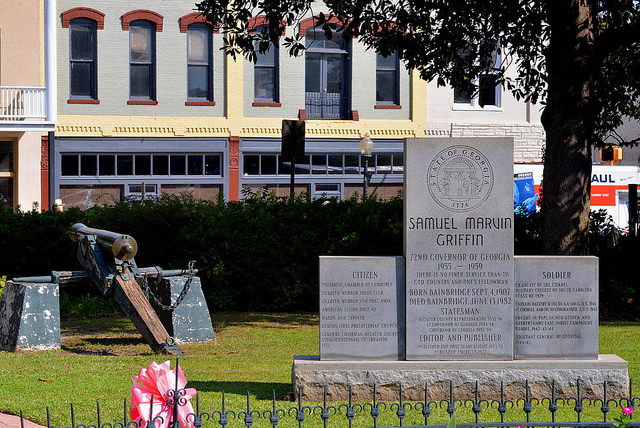
Marvin Griffin of Bainbridge was inaugurated as Governor of Georgia on January 11, 1955.
After Julian Bond’s election to the Georgia House of Representatives in 1965, the chamber voted against seating him ostensibly because he had publicly state his opposition to the war in Vietnam. On January 10, 1967, after the United States Supreme Court held the legislature had denied Bond his right to free speech, he was seated as a member of the State House.
Eleven years ago, on January 10, 2014, the Atlanta Journal-Constitution released a poll of the Georgia Governor’s race that showed Nathan Deal with 47 percent to 38 percent for Jason Carter. The nine-point Deal advantage was as close as the AJC polling firm would come all year to correctly predicting the point spread in the General Election.
Governor Nathan Deal was sworn-in as the 82d Governor of Georgia on January 10, 2011 while snow shut down the planned public Inaugural.
Georgia Politics, Campaigns, and Elections
Lockout: in Adrian, Georgia, the Mayor, two City Council members and the City Clerk all resigned, according to 13WMAZ.
City of Adrian management is at a standstill following the resignation of several elected officials.
Adrian is a small town in Johnson and Emmanuel County with a population of less than 600 people. The front doors to Adrian City Hall and police department are locked as of Wednesday morning, with no leadership in place except for three remaining council members.
Tuesday, Adrian city council members held their first meeting of 2025; less than 24 hours after the meeting, several elected officials resigned, including former mayor Wynola Smith, two council members and city clerks.
During the meeting, council members fired Adrian Police Chief Michael Milton in a three to two vote– the city’s only officer.
All but three council members quit. Jason Bennett, Tiffanie Bennett’s husband, says he hopes the remaining leaders soon restore peace and government activity.
13WMAZ reached out the former mayor, Wynola Smith, for comment. In a statement she responded with the following: “We were just working in such a hostile work environment from the outside… not from the people that actually worked at city hall.”
Current councilmember Gary Green also told 13WMAZ remaining officials hope to open city hall doors sometime next week. In the meantime, deputies from Emmanuel and Johnson counties are patrolling city roads; the city fire department is staffed and responding to emergency calls.
Locked out? Fulton County District Attorney Fani Willis appealed to the Georgia Supreme Court, seeking to keep control of the persecution prosecution of Donald Trump, according to the Associated Press via WSAV.
Fulton County District Attorney Fani Willis has asked Georgia’s highest court to review a lower appeals court’s ruling that removed her from the Georgia election interference case against Donald Trump and others.
The Georgia Court of Appeals last month ruled that Willis and her office could not continue to prosecute the case because of an “appearance of impropriety” created by a romantic relationship she had with special prosecutor Nathan Wade, whom she had hired to lead the case. In a petition filed late Wednesday, Willis asked the Georgia Supreme Court to review and reverse that decision.
The filing argues that the 2-1 ruling “overreached the Court of Appeals’ authority,” creating a new standard for disqualification of a prosecutor and disregarding decades of precedent.
Even if the high court eventually rules in Willis’ favor, it seems unlikely that she will be able to prosecute Trump, who returns to the White House on Jan. 20. But there are 14 other defendants who still face charges in the case.
Willis’ filing asks the Georgia high court to consider whether the lower appeals court was wrong to disqualify her “based solely upon an appearance of impropriety and absent a finding of an actual conflict of interest or forensic misconduct.” The state Supreme Court is also asked to weigh whether the Court of Appeals erred “in substituting the trial court’s discretion with its own” in this case.
“No Georgia court has ever disqualified a district attorney for the mere appearance of impropriety without the existence of an actual conflict of interest,” Willis’ filing says. “And no Georgia court has ever reversed a trial court’s order declining to disqualify a prosecutor based solely on an appearance of impropriety.”
Georgia’s Court of Appeals disqualified Willis and her office from the 2020 election case last month in a 2-1 decision that her romance with former special prosecutor Nathan Wade amounted to a significant appearance of impropriety.
The ruling reversed Fulton County Superior Court Judge Scott McAfee’s decision to let Willis stay on the case if Wade stepped aside, which he did.
The state’s high court, controlled by justices appointed by Republican governors, must first decide whether to take up the appeal at all.
If it lets the appeals court’s ruling stand, the case would be handed off to the Prosecuting Attorneys’ Council of Georgia, a nonpartisan state agency. The agency could then send the case to another district attorney’s office, which would decide whether to proceed, appoint a special prosecutor or handle the case itself.
Even if the court hears Willis’s appeal and rules in her favor, she may not have a chance to resurrect the case until 2029 — after Trump has left office — since legal experts agree sitting presidents cannot be criminally prosecuted.
Yesterday, Governor Brian Kemp issued Executive Order #01.09.25.01, declaring a State of Emergency for winter weather, according to a Press Release.
Governor Brian P. Kemp today declared a statewide State of Emergency, effective immediately through Tuesday, January 14, 2025, in preparation for the approaching winter storm expected to impact Georgia beginning this Friday. The State of Emergency authorizes the Georgia Emergency Management and Homeland Security Agency (GEMA/HS) to activate the State Operations Center (SOC) and mobilize any needed resources to address potential impacts. GEMA/HS, the Georgia Department of Transportation (GDOT), the Georgia Department of Public Safety (DPS), and other state agencies are instructed to provide essential personnel to the SOC, which will move to a Level 2 Activation beginning tonight at 7 p.m.
“The Georgia Department of Transportation, along with the Department of Public Safety, began treating roads early this morning to prepare for the approaching winter storm, and I’m asking all Georgians to help them do their jobs by limiting travel as much as possible in the coming days,” said Governor Brian Kemp. “Hazardous conditions, including ice and snow, can develop quickly and make travel very dangerous. Plan ahead and stay tuned to updates from state and local officials to ensure you and your loved ones remain safe while our first responders continue to work tirelessly throughout this weather event.”
Among other provisions, the State of Emergency order prohibits price gouging; suspends hours-of-service limitations for commercial vehicle operators involved in response activities; and temporarily increases weight, height, and length limits for commercial vehicles transporting essential supplies.
State Action and Preparation:
GDOT vehicles and crews have begun brining roads this morning, particularly in areas north of and along I-20. Residents are encouraged to avoid travel in the most impacted areas, if at all possible. If travel is necessary, motorists should give plenty of space and clearance to allow GDOT crews to continue to treat and clear roads as needed for the safety of the traveling public.
The Motor Carrier Compliance Division has partnered with GDOT to escort brining details across the metro area into northern Georgia to the Tennessee line. DPS Troopers and Officers will be on standby across the state for any service calls regarding the winter weather and the needs of the state.
Winter Weather Preparedness Guidance:
Residents should check with their local officials for information about warming centers and comfort station locations. State parks with warming centers can be found here. More tips are as follows:
Use electric space heaters with automatic shut-off switches.
Keep heat sources at least three feet away from furniture and drapes.
Insulate your home and ensure doors and windows are sealed.
Check and install a working carbon monoxide detector.
Have backup heat sources like extra blankets, sleeping bags, or a wood-burning fireplace.
Check your antifreeze, brakes, heater, tires, and wipers.
Keep your gas tank at least half full.
Carry an emergency Ready kit with items like a portable phone charger, ice scraper, extra blanket, sand for traction, and jumper cables.
Use generators outdoors and at least 20 feet from doors, windows, or vents to prevent carbon monoxide poisoning.
Allow pipes to drip or insulate them to prevent freezing.
Keep pets indoors and check on elderly or disabled relatives and neighbors.
For more winter weather preparedness tips, visit gema.georgia.gov/winter.GEMA/HS will provide ongoing updates regarding winter weather conditions via its website (gema.georgia.gov) and social media accounts. Residents are encouraged to monitor local National Weather Service updates and news stations.
From the Savannah Morning News:
The state of emergency suspends hours-of-service limitations for commercial vehicles involved in storm-response activities and temporarily increases weight, height, and length limits for commercial vehicles transporting essential supplies. The governor’s order also prohibits price gouging.
Fulton County Superior Court Judge Rachelle L. Carnesale dismissed Gwinnett County’s lawsuit seeking to undo the incorporation of the City of Mulberry, according to AccessWDUN.
Fulton County Superior Court Judge Rachelle L. Carnesale ruled Tuesday afternoon that the county did not qualify for declaratory relief in the case, which was filed in October 2024. Gwinnett had initially filed before Mulberry’s first city council elections were conducted by the county, with the suit seeking to stop the elections from taking place. The case was not heard, however, until after the November elections.
Judge Carnesale said in her ruling that the elections already taking place meant Gwinnett no longer had an argument that it stood to suffer financial or operational damages from conducting the elections.
”Any uncertainty regarding the November 2024 election is moot. That election and related runoffs have already occurred. Therefore, the County is no longer in a position of uncertainty about holding and paying for the elections,” Tuesday’s ruling said.
Carnesale also said the county’s concerns about potential service delivery to Mulberry is not valid, because the services in question would have been provided regardless of the city’s existence.
“The County will be providing these services regardless of the validity of (Senate Bill) 333,” the ruling said. “Any requirement for the County to continue to provide services during the transition period does not place the County in an uncertain position about its future conduct.”
Mulberry city officials issued a statement Wednesday morning.
“The Mulberry City Council is thankful that we can now put these lawsuits behind us and begin working with Gwinnett County,” the statement said. “We look forward to further discussing the transition of services with the county and doing what is necessary to build a strong relationship between Mulberry and Gwinnett.”
The lawsuit by Gwinnett was one of several that have been brought forward looking to strike down Senate Bill 333 since it was passed by the state legislature and signed by Georgia Governor Brian Kemp in early 2024. The lawsuits have argued that the city’s charter violates the Georgia constitution by not allowing Mulberry to levy property taxes.
The State of Georgia entered as a party into the Gwinnett County lawsuit recently. It was the state who ultimately petitioned for dismissal in the case, which was granted by Judge Carnesale.
Mulberry occupies the northeastern portion of Gwinnett County and took legal effect on January 1, with several city council meetings already being held and several city ordinances already being passed.
If you’re wondering why you haven’t heard about “pre-filed” bills ahead of the General Assembly Session that convenes Monday, it’s because legislators outlawed the practice, according to State Affairs.
State lawmakers phased out the long-standing tradition where some lawmakers eagerly jockeyed to be among the first to drop their proposed bills in the hopper before the legislative session started. The hopper is a box where bills are placed to be introduced.
Under Senate Bill 341, lawmakers must wait until the legislative session convenes on Monday before they can file proposed legislation.
2025 marks the first year that pre-filed legislation isn’t available to the General Assembly, Rob Mann, deputy secretary of the Senate, told State Affairs.
Though some lawmakers raced to get their proposed bills in the hopper early, those pre-filed bills often had to be refiled once the legislative session began, creating redundancies in the legislative filing process. Ending the practice cuts out unnecessary bill filings, one observer noted.
“It was probably one of those things that outlived its purpose,” one former longtime legislator, who spoke on the condition of anonymity, told State Affairs.
Georgia joins nine other states and Washington, D.C., that don’t allow pre-filing. Minnesota allows pre-filing only before even-numbered-year legislative sessions, so it will not accept pre-filed bills this year.
Pre-filing in Georgia traditionally began on Nov. 15.
The AJC writes about issues to look out for in the session.
Georgia lawmakers will face some big decisions as they develop state spending plans in the upcoming legislative session. One of the biggest: How much of the state’s $16.5 billion in reserve should they spend and what should they spend it on?
Gov. Brian Kemp and the Republicans who control the General Assembly have already proposed spending more than $1 billion in reserve on income tax refunds. With their support, Georgians will likely see those refunds when they file their taxes next year.
Lt. Gov. Burt Jones also wants to use some of the money for child care tax credits, and there’s no shortage of other ideas.
Kemp will get the first shot at shaping the debate in January when he unveils a proposed budget for fiscal 2026 (which begins in July) and a revised spending plan for the remainder of fiscal 2025. He recently told legislators a Hurricane Helene relief package is a top priority.
The battle over Georgia’s voting laws didn’t stop with President-elect Donald Trump’s relatively resounding win in November.
Republicans who have pushed for changes since Trump lost the 2020 election say they’ll continue to do so, including efforts to require paper ballots filled out by hand, eliminate no-excuse absentee voting and empower activists who challenge voters’ eligibility.
House Speaker Jon Burns has said he expects “tweaks” but no “major overhauls.” Senate Ethics Chairman Max Burns, whose committee oversees elections bills, said he would review constituents’ requests but wasn’t making any specific proposals.
The top Republicans in each chamber have signaled they plan to further regulate girls’ and women’s sports in Georgia, and require transgender girls and women to play sports according to the sex listed on their original birth certificate and not by the gender they identify with.
Gov. Brian Kemp has signaled that a litigation overhaul is a top priority. He held several roundtable discussions in recent months with stakeholders, including some of Georgia’s largest employers, health care executives and small-business owners.
Kemp has said he wants to strike a balance between the interests of injured parties and those they claim are liable. He heard from many stakeholders that Georgia’s litigation rules are tipped too far in favor of plaintiffs, often forcing businesses to either settle meritless lawsuits or risk multimillion-dollar verdicts at trial.
Insurers are unwilling to provide policies to companies in certain industries and parts of the state because of the litigation climate, many business owners and representatives said. Kemp said he’s also listening to plaintiff attorneys, who oppose rule changes that they say will unnecessarily interfere with injured parties’ rights.
Legislation could include caps on certain types of damages and a framework for business and property owners to more easily defeat claims before trial.
State lawmakers are expected to take up sports betting again and if they do, it would mark the seventh year in a row since it became a possibility for states. In 2018, the U.S. Supreme Court struck down a federal law that prohibited states from authorizing sports gambling.
When it comes to legalizing sports betting in Georgia, lawmakers have considered two possible approaches. Some supporters say gambling can only be expanded in the state through a constitutional amendment. Others say betting should be considered a lottery game and could be legalized without changing the constitution.
Backers say people already illegally gamble and legalization could generate tens of millions of dollars in tax revenue for Georgia. Most opponents say any form of gambling is immoral, and that legalizing it would only lead to higher rates of gambling addiction, mental health issues and crime.
For more than 10 years, Democrats in Georgia have been pushing Republicans to enact a full-scale expansion of the state’s Medicaid program — meaning adults who earn up to 138% of the federal poverty level would be eligible to receive government-funded health care services.
But with President-elect Donald Trump taking office this month, lawmakers and advocates are waiting to assess what changes may be coming to Medicaid and Medicare during the first 100 days of his administration. In addition, most Georgia legislators acknowledge that Gov. Brian Kemp’s Pathways to Coverage federal Medicaid waiver will remain the state’s plan until his term expires in 2026.
That means it’s unlikely the Legislature will seek to expand Medicaid this year. However, the Comprehensive Health Coverage Commission, which was established through legislation last year, has been studying what Medicaid expansion could look like and produced its first report in December of initial recommendations.
Kemp’s office also said he is open to making changes to Pathways to improve the accessibility of the program, which could include things such as broadening the kinds of approved work activity adults must meet to qualify.
For people who are unable to work because of sudden health challenges, advocates say the approval process for disability eligibility to qualify for Medicare is quite lengthy and could be another area to study.
The Professional Association of Georgia Educators wants more funds appropriated for education, according to the Macon Telegraph.
The Professional Association of Georgia Educators is pushing for more state money to meet the needs of educators and students in areas such as mental health, campus safety and teacher shortages in K-12 public schools.
PAGE conducted a survey in October 2024, and over 3,200 Georgia teachers from 170 school districts participated. The top three workforce challenges identified by educators in the poll were unmanageable workload, student behavior and low pay, Claire Suggs, PAGE senior education policy analyst, said Wednesday at a virtual media event.
In the survey, almost half of educators said they don’t feel supported by their elected officials. Some also said policymakers fail to understand the daily demands of teaching and that their professional experiences are excluded in policy decisions.
Alongside other groups such as the Georgia School Boards Association and the Georgia Association of Educational Leaders, PAGE recently presented a letter to Gov. Brian Kemp’s Office of Planning and Budget to request additional funding in the following areas.
Kemp’s office will release his budget recommendations for the 2026 fiscal year sometime this month.
PAGE urges lawmakers to modify the state’s current professional funding ratio formulas so that school districts can hire more full-time mental health specialists, which can strengthen school safety.
“We are sorry to report that there are a number of school districts in Georgia that don’t receive enough funding for even one school social worker,” said Margaret Ciccarelli, director of legislative services for PAGE.
Georgia’s current funding ratio model pays one school counselor per every 450 students, but this leaves 65 districts without enough money for one full-time school social worker or psychologist, according to the recommendation letter Georgia education groups presented to the governor.
About 21% of all Georgia teachers with 20 or fewer years of experience said they are unlikely to stay in education for another five years, Suggs said.
As many school districts are coping with persistent teacher shortages, PAGE is calling for lawmakers to holistically invest in the state’s educator retention by increasing state funding per paraprofessional to $25,000 and restoring HOPE financial aid programs for educators.
In 2022, lawmakers passed House Bill 385 to help the shortage problem by welcoming retired teachers to fill full-time positions in areas identified as high-need by Regional Education Service Agencies.
But some districts can’t take advantage of the bill because their high-need areas do not align with their designated RESA high-need areas. Certain subjects like English, social studies, and elementary education still face shortages.
HB 385 will expire in June 2026, and advocates are calling for lawmakers to remove the end date from the act, as well as add more high-need educator designations for needed areas.
United States Senator Jon Ossoff (D-Atlanta) announced the passage of legislation to provide relief for Georgia farmers after natural disasters, according to the Albany Herald.
U.S. Senator Jon Ossoff, (D-GA), led the efforts to pass the disaster assistance, which includes $21 billion in disaster relief for farmers and $10 billion in economic assistance for farmers facing tough economic conditions.
“I’ll never stop fighting for Georgia’s number one industry,” Ossoff’s statement read. “Georgia farmers sustain Georgia’s rural communities and feed our great Nation.”
In the first days after Hurricane Helene, which decimated Georgia’s agricultural industries with hurricane-force winds and torrential rains, Ossoff led a group of 34 lawmakers urging Congressional leadership to pass disaster relief for agricultural producers. Last month, Sen. Ossoff testified before the U.S. Senate Committee on Appropriations on the urgent need to support Georgia agriculture by end of the year
The Pecan Growers Association reported that 48,000 acres of pecan orchards were damaged with a loss of nearly 400,000 trees. The Georgia Pecan Growers Association reports that direct tree loss from the storm adds up to about $118 million and future income loss of about $417 million.
The Georgia Poultry Federation reported that 495 poultry houses took significant damage, including 295 that were completely lost.
United States Attorney Jill E. Steinberg resigned from her position in the Southern District of Georgia effective January 17, 2025, according to the Savannah Morning News.
After being sworn into office Feb. 22, 2023, Steinberg served in the presidentially appointed position for the 43-county Southern District of Georgia. Her resignation occurs three days before the inauguration of Donald Trump as president on Jan. 20. Incoming presidents traditionally appoint new leaders for federal agencies.
“Serving as U.S. Attorney has been a distinct honor and privilege, and I am grateful for the hard work, camaraderie, and friendship of the dedicated professionals who continue to serve on behalf of the American people,” U.S. Attorney Steinberg said, according to the press release. “Representing the United States in court is an incredible responsibility, and those who seek justice on behalf of our nation deserve our lasting gratitude. I am proud to have served alongside them.”
During Steinberg’s tenure, she concluded a statewide investigation that identified unconstitutional conditions at Georgia’s state prisons, held accountable individuals responsible for more than $12 million in pandemic relief fraud, and successfully prosecuted nearly 200 cases involving illegal firearms possession, the press release stated.
Under Steinberg, the U.S. Attorney’s Office prosecuted Operation Ghost Busted, which addressed the significant uptick of overdose deaths in Brunswick. The defendants, many of them affiliated with a white supremacist gang, collectively have been sentenced to more than 4,000 months in prison, including one defendant who received a life sentence.
U.S. Attorney Peter D. Leary also resigned his position in the Middle District, according to the Valdosta Daily Times.
Leary said he’ll leave the office Saturday and will join an Atlanta-based law firm. He is the third of Georgia’s three U.S. attorneys to announce their resignations.
Jill Steinberg, U.S. attorney for the Southern District, announced Wednesday she will resign effective Jan. 17, and Ryan Buchanan, U.S. attorney for the Northern District, announced last week that he will resign effective Jan. 19.
The U.S. attorneys are appointed by the president to lead prosecutions of federal crimes.
All three resigning U.S. attorneys will be succeeded on an interim basis by a current assistant U.S. attorney. First Assistant U.S. Attorney Shanelle Booker will succeed Leary.
Incoming President Donald Trump will name new U.S. attorneys for the positions sometime after he takes office. They will be subject to confirmation by the U.S. Senate.
Leary’s Middle District of Georgia covers 70 counties in a swath from the South Carolina line to the southwest corner of the state and includes Valdosta, Moultrie, Tifton and Thomasville as well as Albany, Macon and Athens, among other cities.
“I am honored to have served as the U.S. attorney for the community that raised me, alongside some of the finest public servants in the country,” Leary said. “Every day the men and women of this office stand shoulder to shoulder with federal, state and local law enforcement partners to advance safety and promote justice.”
Georgia State House Speaker Jon Burns (R-Newington) discussed his priorities for the coming legislative session, according to Atlanta News First via WALB.
Georgia House Speaker Jon Burns met with reporters on Wednesday ahead of the start of the 2025-2026 legislative session to discuss what his priorities will be going into the start of the session.
“We’re going to hit the ground running,” Burns said. “We all know no more important issue affecting Georgians and our quality of life than the education of our young people. We want every child in this state to have an opportunity for a good, quality education. We want to provide that opportunity to receive that education for every parent, every teacher that’s employed, and certainly those students, but we want to make sure we do one thing so you can focus on getting that education. We want you to feel safe when you go to school.”
Burns stressed a need to further invest in mental health programs.
“We want to be proactive when it comes to mental health issues, not reactive, when a mental health issue comes on in our schools,” Burns said. “We’ll make sure that that’s part of the process that we put in place.”
The focus on school safety is just one of many issues Burns plans to take on this session. Burns’ full list includes:
Income tax rebates
Improvements to the state’s health offerings
School safety measures, but no safe storage requirements
Mental health funding for Georgia schools
Restrictions to transgender participation in girls’ sports
Strengthening the healthcare workforce
Codifying protections for IVF
Additional funding for Georgia’s prison system
Limits for school zone cameras
Tort reform
Developing a statewide plan on how to use energy and water resources
Limits to attendance zones suggested by the Governor’s Office of Student Achievement
The State House will empanel a committee to consider industrial power demand, according to the Capitol Beat News Service via the Tifton Gazette.
The Georgia House will form a special committee this year to try to get a handle on the growing demand for energy among power-dependent industries moving into the state, House Speaker Jon Burns said Wednesday.
While the effort will not specifically target data centers, it will be comprehensive, Burns, R-Newington, told reporters outside the House chamber during a briefing ahead of the start of the 2025 General Assembly session next week. “We’ll leave no stone unturned,” he said.
An influx of data centers setting up operations in Georgia in recent years has prompted concerns that the state’s utilities might not be able to handle the increasing demand for electricity.
Just this week, Amazon Web Services announced plans to invest an estimated $11 billion to expand its infrastructure in Georgia to support cloud computing and AI technologies. Two data-center projects in Douglas and Butts counties are expected to create at least 550 new high-skilled jobs.
The drain data centers are putting on the state’s electric supply was documented early last year when executives from Georgia Power testified before the state Public Service Commission that 80% of the additional demand for electricity behind the utility’s request for a huge increase in electrical generating capacity was due to data centers.
Lawmakers also have questioned the economic value of data centers. During last year’s legislative session, state Sen. Chuck Hufstetler, R-Rome, cited a 2022 state audit that found the tax exemption for data centers was only returning 24 cents on the dollar.
The General Assembly responded by passing legislation last year that would have temporarily suspended a state sales tax exemption aimed at attracting data centers to Georgia. However, Gov. Brian Kemp vetoed the measure at the urging of business groups including the Georgia Chamber of Commerce.
Burns said he will ask state Rep. Brad Thomas, R-Holly Springs, to chair the special committee. Thomas chaired a House subcommittee on artificial intelligence last year.
The Tift County Board of Education will opt out of a new homestead exemption created by House Bill 581, according to WALB.
Tift County Schools announced that it plans to opt out of the homestead exemption offered by House Bill 581.
HB 581, passed by the Georgia General Assembly in 2024, introduces a floating statewide homestead exemption that limits increases in taxable home values to the prior year’s inflation rate. The law allows local governing authorities to opt out of the homestead exemption following three public hearings.
Tift County Schools has scheduled those public hearings for noon Jan. 10, 2025, noon Jan. 24, 2025 and 6 p.m. Feb. 13, 2025 at the Tift County Board of Education office, 506 W 12th Street in Tifton.
The Tift County Board of Education feels opting out would be the best option to protect the financial stability of the schools and protect public education in the community.
Following the public hearings, the Tift County Board of Education will vote on the resolution to opt out of HB 581 at the February board meeting before the March 1, 2025, deadline.
Brunswick City Commission Finance Committee members recommended a $700,000 dollar increase in the Sheriff’s budget for medical treatment of jail prisoners, according to The Brunswick News.
The Glynn County Finance Committee approved a recommendation for an increase of $700,000 to pay for medical and prescriptions for jail inmates at Thursday’s meeting.
A final decision on the request lies with the Glynn County Commission at a future meeting.
The request for the increase is due to several large medical invoices that have consumed the entire FY25 budget in the first five months of the fiscal year, according to Sheriff Neal Jump.
The original budget was for $400,000 for medical and $200,000 for prescriptions.
The sheriff’s office estimates it will need $500,000 for medical and $200,000 in prescription funds to complete the fiscal year. Any money that is not spent will be returned to the undesignated fund balance at the end of the fiscal year.
Whitfield County Commissioners decided they have the power to create Community Improvement Districts (CIDs) and will not have to ask for legislation to permit it, according to the Dalton Daily Citizen News.
Board Chairman Jevin Jensen said in an email Thursday “further research by county staff” found such legislation passed in 2013.
The commissioners had been expected to vote on a resolution requesting such legislation when they meet Monday at 6 p.m. in the meeting room of the courthouse. The meeting will be livestreamed on the county’s YouTube channel and Facebook page.
CIDs allow local businesses to vote on whether to create a special tax district to fund improvements to infrastructure such as roads, sewer, street signs and stormwater control. The districts are limited to commercial property. They are limited in length, with most lasting five to 10 years. A majority of property owners representing at least 75% of the property values in the district must approve the measure to create one.
The districts can qualify for state and federal grants. The U.S. Federal Highway Administration reports there are currently at least 30 CIDs in the state. Most are in the metro Atlanta area.
The Dalton City Council approved a resolution asking the local delegation to the legislature to introduce a bill giving the city the power to create CIDs.
Washington County Chief Judge Robert Reeves was publicly reprimanded, according to WRDW.
On Thursday, Washington County Chief Judge Robert Reeves received a public reprimand in court.
This comes after the judge was under investigation by the Judicial Qualifications Commission on 58 counts of judicial misconduct.
At the reprimand, Reeves did not speak.
Documents filed with the Judicial Qualifications Commission, or JQC, show formal charges filed against Reeves on November 16, 2022.
Those counts detail incidents of alleged improper comments.
For example, in 2021, while Reeves was talking to attendees, a man started to leave the courtroom. Reeves then made this comment to the man, “Sir, you’re walking and I’m telling you to be still. Are you really that retarded?”
This happened in open court with members of the public, members of the bar and other court personnel present.
From at least 2016 through 2022, Reeves allegedly engaged in a pattern of improper behavior that, at a minimum, gave the appearance of constituting sexual harassment and/or bias based upon the gender of various females involved in the Middle Judicial Circuit court system.
The documents allege that included inappropriate contact with lawyers, and stating they should wear bathrobes and bathing suits during virtual hearings.
Another charge includes Reeves participating in a promotional video with The Sunshine House, which regularly has employees testify in the Superior Court of the Middle Judicial Circuit in cases involving child sexual and physical abuse cases.
Reeves did not speak at Thursday’s reprimand, and he does not plan to seek re-election next year.





Comments ( 0 )