
Solomon’s Masonic Lodge, the first in Georgia, was organized on December 10, 1735. Upon his return to the colony, James Oglethorpe would join the group.
Patriots captured liberated Virginia on December 9, 1775 as militias from Virginia and North Carolina defeated the redcoats at Great Bridge.
John Jay was elected President of the Continental Congress on December 10, 1778.
Emory College was incorporated on December 10, 1836, as Governor William Schley signed legislation chartering the school.
On December 10, 1850, a special convention met in Milledgeville to determine the state’s reaction to the Compromise of 1850, a series of five bills passed in Congress attempting to deal with issues between slave states and free states.
The [Georgia] platform established Georgia’s conditional acceptance of the Compromise of 1850. Much of the document followed a draft written by Charles Jones Jenkins and represented a collaboration between Georgia Whigs and moderate Democrats dedicated to preserving the Union. In effect, the proclamation accepted the measures of the compromise so long as the North complied with the Fugitive Slave Act and would no longer attempt to ban the expansion of slavery into new territories and states. Northern contempt for these conditions, the platform warned, would make secession inevitable.
This qualified endorsement of the Compromise of 1850 essentially undermined the movement for immediate secession throughout the South. Newspapers across the nation credited Georgia with saving the Union.
On December 9, 1867, a Constitutional Convention to draft a new state document convened in Atlanta. Among the 166 to 169 delegates elected to the Constitutional Convention were 33 or 37 African-American members – accounts vary.
The Atlanta City Council appointed the first Board of Education on December 10, 1869.
The Spanish-American War was ended on December 10, 1898, with the signing of the Treaty of Paris.
The Rev. Martin Luther King, Jr., was awarded the Nobel Peace Prize on December 10, 1964 in Oslo, Norway, becoming the youngest recipient of the award.
Jimmy Carter was awarded the Nobel Peace Prize on December 10, 2002.
Georgia Politics, Campaigns, and Elections
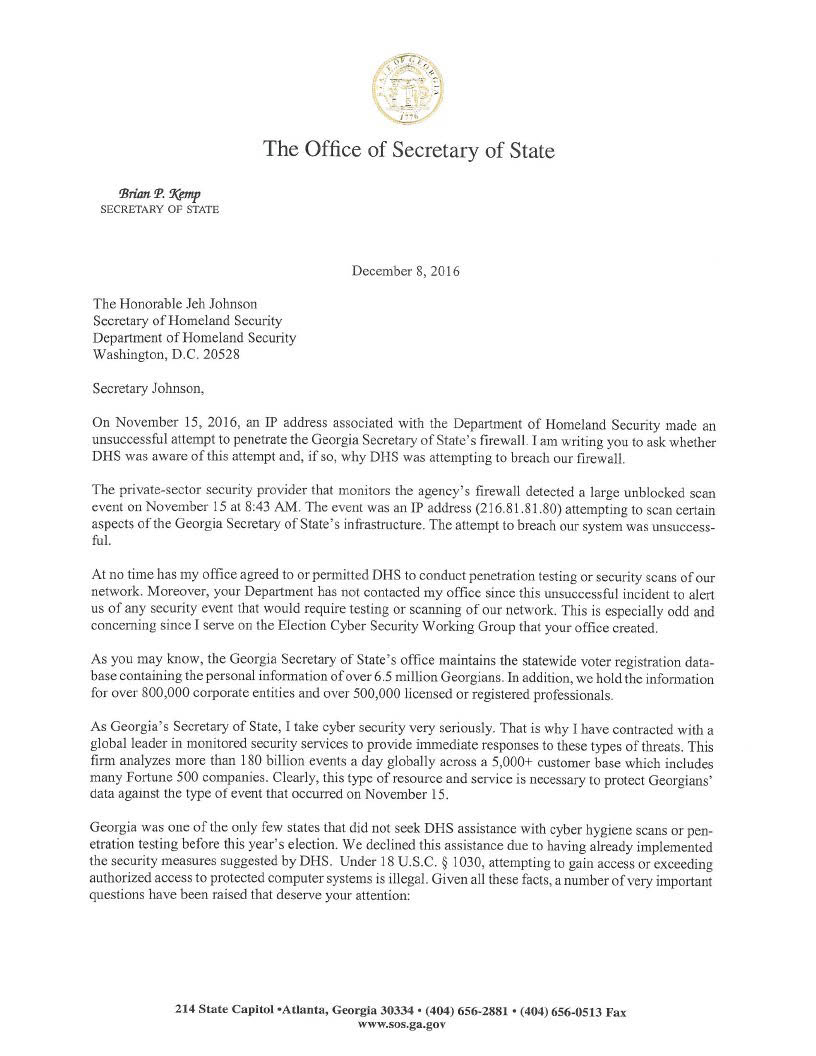
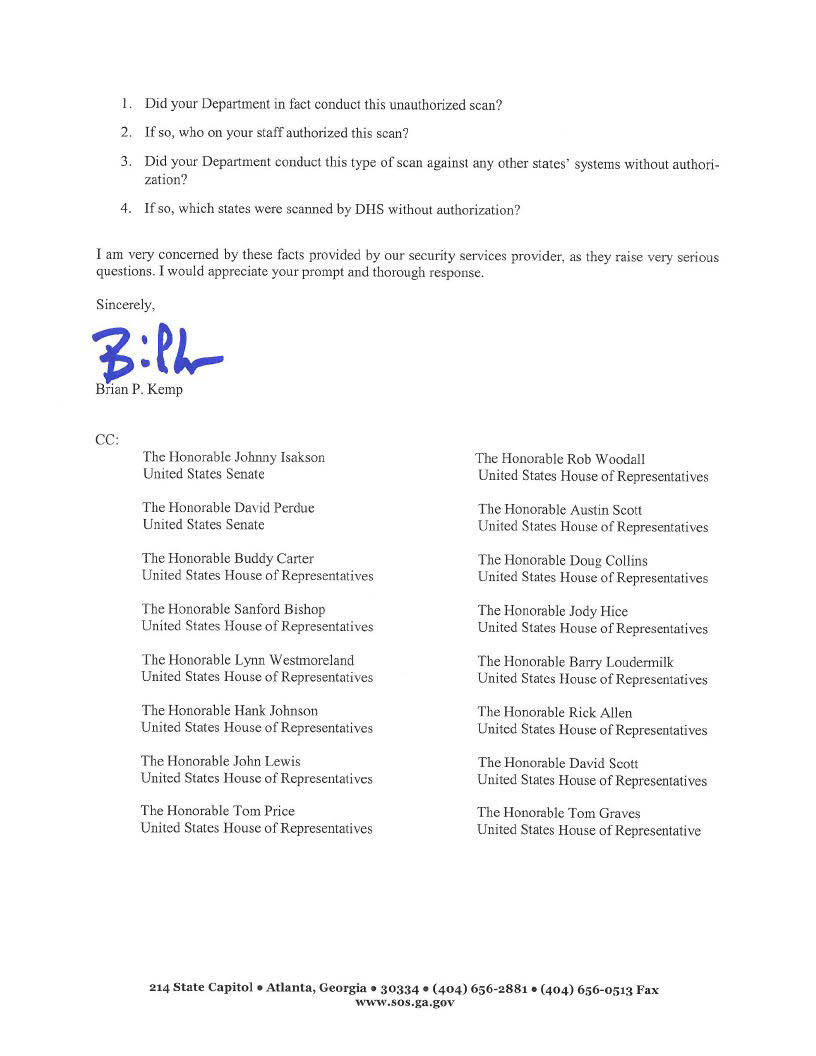
Georgia Secretary of State Brian Kemp sent a letter to Secretary of Homeland Security Jeh Johnson asking why the agency appears to have attempted to break into Georgia’s data systems.
Georgia Secretary of State Brian Kemp alleges that a computer with a DHS internet address attempted to breach its systems.
Kemp writes: “On November 15, 2016, an IP address associated with the Department of Homeland Security made an unsuccessful attempt to penetrate the Georgia Secretary of State’s firewall. I am writing you to ask whether DHS was aware of this attempt and, if so, why DHS was attempting to breach our firewall.”
November 15 was a full week after the election.
“At no time has my office agreed to or permitted DHS to conduct penetration testing or security scans of our network,” writes Kemp. “Moreover, your department has not contacted my office since this unsuccessful incident to alert us of any security event that would require testing or scanning of our network.”
“Under 18 U.S.C. § 1030, attempting to gain access or exceeding authorized access to protected computer systems is illegal,” he notes.
A representative for DHS said it had received the letter and was investigating.
“DHS takes the trust of our public and private sector partners seriously, and we will respond to Secretary Kemp directly,” said Deputy Press Secretary Scott McConnell.
Georgia Speaker of the House David Ralston settled a complaint with the State Bar, accepting a verbal reprimand for inadvertant issues.
The Supreme Court of Georgia also unanimously voted Thursday to accept House Speaker David Ralston’s petition for voluntary discipline. The court ordered that he receive a “Review Panel reprimand” by a panel of the State Bar of Georgia.
Ralston in turn agreed to admit that he inadvertently violated two state bar rules, including loaning money to a client for living expenses.
Ralston’s attorney James Balli issued a statement after the settlement.
“From the first day this matter was reported, we said this was nothing more than an honest mistake made while helping a client’s family pay for medicine and other necessities.”
“As determined by the Special Master and confirmed today by an unanimous Supreme Court, all of the other accusations and speculation were absolutely false.”
“While somewhat biased, I believe anyone who engaged in furthering such rumormongering owes my client an apology. However, knowing his commitment to public service, I am certain the Speaker will put this matter behind him and continue to focus on moving our state forward. I do know he is very grateful to his family and friends for their unwavering support throughout this ordeal.”
State legislators will once again clean up after themselves, having to pass new legislation to address problems raised by legislation passed in the previous session.
The Georgia legislator who authored a constitutional amendment to remake the state Judicial Qualifications Commission says that “a mix-up” during drafting of the amendment and “last minute” changes will result in three separate watchdog agencies overseeing judicial discipline between now and July 1, 2017.
The stumbling block is the effective date to abolish then and replace the JQC, which has been overseeing judicial discipline for more than 40 years. Under the amendment passed by voters last month, the current JQC ceases to exist on June 30, 2017. But its replacement, created by underlying legislation passed in the General Assembly, is supposed to start six months earlier, on Jan. 1. Rep. Wendell Willard, a Sandy Springs lawyer who chairs the House Judiciary Committee said the admittedly “tricky” incongruities will be resolved by abolishing the current JQC on Dec. 31; creating a new interim agency with different members and different operating rules on or shortly after Jan. 1, 2017; and then on July 1 abolishing that agency in favor of one shaped by as-yet-unwritten legislation. But he acknowledged that members of the final version of the judicial watchdog agency would likely not secure Senate approval—a requirement of the constitutional amendment approved by the voters earlier this month—until the 2018 legislative session.
Nick Genesi, a spokesman for Georgia Attorney General Chris Carr, said the attorney general believes Willard’s view “is accurate.”
Charles Bullock, a political science professor at the University of Georgia, said the snafu Willard referenced “sounds like one of those things where the left hand didn’t know what the right hand was doing.”
Bullock said he has seen similar situations before where a law—although not one associated with a constitutional amendment—is passed in the final minutes of the annual four-month session of the General Assembly only to have legislators realize “in the cold light of day … this is not good law” and quietly ask the governor to veto it. “That something slipped through would not be new,” he said. “The real question, I think, is that do the three key players—the Speaker, the lieutenant governor and the governor—get together and say, ‘We’ve got a bit of a problem. How are we going to fix it?’ If they are all on the same page, it probably gets fixed pretty quickly. If somebody wants to play hardball, you’ve got more of a problem.”
Two candidates for Roswell City Council have announced campaigns in the March 21, 2017 Special Election.
Jay Small has said he will run in the March 21, 2017, special election to fill the Post 4 on the Roswell City Council.
That seat has been vacant since November when former Council member Kent Igleheart resigned following his arrest on child sex charges.
Former City Council member Lori Henry previously announced she will run in the special election.
Lori Henry on Tuesday announced her bid to run in the March 21, 2017, special election to fill the Post 4 seat on the council.
Henry, who served on the Council from 2001 to 2009, is seeking to replace Kent Igleheart, who resigned last month following his arrest on child sex charges.
“Roswell has a need for leadership, particularly on the issue of redevelopment of our commercial corridors,” Henry said of why she’s running. “While maintaining the character of existing neighborhoods, we need to diversify our tax base, strengthening both our commercial and business development. The recent announcement of Target’s pending closure in East Roswell, and the departure of the nearby Kohl’s, drives home this point. We need to think outside the box and get ahead, not behind the curve.”
Marietta Board of Education Ward 6 voters will also go to the polls on March 21, 2017 in a special election.
Ward 6 residents Kerry Minervini and Patricia Echols filed for the election Wednesday.
The special election was triggered when school board member Tom Cheater resigned in September and moved out of the ward.
Ward 6 covers the northeast section of Marietta stretching from a section of Cobb Parkway up to the Sandy Plains Exchange at the intersection of Sandy Plains Road and Scufflegrit Road and is the same area that is represented on the Marietta City Council by Michelle Kelly Cooper.
Ward Six voters must be registered by Feb. 20 to vote in the special election.
Gwinnett County Commissioners are asking legislators for changes in how public agencies deal with people who might have mental illnesses.
Officials argue getting that legislation introduced and passed into law would go a long way in helping police intervene in situations where a person may be posing a threat to themselves or others. Law enforcement can’t arrest someone they suspect may be dangerous because of a mental illness issue unless that person has committed a crime.
“This is a situation where our folks in public safety are very concerned that they need to do something, but they can’t because the person isn’t committing a crime,” county Legislative Liaison Susan Lee said. “They’re afraid the next call might be a situation where something has happened and someone is injured or killed.”
The proposal Gwinnett leaders want the legislators to support would let a physician declare someone to be mentally ill and in need of being placed into custody based off the observations of cops, deputies and paramedics.
Gwinnett County Schools Superintendent J. Alvin Wilbanks is asking legislators to address issues with the Title Ad Valorem Tax collection.
As it stands, the “local target collection amount” prohibits school districts and local municipalities from receiving the minimum amount of TAVT collections required to be “made whole” for lost motor vehicle Ad Valorem Tax collections, school district officials said.
“We think the cap on that, as it grows, we think that probably needs to be raised for not only school districts, but municipalities as well,” Wilbanks said. “Hopefully you’ll give attention to that.”
“This TAVT is going to be a huge battle,” [Senator Renee] Unterman said. “And Gwinnett County has a lot at stake.”
The TAVT was one of several main issues related to education and educating funding that Wilbanks touched on to relay priorities to the lawmakers ahead of next year’s legislative session.
Georgia Gwinnett College President Stas Preczewski addressed a question from a legislator about campus carry legislation.
“It’s a challenge,” Preczewski said. “All the presidents have opposed it. All of the faculty senates have opposed it. All of the student government associations have opposed it. … In terms of actual firearms on campus, everybody still remains, students, faculty, staff, presidents. And I’m a former Army guy.”
Preczewski said he’d prefer the move toward Tasers on campus to allow the personal kind, not the projectile.
“Right now, if you’ve ever seen it, it looks like a real gun,” the president said. “You can’t tell. So a police officer comes on the scene of a student who’s got a gun pointed at another student who’s laying on the ground, that’s a potentially bad situation for a lot of people.”
Floyd County Commissioners met with local legislators ahead of the upcoming session of the General Assembly.
The County Commission and incoming commissioners met Thursday with state Rep. Eddie Lumsden, R-Armuchee, Rep. Katie Dempsey, R-Rome, and Sen. Chuck Hufstetler, R-Rome, to discuss a wide range of issues as the legislative session approaches in January. As expected, most of the issues centered on money.
While Whitfield and Pickens counties are seeing a rise in sales tax returns from the state, every other county in Northwest Georgia has seen a decrease, said Assistant County Manager Gary Burkhalter.
Commissioners also asked the lawmakers to look at how, and how much, the state reimburses the county for housing offenders.
State Rep. Trey Kelley (R-Cedartown) said he has not been convinced to change his position in opposition to casino gambling in Georgia.
“This is such a large departure from Georgia’s tradition, and the way our state is now,” he said. “I need to see a more robust debate with a lot more details than we’ve had up to now before I could allow this to come up for a vote.”
Kelley’s concerns about the idea for casino gambling revolve around several items, but the most important being that Georgia should keep with its roots and focus more on promoting tourism efforts without the need for the resorts, along with other business interests such as expanding the state’s film industry.
He also sees problems with proponents who are pushing for the gaming industry to come to the state by using a new revenue stream for the HOPE scholarship as reason to allow for the change in the state constitution.
“The argument putting all the money toward the HOPE scholarship hasn’t been a convincing argument for me,” Kelley said. “It’s not a lack of revenue, but a lack of leadership at our colleges and universities to keep their tuition rates down. I’m leery of giving them a whole new bucket of money instead.”
State Rep. Michael Caldwell (R-Woodstock) is refunding leftover campaign funds to donors.
From 2012 through 2014, Caldwell raised more than $32,000. He refunded nearly 40 percent of that to donors. (Final 2016 figures have yet to be reported.)
“The reason I do it is to give people the opportunity to decide for themselves and decide what happens with their money,” Caldwell said in a recent interview.
“One cashed his check and one asked it go to charity,” he said. The pair totaled about $10, Caldwell said.
Related Posts
 Adoptable (Official) Georgia Dogs for March 17, 2022
 SAVANNAH, Ga.: Ga. lawmakers weigh big change for Jekyll Island | State News | Macon.com
 Ryan Budget: How Did House Republicans Vote? Breaking Down 12 'No's
 Judge approves Savannah dredging suit settlement | www.ajc.com
 Adoptable (Official) Georgia Dogs for July 17, 2024


Comments ( 0 )