
James Edward Oglethorpe was born in London, England, on December 22, 1696. He was elected to Parliament, where he worked on prison reform and had the idea of a new colony where “worthy poor” Brits could be sent. In 1732, Oglethorpe was granted a charter to create a colony of Georgia in the new world.
On December 22, 1775, the Continental Congress created the Continental Navy.
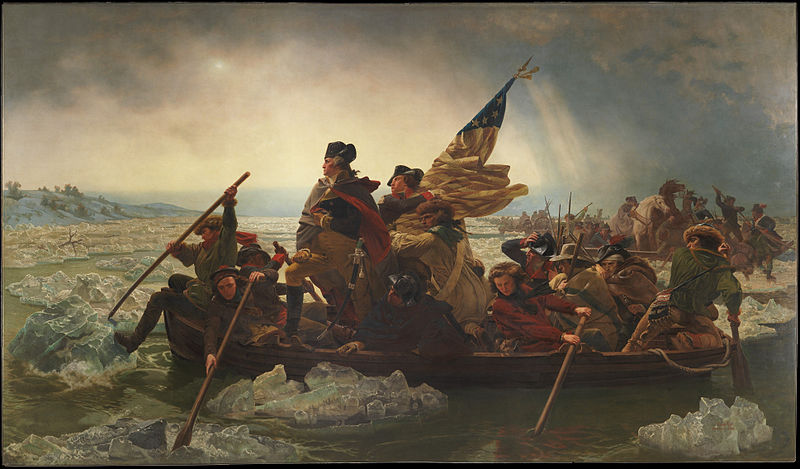
On December 25, 1776, Continental forces under General George Washington began crossing the Delaware River and the next day launched a surprise attack on Hessian soldiers at Trenton, New Jersey.
Beethoven’s Fifth Symphony premiered on December 22, 1808 in Vienna, Austria.
The War of 1812 ended on December 24, 1814 with the signing of the Treaty of Ghent, Belgium by British and American representatives.
Happy Birthday to Columbus, Georgia, founded on December 24, 1827 when Gov. John Forsyth signed legislation incorporating the new town.
Governor George Gilmer signed legislation that prohibited teaching slaves or free African-Americans to read or write on December 22, 1829. One year later to the day, he signed legislation claiming for the state all territory occupied by the Cherokee tribe.
On December 21, 1835, Oglethorpe University was incorporated near Macon, later moving to Atlanta.
Wesleyan College in Macon was chartered on December 23, 1836, becoming the first college chartered specifically to grant degrees to women.
Martha Bulloch and Theodore Roosevelt, Sr. were married at Bulloch Hall in Roswell, Georgia on December 22, 1853. Their son, Theodore Roosevelt, Jr. would later be elected President of the United States.
On December 21, 1863, the Confederate government selected a site in Sumter County for construction of Camp Sumter, which would be better known by the name Andersonville Prison.
General William Tecumseh Sherman received the surrender of Savannah, Georgia on December 21, 1864.
On December 22, 1864, General William T. Sherman wired to President Abraham Lincoln from Savannah, Georgia,
His Excellency President LINCOLN:
I beg to present you, as a Christmas gift, the city of Savannah, with 150 heavy guns and plenty of ammunition, and also about 25,000 bales of cotton.
W.T. Sherman,
Major General.
On December 23, 1864, the Georgia General Assembly passed a resolution specifying that the Senate chamber should be lit by electricity for the next Session. That is the last time the legislature sought enlightenment before passing laws.
On December 25, 1868, President Andrew Johnson issued an unconditional pardon of all Confederates.
President Calvin Coolidge lit the first National Christmas Tree on the White House grounds on December 24, 1923.
On December 26, 1939, President Franklin D. Roosevelt watched a private viewing of Gone With the Wind at the White House.

U.S.S. Atlanta was commissioned on December 24, 1941 at the New York Navy Yard as the lead ship of a new class of Light Cruisers. USS Atlanta (CL-51) was sponsored by Margaret Mitchell, author of Gone With the Wind.
Eugene Talmadge, who was elected four times as Governor of Georgia, in 1932, 1934, 1940, and 1946, died on December 21, 1946, leading to the Three Governors Controversy.
The Jimmy Carter National Historic Site was created in Plains, Georgia on December 23, 1987.
Mikhail Gorbachev resigned as President of the USSR on December 25, 1991, signalling the end of the Godless Communist regime.
Georgia Politics, Campaigns, and Elections
Karlton Howard was elected yesterday to State House District 129 in Augusta, according to the Augusta Chronicle.
Georgia’s House District 129 will continue to be represented by the Howard family.
Karlton Howard, one of the older brothers of the late Rep. Henry “Wayne” Howard, won the special election for his brother’s seat as representative of the house district on Tuesday.
Howard was moved to join this race as a way of carrying on the legacy of his late brother as well as their father, Rep. Henry L. Howard of Georgia House District 121.
“They were for the people, they represented people, did stuff for the people, and they were not self centered,” Howard said. “I thought, to continue that legacy, it would be an honor.”
The newly elected representative said he has that same kind of mentality, and will bring that into the work. One of the issues he is particularly interested in is education, getting much needed resources to teachers and endorsing a grant from Gov. Brian Kemp to better fund early childhood learning for ages 3-5 so they are better prepared for early grades. Howard also looks to be an active part of any efforts to improve living conditions for the elderly.
Howard won 68.38% of the vote, while private security contractor Brad Owens received 16.43%, project manager Scott Cambers 9.22% and Georgia Southern University student Davis Green 5.97%. About 7.82% of voters cast their ballots.
Richmond County Board of Elections Director Travis Doss said the election went smoothly and was pretty quiet. He said they were hoping for at least 10%, but the turnout was about what they were expecting. Doss attributed the low turnout to a variety of factors such as bad weather, this being a special election, and that this was not a county-wide election.
“We had like 45 days to make this happen. In the midst of grieving, in the midst of the death of my brother, we had to make this happen. So we had to put on the happy face and connect with people, and the people spoke today,” he said.
Howard took the lead throughout the night, finishing with 1,810 votes, 68.38%.
“There are some issues that need to be handled in our area, crime is an issue, and education is an issue. We’re concerned about our seniors, health care, and housing, and that’s a problem nationwide, but especially in our district. Over 50% of our district are seniors,” he said.
“At the same time, we’re concerned about education. We’ve got to figure out a way to do things to incentivize our teachers, do something about discipline, but at the same time, find a way to hire teachers and maintain them after we hired them,” said Howard.
“We believe in assisting folk where we can and making sure they have a quality of life. And that’s what we hope to bring to this district,” he said.
Speaking of people who need Jesus, thieves stole a number of pieces of a nativity scene on Tybee Island but forgot our Savior. From WSAV:
Father Jerry Ragan, pastor at St. Michael’s Catholic Church said he was preparing for Mass last Saturday morning when members of his congregation told him the nativity scene display did not look right.
“Only half the figures were in the display case here. And we’ve figured out during the night Friday that somebody came in and took them,” Ragan said. “We figured to replace it, it will cost about $11,000.”
A majority of the figurines were at stolen except one important symbol that was left behind.
“So they took Mary and uh the shepherds, all the animals, and the angel,” Ragan said. “They did not take the baby Jesus.”
“Well, not only our little congregation, but the whole island is kind of heartbroken by it,” Ragan said. “And, you know, we as Christian people we’re called to forgive. Jesus came in to a very disordered world and its still disordered. But we need to do the best we can to share his love. So, forgiveness, we’d love to have the figures back, and hopefully they’ll be a change of heart for those who took them.”
The Georgia Supreme Court held that an agreement via email is sufficient contract to require delaying an execution, according to the Capitol Beat News Service via the Rome News Tribune.
The email was an agreement between defense lawyers and the state Attorney General’s office that capital cases would not move forward during the covid pandemic unless certain conditions were met.
One result was a delay in the execution of Virgil Presnell Jr., the longest-serving person on Georgia’s death row. Presnell was sentenced to death in 1976 after convictions on murder, rape, and kidnapping charges.
In April of last year, a deputy attorney general and Presnell’s lawyers agreed — via email — that no executions could take place until six months after three conditions related to the covid pandemic were met. Vaccines had to be widely available to the public, the state Department of Corrections must have resumed its normal visitation rules, and the COVID-19 statewide judicial emergency order must have been lifted.
The Attorney General’s office moved ahead and set Presnell’s execution for May of this year but provided only two days’ advance notice to his lawyers. They sued the state for breach of contract, arguing Georgia had violated its agreement, that the conditions had not all been met, and that six months had not elapsed.
Lawyers for the state argued the state cannot be sued because of the doctrine of sovereign immunity, which bars lawsuits against the state government without its consent. A Fulton County court judge sided with Presnell and his lawyers and blocked the state from moving ahead with the execution.
The state then appealed to the Georgia Supreme Court, arguing the attorneys’ email agreement was not a written contract that could override the sovereign immunity doctrine.
The state Supreme Court unanimously sided with Presnell and his lawyers on Tuesday, finding the email agreement was a valid contract that the state violated by scheduling the execution.
“Though it may prove inconvenient, uncomfortable, or undesirable to the state … everyone should be able to count on the state to honor its word,” Justice Charles Bethel added in a concurring opinion. “The state should keep its promises because the people of Georgia, who are the very source of the state’s sovereignty, are owed a government that honors its commitments.”
The University System of Georgia has banned use of TikTok, WeChat, and Telegram apps on devices owned by the System or any of its constituent schools, according to the Associated Press via the Statesboro Herald.
Spokesperson Kristina Torres confirmed the move Tuesday, after the Republican Kemp on Thursday became one of numerous governors to ban TikTok from state computers. Because of Georgia law, Kemp generally can’t give direct orders to public universities.
Chancellor Sonny Perdue said in a memo that state-owned devices can only be used to access the programs for law enforcement and security purposes.
Perdue said the students, faculty and staff could still access the sites on their own computers and phones, or those owned by university-related foundations, as long as employees don’t also use those devices to access personal information or sensitive information related to university business.
Many Georgia universities use TikTok to court potential new students and communicate with current students and athletic fans. At least 20 public Georgia universities and four-year colleges appear to have TikTok accounts, although some have never posted. Valdosta State University, for example, appears to have eight separate accounts.
Congress is moving to ban TikTok from most U.S. government devices under a spending bill unveiled Tuesday, with requirements for the Biden administration to prohibit most uses of TikTok or any other app created by its owner, ByteDance Ltd.
Savannah City Council and Chatham County Commissioners appear to be on the same page on LOST (Local Option Sales Tax) distribution, according to the Savannah Morning News.
After nearly six months of strained negotiations, Chatham County and its eight municipalities have finally closed in on a deal for the billion-dollar tax revenue-sharing agreement set to expire at the end of this year.
A final breakdown of the Local Option Sales Tax (LOST) was passed unanimously by Savannah city council members on Tuesday, their last scheduled council meeting of the year. The vote gives the city manager authority to approve the deal with the county as long as the breakdown numbers don’t change.
The approved proposal will give the Chatham County government an initial share of 25% of the funds and increase that share to 31% by 2026 (the eight cities split the remaining share amongst themselves).
With the cities conceding approval of the latest proposal on Tuesday, the two sides have finally reached a consensus on how to distribute nearly $1.6 billion in projected funds over the next ten years.
“For us it was about math, it was about numbers, making it work. Some of the other stuff wasn’t necessary, but in the end, you know, we came to an agreement. I think that’s what the goal was: to come to a meeting of the minds,” Savannah Mayor Van Johnson said.
Tybee Island, Bloomingdale, and Thunderbolt are the only municipalities that haven’t approved this distribution agreement. Mayor Johnson says that the county will sign the agreement with the City of Savannah, and they will do the same with the rest of the municipalities if and when they pass the agreement.
Garnett Johnson was sworn in as the 85th Mayor of Augusta, according to the Augusta Chronicle.
“I’m here to fight with you,” he said. ”I need your prayers, I need your help, I need your love, but most importantly, I need you guys to become united for one Augusta.”
Though the oath has been taken, Mayor Hardie Davis will remain in office until the New Year. Davis congratulated Johnson and said he’s excited for what’s in store for the new mayor and the City of Augusta.
Toby Conner was sworn-in as Bulloch County District 2-B Commissioner, according to the Statesboro Herald.
Toby Conner raised his right hand and took the oath of office Tuesday morning as the new Bulloch County commissioner for District 2, Seat B. Probate Judge Lorna DeLoach also swore in continuing Seat 1-B Commissioner Anthony Simmons and Seat 1-D Commissioner Timmy Rushing to new four-year terms.
After [outgoing Commissioner Walter] Gibson, a Republican, announced last spring that he would not seek re-election, three Republican candidates and one Democrat vied for the seat. After placing second in the Republican primary in May, Conner won a primary runoff and then the November general election.
Re-elected as a Democrat against a young Republican challenger, Simmons is completing his 30th year as a commissioner and heading into a new four-year term.
Rushing, first elected in 2018, ran unopposed for a second term through this year’s Republican primary and the general election.
Very well done to the Statesboro Herald.
Houston County saw an increase in fentanyl-related deaths, according to 13WMAZ.
In Houston County, fentanyl is killing more people this year than last year.
Houston County Coroner James Williams says just a few weeks ago, they had three fentanyl overdose cases in one day. Out of those three cases, only one person survived.
He says in 2021, Houston County had about 20 fentanyl-related deaths. This year, he says, the county has had 30 fentanyl overdose deaths — and several cases haven’t come back from state crime labs yet.
Williams says it’s a “highly-addictive” drug and can be lethal even in small amounts. The ages of this year’s Houston County fentanyl victims range from 15 to 73.
“This doesn’t discriminate against a certain race or age group. There’s no certain age group or race or any of that. It’s out there and it’s on the streets and it’s killing people. We’re seeing it too much here in Houston County,” Williams said.
Criminal Division Lieutenant Matt Moulton says street Fentanyl is about 50 to 100 times more potent than morphine.
“You look at just the money involved in it: You buy a kilo of fentanyl for $4,000. You press a thousand tablets as 30 milligram Oxycontin. That’s $30 million in profit that a clandestine lab can make by pressing those tablets; and that’s leading to the overdose crisis that we are seeing here in Houston County and throughout Georgia and the entire nation,” Moulton said.
Williams and Moulton said these were death-related fentanyl overdose cases; meaning for every one death-related fentanyl overdose case, about 20 to 30 more overdoses involving fentanyl are happening throughout the county.
A common medication used to reverse opioid overdoses is called Narcan. It can be used by anyone, police or family members, especially to save someone from an overdose.
The Richmond County School Board will hold a Special Election to fill the Board of Education seat vacated by the death of member-elect Tyrique Robinson, according to the Augusta Chronicle.
In a statement emailed Monday, Richmond County school board president Charlie Hannah said “The Richmond County Board of Education is working with the Georgia Secretary of State and Richmond County Board of Elections to follow their guidance to request the special election for a School Board Member in District 6.”
Robinson won an uncontested race for the seat earlier this fall, and was set to be the board’s youngest ever member at age 20, but died by suicide on Nov. 15.
In January, the board will meet to request the special election for a date that will be determined in the New Year. Richmond County Board of Elections Director Travis Doss said via email that the first available date for a special election is March 21.
The term for the current District 6 Representative, A.K. Hasan, ends on New Year’s Eve. While the school system has not named anyone specifically to represent the district in the interim, Hannah said the school board will follow guidance to ensure that the families and residents of District 6 continue to be represented.
The Georgia Public Service Commission voted to approve a proposal , according to the Capitol Beat News Service via the Macon Telegraph.
The state Public Service Commission (PSC) approved a $1.8 billion rate increase requested by Georgia Power Tuesday that embraced most of an agreement between the agency’s staff and the company presented last week.
Commissioners slightly lowered the upper limit on profits Georgia Power will be allowed to keep and sweetened incentives to be offered to encourage the development of solar energy and the deployment of electric vehicle charging stations. But the PSC stopped short of more far-reaching changes proposed by Commissioner Lauren “Bubba” McDonald, who provided the lone opposition in Tuesday’s 4-1 vote.
The $1.8 billion rate hike – down from Georgia Power’s original request of $2.9 billion – will raise the average residential customer’s bill by $3.60 per month starting Jan. 1. That’s down significantly from the $14.90 monthly increase customers would have seen next year under the original front-loaded three-year request the company proposed in June.
The commission set the return on equity (ROE) for the utility at the staff-recommended level of 10.5%, down from the 11% the company sought.
But commission Chair Tricia Pridemore amended the upper limit of the “earnings band” – the range within which the utility can earn profits for its shareholders without sharing them with customers – to 11.9%, slightly below the 12% Georgia Power requested and currently receives. The PSC staff had recommended reducing the upper limit to 11.5%.
The commission defeated an alternative amendment McDonald proposed to follow the staff’s suggestion and set the upper limit of the earnings band at 11.5%.
Rome City Commissioners voted to approve Tax Allocation District funding for a new development, according to the Rome News Tribune.
The development adjacent to the Courtyard by Marriot on West Third Street, known as the NOVA Project, is located in the city’s first and largest TAD district, which was established in 2005 and is scheduled to sunset in 2035. Under a TAD agreement, a portion of net new property taxes go back to the developer for a certain period of time to help defray construction costs.
Due to its location in the “arts district,” there are plans to set up art halls in the buildings, and the commercial space will be dedicated to mostly local businesses as opposed to national chains.
However, County Manager Jamie McCord voiced concern during the Friday joint discussion, saying the requested allocation of tax money is somewhat high.
“We’ve developed kind of a guideline, and it’s not a hard number, but when you look back historically, we’ve had 17% — and this is 24% (of the cost),” McCord said.
Gainesville City Council voted to approve improvements to Lee Gilmer Memorial Airport, according to the Gainesville Times.
According to officials, funding for the project will consist of an 80% federal contribution, totaling approximately $4 million. The state and local governments will each contribute 10%, combining for $1 million to reach the project goal. Much of the funding is coming from the FAA.
Lackey said providing a safe and well-maintained runway will help bolster the economic status of the Gainesville community.
“The airport is certainly an economic development generator for the community and corporations want to have their corporate jets nearby and us having the appropriate runway that their pilots feel safe coming in,” Lackey said. “The runway—it’s been a while since we’ve upgraded it for that, there’s been a huge need for it. So I do think the aviation community, especially our corporate aviation community, is going to be excited about that.”
Habersham County Commissioners voted to approve a $1.5 million dollar line of credit for Habersham Medical Center, according to AccessWDUN.
The commission voted unanimously Monday night to allow Habersham Medical Center to draw on the line of credit to cover costs that allow the Demorest facility to continue operating.
Less money coming amid increased operating costs, including provider and supply costs, were cited as reasons for the hospital’s current financial struggles.
“This isn’t just a blank check, so to speak,” said Habersham County Commission Chairman Bruce Palmer. “It’s a line of credit and all the expenditures have to be approved by Habersham County.”
Palmer said keeping the hospital open is imperative for the community.
“The hospital is a life safety decision,” Palmer said. “Some folks if you had to transport them another 30 minutes down the road probably wouldn’t survive their illness or injuries.”
“To me how ethical would it be to not do whatever we can do to keep it open,” Palmer said. “This is kind of the height of the flu season. There are cases of COVID in the hospital at Habersham right now.”
The previous line of credit extended by Habersham County Government expired in August 2022.
The federal government will issue approximately $500 million per year in grants to Georgia hospitals to address the shortage of healthcare workers, according to the AJC.
The new federal money is estimated at nearly $500 million a year and will go to 21 teaching hospitals across the state.
Dr. Bryce Gartland, co-chief of clinical operations at Emory Healthcare, which helped lobby for the money, said in a statement the money will help train the next generation of nurses.
The program comes in the midst of a historic shortage of doctors and nurses, and amid growing understanding that a lack of diversity in medical personnel harms patient care. The demands of the pandemic made the existing health worker shortage far worse.
Over the past two years, many staff nurses left for jobs with private temporary staffing agencies where pay was much higher and they could choose where to go. That contract labor expense pushed some hospital budgets into the red.
“The pandemic has put unprecedented pressure on all our teams and has made our staffing challenges even worse,” Shayne George, CEO of Memorial Health in Savannah, said in a written statement. The money “will help Memorial Health recruit and train clinical staff to serve patients who need the high level of care we provide.”
The Biden administration made the decision to approve Georgia’s application. A remarkably bipartisan group of Georgia lawmakers signed the letter asking for it, led by U.S. Sen. Jon Ossoff, a Democrat, and U.S. Rep. Buddy Carter, a Republican.
The only holdouts from Georgia’s congressional delegation who didn’t sign were Republicans Marjorie Taylor Greene, Andrew Clyde and Jody Hice.
Parasitic Black Gill threatens Georgia’s shrimping economy, according to the Savannah Morning News.
Black gill is a parasite that lodges itself into shrimps’ gills and feeds on that tissue. It’s a ciliate — a single-celled organism. It gets its name from the shrimp’s immune response to the invader, which turns the gills black as the shrimp’s body tries to fight off the intruder.
Luckily, University of Georgia professor and researcher Marc Frischer said black gill does not harm people — it’s totally edible, but the aesthetics could be a problem for shrimpers selling the product.
While it won’t hurt humans who eat it, black gill does have the potential to kill shrimp. With the parasite lodged in its gills, a shrimp can’t breathe as well, and it is more likely to become weaker and be more susceptible to being eaten by a predator. Many of the shrimp with black gill die, but a lucky few will molt their gills — something shrimp do every couple of weeks — and get a new lease on life without the parasite, unless it is re-infected.
Since 2016, Frischer said the parasite has been more common and the span of the year it is most active has been growing. He said when his team collects samples they look at a variety of factors, like oxygen in the water or temperature, but none of them correlated to the prevalence of the parasite except for global climate indices. When there’s a warmer winter, the following fall the black gill gets significantly worse: a correlation.
Shrimpers at the meeting nodded their heads: there used to be winters so cold water would freeze to the boats’ decks, but they hadn’t had one of those in a long time, shrimper Wynn Gale said.
From 2014 to 2015, Frischer’s team sampled off the coast of Georgia and found black gill in just under 50% of shrimp sampled at the parasite’s height for the year in September. Sampling from 2016 to 2020 put that statistic closer to 80%. While the parasite was detected mostly in August through December in 2014, the 2016 to 2020 data saw a black gill season stretching from June to December.
Aside from the black gill, which Gale said he believes is causing shrimp populations to decrease, he said that the climate is affecting the seasons for different types of shrimp. Where brown shrimp and white shrimp used to have distinct seasons, one disappearing almost entirely before the next arrived for the year, they now all meld together, and in turn Gale said it changes the prices that some shrimp, like brown shrimp, are going for on the market.
Related Posts
 Chambliss, Isakson, Austin Scott: A-10 Weapon System Critical to National Defense
 Highway rules could breed confusion | www.myajc.com
 The Evans Report: Big Bucks For Television Stations
 Georgia Politics, Campaigns, and Elections for October 20, 2014
 Ga. sales tax holiday too late for some students | savannahnow.com


Comments ( 0 )