
President George Washington died at Mount Vernon on December 14, 1799. Here’s an article about the nation’s mourning for our first President.
The Congress, in session at the capital of Philadelphia when Washington’s death was announced, immediately adjourned. The House of Representatives assembled the next day and resolved to shroud the Speaker’s chair in black and have members wear black during the remainder of the session. On December 23, John Marshall speaking for the joint committee of both houses, presented five points that became the foundation for the United States’ first “state” funeral. Resolutions structured mourning events around public commemorations that fostered unity and a sense of national identity among grieving Americans.
President William McKinley addressed the Georgia General Assembly on December 14, 1898.


On December 14, 1939, a parade was held through downtown Atlanta with stars from Gone With the Wind and the Junior League held a ball that night. The next day, December 15, 1939, Gone With the Wind held its world premiere at Loew’s Grand Theater in Atlanta.
Georgia Politics, Campaigns, and Elections
Two local small business owners paid off the overdue school lunch balances for Lee County students.
According to the Lee County School System, the Stricklands paid off the entire balance of lunch charges for the entire school system at the end of the day Tuesday, leaving all students’ accounts free and clear for the Spring semester.
“S&S Roofing and Construction — Michael and Sarah Strickland — are very appreciative of our great community, from our school system, police, firefighters, EMS, parents, children, and businesses,” the school system wrote in a release on Facebook.
The entire cost of paying off those school lunches was around $6,500, according to WALB. According to the Census Bureau, about one in 10 people in Lee County live in poverty, which could make it more difficult to keep up with lunch payments. According to ProPublica, about 37 percent of Lee County students receive free or reduced lunch.
“Growing up as a child of a school superintendent, I quickly learned how precious school lunch is to so many children. This community has supported our company and allowed us to grow in ways Michael and me only dreamed of,” Sarah Strickland wrote on Facebook. “The least we could do is show our appreciation for not only the school system, but for the people that make up our great community.”
That’s one reason why local business ownership is so important.
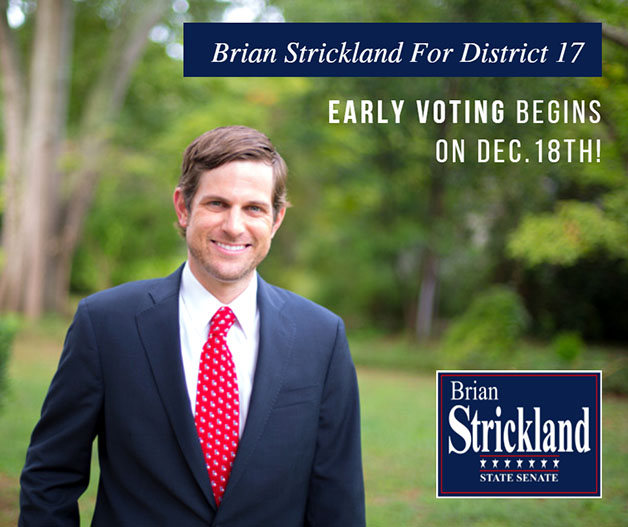
State Rep. Brian Strickland (R-McDonough) notes that early voting begins Monday, December 18th for the Senate District 17 and House District 111 special elections. Strickland is running for the Senate seat, and that opened the house seat. If I hadn’t seen this on Facebook, I would have missed it.
Lieutenant Governor Casey Cagle spoke to the Gwinnett Chamber of Commerce about the upcoming 2018 Session of the Georgia General Assembly.
“The legislative session is going to be busy and this will be a little bit of a bittersweet session in that, obviously, I will not be returning as lieutenant governor (in 2019) and of course the governor, Gov. Deal, will also not be returning,” Cagle said. “Anytime you’re wrapping up a season or chapter in your life, certainly it invokes certain emotions.
“But, you also look to what those new chapters and seasons that are ahead of you.”
State legislators are expected to tackle tax reform, recommendations from the state’s healthcare task force and the opioid crisis, the lieutenant governor said. He also said he will seek to have at least the Senate address broadband gaps in rural Georgia, coming off a taskforce that looked into the matter, and investing in venture capital for companies.
Tax reform, in particular, is expected to a key topic as lawmakers in Washington D.C. workout a major overhaul of the federal tax code.
“It gives us a wonderful opportunity as a state to really cast a greater vision for what our tax reform could look like,” Cagle said. “Every year, we have a house-keeping bill that would align our tax code with what the federal government is doing and so this will be, I assume, a very large debate and conversation throughout the session, and I think it’s one that is long overdue.”
Other issues that Cagle highlighted are expected to be tackled by members of the Senate. The opioid issue is expected to be tackled by an omnibus bill that Sen. Renee Unterman, R-Buford, will likely file during the first weeks of the session.
“Sadly enough, we don’t have access to broadband in many of our rural communities,” Cagle said. “That’s difficult for some of us to recognize in the areas that we do (have access), but today we’re no longer bound by bricks and mortar. We can do business anywhere in the world, from any corner of our state, if we have access to that super highway.”
Senator Renee Unterman (R-Buford) spoke to the Gwinnett Daily Post about opioid legislation.
Unterman, who leads the Senate Health and Human Services committee, has been working on the legislation, which she said will be an omnibus bill. Lt. Gov. Casey Cagle announced earlier this fall that he and Unterman would be working on legislation to address the opioid issue, which was named a public health emergency by President Donald Trump in October.
“It should be ready right at the first week of the session — hopefully,” Unterman told the Daily Post in an interview last week. “It’s such a big issue that it’s hard to put it together.”
Unterman said the legislation that she is working on will address recovery centers, patient brokering, access to NARCAN — which is an agent used to counteract and reverse an overdose — and insurance fraud. The fraud issue, she said, involves doctors ordering more urine tests than are needed.
“So it’s like an omnibus bill and I’m putting it together now,” Unterman said. “It’s really complicated. Right now we have a moratorium on methadone treatment centers. We’ve been getting a lot of complaints about that and how we’re going to implement that.
“I mean here you are in the middle of a crisis and there’s a lot of conflict in communities across the state about the treatment centers and access to care. That’s one of the biggest problems.”
“This is our No. 2 priority in the Republican caucus so it should get a good deal of prioritization,” Unterman said.
Georgia Court of Appeals Judge Elizabeth “Lisa” Branch appeared before the United States Senate Judiciary Committee yesterday on her appointment by President Trump to the 11th Circuit U.S. Court of Appeals.
Introduced to the U.S. Senate Judiciary Committee by Georgia’s U.S. Sens. Johnny Isakson and David Perdue, Branch—who has served on the state appellate bench for five years—testified at her confirmation hearing for an open slot on the U.S. Court of Appeals for the Eleventh Circuit that has been held for two decades by Georgia’s Frank Hull.
She also fielded multiple questions seeking the extent of her embrace of constitutional originalism and textualism and how that judicial philosophy might shape her rulings as a federal appellate judge.
Branch, whom President Donald Trump nominated to the Eleventh Circuit last September, agreed that her judicial record reflected her originalist bent. But she also attempted to assure Democratic committee members, who expressed skepticism that the philosophy was too narrow or overly simplistic, “At the end of the day, I am bound by U.S. Supreme Court precedent.”
Citing the late Supreme Court justice and ardent originalist Antonin Scalia and newly-minted Justice Neil Gorsuch, Branch said that, in following the rule of law, “A judge is going to render decisions that sometimes the judge is pleased with and sometimes is not so pleased with.” Once that ceases to be the case, she added, “Perhaps it’s time to find another job. Or retire.”
Said Branch: “With respect to the separation of powers, sometimes there are situations where I wish a statute were worded differently. But I can’t do anything about it. It’s not my job.” In some cases, she continued, “I have pointed out to the Georgia General Assembly … that if they want to fix it, that is their job to do so.”
Branch said she intends to abide by “what the drafters [of the U.S. Constitution] meant when the words were drafted.”
“At the time the Constitution was drafted and ratified, there were a lot of historical source materials,” she said. “We are not writing on a blank slate. We can actually go back and see the notes and see what the founders meant and intended.”
The Georgia House Rural Development Council issued its report based on a series of hearings this year.
“Keep in mind that the ultimate goal of this group – the ultimate goal – is empowering private business to expand and grow jobs in rural Georgia and lift the quality of life for a major, major part of this state,” he also said. “And that’s what we have to keep our eye on.”
Wednesday marked the culmination of a series of meetings held across the state since May. The council’s work is expected to lead to as many as five major bills this session that are focused on workforce development, broadband deployment, economic development, education and health care. Other smaller bills are also likely.
Specific ideas include proposals such as creating a tax break for people who move to counties with a steady stream of residents leaving. It’s an incentive especially meant to attract high-wage professionals to rural communities.
Or easing requirements in the state’s certificate of need program, which controls how many health care facilities can crop up in one area. That proposal is designed to give rural hospitals more flexibility to operate as small-scale “micro hospitals.”
Rep. Jay Powell, R-Camilla, who co-chairs the council, said no recommendation takes priority over another.
“It’s a package,” Powell said after Wednesday’s meeting held in Milledgeville. “There are some things that are going to be a harder lift than others.”
Wednesday’s first order of business was the discussion of a “Rural Relocate and Reside” initiative, a program designed to give incentives to people moving to rural areas. The resolution would provide a one-time 10-year income tax deduction up to $50,000 for new residents of counties experiencing less than five percent population growth over five consecutive years. The measure would also allow local governments to provide new residents with a one-time 10-year abated property tax exemption, as well as a 10-year state income tax exemption up to $100,000. Representatives said the incentives are designed to attract high-earning professionals like doctors, lawyers, and accountants to rural Georgia by letting them keep much-needed capital to start their own businesses and practices.
“In my home county, Mitchell County, we have a plant that employs 2,200 people. That’s a great thing, but all of the upper management lives somewhere else,” said Co-Chairman [Jay] Powell. “We’re missing the resources that those people who have great organizational skills and are obviously very highly motivated [can bring].”
In the final category discussed at Wednesday’s meeting, representatives discussed the various problems facing rural hospitals and healthcare providers. House researchers report that 79 Georgia counties currently lack a practicing OB-GYN, 66 lack a general surgeon, 63 lack a pediatrician, and six lack any physician whatsoever, a problem that exists simultaneously with rural hospitals’ difficulties collecting payment amid rising healthcare costs. Representatives called for the elimination of a law that bars patients from seeing medical specialists on the same day they are referred by general practitioners, as well as the creation of a uniform billing platform for patients statewide. Rural practitioners who complete a mandatory certification, employ a physician’s assistance, accept Medicare and Medicaid, and operate under extended hours would also be given decreased premiums. The provision calls for the creation of a Rural Center for Health Care Innovation and Sustainability to provide leadership for rural providers, as well as rules for 24-hour “micro-hospitals” in communities without full scale medical centers. Rep. Sharon Cooper (R- Marietta) cited a lack of practicing midwives in Georgia’s rural areas, and called for a tuition abatement for nurses to be trained in the relevant classes.
The biggest tax breaks would go to rural newcomers with the highest incomes. That’s by design in an effort to attract business owners, doctors and professionals to rural areas, said Rep. Jay Powell, R-Camilla, the chairman of the tax-writing House Ways and Means Committee. But tax breaks would also be available to anyone who relocates, regardless of their incomes.
“You’re not going to create jobs if you don’t have the people,” Powell said. “We can attract people to move into a community by giving them tax deductions and giving them residential real estate tax abatements.”
Costs to taxpayers and other details of the plan are unclear until specific legislation is introduced and evaluated. The incentives would be available to residents who move to any of the state’s 124 counties with less than 5 percent population growth over five consecutive years:
Alone, none of the initiatives will make a significant difference in the quality of life in rural Georgia, said state Rep. Jay Powell, a co-chairman of the council. But together, the combination of a professional workforce, fast internet and health care access would create the conditions for business growth, he said.
And from another article by the AJC’s Niesse:
Powell, who is chairman of the tax-writing House Ways and Means Committee, said the income tax breaks come in the form of deductions that would mostly help people with higher incomes such as doctors and business owners, but they’re the type of leaders that struggling communities need.
“You’re talking about people who are going to be providing services, paying sales taxes, buying property and investing in the community,” said Powell, R-Camilla. “I would think the rural broadband would not be controversial. Giving tax credits for folks to move to a location might be.”
The US General Services Administration is backtracking on a proposed federal courthouse annex in Savannah after local opposition mounted.
Remaining parts of the Georgia Dome will be imploded on December 20th after the main implosion failed to level some portions.
The City of Savannah will receive a federal grant to convert some flood-prone spaces into urban tree nurseries.
The city of Savannah is one of six cities to receive a federal grant to convert flood-prone vacant FEMA lots into urban tree nurseries.
The $233,244 grant from the Southeast Sustainable Communities Fund will also provide real world technical training and job placement to 15 unemployed residents, according to city officials.




Comments ( 0 )