
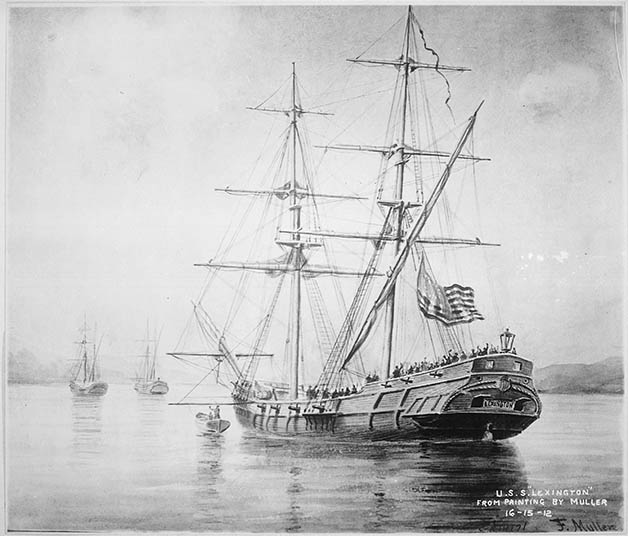
On April 7, 1776, the United States warship Lexington captured a British warship, HMS Edward, for the first time.
On April 7, 1798, President John Adams signed legislation authorizing negotiations between three representatives of Georgia and three Presidential appointees over Georgia’s claim to land west of what is now the Georgia-Alabama state lines. Georgia would continue to claim most of what is currently Alabama and Mississippi until 1802.
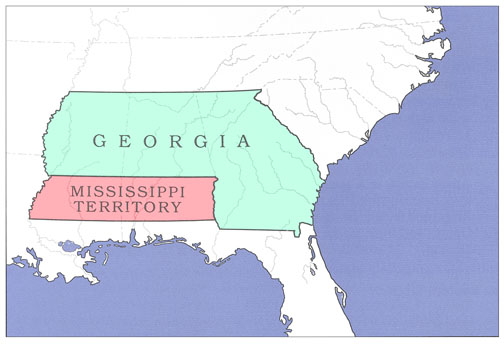
Map by Carl Vinson Institute of Government at UGA
On April 7, 1995, Governor Zell Miller signed legislation recognizing the peach as the official state fruit of Georgia.
The National Society Sons of the American Revolution held an event commemorating the 246th Anniversary of the Battle of Brier Creek, according to the Savannah Morning News.
On Saturday, March 8, members of the National Society Sons of the American Revolution traveled to the Brier Creek Battlefield in Screven County to participate in the 246th Anniversary Celebration of the Battle at Brier Creek that was fought on March 3, 1779.
For 2025, a burial service, a wooden casket, a 21-gun salute and the raising of the Betsy Ross Flag and the Gadsden Flag to half mass.
After the raising of the Betsy Ross Flag and the Gadsden Flag by the Swainsboro High School JROTC, master of ceremonies Tommy Christopher welcomed everyone to the event that was just designated a “SAR NATIONAL” event on March 1.
William Tankersley, senior VP of the GA Society, Darryl Addington, president general of the National Society, K. Scott Collins VP general of the National Society, Amy Pittman Lawson, first vice regent GA State Society NSDAR, Jon Burns, speaker of the Georgia House of Representatives, Max Burns, GA State Senate, 23rd District, Billy Hickman, GA State Senate, 4th District, Lehman Franklin GA House of Representatives, 160th District and U.S. House of Representatives for Georgia’s 12th Congressional District Rick Allen all offered remarks on the event.
[Georgia Army National Guard] LTC [Leslie] Chandler gave a eulogy for the over 200 Patriots that are buried in unmarked graves on this battlefield. As part of her eulogy, there was one wooden casket with the Betsy Ross flag covering it.
Georgia Politics, Campaigns, and Elections
https://www.youtube.com/watch?v=4SXI-eLMq1E
File Under: What Could Go Wrong? Olivia Baptist Church in Dalton, Georgia, will drop Easter eggs from a helicopter, according to the Dalton Daily Citizen News.
Dalton residents passing by Olivia Baptist Church on Saturday, April 12, will be able to witness a “treat” when thousands of small, multicolored plastic Easter eggs filled with candies and toys fall from the sky by helicopter, said Senior Pastor John Everett.
“Our helicopter egg drop event is free and open to the entire community,” Everett said. “We encourage families and everyone from all around to come and have a great time.”
The event, which begins at 11 a.m. at 1817 Guy St., will feature several family-themed activities, including a face painting station, inflatables, balloons and music.
“We’re also going to take just a moment and do a very simple gospel presentation before the helicopter arrives around (noon),” Everett said. Owned and flown by Calhoun resident Ron Dobbs, the CEO and chief flight instructor of Air Adventures Flight Instruction, a helicopter will hover over the church’s field as more than 2,000 Easter eggs are dropped for children to collect.
“It’s going to be a lot of fun,” Everett said. “And of course, anyone who visits during the event is encouraged to come back on Easter Sunday, where we’ll have a large production that blends several elements like choir singing, a dramatic presentation and preaching all folded into one. It’s kind of an Easter spectacular to wrap things up that I think a lot of people will enjoy.”
Qualifying opens today for a Special Election for Mayor of Cairo, according to WALB.
According to a city councilman for Cairo, the mayor resigned to take on the interim city manager position.
The qualifying for the special election starts on Monday, April 7, at 8:30 a.m. and lasts until Wednesday, April 9, at 4:30 p.m. at City Hall, on 111 North Broad Street.
The Qualifying fee for the election is $244.76.
The special election will be held on June 17.
Also on the June 17, 2025 ballot will be two seats on the Georgia Public Service Commission, according to the Macon Telegraph.
For the first time in four years, the Georgia Public Service Commission will hold an election for two of the five commissioner seats this November.
But first, a record-breaking number of qualifying candidates will compete in the June 17 primary election to make it on the ballot in November. Candidates had to qualify by noon Thursday.
“The PSC is really important because they are the only entity to have oversight over utility company plans and what Georgians pay for their energy,” said Brionte McCorkle, Georgia Conservation Voters executive director.
This week, six people decided they are up for the job, officially adding their name in the running against two Republican incumbents: Tim Echols of District 2 and Fitz Johnson of District 3.
Johnson and Echols were supposed to be up for election in 2022. But a lawsuit about voters’ rights postponed it. The 2020 lawsuit argued Black voters weren’t fairly accounted for due to the way the districts were set up. The accusers said it violated Section 2 of the Voting Rights Act. In November 2023, the 11th Circuit Court ruled in favor of Secretary of State Brad Raffensberger and against the group who filed the suit, saying the Voting Rights Act was not violated.
Four Democrats are facing off in the primary to try to unseat Johnson in District 3: Daniel Blackman, Keisha Waites, Peter Hubbard and Robert Jones. This is the first time four Democrats have run for the PSC during primaries. Four Republicans once ran in the ‘90s, according to Robert Sinners, communications director for Georgia secretary of state.
It costs almost $4,000 to enter the race, according to the Secretary of State’s office. A commissioner’s salary is around $120,000 a year, public records show.
Republican Lee Muns and Democrat Alicia Johnson are running against Tim Echols for the District 2 seat. Alicia Johnson is running unopposed on the democratic side and will be the nominee this November.
This will be Blackman’s third run at the Public Service Commission. He lost to Republican Commissioner Lauren “Bubba” McDonald in 2014 by around 300,000 votes. Six years later he lost to McDonald again by about 150,000 votes, but neither got 50% of the vote and they went to a runoff. McDonald narrowly won that race by about 34,000 votes.
Alicia Johnson, who lives in Savannah, part of District 2, has a background in business, strategic planning, grant writing and worked as a public information officer for a judicial circuit. She also serves on Bloomberg’s Sustainable Cities initiative, looking for solutions to climate change.
Echols, who hasn’t had to run in an election since 2016 – a five year term that turned into a nine-year term because of the Voting Rights Act case – will face off against Alicia Johnson this November, should he win against his fellow qualifying Republican candidate, Lee Muns. Muns is a project manager who resides in Columbia County. Muns couldn’t be reached for comment for this story.
Echols told the Ledger-Enquirer under his watch, Georgia is aggressively transitioning to a cleaner grid. He said he helped create a net metering program in 2019, which allows customers with rooftop solar to add extra solar energy credits back to the credit and get paid for it. The program, known as a solar incentive by many experts, was removed in 2022 by the PSC.
“I have been a stalwart supporter of clean energy,” Echols said in an email. Echols pointed to his evangelical Christian faith when asked about climate change, saying, “I believe that God ultimately controls the destiny of the planet …God gave mankind dominion over the planet and we have an obligation to care for His Creation, including our air and water and soil.”
Keisha Waites will also face off against Jones, Hubbard and Blackman in the primary on June 17. Waites was a former three-term state representative. She served District 60 in Clayton and Fulton counties from 2012 to 2017. She spearheaded efforts concerning anti-bullying, HIV testing initiatives and authored legislation (HB-54) to provide tuition assistance to children of law enforcement officers who have died.
She served on the Atlanta City Council starting in 2021 and resigned in March 2024. She planned to run for Fulton County Clerk, according to other media reports. Waites couldn’t be reached for comment for this story.
Guyton Mayor Andy Harville asked City Council member Theodore Hamby to resign after Hamby was arrested, according to the Savannah Morning News.
Hamby was arrested March 14 by the Georgia Bureau of Investigation and charged with theft by taking and financial transaction card fraud, according to a news release.
The investigation began Feb. 21, when the Guyton Police Department requested assistance from GBI for a theft investigation involving Hamby’s misuse of a city credit card, according to the release.
Harville gave Hamby a letter at city hall March 21, which reads in part, “The recent legal issues and the ethical questions surrounding your actions have not only damaged the reputation of the City Council but have also undermined the public’s confidence in the integrity of our elected officials. As mayor, my primary responsibility is to ensure that the citizens of Guyton are represented by leaders who uphold the highest standards of conduct and accountability. After careful consideration of the current situation, I must respectfully request that you resign from your position on the City Council. This decision is not made lightly, but I believe it is in the best interest of our city and the people we serve.”
According to Harville, Hamby said he will not be resigning.
Legislators adopted a FY 2026 State Budget, according to GPB News.
On Friday at the Capitol, lawmakers fulfilled their preeminent obligation on Day 40, but there was still much to be done in the final hours of Sine Die.
After lunch, the House took up the only bill it is constitutionally required to pass, the fiscal year 2026 budget.
The House and Senate’s compromise on House Bill 68 included big wins for the state prison system.
“The Department of Correction receives an infusion of $200 million over the current budget,” Rep. Matt Hatchett (R-Dublin) said. “This is $75 million more than the governor’s original recommendations, but the House and the Senate agree on staffing and safety increases.”
“However, the House went further and wanted to recognize the increased cost for food and health care in the base budget,” he added. “But ultimately, we recognize that some of these additions are a multi-year process and can be adjusted next year.”
HB 68 also funds the Georgia Promise Scholarship, about $141 million or 1% of Quality Basic Education funding.
“I know many of you have been receiving updates on the number of applications and know that of the 10,000 applications started, 5,100 have been deemed eligible for the scholarship to date, and that’s as of today,” Hatchett said. “This full funding allows for more than 21,000 students the opportunity to participate in the program.”
The budget also allocates $15 million for school districts with a significant number of students in poverty, and keeps funding mental health initiatives for students.
“Funding for the new student support services program at DOE is preserved, albeit at a slightly lower number,” Hatchett said. “This includes nearly $20 million for mental health support grants for middle and high schools, and $2.3 million to provide funds for school systems that, due to their size, do not earn full funding for a school social worker.”
Medical programs in rural Georgia and grants for timber farmers also made the final cut of the budget.
The bill passed 170 to 5.
The Senate also passed the FY 2026 budget, agreeing to the changes worked out in the conference committee, 54 to 1.
From the Capitol Beat News Service:
A key line item the House and Senate had disagreed on before a joint conference committee crafted a final version of the budget was how much money to allocate to kick start Georgia’s private school voucher program, which the General Assembly created last year. In the end, the conferees approved Gov. Brian Kemp’s recommendation to fully fund the new program with $141 million.
About 10,000 students have applied for vouchers, although the program doesn’t begin until July, House Appropriations Committee Chairman Matt Hatchett, R-Dublin, said on the House floor Friday. Of that number, 5,100 have been deemed eligible for the program, he said.
The budget also includes $300 million to fully fund the state’s Quality Basic Education K-12 student funding formula. It contains $108.9 million in state grants to help local school systems pay for safety improvements on their school campuses, which will provide each school with $47,124.
Another $19.6 million is earmarked for a new program called “student support services,” which will include mental-health counselors for the schools, and $15.3 million will go to support economically disadvantaged students through a one-time pilot program.
The school-safety and mental-health services funding are in response to the school shooting at Apalachee High School in Barrow County last September that killed two students and two teachers.
Also in the education arena, the budget provides $18.5 million to hire 116 literacy coaches who will work to improve reading scores.
State policymakers have made conditions inside Georgia prisons a top concern after a federal audit released last fall criticized the prison system for failing to protect inmates from violence. The fiscal ’26 spending plan, increases spending on the Georgia Department of Corrections by $200 million, $75 million above what Kemp recommended in the budget he presented to the General Assembly in January.
“(Corrections) Commissioner (Tyrone Oliver) has been a good partner, always picking up the phone when needed,” Hatchett, said.
That $200 million spending increase for the prison system includes $13.4 million to give correctional officers 4% pay raises and $45 million to hire an additional 700 guards to better protect inmates by lowering the inmate-to-staff ratios. Another $34.2 million is allocated for repairing deteriorating prison infrastructure.
The budget conferees were able to draw down additional funds for education and prisons at the 11th hour, when Kemp raised his revenue estimate for fiscal 2026 this week by $50.4 million.
In the area of health care, the budget includes $16.9 million to increase reimbursement rates for providers serving Medicaid patients and $7.4 million for graduate medical education to help address shortages of health-care providers, particularly in rural Georgia.
The budget now heads to Kemp for his signature. Fiscal 2026 takes effect July 1.
The State Senate adjourned Sine Die early on Friday, leaving a number of bills unfinished, according to the Capitol Beat News Service via the Valdosta Daily Times.
Georgia legislators clocked out unusually early Friday night, leaving behind stacks of unfinished bills, many of them torn into pieces for the ceremonial throwing of confetti that marks the final moments of a legislative session.
Among the abandoned bills were several that had seemed to be a priority for Republican lawmakers. They had devoted many hours of hearings to them, to the consternation of Democrats, who called the measures “hateful” and a waste of time.
Left on the table were a bill to withhold puberty blockers from teens and a ban on coverage of transgender-related care for employees on the state health plan. A measure to financially punish colleges and schools that promote diversity, equity and inclusion also foundered. So did a “Red Tape Rollback” touted as Georgia’s answer to Elon Musk’s DOGE. An overhaul of election law also failed to pass.
Before they left, lawmakers did pass a measure banning medical care for prisoners changing their gender. They also gave a Senate committee that has been investigating Fulton County District Attorney Fani Willis permission to pursue former Democratic gubernatorial candidate Stacey Abrams. And they gave that committee subpoena powers, with Democrats labeling the effort “authoritarianism.”
“This is a dangerous bill,” Rep. Sam Park, D-Lawrenceville, the minority whip in the House of Representatives, said before the House passed Senate Bill 255 Wednesday. The Senate sent it to Gov. Brian Kemp on Friday.
The flurry of partisan legislation had Democrats fuming as Republicans ignored many of their bills, including measures about guns after the mass shooting at Apalachee High School in Barrow County last fall.
The General Assembly did pass a comprehensive school safety bill with bipartisan support, but some Democrats complained it did nothing to curb the availability of firearms.
For the second year in a row, legislation that sought an income tax credit for Georgians who buy trigger locks or gun safes failed to pass. Other priorities for Democrats, from expanding Medicaid to tax breaks on clothing and school supplies, went nowhere.
“Instead of coming to the table and working across the aisle with us to address real issues Georgians are facing, they have introduced the politics of hate,” Rep. Carolyn Hugley, D-Columbus, the House minority leader, said last month amid the fusillade of bills that she said were trickling down from President Donald Trump. “Because you know what? Hate wins elections.”
Republicans countered that popular opinion was on their side with their priorities, such as a ban on transgender athletes in female sports that the Senate sent to the governor Monday and the Religious Freedom Restoration Act signed by Kemp on Friday.
Then-Gov. Nathan Deal vetoed a religious liberty bill nine years ago, fearing the boycotts and other economic harm that might have resulted. At least three dozen states now have such a law, Sen. Steve Gooch, R-Dahlonega, noted on Friday.
“So it was time for Georgia to take that final step, and we did it, with very little opposition from the business community,” said Gooch, the Senate majority leader. “You didn’t see the protesters. You didn’t see the chambers of commerce coming down to the building in protest like we’ve seen in the past.”
Lt. Gov. Burt Jones gaveled the Senate’s session to a close a little after 9 p.m., which shocked many observers — and lawmakers. They are used to voting past midnight on the last legislative day, called Sine Die.
The House gaveled to a close an hour and a half later, formally ending the first half of the 158th biennium of Georgia’s General Assembly.
Jones told reporters that he was in no rush to hammer bills through during this year’s session.
“This is a two-year cycle,” he said after leaving the Senate floor. “That means whatever doesn’t get done this this year will be available exactly where it sits for next year.”
From the Associated Press via WALB:
One of their biggest decisions, and the one bill they were obligated to pass Friday, was the 2026 fiscal year budget. The Senate voted 54-1 to approve the budget, while the House voted 170-5.
Under that budget, Georgia will spend more state money on private school vouchers and poor students in traditional schools.
House Bill 68 outlines the spending of $37.8 billion in state funds and $67.2 billion overall, once federal and other funds are included for the year beginning July 1.
The budget pumps more money into Georgia’s troubled prison system. It funds the first year of operation of a private school and homeschooling voucher system, and would spend extra money on the education of students in poverty for the first time.
Kemp on Friday allowed lawmakers to spend an extra $50 million in state funds, saying he wanted it spent on a foster care program and a new science building at the University of North Georgia. Kemp sets the ceiling for how much state money can be spent.
Lawmakers on Friday also agreed to grant a new $250 state income tax credit for parents of children age 5 and under, but had yet to decide whether to ban diversity efforts in public schools and colleges and change how automated speed enforcement cameras work in school zones.
Some top proposals won final passage earlier, including Kemp’s effort to limit lawsuits and a school safety bill that came as a response to last year’s shooting at Apalachee High School. Lawmakers also already agreed to income tax cuts and rebates.
The Georgia House let an elections overhaul bill die Friday night, failing to take a vote on proposals that would have withdrawn the state from a voter registration accuracy organization and banned absentee ballot drop-off the weekend before Election Day.
The bill’s defeat marks the first year since Donald Trump’s narrow loss in 2020 that Georgia Republicans haven’t changed state election laws.
House leaders never called the bill up for a vote before the General Assembly ended this year’s legislative session.
Instead, the House created a study committee to review Georgia’s touchscreen voting equipment, a possible switch to hand-marked paper ballots and voter registration accuracy.“We are going to look at the elections process as a whole here in Georgia, to craft a more thoughtful, meaningful piece of elections legislation to bring back to the 2026 session,” said state Rep. Tim Fleming, a Republican from Covington and the sponsor of the bill.
“I’m disappointed we didn’t get House Bill 397 across the finish line.”
The legislation, which also would have prohibited dropping off ballots, came after Republicans objected to Fulton County’s decision to open election offices the weekend before last year’s election, collecting 307 ballots in-person after it was too late to put them in the mail.
The politically appointed State Election Board would have gained custody of all election investigative reports created by Secretary of State Brad Raffensperger’s office. Raffensperger, who is also a Republican, is a frequent target of the board and members of his own party after he resisted Trump’s efforts to overturn the 2020 election.
Among the legislation that died on the operating table were House bills on speed cameras, according to the Capitol Beat News Service via the Savannah Morning News.
While the Georgia House of Representatives was debating a substitute version of House Bill 651, the state Senate abruptly adjourned “sine die” shortly before 9:15 p.m., calling an end to the legislative session. The General Assembly usually works until midnight on the last day of the session.
The House went on to pass the substitute 140-29, but with senators gone home, final action on the bill can’t take place until the 2026 session begins next January.
“This is the first time in my 30-plus years that I tried to pass a bill, and there was no one left to receive it,” veteran Rep. Alan Powell, R-Hartwell, the measure’s chief sponsor, said on the House floor.
Powell’s House Bill 651 sought to strip school boards of the authority to install the devices, leaving that decision to cities and counties. The other measure, House Bill 225, sponsored by Rep. Dale Washburn, R-Macon, called for prohibiting new contracts with the companies that install school-zone speed cameras starting in July 2027 and repealing the law allowing them starting in July 2028.
The Senate passed HB 651 by a 51-3 vote. But rather than agree with the Senate version of the bill and give it final passage, the House proposed a lengthy amendment.
House Speaker Jon Burns, R-Newington, strongly chastised the Senate for calling it quits before giving Powell’s bill a final vote.
“It appears the Senate has checked all their priorities, their political priorities, and decided to end their night,” Burns informed his House colleagues. “But this chamber puts policies before politics. … Let’s do our work.”
Lt. Gov. Burt Jones, who presides over the Senate, said he called an end to the session when he did because the Senate had completed work on all of its priorities.
“It’s a two-year cycle,” he said. “What we didn’t get done this year is available (in 2026).”
From the Capitol Beat News Service via the Tifton Gazette:
Jones went on to take a shot at his House counterpart.
“I don’t tell the House how to run their chamber, and they don’t tell me how to run mine,” he said.
After the House vote on Powell’s bill, House lawmakers gave a handful of other bills that didn’t have to go back to the Senate final passage, then adjourned for the year shortly after 10:30 p.m.
From Atlanta News First via WALB:
“You will not believe how many people we have heard from since I have announced that I was going to file this bill,” Washburn said in an interview with Atlanta News First earlier this year. “It is clear this system is abusive.”
“These are tools for law enforcement not to be abused and not to be used as money-making generators,” said state Rep. Alan Powell, R-Hartwell, HB651’s sponsor.
Both pieces of legislation were intended to address complaints from drivers over the past six years about cameras issuing tickets during non-school hours; a lack of warning signs; and the millions in revenue generated for private industry.
Butts County Sheriff Gary Long told lawmakers the cameras have been exploited to generate revenue rather than enhance student safety.
The cameras have generated more than $112 million in revenue since 2019, according to public records from 54 Georgia municipalities. “It only leads me to believe [this is] taxation through citation,” Long said.
Also in Purgatory were several bills important to Republican legislators, according to the Capitol Beat News Service via the Moultrie Observer.
Among the abandoned bills were several that had seemed to be a priority for Republican lawmakers. They had devoted many hours of hearings to them, to the consternation of Democrats, who called the measures “hateful” and a waste of time.
Left on the table were a bill to withhold puberty blockers from teens and a ban on coverage of transgender-related care for employees on the state health plan. A measure to financially punish colleges and schools that promote diversity, equity and inclusion also foundered. So did a “Red Tape Rollback” touted as Georgia’s answer to Elon Musk’s DOGE. An overhaul of election law also failed to pass.
Before they left, lawmakers did pass a measure banning medical care for prisoners changing their gender. They also gave a Senate committee that has been investigating Fulton County District Attorney Fani Willis permission to pursue former Democratic gubernatorial candidate Stacey Abrams. And they gave that committee subpoena powers, with Democrats labeling the effort “authoritarianism.”
Then-Gov. Nathan Deal vetoed a religious liberty bill nine years ago, fearing the boycotts and other economic harm that might have resulted. At least three dozen states now have such a law, Sen. Steve Gooch, R-Dahlonega, noted on Friday.
“So it was time for Georgia to take that final step, and we did it, with very little opposition from the business community,” said Gooch, the Senate majority leader. “You didn’t see the protesters. You didn’t see the chambers of commerce coming down to the building in protest like we’ve seen in the past.”
Governor Brian Kemp signed Senate Bill 36 by State Sen. Ed Setzler (R-Acworth), the latest version of the “Georgia Religious Freedom Restoration Act.” From the Capitol Beat News Service via the Savannah Morning News:
Gov. Brian Kemp signed controversial religious freedom legislation Friday aimed at preventing government intrusion into Georgians’ rights to exercise their religious beliefs.
The General Assembly’s Republican majorities passed the Religious Freedom Restoration Act on Wednesday primarily along party lines.
“It’s common-sense legislation,” Kemp said after signing Senate Bill 36. “Georgians still remain the place where there’s no place for hate.”
The bill closely mirrors a federal RFRA law Congress passed back in 1993. However, the U.S. Supreme Court declared in 1997 that the law only applied to the federal government, which has left Georgia lawmakers pushing for years for a state-level RFRA.
Legislative Democrats opposed the bill, arguing it could be used to discriminate against non-Christians and LGBTQ Georgians.
But Republicans defended the measure as applying only to acts by the state and local governments, not to actions by private citizens aimed at other private citizens.
On Friday, Kemp said the RFRA bill builds on past efforts targeting discrimination in Georgia, including a hate-crimes law the General Assembly passed following the murder of Black jogger Ahmaud Arbery near Brunswick by two white men in 2020 and last year’s bill aimed at antisemitism.
RFRA has been championed for years in the legislature almost single-handedly by state Sen. Ed Setzler, R-Acworth, unsuccessfully until this year’s session.
Senate Bill 244 by State Sen. Brandon Beach (R-Alpharetta) passed and awaits a decision to sign or veto from Governor Brian Kemp. From the Capitol Beat News Service via the Savannah Morning News:
Georgia lawmakers approved legislation late Friday that would give innocent people who were convicted and sent to prison money for the time they spent behind bars, while also allowing defendants to recover legal costs when their prosecutor is disqualified and the case against them is dismissed.
Senate Bill 244 passed the Georgia Senate last month as a measure that only allowed defendants to recoup attorney fees and court costs when the case against them is dismissed following the disqualification of their prosecutor over improper conduct.
Then on Wednesday, the state House of Representatives added an amendment that would pay inmates $75,000 per year of incarceration when their conviction is reversed or vacated or they are pardoned. Those awaiting a death sentence would get $100,000 per year.
The bill, when it was only about attorney fees, had passed unanimously in the Senate, with Democrats backing it even though it could allow President Donald Trump and his co-defendants to recoup their legal costs in the election case brought against them by Fulton County District Attorney Fani Willis.
Willis acknowledged romantic involvement with a prosecutor she had hired to help her with that case, and the Georgia Court of Appeals disqualified her.
When Sen. Brandon Beach, R-Alpharetta presented the amended measure on the Senate floor Friday evening, a Democrat brought up Trump’s call to Secretary of State Brad Raffensperger when Trump sought 11,780 votes after he lost the 2020 election.
“If the Supreme Court dismisses it, you don’t think those 15 defendants have some kind of right to get some compensation?” responded Beach, an ardent Trump supporter whom the president recently tapped to be U.S. Treasurer.
Sen. RaShaun Kemp, D-Atlanta, said, “We should not pay Donald Trump’s legal fees for trying to break the laws of this state.”
The measure then passed 35-18, with the support of a few Democrats, sending it to Gov. Brian Kemp for his signature.
Senate Bill 204, originally by State Sen. Harold Jones, II (D-Augusta) received a makeover and passed both chambers, according to the Capitol Beat News Service via the Savannah Morning News.
The Georgia House of Representatives passed legislation Friday aimed at a gun ordinance the Savannah City Council passed last year.
The ordinance prohibits storing firearms in unlocked vehicles, with violators subject to a $1,000 fine and 30 days in jail.
While House Republicans opposed the ordinance on its merits as infringing on gun owners’ Second Amendment rights, much of Friday’s debate centered around GOP arguments that state law preempts local ordinances.
“Municipalities are a creation of this body,” said House Majority Leader Chuck Efstration, R-Mulberry. “If they are circumventing the laws of this state, it needs to be corrected.”
Rep. Anne Allen Westbrook, D-Savannah, defended the city’s right to pass an ordinance regulating guns, arguing council members in her city saw the need to discourage motorists from leaving their guns unlocked. She said 266 firearms were reported stolen from vehicles in Savannah last year, with 228 taken from unlocked vehicles.
“We are a city that is visited by people from all over the world,” Westbrook said. “We want you to have a good time. … We’re just asking that people lock their cars. Is that unreasonable to ask?”
But Rep. Alan Powell, R-Hartwell, who presented Senate Bill 204 on the House floor, said the Savannah ordinance doesn’t go after the right target, criminals who steal guns.
“Why would a city pass a law to penalize someone who is a victim of a crime?” Powell asked his House colleagues. “That’s not justice.”
Senate Bill 204 declares that regulating firearms is an issue of “general, statewide concern” and prohibits local governments from stepping in to regulate them.
The House passed the bill 99-74 late Friday afternoon along party lines, sending it back to the Senate, where it originated. Senators were expected to vote on final passage of the measure Friday night, with the General Assembly facing a midnight deadline to wrap up the 2025 legislative session.
From the Associated Press via WALB:
Senate Bill 204 would let people sue local governments if they have been “aggrieved” by a rule that conflicts with gun rights granted by state law and seek compensation for some damages. The Senate will likely give final approval to the measure that passed in the Republican-led House 99-74 on the last day of the legislative session.
Georgians may be able to sue local governments for enacting local gun safety measures under a bill passed Friday that supporters say ensures localities don’t violate people’s gun rights.
Trenton Republican Sen. Colton Moore proposed the original measure to thwart gun safety ordinances like one in Savannah that punishes people who leave weapons in unlocked cars. But Moore said he no longer supports the move in part because the most individuals can receive in compensation is $25,000 instead of $50,000.
Democrats — including those who said they own and value their guns — said the bill would hinder local governments that want to protect people from preventable gun violence.
“The Apalachee families have come here again and again, asking you to pass common-sense safe storage laws,” said Atlanta Democrat Shea Roberts. “And how do we respond? With a bill that precludes safe storage? SB 204 is a slap in the face to those families. And for what? To punish Savannah for trying to prevent gun theft and violence?”
Republican Rep. Alan Powell called it a “shame” for Democrats to bring up the shooting, arguing it had nothing to do with ensuring state gun laws are upheld.
“This is an affirmation of our strong and unwavering support of the Second Amendment and this legislation ensures that Georgians are protected from government overreach,” said Republican House Majority Leader Chuck Efstration.
Democrats also accused Republicans of “hijacking” bills. The measure got tacked onto a separate Senate Democratic bill.
Senate Bill 12, originally by State Sen. Frank Ginn (R-Danielsville), was Frankensteined in the House and eventually passed both chambers, according to WSAV.
Wednesday, the House Rules Committee passed an altered version of Senate Bill 12, which would reduce the amount of information that is required to be released under the Georgia Open Records Act and create a new exemption for any records or data related to the legislative branch.
The substitute version passed the House and the Senate agreed to the amended version.
The proposed changes to the state’s open records law had popped up unexpectedly Wednesday in the gatekeeping House Rules Committee, bypassing the usual legislative committee process.
Rep. Rob Leverett, an Elberton Republican, said he had seen the proposed changes as just “extensions of existing law and were not really reflecting any new policy.”
But the proposal, Senate Bill 12, was immediately met with opposition from First Amendment advocates who warned the changes would weaken transparency laws.
Under the proposal, police departments would be able to shield almost all information about officers’ stops, arrests and incident responses. And it would have created broad new exemptions to prevent public disclosure of the General Assembly’s activities, including communication with other parts of state government
The change narrowing what police records are available for public inspection appeared to be in response to a lawsuit filed by the Appen Media Group against Sandy Springs that accused the city of withholding public police reports. The state Court of Appeals had recently ruled in Appen’s favor.
Gov. Brian Kemp also seemed cool to the proposal Friday.
“I haven’t seen what the Legislature has done other than just reading a blip in the paper about it,” Kemp told reporters. “But we’ll look at the legislation today. We’ll see what ends up passing or not passing. But I think the General Assembly knows that I’m a pretty transparent person, as you can see being out here answering your questions today.”
The House ultimately retreated from the changes Friday and passed a version that was more in line with the original proposal – to the relief of the bill’s sponsor, Danielsville Republican Sen. Frank Ginn.
“You don’t want to get into an argument with people that buy ink by the train car load,” Ginn said, referring to concerns from newspapers and others.
Governor Brian Kemp proposed an additional $600 million dollars be allocated to the Department of Corrections, according to Georgia Recorder via the Valdosta Daily Times.
The Georgia Department of Corrections and Republican Gov. Brian Kemp unveiled a plan Tuesday to spend an additional $600 million on the state prison system, which has suffered from inadequate staffing, violence, and facilities in disrepair.
During a joint meeting of House and Senate appropriation subcommittees Tuesday, state corrections department Commissioner Tyrone Oliver presented the wide ranging list of budget recommendations, describing them as necessary investments for strengthening prison security, increasing staffing levels, increasing compensation for correctional officers and other staff and renovating facilities. The conditions of Georgia’s prisons were so poor that the United States Department of Justice threatened a lawsuit if the state did not shore up a myriad of problems it found to violate the constitutional rights of inmates.
According to Oliver, the additional money is needed to address the near-term challenges of the prisons, which often leave staff and inmates in dangerous situations.
“Staffing levels for correctional officers are low all around this, all around the country and also at the federal level,” Oliver said. “This leads to insufficient staffing patterns and existing staff do not feel safe. Staffing patterns and training needs need to be updated to meet the needs of the modern workforce.”
Several legislators on Tuesday’s panels addressed the department’s plans to significantly increase staffing over the next several years, referencing the current hiring and retention challenges that have resulted in a system-wide deficit of about 2,600 personnel.
“While adding new positions sounds great, and we should strive for that, we’re having a devil of a time trying to get there to begin with in our current ones,” said Sen. John Albers, a Roswell Republican.
Kemp said the corrections budget proposal is the latest in a series of significant spending on public safety designed to reduce crime by targeting violent offenders and improving training and compensation for law enforcement officers.
“Public safety is the number one priority of the state government, and that is why we have taken a comprehensive and deliberate approach to strengthening law enforcement and improving our corrections system,” Kemp said in a statement Tuesday.
Dublin Republican Rep. Matt Hatchett said holding a state department’s budget subcommittee meeting the week prior to the start of the Legislative session is a sign of pressing needs to address within the state corrections department.
“It is out of the ordinary, and I think it shows the emphasis that (Kemp) and us collectively are putting on this issue,” said Hatchett, chairman of the House Special Subcommittee of Appropriations on State Prisons, “I do appreciate him agreeing to do that. You can study things for a long time and hope that you get the right answer and the right path forward. Well, this has been studied and studied, and I think it’s time to get something done.”
House Bill 233 by State Rep. Rick Townsend (R-SSI) passed, designating Brunswick Stew as the official state stew of Georgia, and awaits the Governor’s signature and veto. From the Brunswick News:
Two bills introduced by state Rep. Rick Townsend this year — House bills 233 and 235 — made it through the legislature before the General Assembly adjourned the 40-day lawmaking session Friday.
HB 233, the Brunswick Stew Bill, faced second approval by the House after the Senate attached three sections to the bill. The Senate modified Townsend’s bill to declare the day after Thanksgiving “National Sugarcane Syrup Day” in Georgia, name cornbread the official bread of Georgia and prohibit adversarial nations from seeking state contracts.
“The House agreed to changes in the Senate,” said Townsend, R-St. Simons Island.
The House passed the stew bill 113-51.
Reps. Buddy DeLoach, R-Townsend, and Steven Sainz, R-St. Marys, were among the bill’s sponsors. State Sen. Mike Hodges, R-St. Simons Island, sponsored the bill in the Senate.
Senate Bill 331 by State Sen. Clint Dixon (R-Buford) passed both chambers and revises the structure of the Airport Authority for the City of Winder and Barrow County, according to AccessWDUN.
Related Posts
 Votes abound across midstate in November | Elections | Macon.com
 Adoptable (Official) Georgia Dogs for May 15, 2023
 Georgia Politics, Campaigns, and Elections for March 7, 2025
 Democrats Using Voting Rights Issues to Protect Senate Majority – NationalJournal.com
 The Press-Sentinel > News > Screven qualifying to begin; ESPLOST vote set for Nov. 5


Comments ( 0 )