
On April 7, 1798, President John Adams signed legislation authorizing negotiations between three representatives of Georgia and three Presidential appointees over Georgia’s claim to land west of what is now the Georgia-Alabama state lines. Georgia would continue to claim most of what are currently Alabama and Mississippi until 1802.

Map by Carl Vinson Institute of Government at UGA.
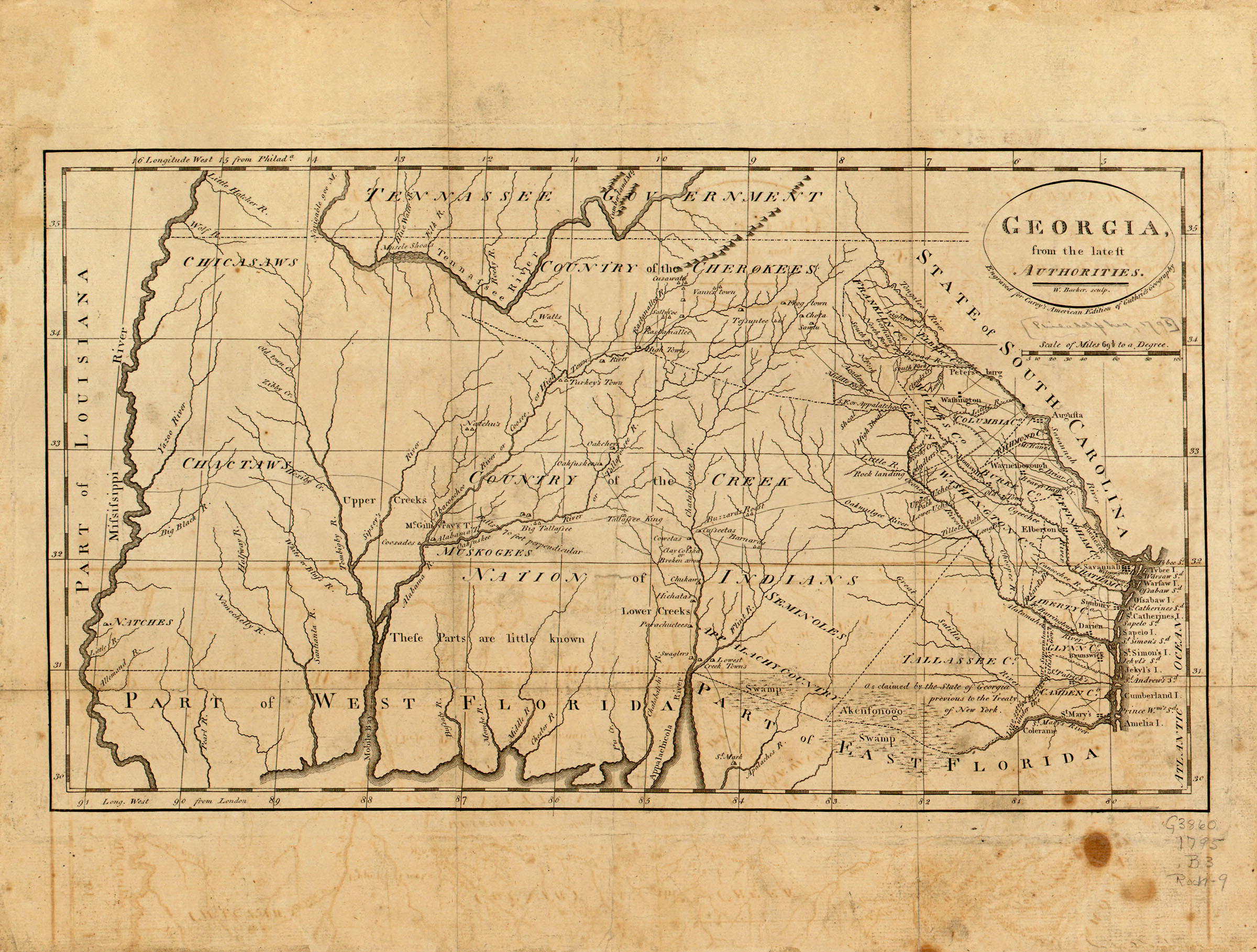
Above: a 1795 map showing Georgia extending west to Louisiana. “These Parts are little known.”
On April 7, 1985, Governor Zell Miller signed legislation recognizing the peach as the official state fruit of Georgia.
Georgia Politics, Campaigns, and Elections
Transportation Tax Bill
Senator Bill Heath (R-Bremen) has written a scathing criticism of Lt. Governor Casey Cagle.
Chicago
“We need to raise taxes,” said The Leader, a sly grin curling across his face. “We just have to, but we have to do it in a way where the regular schmucks out there won’t know it or understand it.”
His lieutenants bristled. “Sir, that’s difficult. People are paying attention to this issue. It’s the biggest issue facing our government right now. How are we going to fool the voters into thinking this isn’t the largest tax increase ever passed by our government?”
“Simple,” The Leader exclaimed, giddy at the thought of his deviousness and deception. “We’ll do this just like they did Obamacare. We’ll wait until the last minute….we’ll ram it through so no one has time to read it until it’s already passed….we’ll cut deals with the other party to buy them off.”
“But sir,” cautioned his staff attorney, “that’s not legal. The law requires a fiscal note from the State Auditor that clearly states how much this will cost taxpayers before something like this can even be considered.”
It might be the largest tax increase ever. We’re not entirely sure because in direct violation of Georgia law (OCGA 28-5-42) and in clear violation of the Senate’s own rules (Senate Rule 3-1.4) there was not a fiscal note from the State Auditor provided for this legislation telling us exactly what it will cost.
When I rose on the Senate floor and pointed out that Georgia law and the Senate’s rules clearly prohibit a vote on this legislation because of the lack of an official fiscal note, the angry Lt. Governor glared at me, said he disagreed with me, and proceeded with this farce.
In today’s Senate, the law doesn’t matter. The rules don’t matter. It’s Chicago, Georgia. The only thing that matters is robbing taxpayers and hardworking citizens to appease big donors and corporate interests.
Andria Simmons of the Atlanta Journal-Constitution writes about what the Transportation bill will and will not fund.
The Legislature passed a $1 billion transportation funding plan last week, but don’t go looking for new rail lines or some towering new interchange that will solve all the problems on I-75 and I-285. What you’ll see instead is work on a mountainous backlog of maintenance: some resurfaced roads, filled-in potholes and bridges that can support the weight they were designed to carry.
“We may be able to do other projects outside of maintenance,” said state Department of Transportation Commissioner Russell McMurry in an exclusive interview with The Atlanta Journal-Constitution. “But not like rebuilding 285 or something huge like that.”
Transportation consultants and state officials made it clear from the start of the debate over transportation funding last year that a billion dollars per year was the bare minimum needed just to bring the transportation system Georgia already has up to snuff.
To really get people moving — expanding transit, widening interstates, building new interchanges — would cost a little less than $3 billion a year, according to an HNTB study. And to pay for “the full universe of transportation needs in the state, including establishment of passenger rail systems,” would cost $4 to $5 billion per year, the study said.
HB 170 lifts the gas tax for the average driver by about 6 cents a gallon starting July 1, 2016. It also imposes a new $5-per-night fee on hotel stays, a $200 annual fee on noncommercial electric vehicles ($300 for commercial) and $50-$100 fee on heavy trucks. And it would eliminate tax breaks for Delta Air Lines and electric vehicle owners.
The bill is expected to raise about $945 million a year for transportation. Technically, the income from the hotel/motel tax or electric vehicle fee could be used to fund transit.
The bill also allows counties — either alone or in groups — to ask voters to approve up to a 1 percent sales tax to fund transportation projects close to home.
Governor Deal tweeted on April 1 that he intends to sign the transportation bill.
I look forward to signing it into law and seeing @GADeptofTrans get to work on roadways and bridges around the state.
— Governor Nathan Deal (@GovernorDeal) April 1, 2015Unintended Consequences Part One
Dade County, Georgia, which borders Alabama and Tennessee is worried that the Transportation Tax bill will cause lost fuel sales and lower local tax revenues, according to the Times-Free Press.
Dade County administrators sat in their offices, considering that gas tax change, the result of a transportation bill that passed the Georgia legislature Tuesday night. People here are worried prices will rise too high, pushing drivers like Ferguson away from their county.
Until the hike actually happens, they can only speculate.
“We’re just kind of waiting it out to see,” Commissioner Robert Goff said.
“The future is very much unknown,” added Don Townsend, the county’s chief financial officer.
Right now, the state charges a 7.5-cent excise (flat-fee) tax and a 4 percent sales tax on every gallon of gas and diesel sold. If Deal signs the transportation bill, the state sales tax will go away and the state will instead charge a flat fee: 26 cents a gallon on gasoline and 29 cents for diesel.
Add in federal tax and the 3 percent local sales tax, and a gallon of gas in Georgia will cost 8 cents more, at least at the current price of fuel. A gallon of diesel will cost 9 cents more.
For a tractor-trailer with a 150-gallon tank, that means an extra $13.50 every time its driver fills up in Dade County. Compared to the average price in Alabama, according to the American Petroleum Institute, truck drivers will spend an extra $33.40. Compared to Tennessee, an extra $40.30.
Dade County, a tiny sliver of Georgia squeezed between those two states, might become a toxic place to buy gas. Which means fewer truckers will stop there and local sales tax revenue will shrink.
Dade County officials might face a tough choice: Tax their residents more, or cut services more. They don’t want to do either one again, not after they did both last year.
Unintended Consequences, Part Two
Legislation intended to boost business in Ocilla, Georgia by relaxing rules on the distance required between a school and a store that sells alcohol might quash a hoped-for grocery store opening in downtown Athens, according to the Athens Banner-Herald.
Last year, Reps. Chuck Williams, R-Watkinsville, Spencer Frye, D-Athens, and Quick, R-Athens, worked together to make a slight change in the part of state law dealing with the distance from schools that a store must locate if it sells alcohol – as long as the local government approves. The goal was to bring a grocery chain to downtown Athens to make shopping more conveninet for University of Georgia students. Large grocery stores won’t consider a location in which alcohol sales are prohibited.
This year, two Ocilla Republicans, Sen. Tyler Harper and Rep. Jay Roberts, sought to use a similar approach to make allowances for a grocery chain wanting to bring 200 jobs and build a 20,000-square-foot, $15 million store in their hometown. That many jobs is a major development for that area.
Harper, a second-term legislator, wasn’t able to get his bill passed in the Senate. However, during the debate on it, Sen. Steve Henson, D-Tucker, expressed concern that a convenience store near a school could present a temptation for students if there were too few cashiers and store employees to prevent underage buying or straw purchases by winos on behalf of students.
Henson sponsored an amendment to change the percentage of floor space safeguard to a minimum size of 10,000 square feet. He said the added staff of a bigger store would show more vigilance against underage purchases.
During the House debate, Rep. Brett Harrell, R-Snellville, argued for accepting the Senate version before time ran out in the 2015 legislative session an hour or so later.
“I certainly don’t want to hurt downtown Athens either. It’s been a year and nothing has come forward there. I believe that we work on that later,” he said. “… We do not know the size of the grocery store that may locate in downtown Athens in the future. We know of two projects in two communities that are ready to move forward.”
Unintended Consequences, Part Three
The $5 per night hotel/motel tax has Savannah innkeepers up in arms over the Transportation Tax bill, according to WSAV-TV.
“We are happy to pay our fair share, but we’d at least like to consulted about this,” said Michael Owens, President of the Tourism Leadership Council.
Consulted about Georgia House bill 170.
Specifically the provision that adds a $5 charge to each and every hotel room, every night.
“One of our largest conventions in this town is about 5000 room nights,” explained Owens. “That’s an additional $25,000 that this group would have to come up with to stay here. What’s that $25,000? That’s displaced revenue. that’s revenue they could be spending in our restaurants, could be spending in retail shops, but they’d rather save that money and go to Charleston, go to another state that doesn’t have this tax.”
“I’ve now heard from all over the state,’ says Owens. “The Roswell CVB, the Alpharetta CVB, Atlanta.”
“I talked to two local hoteliers this morning that say they already have gotten call from prospective clients looking at being clients who said we are going to look back at Charleston again,” explains Owens.
Fulton County suing drug manufacturers
Lawyers for Fulton County government have announced their lawsuit against several major pharmaceutical manufacturers over what they say are bad business practices that lead to street availability of prescription opiates and eventually to costs to taxpayers.
The Georgia Bureau of Investigation (GBI) has reported that of the 686 drug overdose deaths in 2012, 592 (86%) were prescription drugs. The annual cost to Fulton County from the abuse of prescription drug is estimated to be millions of dollars. These costs are from expenses for Fulton County’s hospitals and health agencies, courts, social service agencies, jails and prisons, etc. according to court documents.
The complaint found in court documents alleges that Defendants violated provisions within the Georgia Controlled Substances Act and the Georgia Pharmacy Practice Act. It alleges that Defendants have, by their acts and omissions, caused and substantially contributed to damages to Fulton County by violating Georgia law, by creating conditions which contribute to the violations of Georgia laws by others, and by their negligent and/or reckless disregard of the customs, standards and practices within their own industry.
This civil action has requested that the Court issue a temporary and permanent injunction which will mandate the defendants to inform the Georgia State Board of Pharmacy of all suspicious orders for controlled substances; direct the defendants to submit their system of determining suspicious drug orders; and enjoin defendants from distributing in Georgia any controlled substance for illegitimate medical purpose. The plaintiff, Fulton County, also asks to recover costs, losses and damages; reimbursement for litigation costs; and a trial by jury.
Feds approve drone trials
The Federal Aviation Administration has approved drone trials by an insurance company seeking to speed the review of claims after natural disasters through the use of video drones.
In October 2014, USAA filed for an exemption under Section 333 of the FAA Modernization and Reform Act of 2012 to enable more efficient testing of small drones. Exempt from select FAA regulations, USAA can now fly drones, made by U.S.-based PrecisionHawk, during the day within line-of-sight of a trained pilot and air crew. Prior to the approval, USAA test flights could only take place at FAA-approved sites. No aircraft will exceed an altitude of 400 feet, and all flights will continue to be reported to the FAA prior to takeoff.
With FAA approval, USAA will work with PrecisionHawk to efficiently research and develop best practices, safety and privacy protocols and procedures as it further develops plans for operational use.
USAA also filed for an additional FAA exemption in November that will enhance USAA’s ability to use drones in catastrophes. That exemption petition is pending approval, and a decision is expected soon.
“We’re proud to be among the first insurers approved to test this technology,” Krapf said. “It’s our responsibility to explore every option to improve our members’ experience.”
National Attention for Georgia
The National Journal writes about Gwinnett County, Georgia’s most-diverse, and that it remains governed primarily by white politicians.
With its affordable housing and location along the interstate, Gwinnett County, northeast of Atlanta, became a magnet for the region’s new Latino community. Between 2000 and 2010, the county’s Latino population more than doubled, paralleling a statewide trend.
In Gwinnett County today, 20 percent of all residents are Latinos, and a majority of county residents are minorities (Asians make up 11 percent and African-Americans 26 percent). That blend makes Gwinnett the most diverse county in the Southeast. Yet it is a county almost exclusively represented by white elected and appointed officials.
[Pedro] Marin, who represents the towns of Norcross and Duluth, is one of just two Latino officials in the entire county of nearly 900,000 residents and 16 cities. The handful of other minority officials include three black legislators, one Asian state representative, a black city council member, and a black U.S. House member. That representation doesn’t come close to matching the electorate, says Jerry Gonzalez, executive director of the Georgia Association of Latino Elected Officials.
“It’s truly out of touch with reality,” Gonzalez says. “They know it’s unsustainable. We’re hoping that they’re going to change.”
The New Republic writes that Gov. Nathan Deal has led the most-comprehensive criminal justice reform in the nation.
[O]ne could reasonably argue that Georgia is doing more to reform its criminal justice system than any other state in the country—from sentencing to felon employment after release to juvenile detention.
Over the last four years, mandatory sentencing minimums have been modified, and judges’ discretion in sentencing has been expanded. The adult prison population has been given enhanced access to educational resources, including a program that enables two charter schools in the state to go into prisons to teach inmates, and those participating earn a high school diploma instead of a GED. (Studies suggest that some recipients of a GED tend not to fare any better in employment prospects than high school dropouts do.)
“Our staff have been contacted by staff in other states wanting to know what we’re doing and if they can use it in their states,” Deal told me recently during a phone interview.
States are often called laboratories of democracy, and Deal was determined to experiment with criminal justice reform in what he calls “the laboratory of Georgia” by combining a number of policy and reform initiatives simultaneously. When I asked Deal if the Special Council looked to any other states for models, he said there weren’t any previous models. “We knew Texas had made some reforms, but this was of our own initiative,” he told me. “What will it take and how can we make it work?”
“Because it has had a disproportionately high incarceration rate, because it’s in the South, because it’s Republican,” Holcomb said, “people aren’t expecting criminal justice reform to come out of states with those characteristics.” But Georgia has indeed become what she calls “a leader state.” Reddy agrees. “Georgia, in some ways, had no where to go but up,” he said, “[but] they did do some noteworthy, impressive things that other states that are in a better situation could learn from.”
Jackson was unequivocal in her praise of Georgia’s reforms, which she called particularly innovative. “In terms of the national political context,” she said, “federal elected officials and legislators in other states should be looking to places like Georgia as examples and test cases that prove we can safely and smartly reduce incarceration.” Deal couldn’t agree more. “We certainly don’t have a corner on the market,” he told me. In the meantime, he says that Georgia will “continue to flesh out [the] reforms already in place,” and cited sentencing reform and expanding in the juvenile arena as top priorities.
Governor Nathan Deal’s speech to the Bipartisan Summit on Criminal Justice Reform, which lead to the New Republic article, is available on Youtube.
Along with a talk by former Speaker and Georgia Congressman Newt Gingrich.
And a remote appearance by Georgia Congressman Doug Collins (R-Gainesville), discussing accountability courts in Hall County and across Georgia.
Gary Martin Hays has an interview with Governor Deal that ranges from his religious upbringing, to religious freedom, to criminal justice reform.
State Attention for Milledgeville
Attorney General Sam Olens’s office has recommended remedial Open Meetings training and a $2500 fine for Milledgeville City Council after allegations that the Council violated the Act.
In a document sent to the city, the state accuses the council of holding an illegal meeting featuring a quorum of council members on March 3, 2014, after the regularly scheduled meeting had been adjourned.
According to the memorandum of understanding issued by the attorney general’s office, the council members “continued to discuss city business, and the public and press were not privy to this discussion.”
The document is a draft and has been sent to the council for its consideration, said Lauren Kane, a spokeswoman for the attorney general’s office. The council could vote to approve or reject the memorandum or ask the city attorney to propose changes to the document.
Coincidentally, Milledgeville is one of 16 locations that have expressed interest in hosting a Presidential debate in 2016.
Stockbridge challenges Snellville for craziest politics
We’ve noted before the increasing craziness at Stockbridge City Council meetings, now the Atlanta Journal-Kardashian brings a recap of recent events.
Flying water bottles. Temper tantrums. Vengeful ex-lovers.
In the latest installment of this long-running soap opera, the city council requested that the mayor undergo anger management counseling after he allegedly threatened to beat up the mayor pro tem.
“It’s The Jerry Springer show down here,” said local blogger and historian Mike Moon, who suggested yanking Stockbridge’s city charter. “You go to the meetings to see who’s gonna be fighting next. If they’re not going to stop fighting and bickering, they’re going to have to stop it, clean house and start over. I wish the legislature would step in, pull the charter and start over and make it into a viable community.”
Campaign and Elections
Early and Advance voting continues this week in the April 14, 2015 Augusta Commission Special Runoff Election between Hap Harris and Sean Frantom.
Registered District 7 voters can cast early ballots for any reason and can vote even if they skipped the special election.
Advance voting will be held Monday through April 10 from 8:30 a.m. to 5 p.m. weekdays, at the elections office.
Paper absentee ballots can be obtained by writing to the elections office at 535 Telfair St. Suite 500, Augusta, GA 30901; e-mailing richmondelections@augustaga.gov; or faxing a request to (706) 821-2814.
Click here for more voting information.
Snellville City Council member and Mayor Pro Tem Tom Witts announced he will run for Mayor in November 2015.
“I am excited today to put myself forward as a candidate for Mayor. I am running because I believe in Snellville—all that we are and all that we can be. When I first ran for office in 2009 I said I was committed to making sure Snellville is a place where everybody is proud to be somebody. We have done that, and now more than ever, I am determined to keep it that way,” said Witts in his announcement.
“Over the last 5 years, I have worked hard to make our city even better, and we have seen a lot of success. We have renewed a sense of community with events like the Farmers’ Market and the community events on the green. We have attracted dozens of new businesses and jobs, lowered property taxes for the last four years, and we completed the Veteran’s Memorial, a project that is closest to my heart. But there is more work to be done. I will bring the same amount of enthusiasm and determination to the Towne Center project that I did to complete the Memorial if I am fortunate enough to become the next Mayor of Snellville. This will continue to build our sense of community, attract business and keep our taxes low.”
Unsaid is that the current Mayor of Snellville Kelly Kautz seems at times like 20 pounds of crazy in a five pound sack. That’s just my personal opinion, of course.
Related Posts
 Georgia Politics, Campaigns, and Elections for November 6, 2020
 Georgia College Republicans help Mark Sanford win in SC
 The Marietta Daily Journal – ‘Countering the Common Core’ coming to Cobb
 Jack Kingston on InsiderAdvantage: Preventing Default Means Protecting Our Future
 Adoptable (Official) Georgia Dogs for September 22, 2021


Comments ( 0 )