
German scientist Johannes Kepler dated the creation of the universe to April 27, 4977 BC(E).
James Oglethorpe won reelection to the British Parliament while in America on April 25, 1734.
On April 27, 1773, the British Parliament enacted the Tea Act, granting a monopoly on selling tea to the American colonies.
The Library of Congress was founded on April 24, 1800 and is the largest library in the world today.
Richard B. Russell, Sr. was born on April 27, 1861 near Marietta, Georgia. Russell served in the Georgia House of Representatives, on the Georgia Court of Appeals and Supreme Court, and ran for Governor, Congress, and United States Senate. His son, Richard B. Russell, Jr. served in the Georgia State House, including a stint as Speaker, as Governor of Georgia, and in the United States Senate.
On April 26, 1866, the Atlanta Ladies’ Memorial Association held a Confederate memorial observance at Oakland Cemetery for the first time.
In 1874, the Georgia General Assembly passed legislation designating April 26th of each year as “Confederate Memorial Day,” choosing the day of Confederate General Joseph E. Johnston’s surrender to Union General William T. Sherman at Durham Station, North Carolina. There is no longer a statutorily-recognized Confederate Memorial Day, but it became custom for Governors to issue a proclamation yearly designating April 26th as Confederate Memorial Day or to make it the Monday or Friday closest to the 26th.
The United States declared war on Spain on April 25, 1898.
On April 26, 1913, 13-year old Mary Phagan was found dead, having been sexually assaulted, in the basement of a pencil factory in Atlanta. Guilt was pinned on the Jewish owner of the factory, Leo Frank. Frank was convicted, but later his sentence was commuted after Governor John Slaton concluded from his own investigation that Frank had been framed. Frank was later hanged by a lynch mob.
Jack Kingston was born on April 24, 1955. He was elected to the Georgia House of Representatives in 1984 and served four terms and in 1992 was elected to the United States Congress.
“Georgia On My Mind” became the official state song on April 24, 1979, when Governor George Busbee signed legislation designating it.
On April 24, 1980, an attempt to rescue 52 Americans held hostage in Iran failed.
With the Iran Hostage Crisis stretching into its sixth month and all diplomatic appeals to the Iranian government ending in failure, President Jimmy Carter ordered the military mission as a last ditch attempt to save the hostages. During the operation, three of eight helicopters failed, crippling the crucial airborne plans. The mission was then canceled at the staging area in Iran, but during the withdrawal one of the retreating helicopters collided with one of six C-130 transport planes, killing eight service members and injuring five. The next day, a somber Jimmy Carter gave a press conference in which he took full responsibility for the tragedy. The hostages were not released for another 270 days.
IBM introduced the Personal Computer Model 5150 on April 24, 1981, though some authorities date the introduction to April 12. It sported an Intel 8088 processor at 4.77 Mhz, a whopping 16k of RAM, which was expandable to 256k, and a clicky keyboard. The initial price tag was $1565, equivalent to more than $4000 today.
On April 24, 1982, Jane Fonda released her first workout video.
On April 26, 1986, the world’s worst nuclear accident occurred at Chernobyl in the Soviet Union.
Thirty-two people died and dozens more suffered radiation burns in the opening days of the crisis, but only after Swedish authorities reported the fallout did Soviet authorities reluctantly admit that an accident had occurred.
On April 27, Soviet authorities began an evacuation of the 30,000 inhabitants of Pripyat. A cover-up was attempted, but on April 28 Swedish radiation monitoring stations, more than 800 miles to the northwest of Chernobyl, reported radiation levels 40 percent higher than normal. Later that day, the Soviet news agency acknowledged that a major nuclear accident had occurred at Chernobyl.
On April 25, 1996, Georgia Governor Zell Miller signed Senate Bill 519 designating English the official language of Georgia.
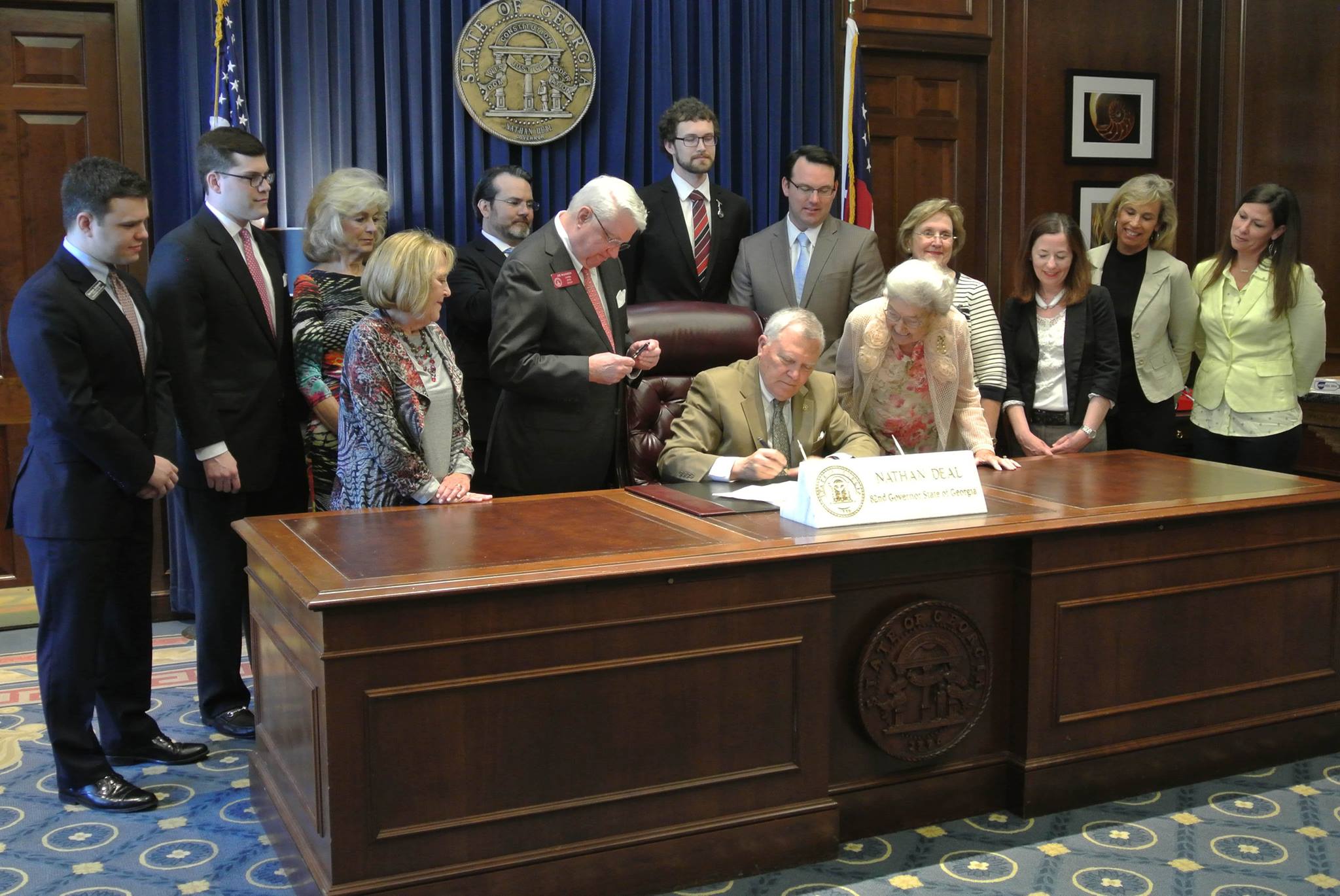
On April 26, 2016, Governor Nathan Deal signed legislation designating “the Adoptable Dog” as the Official State Dog of Georgia.
Georgia Politics, Campaigns, and Elections
Georgia Insurance and Safety Fire Commissioner John King said he expects insurance rates to begin dropping after Governor Kemp signed tort reform, according to Atlanta News First via WALB.
“So much political capital was spent on getting tort reform,” Georgia Insurance and Safety Fire Commissioner John King told Atlanta News First Investigates. “They better not come to our office and ask a ridiculous rate increase.”
Not only does King expect insurers to not increase rates, he expects them to file for decreases, and soon.
“I expect reasonably 3 to 5% decrease in rates in Georgia this year,” he said.
The new laws (SB68 and SB69) are now in effect after Georgia Gov. Brian Kemp signed the reform bills Monday.
The changes are supposed to curb multi-million dollar insurance payouts for lawsuits against businesses that did not take enough precaution to prevent a crime or injury from happening.
Ultimately, the laws are supposed to lower costs for consumers, but state lawmakers who opposed the changes are concerned the laws don’t hold insurance carriers accountable.
“Nothing in this bill will address car accident insurance premiums; it won’t address homeowner premiums; it won’t address business premiums,” said state Rep. Tanya Miller, D-Atlanta.
King said the new laws may not require carriers to lower premiums, but they “eliminated the excuses” for insurance companies.
“Abuses in the civil justice system were their biggest reason why rates were so high,” he said. “Now we expect them to meet us in the middle.”
In Georgia, the insurance commissioner can’t reject rate increases altogether, but he can limit them.
King vows his office will take a hard look at rate requests, look closely at any loss claims, and hold public hearings if necessary.
Experts at the Insurance Information Institute (III) aren’t so optimistic about rates dropping in any time soon. Spokesperson Mark Friedlander said it will likely take 12 to 18 months for lawsuits previously filed to go through the courts, and even then there may be more national challenges.
“Positive impacts of tort reform could be overridden by the negative impacts of tariffs on auto and property insurance,” Friedlander said. “This will generate higher costs of manufacturing new vehicles, replacement parts for auto repairs, and construction costs for homes and businesses, leading to increased auto, home and business premiums in Georgia and across the U.S.”
King said insurance companies must have a “reasonable rate” so they can make a “reasonable profit,” but he will not allow gouging.
In its previous investigations, Atlanta News First Investigates spoke with an Atlanta apartment owner who was struggling to keep rent affordable for residents with rising insurance costs for the coverage he can acquire.
“Our premiums went up tremendously, but the big deal that we can’t get here – which we haven’t been able to get for months – is assault and battery coverage,” said Avi Wolfe, co-owner of 445 Cleveland.
King said he can’t force insurers to offer certain coverages, but he’s willing to incentivize competitors if they don’t.
“What I’m doing is recruiting insurance companies, small and medium insurance companies that are willing to compete against these big carriers that don’t want to go into this area,” he said.
King plans to ask Georgia lawmakers for more authority on fining insurance companies next legislative session.
Right now, Georgia code allows the insurance commissioner to fine companies up to $5,000 per offense, but King said that’s not enough to detour a company from violations.
Governor Brian Kemp announced two new appointments. The Georgia Department of Driver Services (DDS) Board of Directors voted to approve the appointment of Angelique McClendon as Commissioner of DDS, according to a press release.
Governor Brian P. Kemp today announced that the Georgia Department of Driver Services (DDS) Board of Directors has approved Angelique McClendon as the Commissioner of DDS, effective May 1. McClendon has been serving the department as General Counsel and Assistant Deputy Commissioner of Legal and Regulatory Affairs, where she has been a subject matter expert on all legal and regulatory issues relating to the agency’s statutory responsibilities. She will succeed Spencer Moore, who has dedicated over 30 years of service to the people of our state.
“On behalf of hardworking Georgians, I want to congratulate Angelique McClendon on her promotion to Commissioner of the Department of Driver Services,” said Governor Brian Kemp. “With an extensive career serving both DDS and the people of our state, I know she will be a great asset in ensuring that those who interact with one of our most prominent state agencies have an efficient and smooth experience.”
“Marty, the girls, and I also want to thank Spencer Moore for his many years of service to our state,” continued Governor Kemp. “His efforts as DDS Commissioner have helped grow our nationally-ranked logistics network, put state government’s best foot forward when serving the hardworking people of Georgia, and modernize operations at an agency that directly interacts with citizens in every community of our state.”
Angelique McClendon will become Commissioner of the Georgia Department of Driver Services (DDS) on May 1, 2025. She first joined DDS as General Counsel in 2015 and was later promoted to Assistant Deputy Commissioner of Legal and Regulatory Affairs. Her legal career began in 2005 as an Assistant Solicitor in DeKalb County. From 2008 to 2015, McClendon served as an Assistant Attorney General for the State of Georgia. McClendon has provided legal guidance on several large-scale state initiatives and modernization efforts, including Georgia’s Digital Driver’s License. She has served in leadership roles with the American Association of Motor Vehicle Administrators, where she helped create national policy and track trends related to driver’s license administration and identity management.
McClendon is a proud mother of two, a native of Decatur, and a Rockdale County resident. She graduated from Xavier University of Louisiana with a Bachelor of Science in Chemistry and earned her Juris Doctorate from Georgia State University College of Law.
Governor Kemp also announced the appointment of Inez Grant as Hall County Solicitor General, according to a Press Release.
Governor Brian P. Kemp today announced the appointment of Inez Grant as the Solicitor General of Hall County, filling the vacancy created by the resignation of Stephanie Woodard.
Inez Grant has served the Hall County area since becoming a member of the State Bar of Georgia in 1992. She began her legal career as a front-line prosecutor in the Hall County Solicitor General’s Office, where she helped establish Hall County’s Domestic Violence Taskforce. Grant eventually rose to chief assistant under former Solicitor General Jerry Rylee before going on to serve for several years as chief assistant Solicitor General in Forsyth County. Grant practiced both felony and misdemeanor prosecution for 17 years before leaving her beloved line of work for family reasons. Since leaving full-time prosecution, Grant has managed a successful private practice in Hall County focusing on domestic litigation, criminal defense, immigration law, Guardian Ad Litem work, and Juvenile Court matters. In addition, Grant serves as the Solicitor for the City Court of Gainesville and City of Oakwood.
Grant graduated from Brenau University before obtaining her law degree from Atlanta’s John Marshall Law School. When not in court, she enjoys spending time with her family and her beautiful granddaughters. Grant coached high school mock trial teams and was recognized by the State Bar for her work with the Unauthorized Practice of Law Committee. She also currently sits on Brenau University’s Conflict Resolution and Legal Studies Advisory Board.
“I’m very excited and really thrilled to be able to do this and serve Hall County in this manner,” Grant said.
Grant started her career with the Hall County Solicitor General’s office, where she helped establish the domestic violence taskforce.
Grant served under former Solicitor General Jerry Rylee before serving as assistant Solicitor General in Forsyth County. She practiced felony and misdemeanor prosecution for 17 years before leaving for family reasons and started a private practice in Hall County.
“I think it’s given me a very, very well-rounded approach to looking at the people who come through our court, and I think it’s going to benefit all of Hall County,” Grant said.
When asked if she would clear house in light of former Solicitor General Stephanie Woodard’s resignation last August amid a criminal and civil trial, she said she had no intention of doing so.
“I have no intention of clearing house,” Grant said. “That office is a very big office, and it works all day long. You can’t just go in and fire everybody, I would never do that anyway.”
Woodard was charged with 13 counts of false statements and 11 counts of theft by taking that were dropped in a plea deal for one count of unprofessional conduct and an immediate resignation.
“I think Miss Woodard did a really good job for a long time in that office,” Grant said. “I think things just got too busy, and things were delegated that probably were not monitored as closely as they should have been.”
Grant said she will take a hands-on approach to running the office.
“I’m a very, very hands-on person so I will be very involved in day-to-day operations of the office,” Grant said. “I have some very trusted people around me that I can rely on.”
“I’m just very much looking forward to serving Hall County,” Grant said. “I’ve lived here for a long time, and I’ve been a member of the community for a long time and I’m really thrilled to be able to give back to the community in this way.”
Grant will be sworn in on May 15 and will begin work on May 16.
State Senator Bill Cowsert (R-Athens) kicked off his campaign for Attorney General. From the Capitol Beat News Service via the Savannah Morning News:
A second candidate has raised his hand to become Georgia’s next attorney general, as incumbent Chris Carr campaigns for the governor’s office.
Both of the candidates who have filed paperwork to raise funds to campaign for attorney general are Republican state senators.
Sen. Brian Strickland, R-McDonough, a lawyer who chairs the Senate Judiciary Committee, registered with the Georgia Ethics Commissions’ campaign finance system in late March. Sen. Bill Cowsert, R-Athens, a lawyer who chairs the Senate Regulated Industries and Utilities Committee, registered Wednesday.
Neither reported collecting any money yet.
Strickland, who chaired a study committee on the affordability of child care last year, was the chief co-sponsor of legislation that sought tax credits for parents of young children. The legislation did not pass. Lawmakers instead sent a general tax credit of between $250 and $500 to Gov. Brian Kemp, who signed that measure last week.
Cowsert, who chairs a committee that has been investigating Fulton County District Attorney Fani Willis, was recently granted authority by the Senate to expand his scope to include groups founded by former gubernatorial candidate Stacey Abrams. Cowsert also sponsored Senate Bill 255, which seeks to give his committee subpoena powers. It passed the Senate and the House of Representatives after bitter partisan debate, with one leading Democrat labeling it “authoritarianism.” It awaits Kemp’s signature.
Democrat Stacey Abrams has not announced whether she will run for Governor in 2026, according to the AJC.
Now Trump is in his second term, Republicans are ascendant again in Georgia and Abrams is at the center of speculation over whether she will mount a third campaign for governor after back-to-back defeats to Gov. Brian Kemp.
Unlike her 2022 rematch against Kemp, however, Georgia Democrats aren’t stepping aside. State Sen. Jason Esteves entered the race earlier this week and former Atlanta Mayor Keisha Lance Bottoms is expected to follow. Others could join, too.
And unlike her last run, long an open secret, Abrams and her deputies are staying silent about her plans. Most insiders doubt she’ll run again, but she has not ruled it out. Republicans are openly goading her to take the plunge.
Much has changed for Abrams since her 2022 defeat to Kemp. Once the unquestioned leader of state Democrats, U.S. Sens. Jon Ossoff and Raphael Warnock — along with other rising figures — have taken the party’s mantle. And much of the infrastructure she built has eroded.
Her sky-high name recognition, robust fundraising network and national prominence would make her a de facto front-runner against almost any primary opponent in a vote dominated by Black Democrats. She still commands headlines and cable news airtime with ease.
Still, inside the Democratic Party, Abrams remains a force. Jason Carter, the party’s 2014 gubernatorial nominee, noted Abrams remains popular with Democratic voters in Georgia and the out-of-state donors who increasingly power Georgia campaigns.
“The question is how durable is her popularity among that rank-and-file at this point?” said Carter, who this week decided not to join the race. “Can she match this moment better than she matched the moment the other two times?”
United States District Court Judge Victoria Marie Calvert (ND-GA) heard arguments in a lawsuit over the Trump Administration’s immigration policies, according to the Capitol Beat News Service via the Augusta Chronicle.
A federal judge in Atlanta said she will decide by month’s end whether the government must extend the visitor status of 133 current and former college students who were suddenly revoked for no apparent reason.
Judge Victoria Marie Calvert heard oral arguments Thursday in the case involving at least 26 foreign nationals attending a Georgia college or university or doing post-graduate work. Another 106 are in other states, but the students’ lawyers argue their cases should be bundled together in the U.S. District Court for the Northern District of Georgia to reduce the workload on the court.
It’s a core issue that Calvert must consider before she decides on the preliminary junction sought by the students. Calvert already issued a temporary restraining order against the federal government on Friday, ordering that the students’ visitor status be restored.
But her order expires May 1, and a preliminary injunction would secure the students’ status under the Student and Exchange Visitor Program until the trial concludes.
Their lawyer, Charles Kuck, argued that the U.S. Department of Homeland Security failed to follow its own rules when it revoked his clients’ visitor status without providing a reason.
Assistant U.S. Attorney R. David Powell argued that a preliminary injunction could allow the international visitors to stay past the original expiration dates of their visitor status. He asked that any preliminary injunction be tailored to each plaintiff’s expiration date.
The case may be the largest of its kind in the country, but numerous others have been filed, including two class action lawsuits, one in Washington and another in New Hampshire.
On Wednesday, Judge Leigh Martin May, who serves in the same courthouse as Calvert, denied a temporary restraining order sought by three foreign students whose visitor status had been revoked.
But Kuck said the trend favors students. He said judges nationwide have issued 17 temporary restraining orders in similar cases.
Powell acknowledged the impact, saying U.S. Immigration and Customs Enforcement has been busy restoring students’ status.
“More orders are coming out every week and every day,” he said. “Sometimes multiple per day.”
Kuck said after the hearing that he hopes the government backs down, but he said he doubts President Donald Trump will allow that to happen. He said he is prepared for a fight that could go on for “a long time.”
The immigration attorney said his office has been bombarded with calls and emails from nearly 700 students nationwide whose visitor status has been revoked.
“We’re going to file a class action (lawsuit),” he said. “This is a disaster.”
Georgia’s Secretary of State discussed elections and immigration, according to WSAV.
Raffensperger recently wrote a letter to U.S. Secretary of State Kristi Noem asking that the Trump Administration hear the asylum claims of Afghan Christian refugees currently residing in the United States prior to sending them back to Afghanistan, where Christians face persecution and even execution by the Taliban.
He then discussed the Trump administration’s current immigration laws and the state’s voting laws.
Raffensperger called for DHS Secretary Kristi Noem to pause her recent decision revoking temporary deportation protections of Afghans who fled to the United States, many of whom assisted the U.S. during its 20-year war.
“Afghanistan under the Taliban remains one of the most dangerous places in the world for Christians,” Raffensperger wrote. “Afghan Christians face targeted violence, state-sponsored persecution, and near-certain execution under Taliban interpretations of Sharia law.”
The vast majority of Afghan refugees are Muslims.
Raffensperger urged the federal government to wait at least 90 days before revoking the parole status of Afghan Christian refugees, to hear their asylum claims and to consider granting temporary protected status to those refugees.
Election security improvements are on hold after the legislative session failed to produce new laws, according to the AJC.
Despite lawmakers’ promise — written into state law — to eliminate ballot QR codes, they didn’t appropriate any money to get it done. QR codes contain voters’ choices on ballots but aren’t readable by the human eye.
Nor did lawmakers fund an upgrade to Georgia’s touchscreen voting machines that would have patched vulnerabilities in time for the midterms.
And a proposal to switch to paper ballots filled out by hand will have to wait at least until next year — and likely longer.
Adding to the legislative inaction, a federal judge dismissed a major election security case a few days before the end of the legislative session. In her decision, the judge noted “substantial concerns” but dismissed the case after deciding the plaintiffs couldn’t prove they had been injured by the government’s actions. The decision is being appealed.
Georgia voters are left with the same Dominion voting equipment purchased in 2019 for $107 million, with little chance of modifications before next year’s midterms. The system relies on touchscreens attached to printers that create a paper ballot with a QR code that is then read and counted by scanning machines.
Secretary of State Brad Raffensperger said the proposed upgrades — with an estimated taxpayer cost of $66 million to remove QR codes — aren’t necessary.
“We’ve shown that our system is secure and accurate. In fact, in the last election we just had, we did a 100% retally of the human-readable text and there were zero errors with the machines,” Raffensperger said. “We have voter ID for all forms of voting. We have virtually no lines. People can trust the system.”
This was the first year the General Assembly hasn’t changed election laws since President Donald Trump narrowly lost the 2020 election — and then loudly complained that the election was stolen, an assertion that has been repeatedly debunked.
The General Assembly’s failure to pay for election tech upgrades creates the potential for a crisis next year.
Under a state law passed last year, QR codes must be removed from ballots by July 1, 2026. But without funding to buy 33,000 new ballot printers across the state, there’s no way to pay for the upgrade.
Lawmakers were unwilling to spend tens of millions on a voting system they plan to replace in the coming years.
“There’s this train wreck coming, and we’ve got to figure out how to deal with it,” said House Governmental Affairs Chairman Victor Anderson, a Republican from Cornelia. “Everybody I’ve talked to is aware of the pending problem — but nobody is coming up with a solution.”
Segregation-era signs displayed in a Rockdale County elementary school drew complaints, according to the Ledger-Enquirer.
Signs reading “For Whites Only” and “For Colored Only” were reportedly posted in a cafeteria and above water fountains at Honey Creek Elementary School in Conyers, parents told WSB-TV.
School leaders explained the signs were part of an unapproved social studies activity, but it did little to quell public scrutiny, WXIA reported.
Parents voiced their concerns at a recent Rockdale County School Board meeting, prompting district leaders to take a closer look at the incident, the station reported.
In a statement, Rockdale County Public Schools said it has taken “appropriate action to address the reported information” but declined to comment on the matter further, according to WANF.
Principal Adriene Lanier addressed the incident in a letter to parents on April 23, saying it involved a social studies lesson on civil rights activist Ruby Bridges, WSB-TV reported.
Bridges was the first Black child to desegregate William Frantz Elementary School in Louisiana in 1960.
Macon-Bibb County Mayor Lester Miller addressed concerns raised about conditions in their jails, according to the Macon Telegraph.
Macon Mayor Lester Miller addressed the need to fix unsafe and unsanitary jail conditions after a number of incarcerated people were injured or died in separate recent incidents at the Bibb County Law Enforcement Center, prompting heightened attention on the jail.
Upgrades would improve safety for inmates and staff, but several financial and legal factors are at play, Miller said.
A new jail is estimated to cost around $250 million to $400 million, Miller said on Facebook Thursday afternoon in a “long informational post,” as he put it.
Since the 2025 Special Purpose Local Option Sales Tax was passed, the county began working on a quote for a new or refurbished jail, Miller said.
He listed several issues the city must consider before its decision on a new or refurbished jail. These include assessing the current facility’s age, structure, inmate population and capacity, maintenance, legal standards and regulations, technology capabilities, security and safety.
While he supported better jail conditions, he said more effort should go toward alternative rehabilitation and recovery options.
“Consider community-based alternatives and how they might affect the need for additional capacity,” Miller said. “I have previously proposed a work program that would allow inmates to be released for work.”
The Georgia Department of Natural Resources Board approved a new schedule for commercial oyster farmers, according to The Brunswick News.
The new regulation establishes strict time and temperature controls for certified Master Harvesters to harvest oysters when the weather is warm and when harmful bacteria are most active.
“This rule is a major step forward for Georgia’s shellfish industry,” said Doug Haymans, director of the Coastal Resources Division (CRD) of the Georgia Department of Natural Resources, which regulates the state’s shellfish industry. “It balances economic opportunity with rigorous public health protections and helps lay the groundwork for year-round oyster farming in Georgia.”
Georgia’s burgeoning commercial shellfish industry was created in 2019 with the passage of House Bill 501, which allowed the DNR Board to establish rules for mariculture to manage how farmers can grow shellfish sustainably in a single-shell, restaurant quality form as opposed to the naturally occurring clumps.
Georgia currently supports 21 permitted shellfish harvest areas, including nine subtidal zones dedicated to floating oyster farms, a method increasingly used in the state’s mariculture operations. One of those designated harvesting areas is in Jointer Creek, southwest of the Downing Musgrove Causeway.
Oysters are normally harvested during the colder months when bacteria like vibrio vulnificus and vibrio parahaemolyticus are less active.
The new rules allow people who are Master Harvesters to continue harvesting in warmer months if they submit CRD approved operations plans and methods, cold-chain procedures, use properly trained personnel and maintain proper record-keeping. Only oysters that have remained submerged for at least 14 consecutive days prior to harvest may be collected and all harvesters must use proper icing or mechanical refrigeration methods to ensure the oysters stay cool enough to remain safe, information provided by the CRD said.
The rule also gives the CRD authority to immediately suspend harvest in the event of a confirmed outbreak of shellfish-related illnesses.
Glynn County will increase their hotel-motel tax, according to The Brunswick News.
An estimated 3 million visitors a year spending time here. They come for the beaches, parks, golf courses, water parks, restaurants, resorts and other tourism-related businesses. Many return, and they are willing to pay for a memorable stay.
The bed or accommodations tax will increase by 2%, the amount approved by the General Assembly through local legislation this past session. The new rate will be 7%.
Scott McQuade, president and CEO of the Golden Isles Convention and Visitors Bureau, said the additional money will generate an extral $1.3 million for the county’s general fund and about $2.2 million for tourism product development funds, funds set aside for tourism infrastructure projects.
“The 2% increase will represent an estimated $4.6 million in additional tax collections based off of 2024 lodging revenues,” McQuade said.
The CVB will receive an additional $1.2 million which will be primarily used for marketing purposes, he said.
The increase was a collaboration between the lodging industry, the CVB, and the county, McQuade said. The tourism product development fund projects can be used for a wide variety of tourism-related improvement projects yet to be determined.
“A committee will be formed between the CVB and the county to decide what are the most vital projects that can improve our tourism infrastructure,” he said.
County Commission Chairman Walter Rafolski said the tourism product development funds can be used for parks, marinas, wayfinding signage, pier repairs and other tourism-related uses. The good news, he said, is it’s a tax that is not paid by local taxpayers.
“It’s the tourists paying it,” he said.
People staying in RV parks and in short-term rentals less than 30 days have to pay the bed tax. But those staying longer will only have to pay the tax the first 30 days, which addresses concerns by owners of the parks and short-term rentals with tenants planning to stay in the Golden Isles for longer periods of time, Rafolski said.
Tifton City Council continues to receive complaints about the mosquito program they adopted, according to the Tifton Gazette.
Hoping to voice their continued concern over the city’s contract with Astro Exterminating, which has enlisted the exterminator to conduct monthly sprays in an effort to curtail the mosquito population, several members of the community took to the stand during the public hearing period of the April 21 city council meeting.
Council members had approved the program in a 3-2 split during their March meeting, having discussed the topic since early February and receiving protest primarily from Michelle Powers, a resident concerned about the potentially hazardous effects of the chemical sprays Astro planned on using, throughout the entire multi-month debate.
Mayor Julie Smith noted that, as the council had already come to a decision on the matter, they could only reconsider their vote after one of the initial council members who had voted to approve the ordinance made a motion to reconsider. As she was unable to make a motion as per the city charter and council members Joshua Reynolds and Lester Cromer had voted in opposition, only councilmen M. Jay Hall and Michael Franks could put forward this proposal.
City attorney Rob Wilmot recommended that the city wait to discuss the item further at their next workshop meeting, but noted they could refuse to move forward with a reconsideration. In that event, Powers or any other resident would have the option to draft a petition to request the policy revision, needing 20% of the city’s registered voters in support to have it carried.
South Fulton Mayor khalid kamau will not run for reelection, according to the AJC.
South Fulton Mayor khalid kamau, who has faced harsh criticism over his spending and his international travel on the taxpayer dime, announced he will not seek reelection in November and is “scaling back” his public schedule.
Reversing his previously stated plan to run for a second term as mayor, kamau (who does not capitalize his names) announced this week that the annual “State of the City” event on May 1 will be his “farewell address.”
At Wednesday’s City Council meeting, kamau discussed how little he gets paid despite the many demands of the job. His annual city salary is about $47,000.
He said he has “been on food stamps” and turned down job offers so he could make being mayor his only priority.
“To do all of this for over 100,000 people, I am paid about $40,000 per year, about $20 an hour, the salary of a parks groundskeeper or sales associate at Target,” kamau said.
Warner Robins Police hosted a community meeting to hear how they can work better with neurodivergent people, according to 13WMAZ.
Nearly 50 people gathered at the Warner Robins Law Enforcement Center Thursday night for a town hall meeting focused on improving trust between police and the neurodivergent community.
The term neurodivergent refers to individuals with conditions such as autism spectrum disorder and attention deficit disorder.
Police Chief Wayne Fisher led the event, offering safety tips and opening the floor for questions. He said the goal is to better understand the community’s needs and tailor police resources accordingly.
“All of this is for us to figure out what resources are here and again, find out what parameters they meet or fit into,” Fisher said.
One resource now available comes from Houston County’s 911 center. The agency created a voluntary form that allows families of autistic individuals to submit specific information, such as calming methods, known triggers, and the individual’s home address. That information is then entered into the emergency response system.
“We want to try and get the situation stabilized to the point so those that provide proper care can come in,” Fisher said.
According to the Centers for Disease Control and Prevention, 1 in 36 children in the United States is now diagnosed with autism. Patterson said that growing statistic makes conversations like these essential.
“We’re not really together in the sense of what is autism,” Patterson said. “We see the signs, we see the deaf child, we see all that everywhere, but people don’t really understand the difference between low-functioning, profound autism and high-functioning autism.”
This might be a useful exercise for other law enforcement agencies, and I hope they will consider people with dementia among the neurodivergent who might have special needs.
Pooler City Council heard a proposal to create a downtown development authority, according to the Savannah Morning News.
Earlier this month, the Pooler Development Authority launched a grant program for businesses, aimed at improving the façades on Pooler’s Main Street Corridor. This program was one of the first steps toward making the Pooler Main Street Master Plan, which was passed in December 2023, come to life.
Before the regular Pooler City Council meeting Monday night, five members of council discussed the creation of a downtown development authority at a workshop. Mayor Karen Williams and Councilmember Shannon Valim were not in attendance for this part of the meeting, and no vote was taken, only a discussion was held.
A Downtown Development Authority is a public entity created by a city government under state law, and is focused on revitalizing a downtown area. DDA’s have the power to acquire property, enter into contracts, issue bonds, as well as partner with public and private entities. The difference between a DDA and a Development Authority is that DAs have broader economic development focus, while DDAs have designated boundaries.
During the workshop, City Manager Heath Lloyd presented three main reasons why Pooler needed a DDA: to support implementation of the 2023 Main Street Master Plan, provide structures and tools for reinvestment, attract businesses, enhance walkability, and improve public spaces.
After the presentation, a few councilmembers expressed some concern. Councilmember Michae’l Carpenter was concerned about the potential timeline. If council decided to move forward with establishing the authority, the item would appear on the next city council agenda on May 5, and the city would have to adopt the resolution needed to create the DDA as well as the bylaws, which council already has draft copies of.
At that same meeting, council would have to determine who would represent the DDA from city council. Within 30 days of the resolution’s passage, June 4, the city would have to hire an executive director. By July 7, 60 days after approving the resolution, the authority’s board would have to be appointed, and by August 4, a work plan would have to be presented to council.
Chatham County District Attorney Shalena Cook Jones’s office is hosting gun safety and self defense courses, according to WTOC.
As part of Chatham County District Attorney Shalena Cook Jones’ Survivors Series there will be a gun safety course for local citizens at the Eckburg Auditorium at Savannah Tech on April 24 from 6-8 p.m.
There will also be a self defense course at the same place on April 30 from 6-8 p.m.
The DA’s office says according to FBI data, gun ownership is the most diverse it has ever been with more than a million guns sold every month across the country. Experts say Black women are the fastest growing group of gun owners.
The Savannah Chatham County Public School System will offer online counseling services to students, according to WTOC.
Now, the Savannah Chatham County Public School System has partnered with Hazel Health to provide students with free virtual counseling services to help boost those numbers locally.
“Just as you would maintain your physical health, we want to make sure that we’re helping students to maintain their mental health,” said Kimberly McGuire, SCCPSS’s Executive Director of Student Support Services.
The school system’s Wellness Center already offers free in-person counseling services, but McGuire said that doesn’t work for everyone.
“Just the parents getting them here in the afternoons may be a bit of a challenge,” she said.
Soon, families will have access to virtual services they can use at home.
“This can help introduce students and families to counseling, to the benefits of it,” said McGuire. “A lot of our kids are very tech savvy, they can do it in a format that’s more familiar to them.”
The telehealth appointments will start being offered next week. If you want to sign your child up, you asked to call your school’s counselor.






Comments ( 0 )