
In perhaps the most fitting historical tidbit ever, the United States House of Representatives first met on April 1, 1789 in New York City. Frederick Augustus Conrad Muhlenberg of Pennsylvania was elected the first Speaker of the House. Georgia’s first Members of Congress were James Jackson, Abraham Baldwin, and George Mathews.
On April 1, 1870, Robert E. Lee, President of Washington College in Lexington, Virginia, arrived in Savannah, Georgia. Lee’s career in the United States Army began with his first assignment at Cockspur Island near Savannah. While in Savannah for the 1870 trip, Lee was photographed with former General Joseph E. Johnston, who was in the insurance business there.
House Bill 303 by State Rep. Carl Gilliard (D-Garden City), the “Original 33 Memorial Act” honors the first 33 African-American members of the Georgia General Assembly, and passed both chambers, according to WTOC.
State Representative Carl Gilliard (D-Savannah) announced the final passage of House Bill 303 on Monday.
It is known as the Original 33 Memorial Act and was unanimously approved in the Georgia State Senate.
The legislation had previously received unanimous approval in the Georgia House of Representatives.
“I want to extend my heartfelt gratitude to [Senate Rules Committee] Chairman Matt Brass for his dedicated leadership in carrying this bill through the Senate,” said Rep. Gilliard. “Today, we honor the giants—the Original 33 African Americans elected to the Georgia General Assembly in 1868. Unfortunately, they were denied their rightful place in history due to the color of their skin, with 14 of them suffering the unimaginable fate of lynching.”
“With the passage of this bill, we collectively send a powerful signal that Georgia remembers and recognizes the contributions of these 33 courageous Americans,” added Rep. Gilliard. “Finally, we can salute these great leaders and celebrate their legacy and sacrifices.”
HB 303 now heads to the governor’s desk.
According to HB 303, the original 33 members were elected in 1868.
WHEREAS, in 1868, 33 African Americans, the Original 33, were elected to the General Assembly of Georgia: Senators Aaron Alpeoria Bradley, Tunis Campbell, Sr., and George Wallace, and Representatives Thomas M. Allen, Eli Barnes, Thomas Beard, Edwin Belcher, Tunis Campbell, Jr., Malcolm Claiborn, George H. Clower, Abram Colby, John T. Costin, Madison Davis, Monday Floyd, F. H. Fyall, Samuel Gardner, William A. Golden, William Guilford, William Henry Harrison, Ulysses L. Houston, Philip Joiner, George Linder, Robert Lumpkin, Romulus Moore, Peter O’Neal, James Ward Porter, Alfred Richardson, James M. Simms, Abraham Smith, Alexander Stone, Henry McNeal Turner, John Warren, and Samuel Williams; and
WHEREAS, these men were some of the first Black state legislators in the United States; and
WHEREAS, in September of 1868, the Original 33 were expelled from the General Assembly of Georgia; and WHEREAS, it is only fitting that the Original 33 be honored and recognized for their pioneering work and suffering for attempting to integrate the General Assembly of Georgia.
Georgia Politics, Campaigns, and Elections
Under the Gold Dome Today
Tuesday, April 1 . . . . . . . . . . . . . . . . . . . . . committee work day
Wednesday, April 2 . . . . . . . . . . convene for legislative day 39
Thursday, April 3 . . . . . . . . . . . . . . . . . . . . committee work day
Friday, April 4 . . . . . (Sine Die) convene for legislative day 40
Tuesday – April 1, 2025
6:00 AM Senate Approp: Sub Comp 450 CAP
8:00 AM HOUSE SMALL BUS DEV 506 CLOB
9:00 AM HOUSE RULES 341 CAP
9:00 AM HOUSE AG & CONS AFF 606 CLOB
11:00 AM HOUSE TECH & INFRA INNOV 406 CLOB
11:00 AM HOUSE HUMAN REL & AGING 515 CLOB
12:00 PM HOUSE EDUCATION 606 CLOB
12:30 PM Senate Rules 450 CAP
1:00 PM HOUSE TRANSPORTATION 506 CLOB
1:00 PM HOUSE ECON DEV & TOURISM 515 CLOB
1:00 PM HOUSE JUDICIARY NON-CIVIL 132 CAP
1:30 PM HOUSE HEALTH 403 CAP
2:00 PM HOUSE PUBLIC & COMM HEALTH 606 CLOB
2:30 PM HOUSE JUDICIARY CIVIL 132 CAP
3:00 PM HOUSE RURAL DEV 415 CLOB
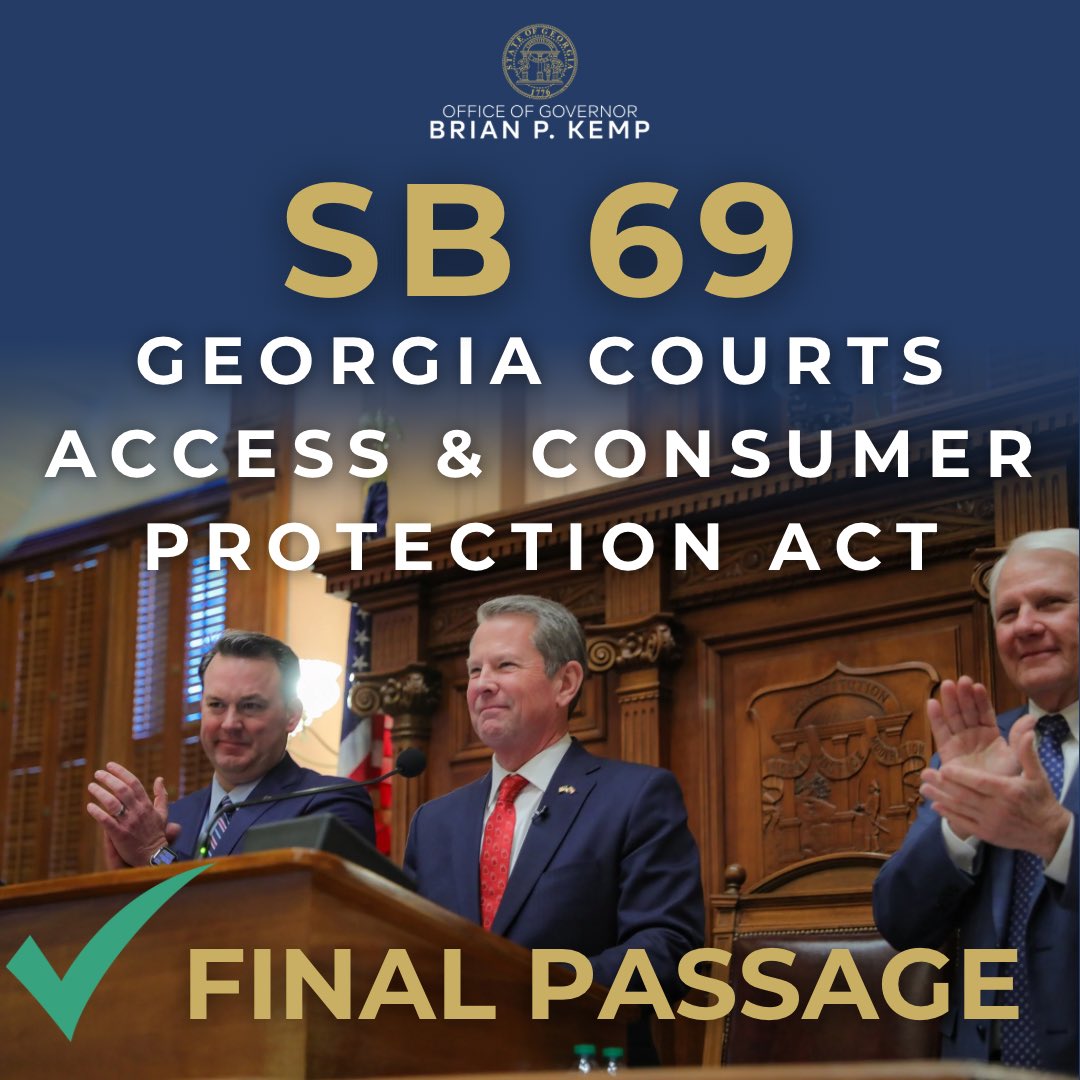
Governor Brian Kemp lauded the final passage of Senate Bill 69, the second piece of his tort reform legislative package, writing on X.
Thankful for our partners in the General Assembly who gave final passage to SB 69 today, further ensuring fairness in our courtrooms and a fair shake for job creators. This second piece of our tort reform package will further help us protect Georgia families, businesses, and consumers from bad actors.
Senate Bill 1, the “Fair and Safe Athletic Opportunities Act” by State Sen. Greg Dolezal (R-Forsyth County) passed and aims to limit the participation of transgender students in school athletics, according to the Capitol Beat News Service via the Savannah M0rning News.
Controversial legislation banning transgender student athletes from participating in female sports in Georgia cleared the Republican-controlled General Assembly Monday.
Senate Bill 1, which the Senate’s GOP majority passed early last month, passed the House 100-64 virtually along party lines early Monday afternoon. The Senate then gave the bill final passage several hours later, voting 34-20 also along party lines to approve several changes the House had made to the measure.
The legislation prohibits Georgia public school and college students from competing on teams that do not match the sex on their birth certificates. It also applies to private institutions that compete against public schools and colleges.
Noncompliant public schools would risk loss of state funding and exposure to lawsuits.
During Monday’s House floor debate, Republican supporters said transgender students born male enjoy an unfair competitive advantage over women in sports to the point of threatening female athletes’ safety.
“It is a narrowly tailored commonsense bill that eliminates the potential for male advantage,” said Rep. Josh Bonner, R-Fayetteville, who carried the Senate legislation in the House. “Allowing that advantage on the field puts females at risk.”
Democrats countered that the bill targets transgender students, already a vulnerable group of young people studies have shown are particularly susceptible to mental health problems.
“This bill does not make our children safer,” said Rep. Jasmine Clark, D-Lilburn. “It’s a license to harass, bully, and harm.”
Other opponents said the bill isn’t necessary because no transgender males are currently competing in women’s sports in Georgia. House Democrats accused their Republican colleagues of seeking to score political gains at the expense of a tiny minority of Georgians.
“This is not about fairness. This is not about safety. This is about politics,” said Rep. Karla Drenner, D-Avondale Estates. “It’s a manufactured crisis designed not to solve a real problem but to create division and fear.”
But Rep. Chris Erwin, R-Homer, chairman of the House Education Committee, said the bill’s purpose is to promote “fairness, safety, and integrity” in school and college sports.
“This legislation does not target individuals,” he said. “It targets inequity.”
After the votes, Lt. Gov. Burt Jones – who presides over the Senate – called the bill a “historic step toward achieving a critical goal” for the 2025 legislative session.
“Since I took office in 2023 as lieutenant governor, the Senate has led the way to make protections for females competing in athletics on any level a reality,” Jones said.
“Today, the General Assembly sent a clear message – biological men are not welcome in girls’ sports or spaces here in Georgia,” added House Speaker Jon Burns, R-Newington. “The House was proud to support this measure, which builds on prior protections championed by the House.”
The bill now heads to Gov. Brian Kemp’s desk for his signature.
From Atlanta News First via WALB:
Senate Bill 1 is a priority bill of Lt. Gov. Burt Jones. It would ban transgender women from competing in women’s sports.
“Today, the Georgia General Assembly made a historic step toward achieving a critical goal for this session — the protection of women’s sports,” Jones said. “Since I took office in 2023 as lieutenant governor, the Senate has led the way to make protections for females competing in athletics on any level a reality. I had the honor of joining President Trump earlier this year when he signed an executive order ensuring these protections on the federal level, and I am proud that Georgia is leading the way on this effort.”
Jones said, “I want to thank all of the brave women and girls who shared their personal stories and helped shape this legislation. Their courage is commendable and ensures that the rights of female athletes are preserved and protected by law. I look forward to standing with Gov. Brian Kemp, Speaker Jon Burns and female athletes with their families around the state when the ‘Riley Gaines Act of 2025’ is signed into law.”
House Speaker Jon Burns and Lt. Governor Burt Jones said this was a priority for the 2025 legislative session.
“Today, the General Assembly sent a clear message—biological men are not welcome in girls’ sports or spaces here in Georgia,” Burns said. “The House was proud to support this measure, which builds on prior protections championed by the House, that protects integrity and fairness for the millions of female athletes who compete across our state. We’re grateful for the support of our colleagues in the Senate who worked alongside us to restore much-needed common sense to athletic competition, and to Riley Gaines who lent us her name and support in the fight to protect Georgia’s athletes.”
House Bill 268 by State Rep. Holt Persinger (R-Winder) passed both chambers and will augment school safety, according to the Capitol Beat News Service via the Valdosta Daily Times.
The Georgia legislature on Monday passed a sweeping school safety bill that seeks to identify students who intend to do harm and bolster mental health services for them.
House Bill 268 drew broad bipartisan support in both chambers of the General Assembly Monday, passing the Senate 45-9 and then the House of Representatives 154-12. The House had already approved the bill by a similar margin in early March but had to ratify Senate changes.
The measure has been a priority for House Speaker Jon Burns, R-Newington. The 57-page bill is a reaction to the mass shooting at Apalachee High School in Barrow County last September, which led to four deaths and murder charges against a student and his father, who was accused of giving his son access to a gun. Nine others were wounded.
“We have to make sure that this never happens again in the state of Georgia,” said Sen. Bill Cowsert, R-Athens, whose district includes Barrow County.
HB 268 seeks to prevent violence before it happens. It would require that schools maintain records on students with troubling behavior, from regularly skipping school to disciplinary infractions and police encounters (police would have to inform the schools when they apprehend their students).
Schools would have five business days to share those records when a student transfers to a different school, as happened at Apalachee High. They would also have to maintain an around-the-clock anonymous tip line.
The legislation also calls for more mental health services. Each school system would get up to three state-funded student advocates, one for every 18,000 students. And it would require annual training for teachers and students about recognizing mental health warning signs.
The Senate deleted some provisions that were in the original bill passed by the House.
A mandate for schools to establish threat assessment teams was cut. So was a database that would have served as a repository of information about students who seemed suspicious. One state official said it might contain records on 1% of Georgia’s 1.7 million public school students.
Parents and their advocates feared such data would be inaccurate, prejudicial and stigmatizing — and follow students into adulthood, with potentially harmful consequences.
Cowsert agreed and deleted that provision during the review process in a committee he leads.
“They say and do stupid, irresponsible things,” Cowsert said of teenagers. “Why should we have this shadow database on misconduct of students that didn’t rise to the level of criminal conduct?”
But misconduct that does rise to the criminal level would be treated sternly under HB 268 through a provision added by the Senate. Children ages 13-17 who commit a terroristic act on campus could be tried in adult courts, with potential prison time and convictions that would go on their records for life.
A terroristic act would involve using a weapon, fire, hazardous substance or simulated hazardous substance to terrorize or cause an evacuation.
The legislation also would allow prosecutors to prosecute teens as adults for aggravated assault with a firearm, on or off campus.
That concerned Sen. RaShaun Kemp, D-Atlanta, who noted students in gangs could see their lives “drastically changed” by that new provision.
HB 268 now goes to Gov. Brian Kemp for his signature.
From Atlanta News First via WALB:
House Bill 268 is a priority bill for [State House Speaker Jon] Burns. It is a school safety bill, focused on creating a statewide framework for mental health and emergency response.
“As legislators, we have no higher calling than to provide every student across our state with a safe and secure learning environment — and today’s passage of House Bill 268 affirms our commitment to doing just that,” said Burns. “This legislation is the result of months of collaboration with educators, students, parents, school administrators and law enforcement agencies to develop a comprehensive school safety plan that addresses the security needs of our school buildings, prioritizes the mental health of Georgia’s students and ensures we take proactive measures to keep our children safe.”
Some families of Apalachee High School students are asking Governor Brian Kemp to veto House Bill 340, the “Distraction-Free Education Act,” for school safety reasons, according to the AJC.
But the families of students who were at Apalachee High School on Sept. 4, when a 14-year-old is accused of shooting and killing four people, don’t see it that way. They’ve asked Gov. Brian Kemp to veto the bill.
“Gov. Kemp, I also urge you to reconsider the cellphone ban in schools,” Tinya Brown, whose daughter is a freshman at Apalachee High, said at a press conference Friday demanding lawmakers take action about gun violence. “It was only through text messages that parents knew what was happening.”
Layla Renee Contreras, whose sister goes to the school and whose mom works there, asked for the same.
“Now, instead of counteracting these root issues (of gun violence), a cellphone ban for kindergarten through eighth grade is about to be signed into law. A ban that does nothing to keep our kids safe from school shootings. A ban that ignores the very real and present dangers our communities face,” she said. “I’m not here to dismiss the work that’s been done. I’m here to say it’s not enough.”
Brown, Contreras and others at the press conference criticized lawmakers for not taking action to address firearm access after the deadliest school shooting in Georgia’s history.
A spokesperson for Kemp said that security and safety has been a top priority throughout his administration, including after the Apalachee High shooting.
“As with all legislation passed by the General Assembly, (the cellphone ban) will undergo a thorough review process during the 40 days following the conclusion of the legislative session before the governor makes any decisions,” the spokesperson said in a statement.
Schools in the Atlanta area that have already implemented a cellphone ban say they’ve established protocols to notify families in case of an emergency. Advocates of the ban say cellphones can be distracting in an emergency if students are on their phones rather than paying attention to teachers and law enforcement.
Last year, Kemp signed more than 300 bills into law; he vetoed 12.
House Bill 123 by State Rep. Bill Werkheiser (R-Glennville) passed and lowers the bar for death penalty defendants to prove an intellectual disability, according to the Capitol Beat News Service via the Athens Banner Herald.
The Georgia legislature threw its support behind legislation that would make it easier for defendants in death penalty cases to avoid execution by proving that they have an intellectual disability.
The House of Represenatives approved House Bill 123 by a vote of 150-3, minutes after the Senate passed it 53-1. The bill, which now goes to Gov. Brian Kemp for his signature, would reduce the burden of proof for intellectual disability to a “preponderance” of the evidence rather than the current standard of “beyond a reasonable doubt.” It would also establish a pre-trial hearing process where the determination could be made rather than requiring it to be made during the guilt phase of a trial.
A convicted defendant could still be sentenced to life in prison. But the Senate amended the bill by adding “without possibility of parole.”
The House had approved the measure by a unanimous vote in early March but had to vote again Monday after the Senate made changes.
Senate Bill 79, the “Fentanyl Eradication and Removal Act,” passed both chambers last week, according to 13WMAZ.
Senate Bill 79, known as the “Fentanyl Eradication and Removal Act,” cleared the General Assembly on March 28, 2025, with a House vote of 131-31 and unanimous support in the Senate, according to legislative records.
The bill creates mandatory minimum sentences specifically for fentanyl trafficking, separating the synthetic opioid from other drug statutes.
“It’s an enormous problem, and it’s not unique to Houston County by any means, but it is a problem that we’re not immune to here,” Houston County District Attorney Eric Edwards said.
Under the legislation, trafficking between 4 and 8 grams of fentanyl would result in a mandatory minimum sentence of 10 years and a $75,000 fine. For trafficking at least 28 grams, offenders would face 35 years in prison and $750,000 in fines.
Edwards explained that even small amounts of fentanyl represent significant danger to the community.
“I think the FDA’s current guidelines set 2 mg as the lethal dosage of fentanyl,” Edwards said. “So anyone who’s dealing with 4 grams, that’s 4,000 lethal doses within one unit of it.”
Houston County law enforcement agencies conducted a major operation targeting fentanyl distributors in late 2023, resulting in 93 arrests over 90 days and the seizure of 532 grams of fentanyl, according to Edwards.
“That was about 266,000 lethal doses of fentanyl taken off the streets during those days,” Edwards said.
The bill’s sponsor, State Sen. Russ Goodman, gained support from Lt. Governor Burt Jones and House Majority Leader Chuck Efstration, who argue the legislation will deter drug gangs from operating in Georgia.
Critics, including Rep. Scott Holcomb, have questioned the effectiveness of mandatory minimums and advocated for a public health approach focused on treatment and prevention.
The legislation does provide some judicial discretion, allowing judges to reduce sentences in cases involving first-time offenders or when trafficking did not result in a death.
United States Representative Lucy McBath (D-Metro Atlanta) suspended her exploratory campaign for Governor, according to the Capitol Beat News Service via the Savannah Morning News.
U.S. Rep. Lucy McBath is pausing her campaign for governor, citing her husband’s health.
McBath, D-Marietta, formed an exploratory committee early this month for a potential run for governor next year. But on Monday, she released a statement announcing her husband is recovering from cancer surgery.
“I’m so grateful for everyone who has stood by my family as we undergo this arduous period,” McBath wrote in a statement. “I will be spending some time focusing on my husband’s health, and I cannot make a decision to run for governor or not at this moment.”
McBath is serving her fourth term in the House representing Georgia’s 6th Congressional District, which includes central and southern Fulton County, South Cobb, eastern Douglas, and northern Fayette counties.
She is the only Democrat who has come forward expressing an interest in succeeding term-limited Republican Gov. Brian Kemp.
Georgia Attorney General Chris Carr became the first Republican to enter the race when he announced his candidacy last fall. Other potential GOP candidates include Lt. Gov. Burt Jones and Secretary of State Brad Raffensperger.
From the Associated Press via WSAV:
McBath might still run for governor that year, spokesperson Jake Orvis said, but she needs to focus on her husband Curtis’ health right now after complications from a recent cancer surgery.
The four-term member of Congress, best known as a gun control advocate, had filed papers on March 5 to raise money for governor.
McBath is remaining in Congress, Orvis said
Republican Gov. Brian Kemp is completing his second term and can’t run again. On the Republican side, Attorney General Chris Carr is already running for governor in 2026 and Lt. Gov. Burt Jones is widely expected to run.
Other Democrats who have been exploring a run include former Atlanta Mayor Keisha Lance Bottoms, state Sen. Jason Esteves and former DeKalb County Chief Executive Officer Michael Thurmond. Democrat Stacey Abrams, who ran and lost to Kemp in 2018 and 2022, has not closed the door on a third run.
McBath first won election to Congress in 2018, ousting Republican U.S. Rep Karen Handel to seize a seat in Atlanta’s northern suburbs once held by Newt Gingrich. When Republicans redrew electoral districts after the 2020 Census, McBath jumped into a primary race against fellow Democrat Carolyn Bordeaux, beating her handily and winning election. Then after a court ordered another round of redistricting after finding African American votes were diluted, McBath shifted to a district Republicans drew on the western side of Atlanta.
Those moves mean McBath has represented a much larger number of voters than the typical member of Congress, which could make her a stronger statewide candidate.
McBath, like Abrams, would be bidding to become the first Black female governor of an American state.
The 64-year-old McBath rose to prominence as a gun control advocate after her 17-year-old son, Jordan Davis, was shot and killed in 2012 by a white man who was angry over the loud music the Black teenager and his friends were playing at a gas station in Jacksonville, Florida. McBath, a former flight attendant, has had her political career heavily backed by billionaire and former New York Mayor Michael Bloomberg.
United States Representative Buddy Carter (R-SSI) received a campaign contribution from Elon Musk, according to The Current GA.
Tech mogul and White House adviser Elon Musk has donated $6,600 to Buddy Carter’s campaign committee, an apparent boost the Coastal Georgia congressman’s political profile ahead of a possible run for the U.S. Senate seat held by Democrat Jon Ossoff.
“Thank you, Elon Musk! Together, we will #MakeAmericaGreatAgain!” gushed Carter in announcing the donation Wednesday on his Facebook page and the social media site X, which Musk owns.
For Carter’s part, his public praise for Musk indicates how he’s angling to keep the attention of the Trump White House as he ponders future political moves.
The former Pooler mayor, who now lives in St. Simons, said last week that he expects Gov. Brian Kemp to announce his own future political plans after the Georgia General Assembly adjourns later this week. “When he makes a decision, I’ll make a decision,” Carter told CNN, referring to the Senate race in 2026.
As of Dec. 31, Carter’s campaign committee had more than $3.01 million in cash on hand, according to reports filed with the Federal Election Commission. The committee, Buddy Carter for Congress, is one of Carter’s three fundraising groups.
Meanwhile, Ossoff’s campaign committee ended 2024 with $4.99 million in cash on hand, his FEC submission said.
In Carter, Musk has an ally in his campaign to slash federal programs and the federal workforce.
The 67-year-old Carter belongs to the House Delivering Outstanding Government Efficiency (DOGE) Caucus, which was launched after the November election.
Its purpose, according to its co-chairman, Florida Republican Aaron Bean, is to “work closely” with Musk’s team to “help rein in reckless spending and stop the abuse of taxpayer dollars.” To date, the nature of that work is unclear, though they continue to champion Musk’s work.
The caucus, all but one of whose 31 members are Republican, is not a part of DOGE nor is it an official congressional committee. It could not immediately be determined whether the caucus’ GOP members and their campaign committees also received $6,600 donations from Musk.
United States District Court Judge Amy Totenberg (ND-GA) dismissed a lawsuit seeking to prevent use of electronic voting in Georgia, according to the Associated Press via WSAV.
A federal judge has declined to block the use of Georgia’s electronic voting system in a long-running lawsuit that alleged that the system is vulnerable to attack and has operational issues that could deprive voters of their constitutional rights.
U.S. District Judge Amy Totenberg found that the activists and individual voters who challenged the state’s voting system did not prove that the problems they identified prevented them from voting, diluted their votes or kept their votes from being counted. She wrote in a ruling Monday that they lack standing to sue and she is unable to consider the merits of their claims.
Georgia election officials have consistently said the system is secure and reliable and that it is up to the state to decide how it conducts elections.
The ruling follows several years of intense focus on Georgia’s elections in the aftermath of President Donald Trump’s narrow loss in the state to Democrat Joe Biden in the 2020 presidential election. Trump claimed without evidence that election fraud cost him victory, and his allies spread wild conspiracy theories about the Dominion Voting Systems machines used in Georgia.
But the lawsuit at issue long precedes those claims. It was originally filed in 2017 by several individual voters and the Coalition for Good Governance, which advocates for election integrity, and targeted the outdated, paperless voting system used at the time. After Georgia purchased a new voting system in 2019, the suit was amended to target that system.
The election system used statewide by nearly all in-person voters includes touch screen voting machines that print ballots with a human-readable summary of voters’ selections and a QR code that a scanner reads to count the votes. The human-readable summary only lists the voter’s choice, not the names of other candidates or the details of a ballot question.
They asked Totenberg to stop the state from using the touch screen voting machine system as the standard method for in-person voting.
“Although Plaintiffs have not ultimately prevailed on their legal claims, their work has identified substantial concerns about the administration, maintenance, and security of Georgia’s electronic in-person voting system,” Totenberg wrote. “These investigative and educational efforts have prompted meaningful legislative action to bolster the transparency and accountability of Georgia’s voting systems.”
In addition to other changes, a law passed by Georgia lawmakers last year requires QR codes to be removed from ballots by July 2026, though she noted that funding and government action would be required to implement that change.
Totenberg’s ruling puts an end to a long and twisting path. Throughout the process she has repeatedly raised concerns about the state’s voting system and practices and, early on, accused state officials of ignoring problems. In an August 2019 ruling, she prohibited the state from using its antiquated paperless voting machines beyond that year. The state had agreed to purchase new voting machines from Dominion a few weeks earlier and scrambled to deploy them ahead of the 2020 election cycle.
Secretary of State Brad Raffensperger, the defendant in the case, said the ruling is a “resounding vindication” of Georgia’s elections.
“All the real-world evidence shows that Georgia’s paper ballot system works well,” Raffensperger said. “The voters of this state know that their votes are counted securely, accurately and quickly.”
One of the plaintiffs, Marilyn Marks of the election security organization Coalition for Good Governance, said Georgia’s voting system is “insecure and unsuitable for use in public elections.”
“While we consider our next legal steps, one thing is clear: the Georgia Legislature must act now,” Marks said. “Georgia must move to adopt hand-marked paper ballots for the 2025 and 2026 elections to protect the integrity of our elections and restore public confidence.”
President Donald Trump also opposed QR codes as part of his executive order last week, calling for them to be banned nationwide.
Totenberg, an appointee of former President Barack Obama, did not decide on the merits of the case when she ruled against the plaintiffs. Instead, she dismissed the case because they failed to show they suffered an injury that would entitle them to intervention or relief from the U.S. courts.
Savannah City Council adopted a new affordable housing plan, according to the Savannah Morning News.
Savannah City Council created a “density bonus” for its affordable housing program aimed at incentivizing missing middle housing types, such as duplexes or quadplexes, when additional units are offered at an affordable rate. The policy will take affect after an Affordable Housing Overlay District, outlining the areas where the program applies, is approved by council in coming weeks.
Council’s creation of the new bonus program comes as the city needs to add nearly 4,000 new housing units by 2030 to meet demand brought by population growth, according to an assessment by the Georgia Institute of Technology. Thursday’s vote also marks one of the first major housing policy moves of the current council administration, which was elected in 2023 from a campaign season where affordable housing proved a prominent topic.
U.S. Army Corps of Engineers (USACE) will study the effect of wakes on Tybee Island, according to the Savannah Morning News.
Regular north end beachgoers know that stretch of beach can experience violent currents and waves caused by the wake of passing cargo ships bound for or leaving the Port of Savannah. The waves can be dangerous for those who frequent the area, and the surges are a concern for further beach erosion, requiring renourishment—the next cycle that Tybee officials already say can’t come quickly enough.
That’s why the City of Tybee Island partnered in 2021 with the U.S. Army Corps of Engineers (USACE) on a study to better understand the effects of vessel-generated wakes. The study also intended to find a path for how to mitigate the impacts of the huge waves on beachgoers in the future. However, the results of the study proved limited—the study did not give the city or USACE the specifics to answer the question: What can we do to reduce the increasingly dangerous waves?
To answer that question, the USACE returned to Tybee Island’s north end in March (and will remain through April 4) to gather more data to support sustainable solutions using a portable tower and three cameras.
The original study lasted four months, from late July to early December 2021. Underwater pressure sensors and broadcast systems, set up offshore of the Savannah River channel’s rock jetties, recorded ship size, speed, direction and their wake magnitudes. Over the four-month period, the sensors captured data on more than a thousand vessels.
This current study, while only about three weeks, will track the movement of the ships with cameras to determine direction .of travel. Underwater sensors will again track ship speed and weight, wave generation and water surge.
Related Posts
 Jack Kingston endorses Eddie DeLoach in Runoff for Mayor of Savannah
 PortSide: Container growth continues at GPA | BiS | Business in Savannah News
 Georgia Politics, Campaigns, and Elections for August 9, 2012
 GOP operatives try the news biz – Mackenzie Weinger and Alexander Burns – POLITICO.com
 Georgia Politics, Campaigns, and Elections for November 23, 2016


Comments ( 0 )