
On January 14, 1639, representatives of three cities in Connecticut adopted the “Fundamental Orders,” the first written Constitution in an American colony and one of the first founding document to cite the authority of “the free consent of the people.”
On January 13, 1733, the ship Ann (sometimes spelled “Anne”) sailed into Charles Town harbor and was met by South Carolina Governor Robert Johnson and the Speaker of the Commons House of Assembly. Aboard the ship were James Oglethorpe and the first 114 colonists of what would become Georgia. Later that year they would land at a high bluff on the Savannah River and found the city of Savannah.
On January 14, 1733, James Oglethorpe and the rest of the first colonists departed Charles Town harbor for what would become Savannah, and the State of Georgia.
On January 12, 1775, St. Andrews Parish on the Georgia coast passed a series of resolutions that included approving the actions of patriots in Massachusetts, three resolutions critical of British government actions, and a renunciation of slavery. The resolutions also appointed delegates to a provincial legislature at Savannah and urging that Georgia send two delegates to the Continental Congress to be held in Philadelphia the next year.
The Continental Congress ratified the Treaty of Paris to end the Revolutionary War on January 14, 1784. The Treaty was negotiated by John Adams, who would later serve as President, and the delegates voting to ratify it included future Presidents Thomas Jefferson and James Monroe.
On January 14, 1835, James M. Wayne took the oath of office as an Associate Justice of the United States Supreme Court. A Savannah native, Wayne had previously served in the Georgia House of Represestatives, as Mayor of Savannah, on the Supreme Court of Georgia, and in Congress. His sister was the great-grandmother of Juliette Gordon Low, founder of the Girl Scouts, and his home is now known as the Juliette Gordon Low house. When Georgia seceded from the Union, Wayne remained on the Supreme Court.
On January 14, 1860, the Committee of Thirty-Three introduced a proposed Constitutional Amendment to allow slavery in the areas it then existed.
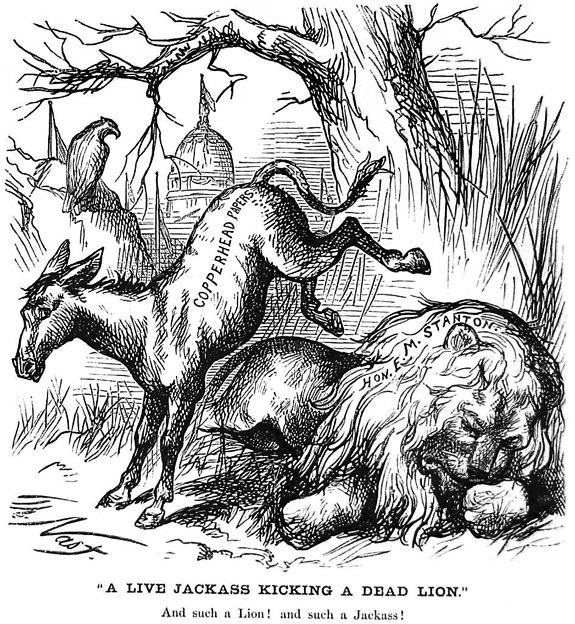
The donkey was first used as a symbol for the Democratic Party on January 15, 1870 by cartoonist Thomas Nash.
On January 12, 1872, Benjamin Conley stepped down as Governor of Georgia, the first Republican to hold the office and the last until January 13, 2003, when Sonny Perdue was sworn in.
He joined the Republican Party and became president of the state Senate after the Civil War. That was the office he held in October 1871 when Gov. Rufus Bullock, also an Augusta Republican, left the state under pressure from state Democrats. According to the Georgia Constitution, Conley became governor, holding the job until a replacement could be elected and take office two months later.
On January 12, 1906, the American Intercollegiate Football Rules Committee legalized the forward pass. Some credit Georgia Tech coach John Heisman as having popularized the idea of making the forward pass legal after seeing it in a game between Georgia and North Carolina.
Kenesaw Mountain Landis was elected the first Commissioner of Baseball on January 12, 1921. Judge Landis was named after the Battle of Kennesaw Mountain, where his father was wounded fighting for the Union.
Julian Bond was born on January 14, 1940 in Nashville, Tennessee, and was one of eleven African-American Georgians elected to the Georgia House of Representatives in 1965. After his election, on January 10, 1966, the State House voted 184-12 not to seat him because of his publicly-stated opposition to the Vietnam War. After his federal lawsuit was rejected by a three-judge panel of the U.S. District Court for the Northern District of Georgia, the United States Supreme Court ordered Bond seated.
True story: Julian Bond was the first Georgia State Senator I ever met, when I was in ninth grade and visited the state Capitol as part of a school assignment.
On January 14, 1942, Franklin D. Roosevelt issued Presidential Proclamation No. 2537, requiring Japanese-Americans, including American-born citizens of Japanese ancestry, as well as Italians and Germans to register with the federal Department of Justice. The next month, Roosevelt would have Japanese-Americans interned in concentration camps in the western United States.
On January 13, 1959, Ernest Vandiver was inaugurated as Governor of Georgia.
On January 13, 1966, President Lyndon Baines Johnson appointed Robert C. Weaver head of the Department of Housing and Urban Development (HUD), making Weaver the first African-American cabinet secretary in U.S. History.
Jimmy Carter was inaugurated as Governor of Georgia on January 12, 1971.
On January 13, 1982, Hank Aaron was elected to the Baseball Hall of Fame in his first year of eligibility.
January 13, 1987 saw the inauguration of Governor Joe Frank Harris to his second term in office.
On January 13, 1998, Governor Zell Miller presented his $12.5 billion FY1999 budget to the Georgia General Assembly, including $105,000 to provide CDs of classical music for every baby born in the state. According to the New York Times,
“No one questions that listening to music at a very early age affects the spatial, temporal reasoning that underlies math and engineering and even chess,” the Governor said[]. “Having that infant listen to soothing music helps those trillions of brain connections to develop.”
Mr. Miller said he became intrigued by the connection between music and child development at a series of recent seminars sponsored by the Education Commission of the States. As a great-grandfather and the author of “They Hear Georgia Singing” (Mercer University Press, 1983), an encyclopedia of the state’s musical history, Mr. Miller said his fascination came naturally.
He said that he had a stack of research on the subject, but also that his experiences growing up in the mountains of north Georgia had proved convincing.
“Musicians were folks that not only could play a fiddle but they also were good mechanics,” he said. “They could fix your car.”
Legislators, as is their wont, have ideas of their own.
“I asked about the possibility of some Charlie Daniels or something like that,” said Representative Homer M. (Buddy) DeLoach, a Republican from Hinesville, “but they said they thought the classical music has a greater positive impact.”
“Having never studied those impacts too much,” Mr. DeLoach added, “I guess I’ll just have to take their word for that at the moment.”
In 2003, on January 13 at the Georgia Dome, Sonny Perdue took the oath of office as Georgia’s second Republican Governor, the first since Reconstruction.
Savannah City Council approved a granite marker for Taylor Square, fka Calhoun Square, according to the Savannah Morning News.
Mayor Van Johnson said at a recent press conference the city will commemorate the square at an event in February.
“Because we are caretakers of history, we should not be trying to erase it,” Johnson said at Thursday’s meeting. “We wanted to make sure that the history of the square was adequately codified within the square.”
The marker text will lay out the history of the square’s name, noting that the square was laid in 1851 and subsequently named for John C. Calhoun, the South Carolinian who served as the seventh vice president of the United States. Then it reads in 2022 City Council “removed the name Calhoun, a staunch defender of slavery.”
The marker rounds out noting the square’s renaming for Susie King Taylor in 2023, and includes that Taylor was a formerly enslaved woman, a nurse and an educator, and the first African American to openly teach in the state of Georgia.
Statesboro installed an Historical Marker commemorating nine African-American lynching victims, according to the Statesboro Herald.
The city of Statesboro along with the Remembrance Committee and The Equal Justice Initiative installed a marker to commemorate the nine African- Americans who were lynched in Bulloch County between 1886 and 1911.
“Many of the things that were actually talked about tonight, my family actually lived through those moments and so for this moment to come into fruition, understanding the history of this community and the struggle that we’ve had to make this a community that’s working to value each individual we can’t even put it into words,” said Mayor Jonathan McCollar.
Georgia Politics, Campaigns, and Elections
Glynn County voters will begin early voting on February 19, 2024 for the March 4, 2024 Presidential Preference Primary, according to The Brunswick News.
Three polling places will be open for early voting for the Presidential Preference Primary beginning weekdays Feb. 19 and ending March 4 from 8 a.m. to 5 p.m.
There will also be two Saturdays on Feb. 24 and March 2 for early voting from 9 a.m. to 5 p.m.
During Thursday’s Board of Elections meeting, officials said a big challenge for elections officials is the week before the March 12 primary elections when qualifying begins for county, state and federal officials for the May 21 general primary elections.
Qualifying for local and state elections is from 8:30 a.m. to 4:30 p.m. March 4-7, and on March 8 from 8:30 a.m. to noon at the main offices for the board of elections.
Under the Gold Dome Today
TBD Senate Rules Committee – 450 CAP
9:00 AM HOUSE FLOOR SESSION (LD5) – House Chamber
9:00 AM Senate Floor Session (LD 5) – Senate Chamber
12:30 PM Senate State & Local Gov’tal Ops – 450 CAP
Next Week
01/16/2024 9:00 AM JOINT APPROPRIATIONS – 341 CAP
01/17/2024 8:00 AM JOINT APPROPRIATIONS – 341 CAP
01/18/2024 8:00 AM JOINT APPROPRIATIONS – 341 CAP`
Yesterday, Governor Brian Kemp delivered the State of the State Address:
From the Savannah Morning News:
In his sixth State of the State address, Georgia Gov. Brian Kemp delivered a resounding message to residents: Georgia is moving in the right direction and is gearing up for more growth in 2024.
Kemp outlined plans for the 2025 state budget in his address Thursday in the chambers of the state House in Atlanta, prioritizing investments in education, healthcare and public safety.
“In an election year, I don’t expect us all to agree on every issue,” Kemp said. “But in the middle of all that, I ask that we also remember Georgia is different for a reason. That our success is not an accident, but the result of resilient people who elected their leaders to keep state government efficient, responsive and accountable.”
“As we look across America, there is no doubt we are at a crossroads,” he said. “From crushing inflation and dysfunction in Washington, to the crisis at our southern border and unrest overseas, these are indeed trying times. But I believe we have an opportunity here in Georgia, an opportunity to highlight a different path.”
In his budget proposal, the governor announced plans to introduce legislation to lower Georgia’s state income tax to a maximum of 5.39%, saving taxpayers an estimated $3 billion over the next decade. The current tax rates are on a graduated scale, ranging from 1% to 5.75%.
He also proposed an additional $1.4 billion in allocations for K-12 education programs across the state, and emphasized that school choice was the best way to improve educational outcomes for students.
The proposal also includes $382 million to increase salaries for state employees, including teachers, raising the base pay for educators by $2,500, meaning the median teacher salary would increase by 4%.
As in previous years, Kemp emphasized the need to invest in public safety programs, outlining a variety of proposed solutions, including $3,000 pay raises for State Patrol officers and $104 million for school safety enhancements. He also voiced his support for the Atlanta Public Safety Training Center, colloquially called Cop City.
“We’re starting this year with a $16 billion surplus,” said state Sen. Nabilah Islam Parkes (D-Lawrenceville). “This is hard-earned tax dollars that should be reinvested in improving the life of every Georgian. Yet here we are, one of only 10 states whose government is refusing to expand Medicaid. This isn’t just a policy oversight. It is a moral failing.”
House Minority Caucus Whip Sam Park (D-Lawrenceville) said that Medicaid expansion would be the Democrats’ main priority this session, as well as housing and early childhood education programs.
From the Associated Press via WSAV:
Gov. Brian Kemp used his State of the State speech to draw contrasts between his Republican philosophy and Democrats in an election year when the presidency and all of Georgia’s state House and Senate seats are on the ballot, but the Republican Kemp himself doesn’t face the voters.
Combined with that heavy dose of politics is good news for the pocketbooks of state employees and public school teachers. Kemp says he wants to give a 4% cost of living increase to public employees and an equivalent $2,500 raise to teachers. That’s possible because the state is on track for another multibillion-dollar surplus despite slowing tax revenues, and has banked nearly $11 billion in extra cash in previous years.
Echoing his economic message from his 2022 reelection and his pledge to put “Georgians First” from his 2018 campaign, Kemp on Thursday painted his policies as bringing opportunity and prosperity, while calling on voters to reject “Washington D.C.” because of high inflation and overregulation.
“They will see what we’ve achieved together at the state level to make Georgia an even greater place to live, work and raise a family,” Kemp said. “And they’ll see the hardships Washington, D.C. has brought into every home and placed on every kitchen table across our state.”
Kemp contrasted his economic record, including low unemployment, big industrial announcements and billions in tax rebates and tax cuts with inflation and high prices that he said are squeezing Georgians.
“These are the people that Washington, D.C. has left behind,” Kemp said. “Because for every challenge our nation faces, the federal response is to spend more, regulate more, tax more, and come up with yet another government program meant to cure every ill.”
In line with that political future, Kemp framed themes Thursday to rally Republicans and dismay Democrats, making his strongest push to date for a school voucher bill and emphasizing support for a much-disputed police and fire training center.
Notably, Kemp also didn’t outline a position on whether Georgia should make a fuller expansion of Medicaid coverage to low income adults, as state House Speaker Jon Burns says he wants to explore.
Among the governor’s request for Fiscal Year 2025 are a 4% cost of living adjustment for state employee as well as a $2,500 salary increase for K-12 teachers and “other certified employees.”
“It’s no secret that most state government jobs pay less than private sector opportunities in the same line of work,” Kemp said in his State of the State Address. “But many of our employees do it because they feel a sense of public service and they want our state to succeed.”
“But for state government to stay efficient and stay ahead of Georgia’s continued growth, we must be able to attract and then retain employees who perform vitally important jobs. That’s why my budget proposal provides a pay increase for all state employees, including our teachers.”
He is also calling on legislators to update the funding formula for pupil transportation for the first time in nearly two decades. The 2025 budget includes nearly $205 million to update the formula and provide local school systems with more state funding support to transport students to and from their schools.
Another funding request that Kemp is making is designed to address school safety.
The 2025 budget proposal includes $104 million to establish an annual school security grant program to help school systems address security needs.
“Schools will determine how best to use this money, whether for personnel like school resource officers or for physical and technology improvements that make our places of learning more secure,” Kemp said in his State of the State Address.
“This investment is more significant because it will enable schools and administrators to plan accordingly, knowing that this money is headed their way for this specific purpose.”
The funding announcements were praised by officials from the Professional Association of Georgia Educators.
“PAGE applauds the governor’s proposal to raise Georgia educator salaries by $2,500,” the group said in a statement. “This much-needed increase reflects the essential role of educators and public education in preparing Georgia students and Georgia’s economy for a bright future.”
“Further, we appreciate the governor’s plan to allocate more than $200 million toward pupil transportation. This proposal, requested by PAGE in conjunction with other education groups, represents a significant step toward transportation-funding parity between the state and local school districts.”
During his annual speech to the Georgia Chamber of Commerce Wednesday, Gov. Brian Kemp said he is proposing a dental school be built at Georgia Southern University in Statesboro.
In discussing health care initiatives to be included in his 2024-25 budget, Kemp said, “With that in mind, my budget proposal includes $178 million for the design and construction for a dental school at Georgia Southern University – the first school of its kind in our state since the moon landing in 1969.”
Republican House Speaker Jon Burns of Newington, also speaking Wednesday, again voiced openness to expanding health care coverage to low-income adults through Georgia’s Medicaid program.
“Expanding access to care for lower income working families through a private option in a fiscally responsible way that lowers premiums is something we will continue to gather facts on in the House,” Burns said.
Gathering facts about Medicaid expansion –– that’s what House Speaker Jon Burns said he’s working with other top Republican lawmakers to do this year.
“When it comes to health care, there has certainly been a lot of discussion of late about Medicaid expansion,” he said.
And Burns talked about it at the Georgia Chamber’s annual Eggs and Issues event this week.
“Expanding access to care for lower-income working families through a private option in a fiscally responsible way that lowers premiums is something we will continue to gather facts on in the House,” said Burns.
He was also careful to say that he supports Gov. Brian Kemp’s limited expansion of Medicaid called Pathways to Coverage.
Burns this week called Pathways “a viable option.”
“And it will continue to work, but we want to make sure that we are looking at every option and certainly working with the governor and the senate, with the lieutenant governor to ensure that we have the facts on the table about good fiscal opportunities that may be important,” he said, “maybe something we could look at in the future to help provide that affordable, accessible health care to Georgians, no matter where you live in this state.”
Burns said he’s also interested in ways to expand access to telemedicine. And he is making mental health legislation a priority for the House.
This year, top GOP lawmakers say they are open to discussing potential changes to Certificate of Need, or CON.
“We believe that CON regulations have not been revised for a long time, since the ’70s, a lot of them. So we know that things have changed, the economy has changed. So a lot of things are different. But we wanted to make sure that we looked at all of those with clear vision from different perspectives –– big hospitals, small hospitals, senior services for folks who are in the senior living area of healthcare. We’ve tried to look at a broad spectrum and they’ve done a good job. We have some recommendations on the table that we’re looking at,” said House Speaker Jon Burns this week.
Meanwhile, House Democrats continue their push for full Medicaid expansion. Johns Creek Democratic state Rep. Michelle Au hosted a public hearing on the issue this week that drew more than 100 people.
Fulton County Superior Court Judge Scott McAfee stayed proceedings against State Senator Shawn Still (R-Norcross) in the Trump case, according to the AJC.
Fulton County Superior Court Judge Scott McAfee has given state Sen. Shawn Still some breathing room in the election interference case against him. He is among the co-defendants in the prosecution of former President Donald Trump.
Still faces a sweeping round of charges for his role as an “alternate” elector for Trump in Georgia. Still stands accused of racketeering, impersonating a public officer, two counts of first degree forgery, criminal attempt to commit filing false documents and two counts of false statements and writings.
On Thursday McAfee issued a stay “on all aspects of the case,” ruling that Still is automatically entitled to a continuance as a sitting member of the General Assembly. The right to a delay in legal proceedings for members of the Legislature is in the Georgia code and has been the subject of controversy in the past, although it has likely never been used in a case as high-profile as the one against Still.
United States District Court Judge Eleanor L. Ross (ND-GA) gave state legislators more time to adopt a redistricting plan for the Cobb County Board of Education, according to the AJC.
A federal judge extended the deadline for Georgia lawmakers to redraw the Cobb County Board of Education boundaries, after lawmakers insisted the original deadline was impossible to meet.
Lawmakers now have until Jan. 22 — less than two weeks — to adopt a new map.
Voting rights groups sued in 2022 after the current map was adopted, alleging it is discriminatory and dilutes the voting power of people of color. Judge Eleanor L. Ross found in December that the groups could likely prove in court that “race was a predominant motivating factor” behind the map. She gave lawmakers until Wednesday to adopt a temporary map to be used in the upcoming school board election while the case continues.
But in meetings on Monday and Tuesday of this week, members of the Cobb County delegation could not agree on a map, but agreed that they wouldn’t be able to make the deadline. So plaintiffs and defendants in the case filed a joint request for the judge to extend the deadline, which she granted Wednesday.
Fulton County District Attorney Fani Willis (D-Atlanta) is accused in court filings of an improper relationship with the lawyer she hired to work on the Trump indictment, according to the New York Times.
A lawyer for one of the defendants charged along with former President Donald J. Trump in the Georgia election interference case said in a court filing on Monday that the district attorney overseeing the case, Fani T. Willis, had engaged in a “clandestine” relationship with the special prosecutor she hired to help handle it.
The filing, from a lawyer representing Michael A. Roman, a former Trump campaign official, provided no proof of the relationship or other claims it contained. It argued that the relationship should disqualify Ms. Willis, her office and the special prosecutor, Nathan Wade, from prosecuting the case.
The defense lawyer, Ashleigh B. Merchant, also wrote that Ms. Willis, the district attorney in Fulton County, Ga., was “profiting significantly from this prosecution at the expense of the taxpayers,” charging that Ms. Willis and Mr. Wade had taken vacations together with money he made working for her office.
Citing “information obtained outside of court filings,” Ms. Merchant wrote that Ms. Willis and Mr. Wade “have traveled personally together to such places as Napa Valley, Florida and the Caribbean” and that Mr. Wade had bought cruise ship tickets for them.
Clark D. Cunningham, a law and ethics professor at Georgia State University, reviewed Mr. Roman’s filing and questioned why it did not contain any proof of a relationship between the two prosecutors.
Ms. Merchant, in a phone interview, said that she had reviewed documents showing that Mr. Wade and Ms. Willis had traveled together to vacation destinations and that Mr. Wade had paid for some of the tickets. She said she believed the records were included in Mr. Wade’s sealed divorce filings. She asked in a separate court filing this week that those records be unsealed.
The filing states that Mr. Wade, who has his own private practice, has earned more than $650,000 for his work with the prosecutor’s office.
From a later story in the New York Times:
While many legal experts doubt that the accusations — if true — will derail the case, they could present significant problems for Ms. Willis and create distractions around the case. The allegations have already created a firestorm on the political right, with Mr. Trump and his allies accusing her of violating a raft of county and state laws. They have even given pause to some Democrats.
“If the allegations are true — and it’s a big if — it’s troubling,” Robb Pitts, a Democrat who is chair of the Fulton County Board of Commissioners, said in an interview this week. “To have this come up at this point in time, and at this point in this trial, can raise questions.”
The filing alleges that Ms. Willis profited from Mr. Wade’s earnings from her office — taxpayer funds — by going with him on vacations that he sometimes paid for.
The day after Mr. Wade started work for the district attorney’s office in 2022, he filed for divorce. Lawyers for his wife, Joycelyn, issued a subpoena this week to Ms. Willis, seeking her appearance on Jan. 23 in a divorce action that is in progress.
While the court papers did not include any proof of the relationship between the prosecutors, they assert that the two have been seen “in a personal relationship capacity” around Atlanta and claim that people close to both of them have confirmed their relationship.
One of his most fervent supporters in Congress, Representative Marjorie Taylor Greene, Republican of Georgia, asked the state’s governor and its attorney general on Wednesday to investigate the matter of Mr. Wade’s appointment. Gov. Brian Kemp has generally not been critical of Ms. Willis’s investigation thus far.
Ms. Greene laid out a number of state laws that she said Ms. Willis had potentially violated, including laws on bribery, improper influence of a government official and conspiracy to defraud the government. It wasn’t immediately clear how some of those laws would apply; the bribery statute appears largely aimed at payoffs made to or solicited by public officials.
But Ms. Greene and others also pointed to the oath taken by district attorneys in Georgia, in which they pledge to take only their “lawful compensation.” If Ms. Willis benefited from the money paid to Mr. Wade, “she violated her oath and many Georgia criminal statutes,” Ms. Greene said in her letter to Mr. Kemp.
Josh McKoon, the chairman of the Georgia Republican Party, said this week that he expected the new allegations to form the basis of a fresh complaint and to hasten lawmakers’ efforts to fix the issues that are keeping the new commission from starting its work.
“I suspect a complaint will be filed,” Mr. McKoon said. “I also expect the legislature is going to move with a great deal of speed to address these technicalities so the commission can get to work.”
On social media this week, Mr. McKoon, a lawyer and a former legislator, called for all criminal proceedings in the Trump case to be put on hold while the allegations against Ms. Willis and Mr. Wade were investigated.
I’ve been holding on to this story for a while, because it illustrates the dangers of the surveillance state. From the AJC:
A prospective Fulton County juror who was surveilled by prosecutors and had his movements tracked for weeks can remain in the jury pool despite concerns over where he lives, a judge ruled Monday.
Juror No. 110 is among 48 potential jurors qualified in the ongoing gang and racketeering case against Atlanta rapper Young Thug and others. But prosecutors sought his dismissal after learning he spends most nights at his Cobb County apartment.
In a court filing, the Fulton County District Attorney’s Office said it monitored the man’s Austell complex for at least a month to see where he slept and that investigators tracked his whereabouts using license plate readers.
The juror said he spends about four nights a week at the house where he grew up and that he’s helping his mom pay off the mortgage. But surveillance conducted by the state found that he rarely, if ever, sleeps in Atlanta, prosecutor Adriane Love argued.
Tracking his car across metro Atlanta through the use of license plate readers, prosecutors said when the man does venture into the city he goes nowhere near his mother’s house.
“I don’t even believe that he has visited his mother in the last three months,” said Love, who noted the man hasn’t voted since 2011. “I think he ought to be excused at this point … for not being a resident of Fulton County.”
Young Thug’s attorney, Brian Steel, raised concerns about the ethics of monitoring potential jurors and accused the state of surveilling people they don’t like “just to save preemptory strikes.”
“Is it that important for the state of Georgia to win at any cost?” Steel asked. “Why don’t we subpoena their subscriptions, or get their (TV) channels or their Google records?”
Here’s my question: will such use of public surveillance equipment be allowed in divorce cases? How about in a felony defense?
The Georgia Senate appointed former State Senator Rick Jeffares (R-Henry County) to the State Elections Board, according to the Associated Press via AccessWDUN.
Republican Lt. Gov Burt Jones announced the choice of former state Sen. Rick Jeffares on Thursday to the Senate Republican Caucus. The full Senate must confirm Jeffares.
Jeffares, a Republican, would take the place of Matt Mashburn on the board. Senate Republican leaders told Mashburn several months ago that they didn’t intend to reappoint him. But his ouster didn’t become public until after he voted against investigating Raffensperger.
Jeffares would join a board besieged by Republican activists who claim Donald Trump was cheated out of Georgia’s 16 electoral votes in 2020 and want big changes, including a shift away from the state’s electronic voting machines to paper ballots that would be marked and counted by hand.
On Wednesday, Burns said he wants to eliminate the use of computer-readable codes by the state’s Dominion voting machines. That system, used statewide by nearly all in-person voters includes touchscreen voting machines that print ballots with a human-readable summary of voters’ selections and a QR code that a scanner reads to count the votes.
Burns said he believes lawmakers, when they passed an intensely disputed election law rewrite in 2021 that was aimed at pacifying disaffected Republicans, intended for machines to use special security paper and for ballots to not use QR codes.
Burns said changes are needed “so the voters of this state can have confidence and feel like there’s transparency in what they’re doing when they cast a vote.”
Gov. Brian Kemp last week named John Fervier, a Waffle House executive, to chair the board. Fervier must be confirmed by lawmakers, but Burns on Wednesday endorsed his candidacy.
Jeffares served in the state Senate from 2011 until he resigned in 2017 to run for lieutenant governor. Before that he was a water system operator, city manager of Locust Grove and a Henry County commissioner.
“I just want to make sure elections are fairly held with no cheating and make sure everybody’s doing what they’re supposed to do,” Jeffares said. “I’ll try to be nonpartisan and try to make sure it’s the right thing to do.”
The City of Brunswick wants other municipalities to stop sending their homeless people, according to The Brunswick News.
Continuing its efforts to clear the homeless out of downtown Brunswick, City Hall is planning to send a formal message to surrounding counties: Stop dropping people off here.
“We’re going to put surrounding communities on notice that, hey, you shouldn’t be dropping off people in our community, at least not without some kind of notice,” Jeremiah Bergquist, assistant city manager, told the Downtown Development Authority on Thursday.
City Manager Regina McDuffie’s office acknowledged the letter had been drafted, but refused to release it to The News because it had not yet been sent. Bergquist told the DDA it was still under review by members of the City Commission.
He also said the Brunswick Police Department has assigned an officer specifically to patrol the city’s downtown commercial areas. Among that officer’s duties would be to watch out for churches and other law enforcement agencies dropping people off near The Well, a daytime shelter and hospitality center for the homeless.
Further, he said state law allows city police to fine other counties for breaching local code.
Michael Kaufman, a member of the DDA Board, asked how the city goes about enforcing that.
Accusations against Effingham County Commissioner Reggie Loper appear stalled, according to the Statesboro Herald.
A criminal case in which Effingham County Commissioner Reggie Loper is accused of child molestation and misdemeanor sexual battery is still pending in Effingham County Superior Court under the arrest warrants from May 2023 but has not been presented to a grand jury for possible indictment.
Checking the status of the case Jan. 10, the Statesboro Herald learned from District Attorney Daphne Totten of the Ogeechee Judicial Circuit that she had in effect recused herself and her office from prosecuting the case soon after Loper was arrested by the GBI on May 17, 2023. The case was then reassigned to the Augusta Judicial Circuit District Attorney’s Office.
“We contacted the Prosecuting Attorneys Council of Georgia, who handles conflict assignments when there is a conflict declared by a district attorney’s office, and then they reassign the case to another district attorney’s office,” Totten said. “So, we conflicted the case and the case was reassigned to the Augusta Judicial Circuit.”
This means that a prosecutor from the Augusta Circuit will present the case, but it would still be heard in the Ogeechee Circuit, and specifically in Effingham County Superior Court.
The Ogeechee Circuit also includes Bulloch, Jenkins and Screven counties.
A Georgia Bureau of Investigation news release last May 17 stated that the agency had arrested Loper, who is from Springfield, on a charge of child molestation, which is a felony charge, and a charge of misdemeanor sexual battery. He was booked into the Effingham County Jail, but posted bond and was released that same day.
Floyd County Commissioners proposed a $77 million dollar budget, according to the Rome News Tribune.
The budget is scheduled for adoption during the next commission meeting, on Jan. 23. Floyd County Manager Jamie McCord announced Tuesday they have frozen almost 30 positions in order to avoid dipping into the county’s savings.
McCord earlier said he expects the county commission will review the budget mid-year and that there’s a potential for a millage rate hike later if revenues don’t increase.
Cave Spring City Council members voted for Charles Jackson as Chair and Jason West as Vice Chair, according to the Rome News Tribune.





Comments ( 0 )