
John Wesley left Savannah on December 2, 1737.
John Wesley’s strict discipline as rector of Christ Church in Savannah irritated his parishioners. More trouble followed when he fell in love with Sophia Hopkey, the niece of Georgia’s chief magistrate. When she married another man, Wesley banned her from Holy Communion, damaging her reputation in the community.
His successful romantic rival sued him; but Wesley refused to recognize the authority of the court, and the man who would eventually found a major Protestant denomination in America left Georgia in disgrace on December 2, 1737.
Touro Synagogue, the oldest existing synagogue in the United States, was dedicated on December 2, 1763 in Newport, Rhode Island.
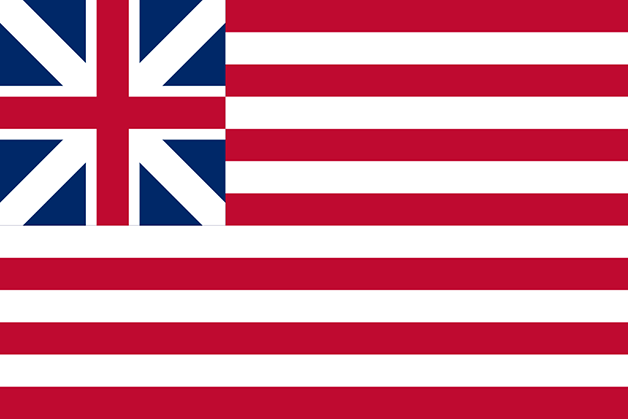
On December 3, 1775, the Grand Union Flag, comprising the Union Jack with thirteen red-and-white stripes was raised for the first time by Lieutenant John Paul Jones over the USS Alfred, a colonial warship. The flag would be used by Continental forces thorugh 1776 and early 1777.
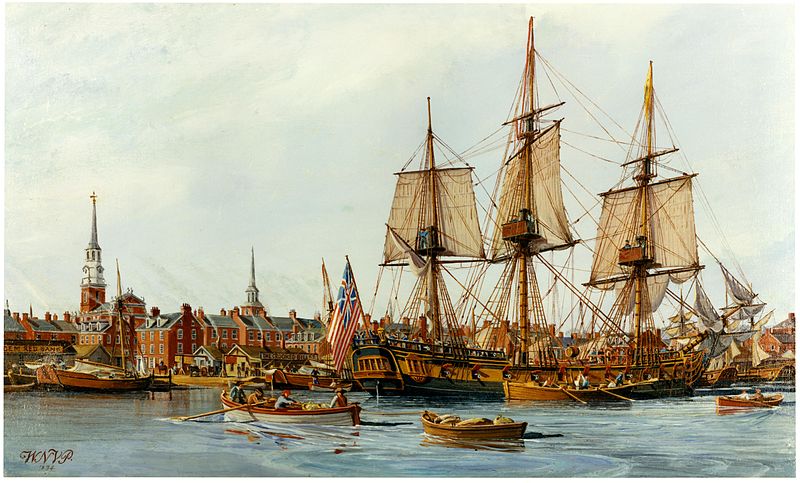
On December 3, 1776, General George Washington wrote Congress that he had moved most of his army across the Delaware River from Trenton, New Jersey to Pennsylvania.
On December 4, 1783, General George Washington told his officers he would resign his commission and return to his life at Mount Vernon.
The Skirmish at Rocky Creek Church took place near Waynesboro, Georgia on December 2, 1864.
On December 3, 1864, Union forces under the command of Gen. William T. Sherman skirmished against Wheeler’s Confederate cavalry at Thomas’ Station in Burke County, Georgia.
The Battle of Waynesboro, Georgia was fought between Wheeler’s Confederate cavalry and Kilpatrick’s federal troops on December 4, 1864.
Governor William Northen signed legislation placing on the statewide ballot a constitutional amendment to increase the number of Georgia Supreme Court Justices from 3 to 5 on December 4, 1893.
On December 4, 1932, a 12-foot tall statue of Tom Watson, former state legislator, Congressman, and United States Senator from Georgia, was placed on the State Capitol Grounds.
On December 4, 1945, the United States Senate voted to approve full U.S. participation in the United Nations. Georgia’s Senators voted in favor.
On December 4, 2018, Brad Raffensperger won the General Election Runoff for Georgia Secretary of State.
Georgia Politics, Campaigns, and Elections
Governor Brian Kemp and the Technical College System of Georgia announced grants for two new career academies, according to a Press Release.
Governor Brian P. Kemp today announced that the State Board of the Technical College System of Georgia (TCSG) approved grants totaling $6 million in bond funds to establish two new College and Career Academies. TCSG Commissioner Greg Dozier will award two partnerships with grant funds to establish the new College and Career Academies in Dooly and Monroe Counties via a cumulative bond amount of $6 million ($3 million to each) and a cash investment of $200,000 ($100,000 to each).
“These new academies will open doors for hardworking Georgians to pursue new opportunities and grow their skillset so that they find success in the No. 1 state for business,” said Governor Kemp. “As we continue to see unprecedented levels of job creation and investment in the Peach State, we know we need to expand our workforce to sustain our position as the best place to live, work, and raise a family. Innovative approaches like these academies will help us do that.”
Central Georgia Technical College (CGTC) will partner with two local education systems to establish the college and career academies. CGTC and Monroe County Schools will establish the MPower College and Career Academy, and CGTC will partner with Dooly County Schools to create the Dooly College and Career Academy.
“College and Career Academies play an important role in ensuring business and industry have a pipeline of skilled talent here in Georgia,” said TCSG Commissioner Greg Dozier. “When we provide high school students more learning opportunities that connect the classroom to the workplace, we are opening doors to meaningful careers for students while filling a workforce need in the community. It’s a win-win.”
College and Career Academies represent a community partnership between a local school system, a technical college, and local business or industry to teach students the skills necessary for career success and ensure fulfillment of the workforce development mission in each community. Georgia’s College and Career Academies have more than 3,000 business partners across the state and serve more than 45,000 students. The addition of these two facilities will bring the total number of College and Career Academies in Georgia to 57.
To learn more about Georgia’s College and Career Academies, visit www.tcsg.edu/gcca.
Georgia voters cast more than a million voted in early voting for the December 6, 2022 Senate Runoff Election, according to WRDW.
By 5 p.m. Wednesday, state election officials reported that more than 1 million ballots had already been cast.
In fact, demand has been so high that people in some areas of the state have had to wait in long lines. For example, wait times in Fulton County have surpassed two hours.
Early voting ends Friday, then Election Day is Tuesday for conventional voters.
In Richmond County, 23,874 people have cast early ballots so far. The total in Columbia County is more than 11,314.
Sterling said early voting is a convenience and voters should do their due diligence and check wait times ahead of time where applicable before heading to a polling place.
Georgia Secretary of State Brad Raffensperger said the pace far exceeds the number of voters who cast ballots in the runoffs of 2018 and 2016.
“Georgia’s voting system is working well,” Raffensperger said. “While some counties are seeing more voter turnout than they anticipated, most have found a way to manage voter wait-times, and I appreciate the election officials and workers across Georgia who are doing their level-best to accommodate our record turnout.”
From the Georgia Secretary of State’s Office:
December 1st, 2022Georgia voters kept adding numbers to their record-breaking turnout for in-person Early Voting in a midterm on Wednesday November 30th. Wednesday’s single-day total of 280,808 pushed turnout over the million-voter mark. As of Thursday morning, 1,054,605 voters have cast their in-person vote in the 2022 Runoff, a pace that far exceeds the number of voters who cast ballots in the runoffs of 2018 and 2016.
“Georgia’s voting system is working well,” said Secretary of State Brad Raffensperger. “While some counties are seeing more voter turnout than they anticipated, most have found a way to manage voter wait-times, and I appreciate the election officials and workers across Georgia who are doing their level-best to accommodate our record turnout.”
Long lines have been reported in some populous counties in metro Atlanta, but several polling locations report little to no wait times. Clayton, Forsyth, Richmond, Gwinnett, Fulton, Dekalb, and Cobb are among the counties publishing wait times, and we encourage voters to check before going to the polls. The last day for in-person Early Voting is Friday, December 2nd. To find Early Voting locations and hours in your county, visit the Secretary of State’s My Voter Page.
More information can be found on the Secretary of State’s Data Hub: Data Hub – December 6, 2022 Runoff | Georgia Secretary of State (ga.gov)
According to the Chatham County Board of Registrars’ most recent tally, there have been more than 19,000 people who’ve cast their vote during the early voting period. But we aren’t just seeing record-breaking numbers locally. The Secretary of State’s Office says the state crossed the one million vote mark on Wednesday.
The last day of early voting is Friday. If you don’t make it out, you will have to wait until Election Day on Tuesday, Dec. 6.
From WTOC reporting on turnout in Liberty County:
According to the county’s elections supervisor, early voters in Liberty County have experienced very few lines, with most being able to get in and out in five to ten minutes. This is also the county’s largest turnout for a runoff election.
By Thursday afternoon, around 6,500 people had cast their ballots either in person or absentee… something area elections officials are calling unprecedented.
“I love the fact that people are coming in and exercising their right to vote, and enjoying themselves when they come in. The last thing you want is a sour face. That’s the best thing ever, because we take care of our people when they come in. When they come through, they love it. They’re always getting a smile, and we’re getting a smile back to us,” said Ronda Walthour, the Liberty County Elections Supervisor.
Former President Barack Obama campaigned with U.S. Senator Raphael Warnock, according to the Associated Press via the Valdosta Daily Times.
Former President Barack Obama and Sen. Raphael Warnock on Thursday urged Democratic voters to keep pushing an apparent head start in early voting in the Georgia Senate runoff against Republican Herschel Walker, ahead of Friday’s last day of early in-person voting and Tuesday’s election day.
“If they didn’t get tired, you can’t get tired,” Obama told a crowd gathered in a cavernous former railroad repair shop east of downtown Atlanta.
Voters have already cast more than 1.4 million ballots amid an all-hands-on-deck push by Democrats to bank as many votes as possible while Republicans, especially Walker, have taken a less aggressive approach that could leave the GOP nominee heavily dependent on runoff Election Day turnout.
Both Obama and Warnock criticized Walker, part of Democratic attacks that Walker is unqualified and untruthful.
“When again and again you serve up bald-faced lies, that says something about the kind of person you are and the kind of leader you would be if elected to the United States Senate,” Obama said.
Georgia voters have cast more than 1.4 million ballots.
TargetSmart, a Democratic data firm, analyzed the identities of the 830,000-plus voters who’d cast ballots by the end of Tuesday and concluded that Democrats have increased their advantage by 14 percentage points over what it was with six days to go before the Nov. 8 election. That analysis did not include the 240,000-plus additional ballots cast Wednesday.
[Walker campaign manager Scott] Paradise said a Walker campaign analysis found that nine of the 10 counties with the highest turnout Monday were counties Walker won in November with a combined 70% of the vote. He added that of the state’s most populous counties — those with more than 100,000 registered voters — it was two Republican strongholds, Hall and Forsyth, that posted the highest turnout percentages Monday. Paradise said those trends reflect high enthusiasm among Republicans.
Obama argued on behalf of Warnock himself, though, saying “51 is better than 50 because it means Sen. Warnock will keep representing you in Washington.”
Warnock got about 70% of his overall first-round votes from advance voting; for Walker, it was about 58%. That translated to an advantage of more than 256,000 votes for Warnock. Walker answered with an Election Day advantage of more than 200,000.
“Plenty folks haven’t voted yet,” Obama said at the rally. “[Friday] is the last day for early voting. And then we need to get people out to the polls on Tuesday. Which means we still got work to do.”
“Since the last time I was here Mr. Walker has been talking about issues that are of great importance to the people of Georgia,” Obama said. “Like whether it’s better to be a vampire or a werewolf. This is a debate that I must confess I once had myself when I was seven.”
“He was an amazing running back,” Warnock said. “And come next Tuesday, we are going to send him running back to Texas.”
Walker also hit the campaign trail in Columbus, Ga. Thursday. Walker said that Warnock wants to defund the police and support abortion.
Floyd County should top 10,000 advance voters in the runoff when both early voting sites close Friday evening.
Through Thursday evening, 8,411 people had voted in person in the U.S. Senate runoff between Republican challenger Herschel Walker and incumbent Rev. Raphael Warnock, D-Ga.
Another 960 absentee votes have been received by the elections office as well, pushing the combined turnout to 9,371 ballots. Absentees are due by 7 p.m. Tuesday, election day.
Thursday’s turnout looks to be around 1,879 people, maintaining a weekday pace that has ranged from 1,832 to 1,970 on Thursday.
Through Thursday night, 33,451 people had voted in person in our five counties. Here are the advance voting totals:
Bartow: 12,138.
Gordon: 5,649.
Polk: 4,869.
Chattooga: 2,384.
From the New York Times on mail-in voting in Georgia:
While voter turnout remained strong, absentee voting in Georgia dropped off drastically in this year’s midterm election, the first major test of an expansive 2021 voting law that added restrictions for casting ballots by mail.
Data released by the Georgia secretary of state showed that mail voting in the state’s November general election plunged by 81 percent from the level of the 2020 contest. While a drop was expected after the height of the pandemic, Georgia had a far greater decrease than any other state with competitive statewide races, according to a New York Times analysis.
Turnout data suggests that a large majority of people who voted by mail in 2020 found another way to cast their ballots this year — turning to in-person voting, either early or on Election Day. Turnout in the state was 56 percent of all active voters, shy of the 2018 high-water mark for a midterm election.
“Under this new legislation, we just had the third-largest voter turnout for early voting in our state’s history,” Mr. Kemp said on Fox News two days before the election. “So it truly is easy to vote and hard to cheat here.”
The decrease in absentee voting in Georgia compared with 2020 was far greater than in other states with similar races. In Michigan, for example, absentee voting decreased by about 46 percent from the 2020 election, according to a Times analysis of data from the University of Florida’s U.S. Elections Project. In Florida, the drop-off was about 45 percent, and in Pennsylvania, absentee voting had a roughly 54 percent decrease.
About 1.3 million mail ballots were cast in Georgia in the presidential election two years ago, compared with just under 250,000 last month — an 81 percent decrease.
President Joe Biden endorsed a proposal to change the Democratic Party’s nominating process and elevate Georgia’s role, according to WSAV.
Multiple outlets reported that Biden suggested South Carolina be followed by Nevada and New Hampshire on the same day, then Georgia and finally Michigan. Iowa, the traditional first state on the nominating calendar, would be knocked out of first five altogether.
Biden said in the letter that voters of color must have a voice in choosing the party’s nominee much earlier than they currently do. He said someone should not be the Democratic nominee and win a general election unless they show they have “overwhelming support” from voters of color, including Black, Brown and Asian and Pacific Islander individuals.
Biden said the early voting states should reflect the party and country’s economic, geographic and demographic diversity, adding that union households should be represented in greater numbers than before. He said urban, suburban and rural voters should continue to have strong representation in early voting states.
Biden also called for the DNC to no longer allow caucuses, which he said are “inherently anti-participatory.” He said caucuses require voters to go vote in public and spend significant amounts of time to cast a vote, disadvantaging hourly workers and anyone who does not have the flexibility to go to a voting location at a set time.
Camden County Democrats are demanding expanded early voting hours, according to The Brunswick News.
The Camden County Democratic Party has sent a “demand letter” to county election officials asking for early voting hours to be extended to 7 p.m.
“While I am personally excited that Camden County is experiencing this surge in voter turnout, it seems clear that there has not been adequate preparation or planning,” [County Democratic Chair Kevin Blue] said. “Camden County has had as much time as any other county in Georgia to prepare for this special election. There can be no excuse to restrict or hamper voting access.”
The letter, sent at 10:52 p.m. Tuesday, was emailed to Camden County Clerk Katie Bishop and to an incorrect email address for the county attorney. The county clerk plays no role in elections.
Camden County Supervisor of Elections Shannon Nettles said she never knew about the demand letter until Wednesday afternoon. Even if she had gotten it earlier, Nettles said there was little she or board of elections officials could have done to accommodate the request on short notice.
“I couldn’t do anything this late in the game,” Nettles said. “The advertising requirements would not have been met.” The only way early voting hours could have been extended on short notice would have been through a court order, Nettles said.
“You can’t arbitrarily extend hours,” she said. “It takes more than me saying the polls will stay open until 7 o’clock. It would take the order of a judge.”
Nettles talked with state elections officials Wednesday after learning of the request and was told there were no circumstances such as long waits or problems with voting equipment that would have compelled a judge to grant such a request.
“I hope that Camden County Board of Elections will take these demands seriously and make the best decisions for the voters of Camden County,” Blue said in his letter. “But should the board decide otherwise, I will have no choice but to immediately refer my concerns to the Department of Justice.”
The New York Times writes about how Herschel Walker could win the U.S. Senate race.
With the runoff election just days away, the conventional wisdom holds that Senator Raphael Warnock is waltzing toward re-election against an inexperienced Republican opponent who has a thin grasp on policy issues, avoids reporters, faces serious allegations about his personal conduct and has been known to ramble on the stump. But if things were that simple, Warnock would have won handily in November.
And if there’s one thing American politics keeps teaching us, it’s to be humble about predicting what voters will do.
The case for Walker
The second theory rests on the fact that Georgia is still fundamentally a right-leaning state, as this year’s blowout race for governor showed. Perhaps the state’s historical tendencies will prove decisive in the runoff, whatever Walker’s deficiencies as a candidate.Warnock finished ahead of Walker in the general election by fewer than 40,000 votes. The Libertarian candidate, Chase Oliver, received more than 81,000 votes — and he is not on the ballot this time. Oliver earned about 50,000 votes more than the Libertarian candidate did in the race for governor, suggesting that he was a sponge for conservatives who could not stomach Walker. If only 46 percent of Oliver’s supporters vote for the Republican this time, Warnock’s margin on Nov. 8 will be completely erased.
It’s possible, too, that voters who chose Kemp but not Walker in November will change their minds — if they show up, that is. Walker drew a lower share of the vote than Kemp did, not just in metro Atlanta but also in the most conservative areas of the state. According to The Atlanta Journal-Constitution, Walker ran behind Kemp by at least six percentage points in eight counties — most of them Republican strongholds, with the exception of Cobb County.
Walker’s indictment of Warnock was always a simple one: He’s another vote for President Biden’s agenda. And, Biden, with an approval rating in the 30s or low 40s, is about as popular in Georgia as the Florida Gators. So Warnock was careful, during his lone debate with Walker, not to associate himself too closely with Biden.
The compressed time frame might play to Walker’s advantage, too. In 2021, there were nine weeks between Election Day and the combined runoff and special election for Georgia’s two Senate seats; Democrats used that time to out-organize Republicans. This year, because of a new Georgia election law, the runoff period is just four weeks, with less time for early voting.
Many of the younger voters who showed up for Warnock during the midterms, meanwhile, might not bother to vote, now that the perceived stakes are lower.
One recent poll, commissioned by AARP, shows Warnock with a narrow lead of 51 to 47 percent — within the margin of error. Although Warnock was up by 24 points among voters 18 to 49 years old, he was behind by nine points among voters 50 and older. The poll assumes that those older voters will make up 62 percent of the electorate in the runoff, but that’s just an assumption.
According to TargetSmart, a Democratic data firm, Democrats have a large edge in early voting. Georgia does not register voters by party affiliation, but according to TargetSmart’s modeling, 56.6 percent of the early votes were likely to have been Democrats, versus 35.6 percent for Republicans. A further 7.8 percent of votes were “unaffiliated.”
That doesn’t necessarily mean that everyone assumed to be a Democrat voted for Warnock, or that all of those assumed to be Republicans voted for Walker, but it’s one potential indicator that Warnock is well ahead among the 831,000 Georgians who have already cast ballots.
Even if it is behind in the early vote, the Walker campaign is banking on a surge of Republican turnout on Tuesday. Going into Nov. 8, Warnock was ahead by 255,000 votes, but Walker won Election Day voters by nearly 220,000 votes.
From another New York Times article:
Herschel Walker was being swamped by negative television ads. His Democratic opponents were preparing to flood the polls for early voting as soon as doors opened. After being hit by fresh allegations of carpetbagging, he was left with just over a week to make his final appeals to voters in the runoff for Georgia’s Senate seat.
But for five days, Mr. Walker was off the campaign trail.
The decision to skip campaigning over the crucial Thanksgiving holiday weekend has Mr. Walker’s Republican allies airing frustrations and concerns about his campaign strategy in the final stretch of the overtime election against Senator Raphael Warnock.
“We almost need a little bit more time for Herschel’s campaign to get everything off the ground,” said Jason Shepherd, the former chairman of the Cobb County Republican Party, pointing to the transition from a general election campaign to a runoff sprint. Notably, the runoff campaign was cut from nine weeks to four by a Republican-backed law passed last year.
“I think we’re behind the eight ball on this one,” Mr. Shepherd added.
Mr. Shepherd said Mr. Walker’s decision not to campaign during Thanksgiving was just one troubling choice. He also pointed to a series of mailers sent by the Georgia Republican Party encouraging voters to find their polling places that contained broken QR codes as examples of poor organizing. And he raised concern about the steady stream of advertisements supporting Warnock, a first-term senator and pastor, on conservative talk radio and contemporary Christian stations.
Perhaps the most important surrogate for Mr. Walker is Governor Kemp, who pulled in just over 200,000 more votes than Mr. Walker to win re-election. Mr. Walker’s campaign views Mr. Kemp as an influential voice with both conservatives and moderates who may be motivated to vote for Mr. Walker. The governor has contributed staff and resources to Mr. Walker’s cause and has appeared alongside Mr. Walker at a campaign event and fund-raiser. He also cut an ad with a direct-to-camera appeal to voters on behalf of Mr. Walker.
“Herschel Walker will vote for Georgia — not be another rubber stamp for Joe Biden,” Mr. Kemp says in the ad. “That’s why I’m backing Herschel. And I hope you’ll join me in voting for him too.”
Sheree Ralston, who was widowed by the death of her husband, Speaker David Ralston, will run in the January 3, 2022 Special Election to fill the remainder of his term, according to the AJC.
Sheree Ralston said in a statement Wednesday that she’s running to “complete the unfinished work of my husband,” both in the solidly Republican North Georgia district he represented from 2003 until his death Nov. 16 and on the issue of mental health care.
“David was our champion and voice at the Capitol,” she said, “and, if elected, that’s what I intend to be as well.”
Sheree Ralston is well-known in the Blue Ridge-based district she’s seeking to represent and at the state Capitol, both as David Ralston’s wife and as the executive director of the Fannin County Development Authority.
She was a frequent presence at the speaker’s side, including during the March vote by the House to approve his measure to expand mental health and addiction treatment programs in the state. David Ralston often said his wife pushed him to address the complicated issue.
Gov. Brian Kemp has set the date for the special election for Jan. 3. The winner will represent the district for the full 2023-2024 legislative session.
In a rare move, Kemp immediately endorsed Sheree Ralston’s candidacy, saying there’s “no one better” to serve the district.
“Sheree’s passion for mental health reform and experience creating greater opportunity for the citizens of her community uniquely qualify her to be a strong voice for the hardworking Georgians of Fannin, Gilmer and Dawson counties in the state House.”
I have not seen anything from the Secretary of State’s Office about qualifying dates and times for the Special Election.
Georgia’s United States Senators announced the state will receive more than $250 million to expand broadband, according to the Savannah Morning News via the Augusta Chronicle.
The federal money will be distributed by the state to a number of counties, including areas surrounding Augusta and Athens.
“This is vital for small businesses, for farmers, for schools and families, for kids doing schoolwork in the afternoons at home, for all of us for our state’s prosperity, to move toward universal access to high-speed internet,” Ossoff said during a press conference.
Ossoff said the money would go from the federal Treasury Department to the state, which would distribute the funds to broadband providers to actually build out infrastructure. The Governor’s Office of Budget and Planning has a website for providers looking to apply for funding.
Gov. Brian Kemp announced the program over the summer, and opened up the site for applications, but the federal funding for the program has now been finally approved.
“Broadband expansion is crucial to keeping Georgia’s economy moving forward,” [Warnock] noted in the release.
The counties that are eligible to apply include Banks, Jackson, Madison, Oglethorpe, Burke, Glascock and Jefferson.
Gwinnett County Public Schools is getting more than $5 million from the federal government to pay for improvements to off-campus broadband internet access for students, according to U.S. Sen. Raphael Warnock.
Warnock announced that his office worked with the Federal Communications Commission to get the funding for GCPS. Warnock’s office also secured funding for similar off-campus broadband access improvements for students at Brighten Academy in Douglasville and The Museum School of Avondale Estates in Decatur.
Chatham County legislators laid out their priorities for the 2023 Session of the Georgia General Assembly, according to the Savannah Morning News.
New will be Rep. Anne Allen Westbrook, who was elected to the District 163 seat in 2022 when the incumbent, Rep. Derek Mallow, ran successfully for Jackson’s open post.
Also joining the fold is Sen. Billy Hickman, a lawmaker who now represents a swath of Chatham County. The Statesboro resident’s district boundaries changed with the 2021 redistricting and now includes Bloomingdale and parts of Pooler and unincorporated Chatham County.
All nine members of the local delegation attended the Savannah Area Chamber of Commerce’s annual Eggs & Issues breakfast Thursday at the Savannah Marriott Riverfront. Each lawmakers shared his or her priorities for the next session and gave brief remarks.
If you’re interested in legislative issues, I recommend reading the entire article.
Representatives from the Coastal Empire say a lot of the focus in the year ahead will be on building around 2022′s big economic boom.
The group came together with local business leaders for the Savannah Area Chamber of Commerce’s annual Eggs and Issues Breakfast. WTOC caught up with three of the people representing our area in the upcoming legislative session, who all say the coming year is about our area’s expanding opportunities.
“We’ve got so much that all of a sudden is happening in Chatham County, Coastal Georgia, with the ports, of course the explosion of Hyundai coming here is going to be a game changer – 5 times larger than anything we’ve ever done,” State Rep. Ron Stephens said.
The growth right next to Chatham County in Bryan County means Georgia’s Coastal Delegation is expanding this year, something one 25-year veteran of the General Assembly says won’t change what the group is known for under the Gold Dome.
“We’ll have three senators now instead of two, but we’ll still have 6 of us in the House, evenly split, Democrats and Republicans, which is a very good thing. And I got to tell you after all these 25 years, we always work together. That’s something that Chatham County has been known for and Coastal Georgia quite honestly, and our issues are so much different than Atlanta and other parts of the state,” Stephens said.
Lawmakers have just over a month before they return to Atlanta. The new session starts on Jan. 9.
Bulloch County and Statesboro expect to surpass 100,000 residents by 2030 as the new Hyundai plant comes online, according to the Statesboro Herald.
Bulloch County and Statesboro city officials in a joint meeting Tuesday afternoon shared projections that the county’s population will approach or exceed 100,000 by 2030 and proposals or aspirations for more than $100 million worth of water, sewer and natural gas projects.
“In the bigger picture, we’ll probably go from 81,000 to about 98,000 to 103,000 by 2030, and it really depends on how fast this Hyundai growth occurs,” County Manager Tom Couch said during his presentation Tuesday.
In the revised projections, the population of the southeastern portion of Bulloch County, nearest the Hyundai plant, is expected to grow by 4,000 to 6,400 people, with a midrange estimate of 5,184 new residents for that area alone. Meanwhile, the rest of the county is expected to gain 12,442 new residents, according to a projection in Couch’s slideshow.
County planners here looked at growth patterns in multi-county regions around the Kia factory at West Point, Georgia, and the Hyundai plant at Montgomery, Alabama, in making the revised projections. Both of those vehicle factories are smaller than the one planned in Bryan County.





Comments ( 0 )