
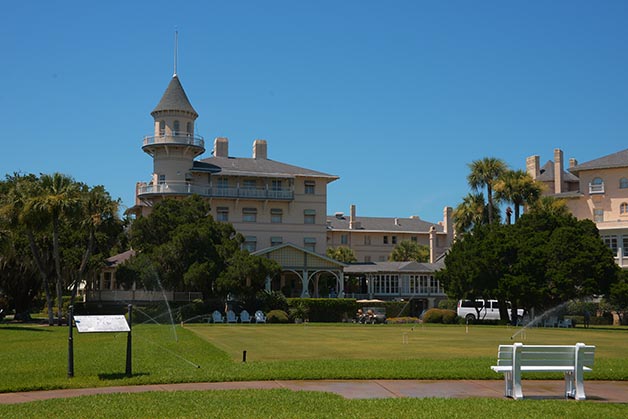
On January 24, 1915, the first transcontinental telephone call was placed from Jekyll Island, Georgia.
January 24, 1933 saw the first sales tax in Georgia proposed to fund schools and aid for farmers.
On January 24, 1960, Martin Luther King, Jr. became co-pastor of Ebenezer Baptist Church, sharing the pulpit with his father.
On January 24, 1987, some 12,000 to 20,000 civil rights protesters marched in Forsyth County, a week after a smaller protest. From the New York Times reporting:
CUMMING, Ga., Jan. 24— This small town in Forsyth County was overwhelmed today by civil rights marchers, members of the Ku Klux Klan and their sympathizers and an army of National Guardsmen and law-enforcement officers who kept the opposing groups separated.
Guarded by what a spokesman for the Governor’s office called ”the greatest show of force the state has ever marshalled,” a crowd of marchers estimated at 12,000 to 20,000 funneled slowly into Cumming, where a week earlier counterdemonstrators, throwing stones and bottles, disrupted an interracial ”walk for brotherhood” prompted by the all-white county’s racist legacy.
As the marchers headed into Cumming, which has a little more than 2,000 people, they found waiting for them, behind a stern-faced force of 2,300 guardsmen and police officers, a group of hundreds if not thousands of white, mainly young, rural men and women, repeatedly shouting, “N***er, go home!”
Whatever the final figure, the march was one of the largest civil rights demonstrations since a 1965 rally that followed a march from Selma, Ala. to Montgomery. The rally, led by Dr. King, drew 25,000 people.
Seriously, read the Times report.
On January 24, 2001, the Georgia House of Representatives approved legislation changing the state flag to the Barnes design with the state seal on a blue background and a banner depicting five previous flags that flew over Georgia.

Georgia Politics, Campaigns, and Elections
Governor Nathan Deal spoke to the annual Tourism, Hospitality & Arts Day yesterday.
Industry representatives presented Deal with a check representing the $3.1 billion in state and local tax revenue generated by tourism-related expenditures.
“With a record economic impact of $60.8 billion, Georgia’s tourism industry is a powerful economic development tool for local communities and our state as a whole,” said Deal. “This impact goes well beyond direct spending by visitors, as the industry provides job opportunities for more than 450,200 Georgians, accounting for approximately 10.6 percent of the state’s non-farm workforce. As this industry continues to grow, this success reflects our state’s status as a world-class tourism destination and once again affirms that Georgia is on the minds of travelers around the globe.”
Deal also unveiled the cover of the official 2018 state travel guide, which features Georgia-native Jason Aldean, the reigning Academy of Country Music “Entertainer of the Year.” The cover photo was taken in Macon, Aldean’s hometown, at The Big House Museum where original members of The Allman Brothers Band lived and wrote some of their first songs.
“Being from Georgia is something I’m really proud of,” said Aldean. “A lot of my influences as an artist come from its musical history and it will always be a big part of who I am.”
LEGISLATIVE COMMITTEE MEETINGS
8:30 AM SENATE VETERANS, MIL & HOMELAND SEC 307 CLOB
NOON SENATE RULES – UPON ADJOURNMENT 450 CAP
1 PM SENATE INS & LABOR 310 CLOB
1 PM HOUSE MEDICAL CANNABIS WORKING GROUP 606 CLOB
1:30 PM House Ways & Means Sub Pub. Fin. and Policy 133 CAP
2 PM SENATE TRANS – CANCELED 310 CLOB
2 PM HOUSE RETIREMENT 515 CLOB
3 PM HOUSE IND & LABOR 506 CLOB
3 PM SENATE FINANCE MEZZ 1
3 PM SENATE ED & YOUTH – CANCELED
4 PM SENATE JUDICIARY 307 CLOB
The AJC Political Insider reports that Gov. Deal will likely name Tricia Pridemore to a vacancy on the Georgia Public Service Commission.
“It is my inclination at this point to appoint Tricia Pridemore, but we’re not at that stage of the game yet,” he said. “We’ll wait and see when the actual opening occurs, but that is my inclination.”
The seat will be vacated by Stan Wise, the PSC chair, who said last week in a letter to Deal that he will step down on Feb. 20. The Cobb County resident had previously announced he won’t be seeking re-election in 2018 after serving 23 years on the commission.
Democrat Doug Stoner, a former state senator, is among the likely candidates for the office.
Democrats hope to gain a foothold in the PSC, which regulates Georgia’s utilities, by highlighting the panel’s unanimous vote to allow construction to continue on two nuclear reactors at Georgia Power’s embattled Plant Vogtle despite billions of dollars in cost overruns.
Former Democratic State Senator Vincent Fort is considering a run for Lieutenant Governor.
The Atlanta Democrat said he’s discussing with advisers whether to jump into the contest to succeed Lt. Gov. Casey Cagle, who is running for governor.
The statewide race for lieutenant governor would be a much bigger and costlier race for Fort, who struggled to raise cash and gain traction in the mayor’s election.
He also won’t have a clear path. Several Democrats are already in the race, including political newcomer Sarah Riggs Amico, a logistics executive. And three leading Republicans are in the race: Former state Rep. Geoff Duncan, ex-state Sen. Rick Jeffares and state Sen. David Shafer.
And while endorsements from Sen. Bernie Sanders and former Gov. Roy Barnes helped him raise cash, it couldn’t keep pace with the millions of dollars his rivals collected for their runs. Ditto for his union support, whose force of door-knockers couldn’t overcome other get-out-the-vote machines.
A Fort bid could set up an awkward situation for the party. He’s a critic of another Democrat who is running for a spot on the top of the ticket: Stacey Abrams.
Former Forsyth County Commissioner Brian Tam will run for the State Senate District 27 seat being vacated by the incumbent.
Tam was commissioner of Forsyth County District 2 from 2005-16 and selected as board chairman in 2011.
In February 2016, Tam announced he would not seek re-election for the seat and said the time was a “good stopping point.” On Monday, he said there were still some things he wanted to see happen in the county.
“I think there is work to be done,” Tam said on Monday. “I want to continue the relationship that I built with the Georgia Department of Transportation, as far as getting the necessary funding for our roads in here in Forsyth County, and I want to continue to work toward getting funding for new schools in the county.”
Tam is the second candidate to publicly announce he would run for the seat. Candidate Greg Dolezal — a local businessman who has part of several Forsyth County boards and committees, including planning commission and comprehensive plan steering committee — announced his candidacy for the seat in June 2017.
Democrat Donna McLeod will kickoff her campaign for House District 105, currently represented by Republican Rep. Joyce Chandler.
The Democrat will formally announce she is running again for the seat during the kickoff event, which will begin at 4 p.m. Saturday at Jay’s Caribbean Cuisine, 150 Hurricane Shoals Road in Lawrenceville. McLeod narrowly lost the seat to incumbent Rep. Joyce Chandler, R-Grayson, in 2016 in a race that was close enough that a recount was needed.
State Sen. Nikema Williams, D-Atlanta, will host the event. State Reps. Brenda Lopez, D-Norcross; Pedro Marin, D-Duluth; Dewey McClain, D-Lawrenceville, and Sam Park, D-Lawrenceville, are expected to address attendees as well, according to the McLeod campaign.
Savannah-area legislators will introduce legislation to rename the Talmadge Bridge.
Rep. Ron Stephens, the dean of Chatham County’s legislative delegation, informed the Savannah City Council on Monday that he intends to introduce legislation to rename the Eugene Talmadge Memorial Bridge after Savannah native and Girl Scouts founder Juliette Gordon Low, as requested by the organization.
Stephens’ support for the change comes after Girl Scout representatives informed the mayor and aldermen earlier this month of their intention to ask state legislators to rename the bridge after Low, who started the Girl Scouts with an inaugural gathering of just 18 girls in Savannah. The Girl Scouts adopted the name change as a national policy at their convention in October and officials said the city would benefit financially by attracting Girl Scouts and their families from around world to the national convention and other events in Savannah.
Named for a former state governor and staunch segregationist, the Talmadge Bridge’s renaming was one of the Savannah City Council priorities Stephens and other state lawmakers discussed with the mayor and aldermen at the state capital during the meeting this week.
The city council had submitted its own resolution to rename the bridge The Savannah Bridge as a way to avoid any more controversies surrounding public figures, but Mayor Eddie DeLoach said he is not opposed to Stephens’ proposal.
“The biggest thing we’re doing is trying to get a name change, so if that’s a fallback that will bring someone along I don’t have a problem with it,” DeLoach said. “Anything but Talmadge.”
Cobb County Commissioners voted 3-2 in favor of a resolution to move forward with a sales tax for public safety.
Commissioner Bob Weatherford’s proposal to ask Cobb voters to increase the county’s sales tax from 6 to 7 percent would generate an estimated $130 million a year. After Cobb’s six cities were given a cut of the revenue, the county would be left with $96.2 million to use toward public safety.
That amount would cover the $71 million in public safety expenses paid using the county’s general fund with the exception of the Cobb Sheriff’s Office.
Instituting the new tax requires three steps. First, the county commission will send its resolution to state lawmakers asking for a bill to create a referendum on the issue. Then, the Legislature would need to approve the bill. Lastly, the measure would come before voters for a final say.
Commissioners on Tuesday night approved step one of the process, with Weatherford, County Chairman Mike Boyce and Commissioner JoAnn Birrell in favor of the resolution and commissioners Bob Ott and Lisa Cupid opposed.
Hall County will study the costs of implementing bilingual ballots for local elections.
“We’ve looked at it every which way, and you’re talking signs, duplicate ballots, Spanish-speaking staff,” Bill Moats told The Times in late 2017. “For a large election like we had in 2016, it was north of $150,000.”
On Monday, the county called that figure a “very rough estimate.”
“The Elections Board’s decision to form a committee to further research those costs in greater detail should help give the county a better and more thorough understanding of the costs associated with bilingual ballots,” said Hall County spokeswoman Katie Crumley.
Craig Lutz, a Republican member of the board, sponsored the vote to scrap bilingual ballots in Hall County. He also moved to create the committee charged with studying the cost of Spanish-language ballots, saying earlier this month that the county needed to research the issue to see what the costs would be and also research whether voters were being disenfranchised with English-only ballots.
Voting rights advocates supporting bilingual ballots have said that county demographics — especially given that more than a quarter of its population is Latino — means it will be forced by the federal government to adopt Spanish-language ballots in the next few years under federal elections law.
Floyd County Commissioners are considering joining a lawsuit by Rome and other local governments against opioid manufacturers.
The board officially labeled the growing effects of overuse as a public nuisance Tuesday in a resolution that points the finger at pharmaceutical companies.
However, commissioners softened the language adopted by the city of Rome Monday to say they may sue, instead of they shall sue. Commissioner Scotty Hancock asked for the change until the medical community can weigh in.
“I feel we need to bring these groups to the table and get feedback before we commit to a lawsuit,” he said.
“We 100-percent agree it is a nuisance, and we need to do something about it,” Commission Chair Rhonda Wallace said.
The discussion followed a presentation from attorneys Bob Finnell and Andy Davis, who are putting together a case for a group of cities and counties in Georgia.
DeKalb County Commissioners are working on a proposal to lower penalties for marijuana possession.
Georgia law gives municipalities the freedom to create local rules for drug-related violations. Now DeKalb wants the General Assembly to give counties the opportunity to create ordinances related to pot possession.
Commissioners said Tuesday that taxpayer dollars are wasted and lives negatively affected when people are prosecuted for possession of small amounts of marijuana.
[Commissioner Mereda] Johnson, a Democrat, received a commitment from fellow Commissioner Nancy Jester, a Republican, to work together on the measure.
Although the full DeKalb commission won’t sign off on the proposal for another two weeks, five of seven members were present at Tuesday’s committee meeting where the proposal received an initial vetting. They directed their lobbyist to float the issue among legislators and law enforcement officials to gauge initial reaction.
As the proposal is written now, any county in Georgia would be allowed to create local rules for possession of less than an ounce of pot. But language could be added to make it applicable only to DeKalb if members of the General Assembly indicate that would be more palatable.
Apple Computer co-founder Steve Wozniak will speak at the 13th annual Jim Blanchard Leadership Forum August 27-28 at the Columbus Convention & Trade Center.
Muscogee County School Board members Frank Myers and John Thomas announced jointly that they will not run for reelection.
“To accomplish anything with the school board, there must be five votes,” Thomas wrote. “Frank and I have evaluated our tenure on the board to this point, and looking ahead to the future, we have done the math. We will not have five votes on any of the issues that are most important to us.”
Thomas, an IRS agent, represents District 2. Myers, a self-employed lawyer, represents District 8.
Hall County Board of Education member Brian Sloan announced he will not run for reelection.
“With the wonderful blessing of the rapid growth of the church in which I serve … and the additional responsibilities that come along with hundreds of additional people coming has made me seriously evaluate my time and priorities,” Sloan said.
Sloan is currently serving his third term on the board representing South Hall and was last re-elected in 2014, narrowly defeating Mark Pettitt.
“I think I still have a strong support base and would like to think I would be re-elected if I entered the race,” Sloan said. “However, that is just not the wise thing for my family, Chestnut Mountain Church, the Hall County School District or me. It is my strong belief that there is someone out there who can take this position and give it the time and attention in the next four years that I would not be able to give.”
Three candidates announced plans to run for seats on the Savannah-Chatham County School Board.
Alfreda Goldwire has announced she will run for the District 6 Savannah-Chatham County school board seat.
The seat is currently held by Larry Lower. Lower has announced he will run for board president.
Jolene Byrne currently holds the president’s post. She has not yet indicated if she intends to seek another term.
District 5 board member Irene Hines also announced she will run again.
David Lerch filed a declaration of intention to accept campaign contributions for the school board president post in August of 2017.
The non-partisan general election will be held on May 22. Qualifying begins on March 5.
The Georgia Ports Authority will break ground on its Mason Mega Rail project.
Georgia Ports Authority Board members approved a budget increase this week of $5.8 million for the port’s Mason Mega Rail project. The money will cover work to integrate American parts into large cranes for the project being manufactured in Finland.
GPA was approved in 2016 for a $44 million grant for the overall project cost from the federal government’s FASTLANE program, designed for infrastructure projects supporting growth of the economy and encourages use of American-made products through its Buy America clause.
The federal funds are to be used for design, delivery and commissioning of eight rail-mounted gantry cranes as part of the project that will connect the Mason and Chatham rail yards at the Garden City Terminal. The overall mega rail project cost is $126.7 million.
The mega rail project will double on-dock rail capacity and open service to inland markets, including Chicago. The new rail terminal will allow 10,000-foot trains to be loaded at the terminal with containers double-stacked. Those trains will increase the capacity from 500,000 container lifts per year to 1 million. Eighteen new railroad tracks will also be built, adding 97,000 feet of new rail.
Groundbreaking for the project is expected in February, with an official GPA board event being held in March.
A federal tariff on imported solar panels may slow the industry’s growth in Georgia.
The Trump Administration announced Monday that imported solar panels will be subject to a 30 percent tariff, a result of the recommendation of the International Trade Commission in its decision on a case filed by Georgia-based, foreign-owned Suniva. The trade tariff is expected to go into effect Feb. 6.
The Georgia Solar Energy Association predicts the tariffs will slow the growth of what has been a booming business in Georgia, with utility-scale solar being the hardest hit.
“While these erroneous tariffs may cause short-term headwinds to Georgia’s thriving solar industry, it will only strengthen our resolve to continue moving forward into a clean energy future,” said Don Moreland, chair of the Georgia Solar Energy Association.
Georgia ranks ninth among states with about 1,500 megawatts installed, enough to power about 170,000 homes. The state’s 238 solar companies employ about 4,000 people, according to the Solar Energy Industries Association.
U.S. Rep. Buddy Carter, R-Ga., who supported solar energy when he served in the state legislature, said solar will play an important role in energy independence in the U.S. But he wasn’t ready to praise or condemn the tariff.
“I am still reviewing the administration’s proposal, but President Trump is focusing on America first. He is serious about addressing trade imbalances and market dumping in the international market,” Carter said. “President Trump is working to rebuild and invigorate our manufacturing industry and manufacturing jobs. His goal is to put American workers and companies first, and I absolutely support that.”
The University of Georgia is working with Pulaski County to address healthcare needs in the rural county.
Before the [Taylor Express Care] clinic opened in June 2016, Pulaski County residents had nowhere to go for immediate care except the emergency room at Taylor Regional Healthcare, the local hospital. A Community Health Needs Assessment, or CHNA, facilitated by faculty and students at the University of Georgia showed that the county needed an alternative.
Today, the clinic averages about 15 patients a day and emergency room visits are down almost 23 percent, from nearly 6,000 annually before Taylor Express Care opened to just over 4,600 in the past year.
“It was greatly needed,” said Bailey Lanier, a nurse practitioner on duty during a chilly November morning. “Before you just had the ER, and that was it. We’ve opened doors to people who didn’t have health care, who just didn’t know who to go to.”
Helping with the CHNA, required of all hospitals to receive federal funding, is just one of the many ways that the University of Georgia has helped Pulaski County address critical health care issues, a common problem for rural Georgia communities.






Comments ( 0 )