
President George Washington died at Mount Vernon on December 14, 1799. Here’s an article about the nation’s mourning for our first President.
The Congress, in session at the capital of Philadelphia when Washington’s death was announced, immediately adjourned. The House of Representatives assembled the next day and resolved to shroud the Speaker’s chair in black and have members wear black during the remainder of the session. On December 23, John Marshall speaking for the joint committee of both houses, presented five points that became the foundation for the United States’ first “state” funeral. Resolutions structured mourning events around public commemorations that fostered unity and a sense of national identity among grieving Americans.
President William McKinley addressed the Georgia General Assembly on December 14, 1898.


On December 14, 1939, a parade was held through downtown Atlanta with stars from Gone With the Wind and the Junior League held a ball that night. The next day, December 15, 1939, Gone With the Wind held its world premiere at Loew’s Grand Theater in Atlanta.
Georgia Politics, Campaigns, and Elections
State Senator P.K. Martin (R-Gwinnett) made good on his wager with Senator John Albers (R-Roswell) over a high school football game.
Meanwhile, Senator Renee Unterman (R-Buford) and Sen. Bruce Thompson (R-White) followed the lead of their colleagues and met at the Georgia Dome for a charity challenge to support their local high school football teams.
Chatham County Sheriff Roy Harris, who took over the office when Sheriff Al St. Lawrence died in office, will run for the job in a Special Election on March 1, 2016.
He qualified to run on Tuesday and is one of five candidates in the nonpartisan March 1 election, each of whom has experience in the department.
St Lawrence’s daughter, Tammy St. Lawrence Canfield, said afterward the family supports Harris as her father’s successor.
“Today I speak for my beloved father who wished for Roy Harris to continue his legacy as a public servant. It was his belief that Roy Harris is committed to protecting your family and our dedicated law enforcement professionals.”
Harris is one of five candidates to qualify for the post by the Wednesday deadline:
• John Wilcher, 71, a 40-year veteran of the sheriff’s office who retired in 2014 as jail administrator with the rank of colonel.
• McArthur Holmes, 60, who served in the sheriff’s office for more than 33 years before retiring as jail administrator in 2011 with the rank of colonel.
• Ken Williamson, 57, who served 10 years in the Deputy Sheriff’s Reserve Unit before leaving in 2008 and with more than 30 years in the commercial finance industry.
• Kimberly Middleton, 54, who served for 28 years in the sheriff’s office before retiring in September as chief of operations with the rank of major.
Clarkesville Mayor Dr. Terry Greene died Sunday after a gunshot wound to the head and the investigation continues.
Reva Jennings, a well-known and popular Georgia Republican activist, died this weekend after it appears she accidentally drove into Lake Lanier. She’ll be sorely missed by all who knew her. I’ll miss most her always-positive and enthusiastic attitude.

Savannah City Council adopted a zoning ordinance that will restrict fireworks sales to industrial and heavy commercial districts in the city.
Honey Van De Kreke and Michell Penkava will take office as members of the first Tucker City Council after they each qualified unopposed for the March 1, 2016 election. The elections for first Mayor of Tucker will be a three-way race with Frank Auman, Lorne D. Cheek, and Bruce K. Jackson qualifying.
Three Democrats qualified for the January 19, 2016 Special Election for House District 58 – Park Cannon, Kwame Thompson, and former State Rep. Ralph Long, III.
A report on the release of personal information about Georgia voters is due to be released today.
How fines and fees are used by the state continues to be an issue raised by local governments heading in the 2016 Session.
Fees and fines gathered by the state from hazardous waste cleanups should go back to fund environmental issues, a member of the Coosa River Basin Initiative told local legislators Thursday.
Joe Cook, riverkeeper for Rome-based CRBI, brought up the issue during a pre-legislative breakfast hosted by the Greater Rome Chamber of Commerce at Coosa Country Club.
Right now, most fees and fines collected by the state go back into the general fund, instead of into specific areas.
“It’s kind of disingenuous of the legislature to, year after year, raid those funds to pay for something else,” Cook said afterward in an interview with the Rome News-Tribune.
The proposal would require a constitutional amendment.
Rep. Christian Coomer, R-Cartersville, said adding such an amendment would burden the state by preventing it from spending the money where it is needed most.
He said an amendment would most likely not happen, but he can foresee a bill that might earmark some fees and fines to fund certain programs — with the leftover money going to the general fund.
Last week former Congressman Jack Kingston wrote about the progress made by the Georgia Republican Foundation under his leadership.
• We’ve grown from 8 members to 78 members, which includes more than 30 who have given far more than the requested amount.
• Secretary of State Brian Kemp became the first statewide Constitutional officer to join us and Tom Price became the first Member of Congress to join.
• Eight state legislators have joined, including Senators Burt Jones, Jack Hill, Bill Cowsert, Tyler Harper and Josh McKoon and State Reps. Regina Quick, Terry England, and John Meadows.
• Three local Republican parties – Jackson and Fulton Counties and the 9th Congressional District have joined the Foundation.
• We’ve hosted receptions for Foundation members with Rep. Buddy Carter, Rep. Lynn Westmoreland, Sen. David Perdue, and State House Speaker David Ralston where our members hear from elected officials in a relaxed setting that allows for conversation, and question and answer not usually possible at other GOP events.
A State House committee held three hearings to learn about arguments for and against legalizing casino gambling in Georgia.
Chairman Rep. Matt Ramsey, on Thursday said the group will sum up what it has learned in a report rather than make an up-or-down recommendation before lawmakers return to the Capitol on Jan. 11.
In the meantime, gambling powerhouses aren’t staying quiet. MGM Chairman and CEO Jim Murren teased interest in a downtown resort and casino at the panel’s first meeting, adding that metro Atlanta could support a $1 billion project with restaurants and concerts for other entertainment options.
MGM has 14 lobbyists prepared to continue making the company’s pitch, a number that rivals other Capitol powerhouses. For instance, state records listed 15 lobbyists registered on behalf of the utility Georgia Power and named eight for the Georgia Chamber of Commerce.
Other gambling firms have hired lobbyists ahead of the session. Records show three registered for the Boyd Gaming Corp., which runs 22 casinos in eight states including Louisiana and Mississippi. Penn National Gaming, with 27 casinos including several Mississippi properties, also has three registered lobbyists.
Opponents of gambling expansion in Georgia, wary of gambling companies’ clear preparations for 2016, are trying to reach members at home before the session begins. The conservative Faith and Freedom Coalition this month sent out flyers headlined “Stop the casino rip-off!” to voters in several of the study committee members’ districts, warning that crime, corruption and addiction will follow gambling expansion.
Cruz Returns to Georgia
Politico.com writes that Ted Cruz will undertake a barnstorming tour of the South in December, ahead of the 2016 early state primaries and the March 1 “SEC Primary.”
Ted Cruz will embark next week on a splashy swing through many of the states that vote on March 1, an effort to lock down support in those mostly Southern states before turning full attention to the first four voting contests of the 2016 Republican presidential primary.
The Texas senator, flying with staff and his family on a chartered plane, will do 12 events in 12 cities in one week, flying from Las Vegas to St. Paul, Minnesota, on Dec. 17 after the next presidential debate, and wrapping up on Dec. 23 in Oklahoma City. The fly-around tour, dubbed “Take Off with Ted,” will feature rally-style events in states including Minnesota, Virginia, Georgia, Alabama, Tennessee, Arkansas and Oklahoma. The tour will be a highly produced endeavor apparently designed to help voters envision Cruz as a general election contender.
The Cruz campaign for months has worked to make the South its bulwark, embarking on a bus tour there in the summer and building out campaign infrastructure in the Super Tuesday states, a list that includes Georgia, Alabama, Arkansas, Tennessee, Texas and Oklahoma — places with large evangelical populations, a constituency that Cruz is hoping will coalesce around him.
Cruz makes his swing through Georgia this Friday and Saturday with events in Kennesaw and Atlanta. Hit the links for your free tickets.
Take Off with Ted Atlanta Rally
Friday, December 18, 2015, Doors Open at 3:30 PM, Program starts at 4:30 PM.
Cobb County International Airport – McCollum Field
Hawthorne Aviation Hangar
1723 McCollum Pkwy NW
Kennesaw, GA 30144Take Off with Ted Savannah Rally
Saturday, December 19, 2015, Doors Open at 9 AM, Program starts at 10 AM
Ottawa Farms
702 Bloomingdale Road
Bloomingdale, GA 31302
Over the weekend, a Des Moines Register/Bloomberg poll showed Cruz opening up a significant lead among likely Iowa caucus-goers.
Seven weeks from the caucuses, Ted Cruz is crushing it in Iowa.
The anti-establishment congressional agitator has made a rapid ascent into the lead in the GOP presidential race here, with a 21 percentage-point leap that smashes records for upsurges in recent Iowa caucuses history.
Donald Trump, now 10 points below Cruz, was in a pique about not being the front-runner even before the Iowa Poll results were announced Saturday evening. He wasted no time in tearing into Cruz — and the poll — during an Iowa stop Friday night.
Here’s the breakdown from that poll:
Ted Cruz 31%
Donald Trump 21%
Ben Carson 13%
Marco Rubio 10%
Jeb Bush 6%
Rand Paul, Mike Huckabee, Chris Christie, 3% each
All other candidates 2% or less
This graphic, from the Des Moines Register/Bloomberg poll shouldn’t surprise anyone who was in Georgia last year for David Perdue’s Senate campaign.
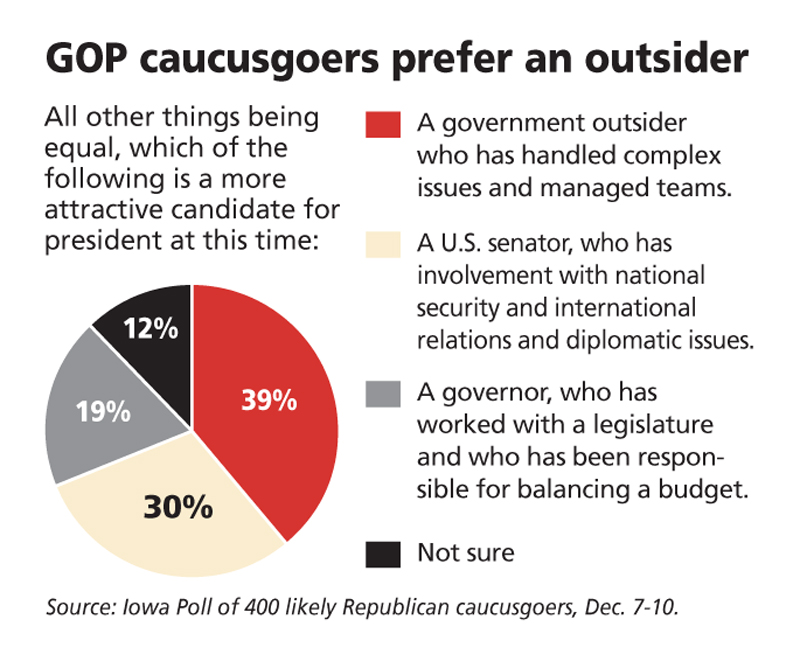
Before the poll results were released, Politico spoke to J. Ann Selzer, who performed the Des Moines Register poll and has done so for years.
At a time when trust in public polling has eroded after high-profile failures in elections across the country and around the globe, people in Iowa still have faith that one woman can accurately measure where things stand in next year’s volatile caucuses.
That woman, J. Ann Selzer, has predicted election after election in Iowa working out of a small office in the Valley Junction section of West Des Moines — between the Tres Amigos Mexican restaurant and Perry Bridal shop, and across the street from At the Heart of Quilting, a sewing-supply store
As the Des Moines Register and Bloomberg News prepare to release Selzer’s latest survey of the GOP caucuses Saturday evening, how does the longtime Iowa pollster explain how she’s bucked the trend, even while acknowledging that conducting accurate polls becomes more difficult every cycle?
“I think it has to do with being more of a traditionalist, science-based pollster,” Selzer told POLITICO during an interview at her firm’s offices last month. “And because it has worked for me, I’ve not been tempted to go and try other methods. And because I have clients who are willing to pay the premium that it takes to do it this way, I’ve not had to cut corners.”
Selzer, who has polled for the Des Moines Register for decades, was the only pollster to nail the order of Democratic candidates in 2004. Her final poll before the 2008 caucuses accurately predicted that a surge of first-time caucusgoers would propel Barack Obama to a decisive victory. Selzer saw former Pennsylvania Sen. Rick Santorum’s surge in the waning days before the 2012 GOP caucuses when few others did.
And just last year, the final Register poll in the Iowa Senate race showed Republican Joni Ernst with a 7-point lead, contrary to other polls that showed a much closer race with Democrat Bruce Braley. Braley’s campaign decried the poll, calling it an “outlier.” But Ernst won by 9 points.
The Washington Post takes a look at the bleeding edge of voter targeting with the Ted Cruz campaign.
The [Cruz campaign] outreach … is part of a months-long effort by the Cruz campaign to profile and target potential supporters, an approach that campaign officials believe has helped propel the senator from Texas to the top tier among Republican presidential candidates in many states, including Iowa, where he is in first place, according to two recent polls. It’s also a multimillion-dollar bet that such efforts still matter in an age of pop-culture personalities and social-media messaging.
So far, the Republican primary season has been dominated by Donald Trump, a businessman who is running a race based almost entirely on his personality and mass-media appeal. The campaign of Sen. Marco Rubio of Florida has also placed a limited emphasis on the door-knocking tactics of the past, while others, such as New Jersey Gov. Chris Christie and Ohio Gov. John Kasich, are hoping that a strong finish in the New Hampshire primary will help them reach voters through free media coverage.
Cruz has largely built his program out of his Houston headquarters, where a team of statisticians and behavioral psychologists who subscribe to the burgeoning practice of “psychographic targeting” built their own version of a Myers-Briggs personality test. The test data is supplemented by recent issue surveys, and together they are used to categorize supporters, who then receive specially tailored messages, phone calls and visits. Micro-targeting of voters has been around for well over a decade, but the Cruz operation has deepened the intensity of the effort and the use of psychological data.
Cruz, a critic of excessive government data collection, has been notably aggressive about gathering personal information for his campaign. Some of the data comes from typical sources, such as voters’ consumer habits and Facebook posts. Some is homegrown, such as a new smartphone app that keeps supporters in touch while giving the campaign the ability to scrape their phones for additional contacts.
Another emerging tactic that the campaign has employed is “geo-fencing,” a technique that allows people to send messages to digital devices in narrow areas, such as a city block or a single building.
And Gizmodo takes a closer look at how Cruz is data mining its supporters and their Facebook friends via the Cruz Crew smartphone app.
In addition to releasing an app that rewards people for turning over their friends’ personal information, the campaign is leaning on a data analytics company that has paid people $1 for access to their Facebook data and their friends’ data.
Cambridge Analytica builds “psychographic profiles” for the campaign using Facebook data. This is where things get weird: Even if you didn’t agree to give your data to the company, it still might have access to it.
The Guardianreports that Cambridge Analytica’s parent company, Strategic Communications Laboratories, has gathered Facebook data by paying people around $1 for it on Mechanical Turk, Amazon’s marketplace for buying and selling “human intelligence.” For a buck, Mechanical Turk users took personality questionnaires that allowed access to their Facebook profiles.
Cruz has said his campaign is using the “Obama model” for outreach, and he’s right. Using data analytics to target voters is de rigueur for any serious candidate.
Finally, Chris Cillizza of the Washington Post argues that the SEC Primary will help Cruz win the GOP nomination.
The calendar beyond the Big 3 favors Cruz. Winning one of the first three states is almost certainly the way a candidate makes it to March. But assuming Cruz can win Iowa (at least), the calendar starts to look very favorable to him beyond February. On March 1, what’s being referred to as the “SEC primary” takes place; Alabama, Arkansas, Georgia, Tennessee and Texas will vote on that first Tuesday in March.
It’s difficult to handicap how those states might play out because of how much the first three states in the past have influenced who stays in the race and what their poll numbers look like. Still, Cruz’s profile as the one true constitutional conservative in the race, coupled with his Southern roots and his fundraising, should make for an attractive package for voters going to the polls that day.
Related Posts
 ‘SEC’ presidential primary idea picking up steam, has support of Alabama Secretary of State Jim Bennett | AL.com
 While Fulton gets a makeover, some ask why Gwinnett gets a pass | www.myajc.com
 The Marietta Daily Journal – Cobb chamber slams legislator’s bill to rein in development agencies
 Georgia Politics, Campaigns, and Elections for March 13, 2019
 Georgia Politics, Campaigns, and Elections for January 10, 2019


Comments ( 0 )