
Georgia and American History
The Magna Carta was sealed by King John on June 15, 1215.
The charter consisted of a preamble and 63 clauses and dealt mainly with feudal concerns that had little impact outside 13th century England. However, the document was remarkable in that it implied there were laws the king was bound to observe, thus precluding any future claim to absolutism by the English monarch. Of greatest interest to later generations was clause 39, which stated that “no free man shall be arrested or imprisoned or disseised [dispossessed] or outlawed or exiled or in any way victimised…except by the lawful judgment of his peers or by the law of the land.” This clause has been celebrated as an early guarantee of trial by jury and of habeas corpus and inspired England’s Petition of Right (1628) and the Habeas Corpus Act (1679).
On June 15, 1740, Spanish troops attacked the English who were led by James Oglethorpe, at Fort Mose, two miles north of St. Augustine, Florida. With 68 English killed and 34 wounded, it was the heaviest losses sustained by Oglethorpe during his campaign against St. Augustine.
On June 14, 1736, James Oglethorpe ordered plans to be drawn for a new city to be called Augusta.
George Washington accepted the assignment of leading the Continental Army on June 15, 1775.
If you’re on Facebook, Tara Ross has daily history notes concentrating on the Revolutionary Period of our nation’s history. Here’s part of what she wrote today.
Washington’s appointment came at the suggestion of John Adams, who formally recommended the creation of an army-and its General! He spoke before Congress of a “Gentleman from Virginia who was among Us.” This man, Adams concluded, “would command the Approbation of all America, and unite the cordial Exertions of all the Colonies better than any other Person in the Union.” He did not mention Washington by name, but everyone understood the reference.
Two people most definitely understood what Adams meant! John Hancock had a very negative reaction. He was from Adams’s home state of Massachusetts, and he wanted the job for himself! Adams had a good view of Hancock’s face when he spoke before the Congress. “Mr. Hancock,” Adams wrote, “heard me [recommend the creation of an army] with visible pleasure, but when I came to describe Washington for the Commander, I never remarked a more sudden and sinking Change of Countenance. Mortification and resentment were expressed as forcibly as his Face could exhibit them.”
For his part, Washington responded differently. Adams could see Washington, too. He related that Washington, “who happened to sit near the Door, as soon as he heard me allude to him, from his Usual Modesty darted into the Library Room.”
I highly recommend “Liking” her page on Facebook if you’re a history enthusiast.
The Oregon Treaty was signed on June 15, 1815 between England and the United States, establishing the border between the U.S. and Canada.
On June 15, 1864, a funeral was held at St. Luke’s Episcopal Church in Atlanta for Confederate General Leonidas Polk, who was killed the day before at Pine Mountain near Marietta.
Georgia Politics
State House Committee assignments continue to filter out, with the following announcements being made:
State Rep. Katie Dempsey (R-Rome) will serve on the Transportation Committee
State Rep. Lee Hawkins (R-Gainesville) will serve as Vice Chair of House Health & Human Services
State Rep. Jason Shaw (R-Lakeland) will Chair the House Industry & Labor Committee.
State Senator David Shafer presented War Certificates of Honor from the Governor’s Office, to several Vietnam veterans, according to the Gwinnett Daily Post.
Service Officer Henri Torres from the Georgia Department of Veterans Service read the governor’s order, which detailed the lack of respect many returning Vietnam vets faced. Shafer then took the podium, delivering a speech about the importance of honoring veterans, regardless of an individual’s political beliefs.
“I was 10 years old when the war broke out,” he said. “Most Americans don’t understand it. Over two-thirds of the people that served in Vietnam were volunteers, not drafted. They chose to fight for us. It is a tremendous privilege to be here today, to honor these veterans.”
One by one the veteran’s names were called. They saluted the flag before approaching the senator and taking their certificates. Some paused for photo ops, while others were just happy to be given recognition. The final person called was also the only woman, retired Chief Master Sergeant Rosanne M. Hunter. She served during two separate tours with the Air Force in Vietnam and the room filled with cheers when she received her certificate.
Thomas Ferraiolo, a retired Army specialist who served in Vietnam in 1968 and 1969, was overjoyed that the soldiers of his generation were finally being recognized.
“It feels good. It wasn’t great when I came home, they almost asked us not to wear our uniforms in the airport,” he said. “They called me ‘baby-killer,’ but I love kids. It was hard … it feels so good to finally be honored.”
State House Campaigns
As of this moment, we don’t know whether six or seven candidates are in the election for State House District 55, which takes place tomorrow from 7 AM to 7 PM.
One week ago, after Administrative Law Judge Robert Malihi found that Tyrone Brooks, Jr. did not qualify as a one-year resident of House District 55, Secretary of State Brian Kemp ordered Brooks off the ballot. Because there was insufficient time to reprint ballots, signs would be posted as voting locations noting that Brooks was not officially a candidate and votes cast for him would be null and void.
Later last week, Fulton County Judge Kimberly Esmond Adams enjoined the order Kemp that removed Tyrone Brooks, Jr. from the ballot for failure to prove he was a resident in the district formerly held by his father.
Then Assistant Attorney General Russell Willard weighed in to inform Judge Adams that Secretary Kemp would not comply with her order, and Adams moved the date of the hearing on her injunction from after the election to today at 8:30 AM. So we may not know until later today whether votes cast for Brooks will be counted. Heck, we may not know for some time yet.
AJC opinion writer Kyle Wingfield discusses how early voting is problematic in this context.
At least 350 people voted before Brooks’ qualifications were called into question; as many as 100 more cast their ballots thinking he had been disqualified. The past dozen special House elections in Georgia have drawn an average of just 2,716 voters, so 450 is a substantial number.
Early voting has come to be considered sacrosanct, with any reduction in voting days regarded as an attack on the republic itself. But as the Brooks case demonstrates, the earlier you cast your ballot, the less time you have to learn information that could sway your decision — at least, in theory.
Yes, there’s a public interest in allowing people to cast ballots on more than one single day. Some people have to be out of town on Election Day. Others’ work schedules keep them away from their polling places. And limiting voting to one day can create long lines in some places.
If we were really concerned about access, we could stage 24-hour voting for the last four days of an election (that’s a weekend plus two weekdays) and allow absentee voting for those who couldn’t still couldn’t make it to the polls.
Back in 2011, I wrote about a similar situation that took place in the 2010 runoff election for DeKalb County Superior Court between Michael Rothenberg and Courtney Johnson. Rothenberg would eventually be indicted and plead guilty to fraud charges that first were aired in the 2010 election.
To review the timeline of the 2010 elections, the General Election was held November 2, 2010 with runoff elections on November 30, 2010. Here’s what I wrote about early voting in that race.
On November 18, 2010 the Daily Report ran a story that Rothenberg implied that his campaign was supported by Congressmen Hank Johnson and John Lewis and State Senator Jason Carter. All three of those elected officials denied having endorsed Rothenberg.
On November 29th, the AJC reported that State Representative Mike Jacobs withdrew his personal endorsement of Rothenberg based on concerns over the private lawsuit. That article also reported that DeKalb County Commissioner Elaine Boyer (R-Smokerise) denied having endorsed Rothenberg, despite her picture appearing on Rothenberg’s mailings under the heading “Endorsed By”.
After Courtney Johnson won the runoff election with 61% it wasn’t clear how much of her victory could be attributed to the last news cycles of the election.
But precinct-level returns shed some light.
Mike Jacobs’s district comprises eleven precincts in North DeKalb. During early runoff voting, Rothenberg ran the table here, carrying 66% of the vote and all but two of the eleven precincts. On election day, voters gave Courtney Johnson 56% of the vote, a twenty-three point gain over the weekend, and she carried nine of eleven precincts.
Courtney Johnson won the rest of the county handily, approaching 90% in a number of precincts. But it is instructive to view the sea-change in voter sentiment in reaction to a news story about candidate ethics.
In that race, information that almost certainly affected the vote choice came out during the early voting period, and likely as a result, voters on election day reversed the preference pattern of those who voted early or absentee. I suspect that many who cast ballots early for Michael Rothenberg would have voted differently on runoff election day and would later regret casting their ballot for Rothenberg.
Voters go to the polls tomorrow in State House District 55, and also in State House District 24 in Forsyth County.

Throwback Thursday came late last week, with this sound truck cruising through House District 55, blasting Pharrell’s “Happy.”
This weekend, my door was knocked on by a nice young hipster fellow going door-to-door on behalf of Democratic candidate for House District 80, Taylor Bennett. Here’s the pushcard they’re using.
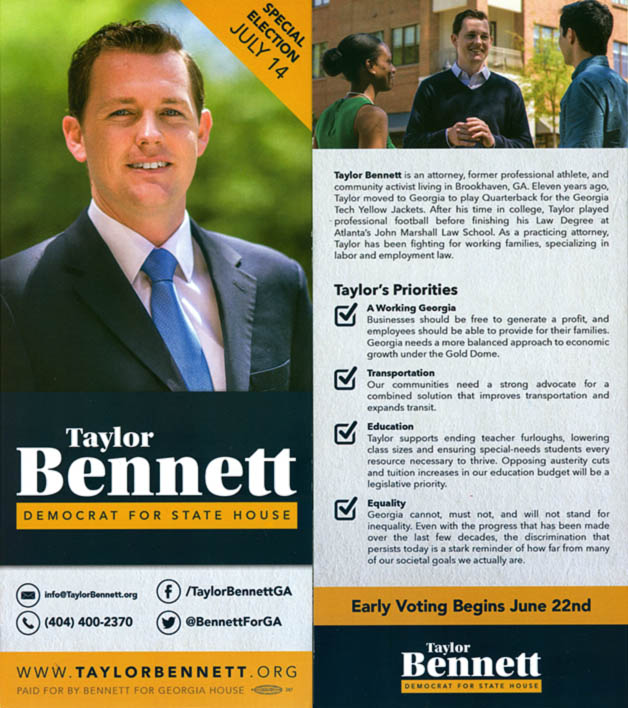
Note what appears to be a union bug on the bottom of the front of the card.
During the talk at the door, the knocker said, “We’re running against [J.] Max Davis.” So you know who they think the leading candidate is, and the only candidate whom they’re worrying.
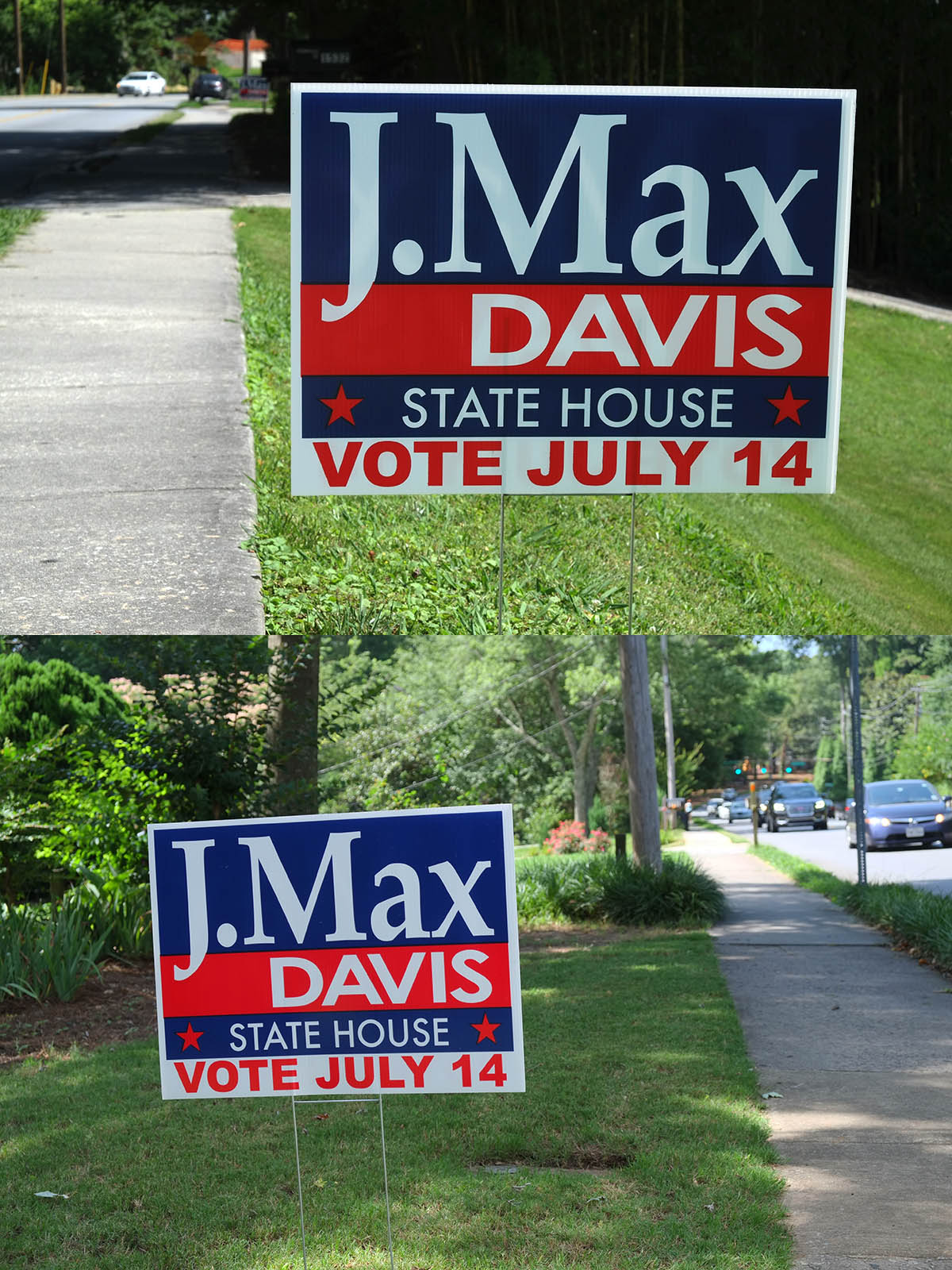
I haven’t driven the entire district, but Brookhaven appears to be strong for J. Max Davis.
Also notable in the HD 80 race is a fundraiser being for Davis with none other than Georgia House Speaker David Ralston, who served with Davis’s father, Max Davis.

Related Posts
 Flavor of Ga. food product contest seeks entrants | savannahnow.com
 Bob Barr Endorses: Georgians for Healthcare Freedom – Let the Citizens Decide Campaign
 Richmond County school budget includes tax increase, job cuts, extra furlough day | The Augusta Chronicle
 The Marietta Daily Journal – Border war Arpaio says yes to Barr King says no
 VIDEO – Rep. Lynn Westmoreland: Questions Former CIA Deputy Director in Benghazi Hearing


Comments ( 0 )