
New Jersey became the first state to ratify the Bill of Rights on November 20, 1789.
Franklin D. Roosevelt visited Warm Springs, Georgia for the 22d time on November 20, 1931.
Duane Allman was born in Nashville, Tennessee on November 20, 1946.
President John F. Kennedy lifted the naval blockade of Cuba on November 20, 1962, ending the Cuban Missile Crisis.
Newt Gingrich was reelected Speaker of the House on November 20, 1996.
Georgia Politics, Campaigns, and Elections
Mark your calendars: Brian Kemp will schedule Georgia’s 2016 Presidential Preference Election for March First.
Last week, Kemp told the five other secretaries of state he’s working with in establishing a so-called “SEC” regional primary (named after the powerhouse college sports conference) that he intends to schedule Georgia’s presidential primary for March 1, 2016—an authority he was granted by the state Legislature in 2011. Tennessee has already set March 1 as its primary day, while the other four states still need to act through their respective legislatures to do the same. Primaries in Alabama, Louisiana and Mississippi are currently slated for later in March, while Arkansas’s is set for May.
Two other Southern states, Texas and Florida, are already planning to hold their primaries March 1. This is the earliest date anyone outside the usual four early-voting states can hold its presidential primary in 2016 without penalty under the new RNC rules. However, a state that sets its primary during the first two weeks of March must award its delegates to candidates proportionally, as opposed to a winner-take-all system, meaning there is still a benefit for states that choose to hold their primaries later on in the cycle.
“It definitely plays to the weaker candidates’ benefit for a bunch of states to go load up and go during the period of time that’s proportional,” one Southern GOP strategist says. “It seems like the South could make a much bigger statement if it went on March 15.”
But Kemp and his allies ultimately decided that bringing together a group of states that have been largely ignored in recent nomination battles and holding a primary as early as possible is the best way to get the attention of White House hopefuls.
Congressman Tom Price (R-Roswell) was elected Chairman of the House Budget Committee, and will take the gavel from Rep. Paul Ryan (R-Wisconsin), who is moving up to Chairman of House Ways & Means. Price spoke of his priorities as the incoming Budget Chair:
“In years past, the House Budget Committee along with the House of Representatives as a whole have drafted, debated and adopted bold budgets that have staked out a path to greater American prosperity. In the next Congress, we will build upon that success. We will put forward a budget that restores balance to the nation’s books. It will provide a blueprint for how to save and strengthen vital health and retirement programs while ensuring needed resources for those who protect and defend our great nation. Key to accomplishing real results will be to use budgetary processes at our disposal to move meaningful legislation through the House and Senate and to the president’s desk for his consideration. This can and must be done in a transparent manner with consultation and input from members across different committees of jurisdiction and Congress at large.
“Unique to our committee will be a continued commitment to the review and reform of the Congressional budget process. Congress budgets and assesses the fiscal and economic impact of policies using a 40-year old framework in which the default is to spend more, not less. The current Congressional Budget Office rules and analytical limitations lead to unrealistic projections and are vulnerable to manipulation. We need to modernize the budget process so Congress has a more complete and realistic understanding of the impact policies will have on the nation’s fiscal health, the economy and the well-being of families and businesses.
“For all the challenges America faces today – both at home and abroad – we also have tremendous opportunities to accomplish positive solutions on behalf of the American people. Much of that effort will begin with and be aided by putting forward a balanced budget that is equal to the tasks at hand – that speaks to the priorities of our diverse country, to our fiscal realities and our economic aspirations, to our national security concerns and the personal financial security of American families.”
The Cities of Clusterville will move forward under a five-member State House panel named by Georgia House Governmental Affairs Committee Chairwoman Amy Carter (R-Valdosta).
The following House members were appointed to serve on this subcommittee:
• Rep. Buzz Brockway (R-Lawrenceville), Chair
• Rep. Barry Fleming (R-Harlem)
• Rep. Mark Hamilton (R-Cumming)
• Rep. Howard Mosby (D-Atlanta)
• Rep. Mary Margaret Oliver (D-Decatur)
“At the outset, I was very hopeful that the DeKalb cityhood proponents could come together and agree upon boundaries for the proposed cities. Unfortunately, their efforts failed to result in one, unified map,” said House Governmental Affairs Committee Chair Amy Carter. “I am following through on the pledge to appoint a five person subcommittee of state House members to draw a map for the proposed DeKalb cities after stakeholders couldn’t come to an agreement on their own. This bi-partisan group of Governmental Affairs Committee members will convene a meeting, gather input, draw a map and complete this effort by December 31, 2014. I want to thank the members of this subcommittee in advance for their commitment to seeing this effort through to the end.”
The Decaturish blog, which has provided as extensive coverage of the cityhood issues as we’ve seen anywhere, has local reactions to the empanelment.
Mary Kay Woodworth with LaVista Hills Yes told Decaturish, “We look forward the next phase of the process that the House Governmental Affairs Committee put in place. We are pleased that Representative Carter appointed legislators who are familiar with DeKalb County and the region, and look forward to presenting our best evidence to support the boundaries for the City of LaVista Hills.”
Michelle Penkava with Tucker 2015 said, “We are confident that this five person subcommittee of State House members will bring about a solution that is fair and respectful of our long-standing and recognized Tucker community while allowing our neighbors in other areas to achieve their own vision of local control. We are thankful for the time they are committing to ensure that Central/North DeKalb will have two successful cities that will benefit generations.”
Georgia Economy
“The rate fell as we had extremely strong job growth in October, which gave us the largest number of jobs in Georgia since May of 2008,” said State Labor Commissioner Mark Butler. “Our state’s private-sector employers get the credit because they created more than 91 percent of the new jobs in October and all of them since October of last year.”
There were 4,166,400 jobs in October, an increase of 33,800, or eight-tenths of a percentage point, from 4,132,600 in September. The increase is 31 percent more jobs than the average September-to-October growth for the last three years. The private sector created 30,800 of the new jobs, while state and local government education created the remainder. Job growth also came in trade, transportation and warehousing, 14,200; professional and business services, 7,900; education and health services, 4,900; construction, 1,200; leisure and hospitality, 1,100; information services, 1,000; and financial services, 500.
“Georgia employers have added 96,000 jobs since October of last year,” said Butler. “We had significant over-the-year growth in almost every sector, which shows the overall strength in our job recovery. I’m especially encouraged that the number of construction jobs grew by nearly five percent to give us the most jobs in that industry in five years.”
The Economic Forecasting Center at Georgia State University predicts that Georgia will add 71,000 jobs next year, according to Michael Kanell at the AJC.
The pace will be slightly slower than this year’s job growth, although it will include virtually every sector except federal government positions, Rajeev Dhawan, the center’s director, said.
“Job growth will be very broad,” he said.
More than five years after the official end of recession, Georgia is still about 224,000 jobs shy of the peak in late 2007. Metro Atlanta is down about 77,000 jobs.
Meanwhile, median household income has likewise not returned to pre-recession levels, in Georgia or nationally, according to government statistics. But the gap should narrow, according to Dhawan: Personal income in Georgia should grow 4.4 percent in 2015.
While Dhawan predicted a drop in Georgia’s September rate of 7.9 percent to 5.9 percent in two years, he added that will still be slightly higher than the national rate.
Dhawan discounted the unemployment rate as an accurate measure — as did Gov. Nathan Deal in winning re-election despite the high jobless rate.
“The numbers aren’t cooked,” Dhawan said. But other indicators are better, he said, especially a separate survey on job growth and the state government’s report on tax revenue.
Part of the forecast included breakouts for regions in Georgia. Savannah is predicted to see 2.8% growth next year, according to Walter Jones, writing for Morris News,
Savannah’s job-growth rate next year will improve to 2.8 percent, according to the outlook released Wednesday by Georgia State University’s Economic Forecasting Center.
Savannah and Atlanta are expected to be the two most vibrant metro areas for the second year in a row. This year, both areas are slated to wind up with growth of 2.4 percent. Next year, Atlanta will register the same rate, but Savannah should enjoy the best rate in the state, according to the forecast.
Savannah gained 1,440 jobs in the July-September period, with the government sector adding 600, transportation/utilities 550 and construction/mining 320. Those compensated for losses elsewhere, including 210 in manufacturing and 110 in the professional/business-services sectors.
Statewide next year, tourism-related payrolls will swell faster than other sectors as will those in health care across Georgia, but manufacturing employment and exports will be slowed by weak global demand.
Rises in home values that boost property-tax digests are reviving local government budgets.
“Unsurprisingly, this has led to higher employment levels, where one in 10 people work for their local government in this modern era,” said Rajeev Dhawan, director of the Forecasting Center. “Furthermore, home prices are expected to continue to rise, which will result in more local spending and subsequent hiring.”
Walter Jones also writes that Augusta’s metro area will lag, with predicted economic growth of 2% next year.
Augusta’s job growth in 2015 will be 2 percent, according to Georgia State University’s Economic Forecasting Center, slightly better than the overall state’s 1.9 percent and slightly worse than Augusta’s pace this year of 2.1 percent.
Metro Augusta added 3,140 jobs in the first three quarters of 2014, with 1,230 of them in the leisure-and-hospitality sector and 70 in manufacturing. The retail sector lost 180 jobs.
The Athens Banner-Herald’s version of Walter’s article notes even slower growth for the Classic City.
The Athens-area job growth rate next year is expected improve slightly to 1.3 percent after winding up the current year at 1 percent, according to the outlook released Wednesday by Georgia State University’s Economic Forecasting Center.
From January to September, the Athens area added 170 jobs, coming mostly from professional/business services with 90 positions, leisure/hospitality with 70 and government with 40. The retail sector stayed relatively flat, despite the opening of a Kroger Marketplace in Hull.
However, global woes are dampening the spirits here at home. The slowing of the Chinese economy and the economic weakness of Europe has put the pressure on global companies headquartered in Atlanta.
“This means that the globally diverse companies headquartered in the Atlanta metro area will have to deal with this global slowdown.”
Dhawan cited Delta Air Lines Inc., The Coca-Cola Co. and Turner Broadcasting System Inc. as sufferers of these concerns already. As a result, corporate job creation will suffer adding only 21,000 jobs in 2015 after a stellar 2014 in which 32,000 jobs were created.
On the other hand, Dhawan believes the construction industry should remain somewhat immune to global malaise. Housing permit activity has increased to 24,000 units and projects like the new Atlanta Falcons and Braves stadiums with the recently approved deepening of the Savannah port will create jobs in the coming years. Expect construction to add 5,000 jobs in 2014, 8,000 in 2015 and 9,800 in 2016.
WABE has more on the global aspect of Georgia’s economic future:
Granted, Delta’s having a record year. But Dhawan said the airline’s best chance to grow its bottom line depends on demand for International travel.
And while consumers welcome recent trends toward lower gas prices, Dhawan said further drops likely mean the global economy is slowing. “Oil prices remaining so low is bad news for the overall economy,” he said, noting that consumers generally see lower pump prices as good news for their pocket books.
A report by Pew Charitable Trusts says that Georgia led the nation in the growth of solar-related jobs.
“A suite of policies—a target, a buyback program, interconnection guidelines, and net metering—have catapulted Georgia into a national leadership position in solar,” said Phyllis Cuttino, director of Pew’s clean energy initiative. “The state is now realizing the economic benefits of renewable power, including solar jobs, which grew 225 percent last year to 2,600—the largest gain of any state.”
Georgia Ports and the state economy
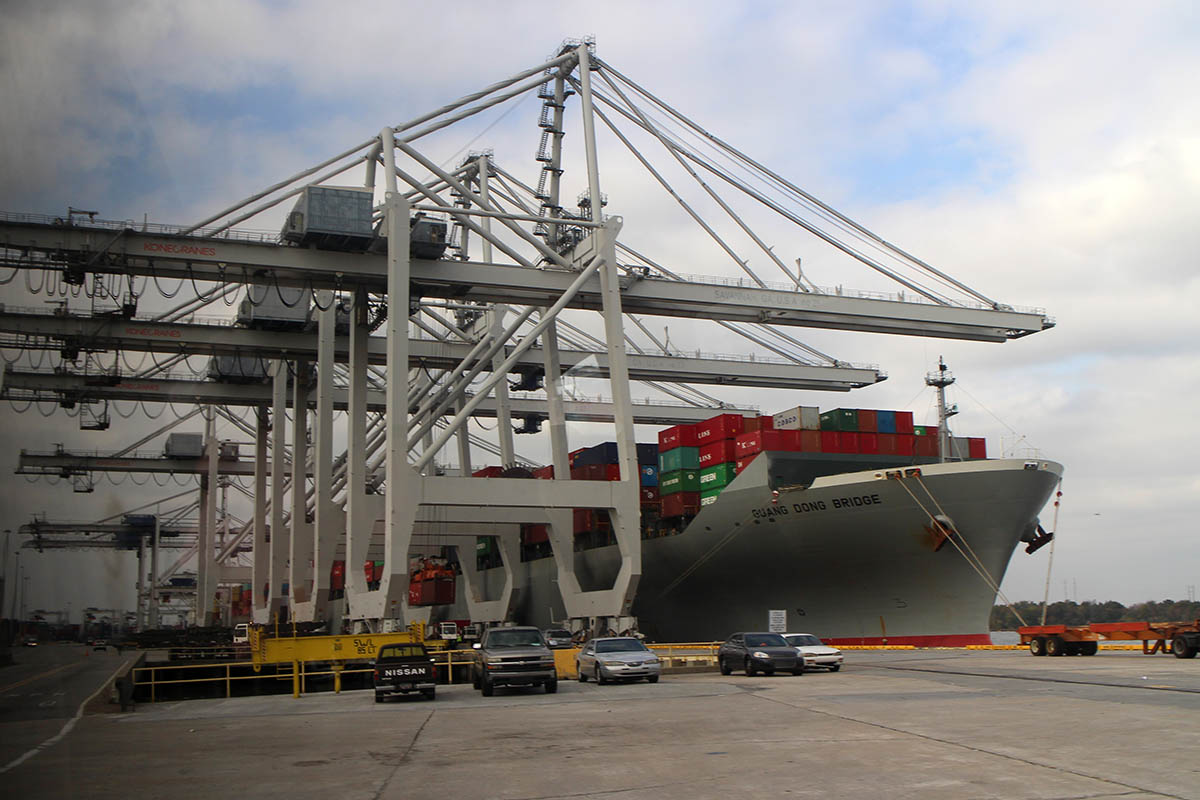
The Georgia Ports Authority set a new throughput record for October:
The Georgia Ports Authority announced Monday that its terminals in Brunswick and Savannah moved a combined 2.79 million tons of freight in October, a record for the authority.
The two ports also showed growth in vehicle shipments while bulk cargo shipments in Brunswick showed a dramatic year-over-year increase, the Ports Authority said.
“Strong growth across all key sectors of our business is an indication that our ports are reaching a larger and more diverse customer base,” said Executive Director Curtis Foltz.
For the fiscal year to date, the Ports Authority has moved 10.28 million tons, up 7.2 percent or 694,045 tons.
Moving forward, the Ports Authority will invest in expanding the Garden City Terminal:
With record cargo numbers across the board for the third month in a row, Georgia Ports Authority is making sure it’s ready for more with a nearly $20 million investment in a new gate at its dedicated container terminal.
At Monday’s meeting, the authority board approved an additional $10.2 million for construction of Gate 8, which will serve as a third major truck interchange at its Garden City Terminal. At a previous meeting, the board approved expenditures of more than $8 million to relocate some gate activity and expand storage capacity in the area.
The new interchange will start with some 20 truck lanes and is designed for expansion, GPA executive director Curtis Foltz said, adding that he expects the project to be completed by the end of 2015.
Savannah’s Harbor Expansion Project could begin work next month, according to, yep, you guessed it, Walter Jones,
Work could begin as early as next month on the initial phases of the project to deepen the shipping channel of the Savannah River, a state transportation official said Wednesday.
Divers hired to raise a Confederate ironclad sunk 150 years ago could be on site in a few weeks, almost on the anniversary of the intentional sinking to prevent seizure from Union forces.
The CSS Savannah sits on the river bottom in the way of the dredging, requiring its removal by marine archeologists as a critical step in clearing the way for the machines that will dig the channel deeper to accommodate larger freighters at low tide.
Dredging in a different part of the channel could begin soon, too.
Companies submitted bids Nov. 12 for a contract to dredge from the entrance to the river, 7 miles beyond land. Details of those bids have not been released as the U.S. Army Corps of Engineer reviews them for qualifications and procedures as well as costs.
The contract for the three-year job is likely to be awarded in January, according to Claude R. Jackson, waterways program manager for the Georgia Department of Transportation.
This one will sound familiar to my classmates in the 2015 Class of the Conservative Policy Leadership Institute: Lowndes County would like to create an inland port in Valdosta.
The Lowndes County Commission wants Valdosta to be one of Georgia’s newest inland ports.
The matter was discussed Wednesday in a meeting with Valdosta and Lowndes County’s representatives to the Georgia General Assembly.
The commission cited the area’s proximity to the Florida border, and to Interstate 10, a coast-to-coast interstate that runs past Jacksonville, Mobile, New Orleans, Houston, San Antonio, Phoenix, and Los Angeles.
Currently, the city is served by the Cordele inland port district.
“I think Valdosta, being where Valdosta and Lowndes County are at, I certainly think you can look at it and make the argument as to whether or not it can be its own district, and allow Valdosta to be one of those additional five inland ports,” said Bill Slaughter, Lowndes County Commission chairman.
“I think if the state is going to continue to push some money into Highways 82 and 84 so we can take advantage of the widening of the port situation over there, and us being at the Florida line, it will give us the closest access to Interstate 10 than any other city in the state to move transportation and freight east and west, I think it really needs to be considered.”
Slaughter said an inland port would be an important designation for the area.
State Rep. Amy Carter asked Slaughter if the “naysayers” in the community would block anything related to an inland port designation.
“I don’t think anybody could argue with the fact that Lowndes County already has a certain amount of distinction as far as a logistics community, and an inland port isn’t going to do anything but add to it,” Slaughter responded. “It’s an argument that may have to be had but I think it is an argument that is very well worth the effort and the fight, if that’s what it’s going to take.
Related Posts
 Georgia Politics, Campaigns, and Elections for February 7, 2022
 Supreme Court, in Koontz case, rules government can’t make ‘extortionate demands’ on property owners – Atlanta Business Chronicle
 Adoptable (Official) Georgia Dogs for February 12, 2018
 Georgia Politics, Campaigns, and Elections for July 18, 2016
 Adoptable (Official) Georgia Dogs for August 3, 2018


Comments ( 0 )