
On October 2, 1789, President George Washington signed a resolution transmitting the (then-twelve) amendments constituting the Bill of Rights to the states that had ratified the Constitution. Click here for the letter from Washington to Governor Charles Pinckney of South Carolina that accompanied the amendments.
On October 2, 1835, Texans and Mexicans met in the first military battle of the Texas Revolution, the Battle of Gonzales.
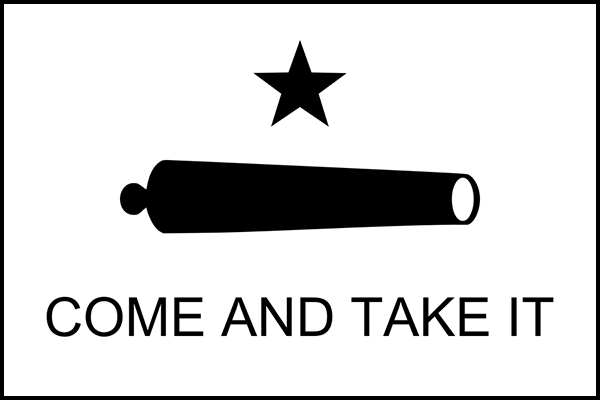
In 1831, Mexican authorities gave the settlers of Gonzales a small cannon to help protect them from frequent Comanche raids. Over the next four years, the political situation in Mexico deteriorated, and in 1835 several states revolted. As the unrest spread, Colonel Domingo de Ugartechea, the commander of all Mexican troops in Texas, felt it unwise to leave the residents of Gonzales a weapon and requested the return of the cannon.
When the initial request was refused, Ugartechea sent 100 dragoons to retrieve the cannon. The soldiers neared Gonzales on September 29, but the colonists used a variety of excuses to keep them from the town, while secretly sending messengers to request assistance from nearby communities. Within two days, up to 140 Texians gathered in Gonzales, all determined not to give up the cannon. On October 1, settlers voted to initiate a fight. Mexican soldiers opened fire as Texians approached their camp in the early hours of October 2. After several hours of desultory firing, the Mexican soldiers withdrew.
On October 3, 1863, President Abraham Lincoln proclaimed a national day of Thanksgiving to be observed on November 26, 1863 and on the fourth Thursday in November every succeeding year.
This announcement harkened back to when George Washington was in his first term as the first president in 1789 and the young American nation had only a few years earlier emerged from the American Revolution. At that time, George Washington called for an official celebratory “day of public thanksgiving and prayer.” While Congress overwhelmingly agreed to Washington’s suggestion, the holiday did not yet become an annual event.
Thomas Jefferson, the third president, felt that public demonstrations of piety to a higher power, like that celebrated at Thanksgiving, were inappropriate in a nation based in part on the separation of church and state. Subsequent presidents agreed with him. In fact, no official Thanksgiving proclamation was issued by any president between 1815 and the day Lincoln took the opportunity to thank the Union Army and God for a shift in the country’s fortunes on this day in 1863.
On October 2, 1879, Wallace Stevens was born. Stevens would become a renowned poet and insurance industry lawyer. My favorite poem of his is “Connoisseur of Chaos.”
A. A violent order is disorder; and
B. A great disorder is an order. These
Two things are one.
President Woodrow Wilson suffered a stroke at the White House on October 2, 1909.
On October 4, 1918, President Woodrow Wilson sent a telegram to the Georgia Democratic Party Convention delegates in appreciation for their support of his administration.
On October 3, 1922, Rebecca Latimer Felton was appointed to the United States Senate from Georgia following the death of Senator Tom Watson. After initially being rebuffed by the Senate, Felton was sworn-in on late in November, becoming the first woman to serve in the United States Senate.
The Savannah River Bridge opened on October 4, 1925.
The Soviet Union launched Sputnik, the first artificial satellite, on October 4, 1957.
Thurgood Marshall was sworn-in as an Associate Justice of the United States Supreme Court on October 2, 1967.
Betty Talmadge, then wife of Senator Herman Talmadge, hosted a fundraiser with Rosalynn Carter and Joan Mondale on October 2, 1976.
Ground was broken for The Carter Presidential Center in Atlanta on October 2, 1984.
Beverly Hills, 90210 debuted on October 4, 1990.
On October 3, 1995, O.J. Simpson was acquitted of murder.
The last Braves game at Turner Field was played on October 2, 2016, with the Detroit Tigers besting the Braves by 1-0.
Georgia Politics, Campaigns, and Elections
The website for Democrat Brenda Hankinson claims she is the new Democratic candidate for State Senate District 47 after the nominee was sentenced to prison, according to the Athens Banner Herald.
A woman has announced she will be a candidate for the State Senate District 47 seat in November to oppose incumbent Republican Frank Ginn, but she has yet to qualify as a candidate.
A message on the Brenda Hankinson website stated, “Brenda is the new Democratic nominee for State Senate District 47, following the disqualification of the previous nominee.”
“She is not a qualified candidate at the moment,” a spokesman for the Georgia Secretary of State said late Thursday afternoon. The Secretary of State’s office manages elections. “There is a legal process that must be followed to disqualify a candidate. We are in the initial stages of that process.”
Hankinson’s announcement and the investigation by the Secretary of State follow the Sept. 16 felony conviction of 41-year-old Justin Grant Gillespie of Hull. Gillespie’s name is on the ballot as the Democratic Party candidate, but the Secretary of State noted that “a candidate cannot hold office while serving a felony sentence.”
Gillespie was sentenced to two years in prison following his conviction for battery and cruelty to children for hitting a 5-year-old child in a daycare center in 2021.
State officials had announced earlier that Gillespie’s name will remain on the ballot because it has already been printed.
Hankinson described herself as a University of Georgia graduate and a food and nutrition specialist. She could not immediately be reached for comment.
Contacted Thursday, Ginn said he is in a “wait and see” mode about what happens next. “Qualifying was in March, and this young man (Gillespie) that qualified, it’s kind of interesting, but he qualified with this case outstanding,” Ginn said.
District 47 covers portions of Madison, Clarke, Barrow and Jackson counties. Ginn has held the seat since he was first elected in 2010.
I’m not sure how Ron Swanson would feel about it, but Special Purpose Local Option Sales Tax (SPLOST) proceeds have helped develop parks and recreation in Effingham County, according to the Savannah Morning News.
Special Purpose Local Options Sales Tax, or SPLOST, was a key talking point for Effingham County Manager Tim Callanan on Thursday during the State of the County address.
Callanan kicked off the address noting several park improvements paid with funds raised through the 2022 sales tax. Those included upgrades at Baker Pond Community Park, including a new pickleball courts and playground equipment, as well as a resurfaced lighted trail and a dedicated dog park.
Baker Park is one of the only areas in the county that gives residents direct access to water recreation via a kayak launch, fishing pier and boat ramp.
“It’s a wonderful park,” said Callanan. “About three days a week when I’m driving home, it’s lit up and loaded with people. More importantly, it’s loaded with kids. This is a great [way] to get them out of the house.”
SPLOST money also helped get Atlas Lake ready for use. The 600-acre outdoor recreation space will feature campgrounds; a 138-acre lake for swimming, boating and fishing; walking trails; a playground; a pavilion and more. It may include a beach.
SPLOST funds have also contributed to two new public safety buildings, the emergency operations center and the animal shelter.
At the event, Callanan unveiled plans for SPLOST 2026, which he said is expected to raise $200 million.
Georgia voters’ names will be recorded on paper in November, according to the Capitol Beat News Service via The Moultrie Observer.
Attentive Georgia voters will notice something different when they go to their polling places on Election Day: pen and paper.
Poll workers will log each voter in electronically, but they will also be recording voters’ names on a backup log using pen and paper.
The retro method is required by a rule adopted in June by the State Election Board, the appointed body that establishes voting procedures in Georgia.
Approved in a 4-0 vote by the five-member Republican-controlled board, with the support of the lone Democrat, the measure was introduced after digital check-in failures during the May primary.
“This will be your paper document to refer back to if there’s an audit, if there’s a forensic audit,” then-board member Janice Johnston said at the meeting, according to the official transcript.
“Now, will it be perfect? No,” said Johnston, who subsequently stepped down from the board. “Someone will forget to write a name down, but it is the paper document to go back to.”
Anne Dover, the election director in Cherokee County, one of the largest counties in Georgia, said this week that she was concerned the requirement could slow the check-in process and result in longer lines.
Dover also worried about errors. Many of her poll workers are retirees in their 70s. She has asked them to write legibly but noted they will be recording hundreds of names on a busy Election Day.
“I feel like they will — whoever they are that are so concerned about this, I think we know who it is — they will get the electronic version of the numbered list, which they always have access to, it comes from the poll books, and they will take that list and try to compare it with the written numbered list. And if they see any discrepancies, we’ll be before the state election board,” said Dover, who has been doing this work for two decades.
“And I can promise you that, especially in these larger counties like ours, there will be mistakes,” she said.
Robert Sinners, a spokesman for Secretary of State Brad Raffensperger, the top election official in Georgia, also said he expects delays.
“This additional step may slow down the check-in process,” he said.
State Election Board members voted to reject a proposal to require “shuffling” of ballots, according to Georgia Recorder.
A last-minute proposal that would have required poll workers to manually “shuffle” ballots before scanning them in an effort to prevent bad actors from identifying how Georgia residents voted failed to advance Thursday at a special-called meeting of the State Election Board.
Election workers and advocates said the proposed rule would be impossible to implement before the November midterms and would likely create more problems than it solved.
State Election Board member Salleigh Grubbs, a top Georgia GOP official who was appointed to the board last year, argued that emergency rules were needed to uphold Georgia’s constitutionally required ballot secrecy rules. Her proposal would require voters to place their completed ballots into “secure boxes” rather than ballot scanners, which voters use to submit their printed ballot. Under Grubbs’ proposal, ballots would later be scanned by poll workers rather than the voters themselves.
Thursday’s meeting was called to consider Grubbs’ proposal.
“We cannot continue on the same path with these kinds of vulnerabilities,” Grubbs said. “It must be addressed before the November election so that we can continue on to secure all future elections.”
But other members of the board appeared more skeptical. Janelle King, the board’s vice chair, said she worried that the proposal would likely generate more fear and distrust among voters.
“I also have major concerns about dropping our ballots into a secured box and then having other individuals scan my ballot,” she said. “How do I know that in the shuffling something doesn’t fall out?”
Anne Dover, the Cherokee County elections director, raised concerns that counties could struggle to recruit poll workers if the proposal were approved.
“Elections officials are put in a very difficult position,” she said. “We’ve been accused of fraud. We’ve been accused of being criminals. Our poll workers have been accused of doing things they shouldn’t do, and this atmosphere just gets worse for us as elections officials and poll workers. And I’m afraid we will lose poll workers if something like this is mandated, because they’re going to feel that pressure not to make a mistake.”
The change would also be extraordinarily expensive for counties, Dover said. Cherokee County’s policies mandate that at least three poll workers be assigned to monitor ballots. The cost of hiring enough poll workers to have three people monitoring ballots at every early voting location across the county, she said, would require an extra $80,000 for the midterm elections.
Ballot images have been public record in Georgia since 2021, and records dating back to 2024 are available online at the secretary of state’s website. In August, a Princeton University researcher claimed that he was able to use artificial intelligence to tie thousands of voters to specific ballots with relative certainty by putting publicly available data through an AI tool.
In July, Election Director Blake Evans issued guidance to county election workers instructing them to redact ballot record numbers before uploading them to the secretary of state’s website to prevent ballots from being traced back to specific voters. At Thursday’s meeting, VotingWorks executive director Ben Adida, whose company also manufactures election equipment, said the secretary of state’s office had successfully addressed election security concerns.
But some election activists have maintained that Georgia’s system contains critical security issues and are urging the state to take action ahead of the midterm elections. Early voting begins on Oct. 13.
Last week, the Georgia Republican Party and Republican National Committee penned a joint letter to the board raising concerns about Georgia’s voting equipment software in light of the Princeton researcher’s findings and also called on the board to “seek any federal technical assistance required to complete a certified upgrade” of the state’s voting equipment.
On Monday, members of the board approved a resolution urging the secretary of state’s office to update the state’s voting machine software and calling on the U.S. Department of Justice and U.S. Department of Homeland Security to step in to ensure that the update takes place.
But Carolyn Roddy, the board’s GOP appointee and sponsor of the resolution, said she shared board members’ concerns about ballot secrecy, but that Grubbs’ proposal went too far.
“I’m not in favor of putting election officials through the ringer on this thing,” she said Thursday. “I think that it will cause incredible conflict that will deter us from other missions.”
State Election Board Executive Director James Mills is seeking help from Washington, according to the AJC.
In letters to U.S. Attorney General Todd Blanche and other top federal officials on Wednesday, Mills asked the U.S. Justice Department to put additional security measures in place before the midterm election and give the state a six-month deadline to eliminate the use of QR codes on ballots to tally votes.
The demandwould require Georgia to revamp its in-person voting process, which relies on scanners reading QR codes on ballots to count votes.
By appealing to the Trump administration, Mills is seeking to force changes to Georgia’s voting system less than two weeks before early in-person voting starts, escalating disputes over vote tallying and security upgrades that election officials and voting experts saycan’t be done this close to the midterms.
Sara Tindall-Ghazal, the State Election Board’s sole Democrat, questioned how, after years of use, Georgia’s current voting system is out of compliance with federal law.
“This is clearly a bad-faith attempt to set up a contest to election results that Republicans do not like,” she said.
Mills’ letters, which were also sent to Assistant U.S. Attorney General for the Civil Rights Division Harmeet Dhillon and U.S. Homeland Security Director Markwayne Mullin, also asked for investigations into alleged “alteration, destruction, or withholding” of various election records.
The letter accused Raffensperger of withholding election records and allegations regarding record alteration but did not provide specifics.
The Libertarian and Green parties filed suit against Georgia seeking to overturn the state “leadership committee” law, according to the AJC.
On Wednesday, the Libertarian and Green parties became the latest groups to challenge the legality of that campaign system. They argued their case before the 11th U.S. Circuit Court of Appeals at a hearing in Jacksonville, Florida.
But it’s not clear if they will succeed — even though the 11th Circuit itself recently concluded that Georgia’s law is likely unconstitutional.
Georgia law caps contributions to political candidates to limit corruption or even the appearance of corruption. Candidates for statewide office can accept up to $8,400 from individual donors for both the primary and general elections, plus an additional $4,800 for runoff elections.
But leadership committees can raise unlimited funds. Under state law, only the governor, lieutenant governor, the Republican and Democratic nominees for those offices and a handful of legislative leaders can have leadership committees.
That gives those officials and candidates a powerful advantage. Campaign records show the two major party nominees for governor, Democrat Keisha Lance Bottoms and Republican Rick Jackson, have accepted six-figure donations that would be illegal for other candidates.
Leadership committees have come under scrutiny for years. In 2022, Democrat Stacey Abrams and Republican David Perdue won court orders prohibiting Gov. Brian Kemp’s leadership committee from raising and spending money on his campaign until he won the Republican nomination for governor that year.
Earlier this year, Jackson won a similar order, barring Lt. Gov. Burt Jones from using his committee to support his campaign for governor. That case wound up before the 11th Circuit, and in June the appeals court became the latest to conclude Georgia’s leadership committee law is likely unconstitutional.
But the plaintiffs in each case dropped their lawsuits before judges could reach final conclusions on the legality of leadership committees. Jackson dropped his lawsuit just last week — his campaign spokesperson said Jackson is “not looking backwards,” focusing instead of defeating Bottoms.
On Wednesday, Bryan Sells, an attorney for the Libertarian and Green parties, told the 11th Circuit that leadership committees create an unequal playing field for candidates running for the same office.
As written, Sells argued the law allows only Democratic and Republican candidates for governor to have leadership committees. He said that creates an unfair advantage that discourages other candidates from seeking the office. Chase Oliver, the Libertarian Party candidate for governor, suspended his campaign earlier this year.
David Dove, an attorney representing the state of Georgia, urged the appeals court to uphold a lower court’s ruling dismissing the case. That judge concluded the parties’ claims to have been injured by the law were “conjectural” and “insufficiently concrete” to demonstrate they were harmed.
Members of the Joint Election Equipment Specifications and Standards Committee saw election machine demos, according to Atlanta News First via WALB.
The touchscreen machines Georgians have used to vote for years could soon be gone, as state lawmakers vet new equipment to overhaul the state’s voting system ahead of 2028.
With a deadline approaching to overhaul how Georgians vote, lawmakers packed into a room at the state Capitol Thursday to test new machines firsthand.
Georgia spent $108 million on touchscreen machines in 2019. Now, Senate Bill 3EX pushes for hand-marked paper ballots printed at check-in.
Three vendors made their pitch to lawmakers. Hart InterCivic brought air-gapped printers. Runbeck showed heavy-duty printers built to prevent heat jams. ES&S pitched high-speed tabulators.
Paulding County Elections Supervisor Deidre Holden pressed vendors on whether Georgia’s 159 counties can handle paper loads, pricey ink and dying batteries.
“Because elections are not pretty. There’s things that can go wrong. There’s times we’re having meltdowns. We need that vendor that’s going to be there and say, hey, we’ve got a fix for this,” Holden said.
“I can’t put a price tag on a secure voting system in Georgia. We can put a cost on it. We can’t put a value on it,” said state Sen. Max Burns, committee co-chair.
Still, frontline election workers worry voter trust won’t come easily.
“They’re the ones that’s going to be touching this, using this, trying to explain to the voters what’s going on. And it’s a change. And our voters, you know, people don’t like change,” Holden said.
Lawmakers will hear from four more vendors later this month before sending their final recommendations to the General Assembly by Jan. 31. The Legislature only sets the standards and approves the budget — the ultimate contract award falls to Georgia’s next secretary of state.
The University System of Georgia Board of Regents voted to appoint former Southern Company CEO Tom Fanning as Chancelor, according to the Capitol Beat News Service via the Valdosta Daily Times.
Georgia’s Board of Regents formalized the hiring Thursday of the next leader of the state’s 25 public colleges and universities, naming Thomas A. Fanning as chancellor.
The former president and CEO of Southern Company will take control of the University System of Georgia on Jan. 1, the day after Sonny Perdue retires.
The regents named Fanning sole finalist last month.
“As a proud USG graduate, I know firsthand the transformative power of this system,” Fanning said in a statement.
The Georgia Tech graduate, who went on to earn a master’s degree there, said his priorities are to ensure college remains accessible, to support innovation and to drive the state’s economy with talented graduates.
Fanning led Southern Company from 2010 to 2023. He also chaired the Cybersecurity Advisory Committee of the Cybersecurity and Infrastructure Security Agency and the board of the Federal Reserve Bank of Atlanta.
After leading the university system for four years, Perdue announced his retirement in April, prompting a five-month search for his successor.
Perdue served as agriculture secretary for President Donald Trump during his first term in the White House and as Georgia’s first Republican governor since Reconstruction starting in 2003.
Police blotter: the Abraham Baldwin Agricultural College (ABAC) Police Department fired Chief Mike Tompkins after allegations of Flock camera misuse, according to WALB.
An administrative review by the University System of Georgia (USG) has substantiated allegations that a member of the Abraham Baldwin Agricultural College (ABAC) Police Department improperly used an automated license plate reader system.
The findings follow previous reporting by WALB that ABAC Chief of Police Mike Tompkins was placed on paid administrative leave earlier this week. Ryan Hogan, vice president of enrollment, marketing, and student affairs, initially confirmed Tompkins was placed on leave but stated no additional information was available at the time.
Tompkins had been appointed chief of police effective Nov. 10, 2025 and was sworn in Dec. 16, 2025 after serving more than 17 years with the department.
In a statement, ABAC leadership says they received the investigation findings Wednesday, Sept. 30.
Effective Oct. 1, Acting Chief Douglas Chadwell has been appointed interim chief of police for ABAC after Tompkins was fired.
According to the college, ABAC does not own, operate, or maintain any Flock automated license plate reader cameras on campus, nor does it maintain its own network.
However, the USG review determined that an employee gained access to the Flock system through an outside local law enforcement agency and used it to conduct searches. Investigators concluded that certain searches were not conducted for an authorized law enforcement purpose and failed to comply with state requirements governing the use of law enforcement resources.
Police blotter: Justin Keith Brown was fired from the Hall County Sheriff’s Office and arrested after charges of Flock camera misuse, according to AccessWDUN.
Justin Keith Brown, age 42, was fired by the sheriff’s office on Aug. 19 after officials said he used the camera system to perform unauthorized searches involving at least two tag numbers. No other details on those searches were released, with the sheriff’s office only saying the searches “had no legitimate law enforcement purposes.”
On Wednesday morning, Sept. 30, Hall County Jail records show Brown was booked into the Hall County Jail on charges including violation of oath of office and two other “miscellaneous” offenses. As of 10:30 a.m. Wednesday, he remained jailed without bond.
No details on why he was arrested have been released, with the sheriff’s office saying the charges came from the Georgia Bureau of Investigation (GBI). The GBI has not released information on the case so far.
U.S. District Judge Victoria Marie Calvert (ND-GA) dismissed a lawsuit by the U.S. Department of Justice seeking unredacted voter records from Georgia’s Secretary of State. From Fox5Atlanta:
In a decision issued Wednesday, U.S. District Judge Victoria Marie Calvert ruled that federal election requirements do not force states to disclose sensitive personal data.
“Federal law does not preempt Georgia’s voter privacy law,” Judge Calvert wrote, officially dismissing the case and denying the Justice Department’s motion to compel.
In her ruling, Judge Calvert established that Title III of the Civil Rights Act does not preempt Georgia’s voter privacy laws. The court further determined that neither the National Voter Registration Act nor the Help America Vote Act requires states to disclose sensitive, confidential voter information. Additionally, Judge Calvert noted that Georgia’s ongoing list-maintenance efforts already demonstrate full compliance with federal election laws without the need to surrender unredacted voter data.
The backstory: The dispute began in mid-2025 when the Justice Department demanded Georgia’s full statewide voter registration list, including voters’ Social Security numbers, driver’s license numbers, full dates of birth, and voting histories. Federal officials said they needed the unredacted files to check compliance with federal election laws and verify citizenship through a federal database.
Georgia officials pushed back against the federal demands. In December 2025, Secretary Raffensperger’s office turned over a voter registration file, but stripped out all sensitive personal identifiers, citing state laws that make that information strictly confidential.
The Department of Justice then sued, claiming Georgia’s refusal to hand over the unredacted records violated the Civil Rights Act of 1960 and asking a federal judge to force the state to turn over the full data.
What they’re saying:
Georgia Secretary of State Brad Raffensperger praised the ruling Wednesday, framing it as a major victory for voter privacy.
“I will always protect the sensitive personal information of Georgians, in accordance with the law and the Constitution,” Raffensperger said in a statement. “I will not give in and break the law for anyone. Period.”
Raffensperger added that while his office will continue cooperating with federal partners, “cooperation does not mean ignoring the law or surrendering the privacy rights of Georgia voters. We stood our ground because the law was clear, and we are thankful the Court agreed.”
FOX 5 reached out to the the DOJ for comment following the decision and is awaiting a response.
What we don’t know:
The Department of Justice has not indicated whether it plans to appeal the district court’s decision to the 11th Circuit Court of Appeals.
It remains unclear if the DOJ will seek alternative legal mechanisms or revised agreements to review Georgia’s voter list maintenance procedures without accessing unredacted personal identifiers.
Earlier this week, Governor Kemp announced $105,000 in state grants to local fire departments, according to First Coast News.
Nahunta, Ga. — Georgia Gov. Brian Kemp announced Tuesday that seven South Georgia fire departments will receive a combined $105,000 in private donations to help them access additional federal funding for wildfire equipment.
The announcement comes months after historic wildfires tore through parts of Brantley, Clinch and Echols counties, destroying more than 100 homes and leaving some residents without permanent housing.
The fire departments are from Waynesville, Hortense, Calvary, Hoboken, Clinch, Homerville, and Echols Counties.
The seven departments will each receive $15,000 through a strategy that uses private donations to satisfy the local match required for the federal Volunteer Fire Assistance grant program.
The federal program can cover half the cost of eligible equipment, but local departments are required to provide the other half. The private donations will cover that local match, potentially unlocking another $105,000 in federal funding.
That could double the combined funding for equipment and resources for the seven departments.
“This is the least that we can do for all that they did to help their neighbors, their friends and their local communities,” Kemp said Tuesday.
The money can be used for needs including protective equipment, brush trucks, radios and other wildfire response equipment.
Nahunta Fire Chief Marty Lee said the funding will help departments that operate largely with volunteers and limited budgets.
“We have older trucks and equipment, and this is going to help us,” Lee said.
The funding is aimed at strengthening the local response to future wildfires.
The Federal Emergency Management Agency (FEMA) awarded a $2.8 million dollar federal grant to Pooler, according to WSAV.
As part of $55 million awarded across the Southeast, Pooler was the recipient of a $2.8 million grant aimed at helping the city hire firefighters.
“Firefighters and other first responders are everyday heroes, helping their neighbors and communities when they need it most,” said FEMA Administrator Cameron Hamilton. “Through this grant funding, FEMA is building the capability of these local organizations to respond to disasters and emergencies. By empowering fire departments to get the staff, training and equipment they need, FEMA is strengthening the resilience of American communities nationwide.”
Republican candidate for Congress Jim Kingston (Savannah) hosted a roundtable with Governor Brian Kemp, according to the Savannah Morning News.
Governor Brian Kemp appeared alongside the Republican hopeful for Coastal Georgia’s U.S. House seat Wednesday, attending a roundtable of local business leaders to discuss issues impacting them.
Republican candidate Jim Kingston hosted the roundtable, telling reporters afterward that it was critical to hear the firsthand needs of business owners and adding that, if elected, he would strive to be accessible and responsive to their concerns.
“The main thing is people want to be heard,” Kingston said. “The disconnect between Washington D.C. and the state of Georgia is so much further than it needs to be.”
Kingston won the Republican nomination in May with 52% of the vote despite the crowded eight-candidate field. Kingston is the son of Jack Kingston, [incumbent U.S. Rep. Buddy] Carter’s predecessor in the District One post.
The duo spoke with media after the event, where Kingston touted his support for President Donald Trump in response to a reporter’s question about rising costs nationwide. Kingston said getting those rising costs under control didn’t start overnight and won’t be fixed overnight.
Kingston added that part of why he is running is so Trump will have all the “foot soldiers” needed to work quickly in Congress. Republicans have a majority in both the House of Representatives and the Senate, although by narrow margins.
“The Trump Administration is doing everything it can but I, like all Georgians, would like to see things done quicker,” said Kingston, who received Trump’s endorsement in May’s primary.
State Rep. Gerald Greene (R-Cuthbert) faces a challenge to continuing his term as longest-serving legislator, according to the Albany Herald.
State Rep. Gerald Greene’s name is well-known throughout District 154, and he is the longest-serving elected representative in the Georgia Legislature. Harry James has also been active in politics for decades and has continued to participate since his stint as a Dougherty County Commissioner.
James, the Democratic Party nominee, and Greene, the incumbent Republican, are set to vie for a two-year term in the district that includes eight southwest Georgia counties and a portion of Dougherty County.
The two expressed that they have had an amicable relationship over the years, and identified some of the same issues as priorities for the district that includes Baker, Calhoun, Clay, Early, Miller, Quitman, Randolph and Seminole counties as well as the bottom half of Dougherty County stretching to the Flint River.
Greene, a retired educator who was first elected in 1982, said that he is seeking another two years to usher through some of the projects he has worked on during his tenure, including the revitalization effort at Radium Springs near Albany, for which he got an appropriation of $400,000 last year, and a Dougherty County library. Some of the other projects he said he has supported include the widening of U.S. Highway 27/State Route 1, work at George T. Bagby State Park and preservation work in the Okefenokee Swamp.
“You get to the point that you want to finish your projects,” he said. “The only way to do it is to run again and get those things in line. I wanted to do Radium Springs, Westtown Library. The only way to do it is to run again and get them over the finish line.
“We’ve been helping the people at Lake Seminole to break up the invasive species, and it looks great. We’re taking the lake back because we’ve put monies in there. Because we did that, the federal government is now matching our (contribution). As we roll through the counties, there are so many needs.”
One of the biggest needs for the region is infrastructure, the incumbent said.
“Our infrastructure is wearing out,” he said. “Those grants from the federal government are gone, so it’s up to the state to help them with grants. Water, sewer, housing … it’s a lot of these things. If you’re going to have industry, you have got to have somewhere decent for people to live. That’s why it’s important to promote our schools, promote housing, to provide for our workforce.”
For his campaign, James has identified healthcare, housing, jobs and education as the most pressing issues for District 154’s residents.
After serving on the Dougherty County Commission from 2012 through 2014, the candidate has kept up with political issues as a member of the Dougherty County Democratic Committee and in most years attending the Association County Commissioners of Georgia’s annual meetings.
During his time on the commission, he was elected as president of the Georgia Association of Black County Officials, a title he held for two years after leaving elected office.
“I’m running because I always wanted to serve to make it better for my community and the people of the community and to advocate for the people who cannot be at the table to advocate for themselves,” James said.
Of his four identified issues, he identified healthcare as the top need in the rural district.
“In District 154, there is a healthcare desert,” James said. “For most of the district outside Dougherty County, they’re having to drive an hour, an hour and a half for healthcare.”
State lawmakers’ refusal to expand Medicaid under the Affordable Care Act has led to hospital closures and affected rural residents’ ability to access healthcare in a timely manner, James said. As a state representative, he said he would work to move Georgia out of the group of 10 states that have not taken that step.
“(The lack of) Medicaid expansion has crippled a lot of rural hospitals,” James said. “There’s a great need for healthcare for the people of District 154.”
Albany Police will launch a flying RoboCop first-responder drone, according to WALB.
The initiative allows APD to deploy drones to an incident, giving officers an aerial view before they arrive on scene. Equipped with zoom capabilities and thermal imaging, the drones provide real-time situational awareness and help locate individuals.
APD Investigator Lt. Kalandria Peterson said the drones will reduce response delays.
“When we have shootings, when we have a robbery, we’re not having to wait in traffic. We don’t have to wait in the red light. You know, it’s pretty much get that drone out of the air, get it up in the air, get it on scene and start relaying information,” Peterson said.
The department will use nine stationary drone pods positioned across the city, along with mobile units that officers can launch in the field for missing persons, barricaded subjects and other critical incidents.
The stationary units are operated exclusively from the Real-Time Crime Center and can cover roughly 85% of Albany. The remaining 15% is restricted due to airport airspace.
Albany Police said the technology will only deploy for active emergency calls, not neighborhood surveillance. Officials said the drones fly autonomously toward calls with cameras fixed on the horizon to avoid capturing private property along the route.
“I think the big misconception that’s going to be is they’re spying on me. And that is not the case,” said David Sparks, senior crime and intelligence analyst for the Albany Police Department. “We will not launch the drone unless we have a legitimate call for service, which results in a record of how we fly.”
Sparks said APD will also conduct routine audits to ensure the drones are used appropriately.
“We are working on how much data we want to push out to the public as far as their ability to see what we’re doing, how we’re doing it. I think we’re at a point where you’ll see the flights, the flight paths, the times, and the reasons. You just won’t have access to the footage unless you did an open records request,” Sparks said.
Columbus Democrats urged voters to turnout in the November General Election, according to the Ledger-Enquirer.
The last day to register to vote is Oct. 5, state Rep. Carolyn Hugley (D-141), the Georgia House minority leaders, said at a news conference Wednesday in Columbus, asking voters to visit iwillvote.com for more information about registering to vote in Georgia.
Advance voting begins Oct. 13 and runs through Oct. 30, according to information from the Muscogee Council Elections and Registration Office.
[I advise you check your own County’s advance voting dates and locations at the Secretary of State’s MVP page.]
In addition to sharing voter information, Hugley and state Rep. Debbie Buckner (D-137) also used the opportunity to make their case for Democrats up and down the ballot.
“I’m here today to remind Georgians how much we have on the line in this year’s election in the race for governor,“ Hugley said.
Hugley spoke in support of Georgia gubernatorial candidate Keisha Lance Bottoms, the Democratic nominee. She said Republican candidate Rick Jackson is trying to “buy” the election.
She also referred to Jackson’s comments linking him to President Donald Trump, whose approval rating in Georgia is underwater by 24 points, according to recent polling by Civiqs.
“I believe that the citizens of Georgia can clearly do much better than a man who wants to be just like the president — but with a Southern tone,” Hugley said. “We can clearly do much better than a man who profits off of our pain and pledges to be Trump’s favorite governor.”
Buckner spoke in support of Sen. Jon Ossoff (D-Ga.), criticizing the GOP nominee, U.S. Rep. Mike Collins (R-Jackson), for his controversies involving allegedly misused government funds.
“(Collins) is under federal investigation by the House Ethics Committee,” Buckner said. “And we can do better than a puppet for Trump, whose record is littered with attacks on Georgia’s healthcare system, your pocketbooks and your voting rights.”
Work requirements in Georgia may prevent some residents from reciving Supplemental Nutrition Assistance Program (SNAP) benefits, according to Atlanta News First via WTVM.
According to the Georgia Division of Family and Children Services, before Oct. 1, able-bodied adults without dependents had to meet certain work requirements to continue receiving SNAP benefits beyond a three-month time limit. That applied to people between the ages of 18 and 59. Now, those requirements apply to a larger age group, including people up to age 64.
“It puts another barrier in the space where they’re already fighting things that they shouldn’t have to, that should be a guaranteed when we live in the land of the free,” said Christina Moss-Drawford, senior vice president of operations at Frontline Response.
Moss-Drawford said the new requirements could put more pressure on vulnerable people.
“The majority of the people that are on SNAP are on SNAP because they already are having difficulties getting jobs and getting housing. So it just puts another stress on them for those things,” Moss-Drawford said. “A lot of older people, they have disabilities, so they are unable to work, which is the reason why they needed the SNAP in the beginning. So now it’s just kind of like a revolving door.”
Supporters of the changes argue the requirements could encourage more people to enter the workforce and reduce dependence on government assistance. Advocates for people experiencing food insecurity say the need for food does not disappear when benefits do.
Moss-Drawford said she worries losing that support could have consequences beyond hunger.
“A lot of them go hungry, simply like that. They go hungry and they have to then flood our hospitals, which are already stressed to capacity,” Moss-Drawford said. “It just kind of increases the services that they’re not getting, but they’re getting denied all over again.”
Card skimming, cloning and other fraud has been happening for years in the Supplemental Nutrition Assistance Program (SNAP).
The woman and others she knows are only the latest victims in a string of scams that the Georgia Department of Human Services (DHS) and federal agencies have been trying to stop.
“It makes us not be able to feed our families,” she said.
Her story is not a new one, said Kylie Winton, assistant deputy commissioner for DHS External Affairs.
“It’s a nationwide problem,” she said. “SNAP theft can occur in a number of different ways outside of DHS’s immediate control, which is why — in addition to locking their cards — we also encourage clients to practice good online security habits like maintaining strong, unique passwords and not clicking suspicious links or sharing sensitive information.”
Benefit theft became so prevalent several years ago that in December 2022 Congress passed a law to replace stolen SNAP benefits. They were eligible for replacement if stolen through December 2024. The American Relief Act in 2025 did not extend the replacement program.
The fight against theft is a challenging one. Even when recipients follow the protocols suggested to protect their benefits, accounts are still wiped out, the female victim said.
In May 2025 the USDA, which administers the program, confirmed that the thefts are linked to international crime rings. They are stealing hundreds of millions of dollars each year, the agency said.
A dashboard set up by the USDA on replacement of stolen benefits through the second quarter of 2025 showed that 29,144 stolen benefits claims were received in Georgia, 16,788 of which were approved. Another 12,356 were denied, 11,459 of which were deemed invalid.
A little more than a year ago, in September 2025, the state’s Department of Family and Children Services was awarded a $748,673 grant to reduce SNAP recipient fraud and enhance program integrity.
“Georgia DHS will use the grant to fund its multi-year SNAP Fraud Framework Implementation project to enhance recipient fraud prevention, detection and investigation,” Winton said. “The project deliverables include educational outreach to the public on fraud, waste and abuse prevention and reporting, as well as specialized fraud prevention tools and training for agency staff.”
On Oct. 1, SNAP benefits saw increases of $8 for single individuals, $23 for families of three, $29 for families of four, and $34 for families of five.
While this is good news, other changes are less-so. Georgia and other states will need to cover 75% of that tab when they previously only covered 50%. The Food Research and Action Center estimates this will add millions of dollars to each state’s bill, with the lowest being Wyoming (estimated to incur $3 million in extra costs) and the highest being California (estimated to incur $670 million).
This would be on top of another update starting in 2027: States with a SNAP recipient error above 6% are on the hook for a portion of benefits. The Center on Budget and Policy Priorities says Georgia had a Fiscal Year 2025 SNAP error rate of 15.21%.
There have also been changes to who is eligible for SNAP. Work requirements apply to able-bodied adults without dependents aged 18-64, up from 54. Also, families with children 14 and older are no longer eligible for an exemption from those work requirements.
Regarding immigrants, a green card is now required for SNAP, meaning refugees and asylum seekers are no longer eligible.
State Rep. Floyd Griffin (D-Milledgeville) says Baldwin County needs a plan for addressing a $15 million dollar budget shortfall, according to 13WMAZ.
State Rep. Floyd Griffin said Baldwin leaders need to adopt a recovery plan amid their budget crisis, he said on Thursday.
Griffin represents District 149, which covers portions of Baldwin, Bibb and Jones counties.
Griffin said he met with Gov. Brian Kemp’s office to help develop one, and then presented the plan to county commissioners. He said it would call for an outside study of how the county ran up its $15 million debt.
It would also assess the county’s resources and draw up a payment plan, while protecting county services.
“It was a very productive and informative meeting,” Griffin said in a media release. “The discussion made it clear to me that the solution to Baldwin County’s immediate financial problems will have to come primarily from the county level rather than through direct state intervention.”
Griffin’s plan also calls for the county to develop a realistic debt-management and expenditure-reduction options, protect taxpayers from unnecessary burdens, establish accountability and transparency, and develop a clear timetable for long-term financial stability, he said.
He said the county should consider getting professional help in developing the strategy to recover from the budget shortfall.
The county would also develop a written financial recovery plan within 60 days after the professional assistance is put into place, Griffin said.
So far, commissioners have not responded, and there’s no word on when or if the board may vote on Griffin’s proposal.
Augusta Commissioners will consider a $1.26 billion dollar FY 2027 budget, according to WJBF.
District 7 Commissioner Tina Slendak said the budget process will continue over the next several weeks.
“We’re gonna be having budget meetings every couple weeks now until November, so we hope by then it will be approved,” Slendak said.
The discussion comes as the city continues working to address financial challenges from the previous budget cycle. Around this time last year, city leaders said Augusta was heading into 2026 facing a $21 million deficit.
The city is still working to address the shortfall while maintaining services. [City Administrator Tameka] Allen said stopgap funding from the city’s fund balance is being used to help cover the gap.
“You don’t fix it overnight, but I think we’re making some progress,” Allen said.
Chatham County Sheriff Richard Coleman announced an anti-gang unit, according to WSAV.
The new unit will enhance the CCSO’s ability to “identify, investigate and address gang-related activity throughout Chatham County while strengthening collaboration with local law enforcement and community partners,” a spokesperson said Wednesday.
Chatham County Sheriff Richard Coleman started a media conference about the creation of the Chatham County Gang Unit Wednesday by saying, “Gangs, gangs, gangs…we have a gang problem.”
Sheriff Coleman said, “I will not stand idly by and allow gang activity to gang activity, gang members and gang behavior to rule and strike fear in members and citizens of this county.”
The announcement comes less than a week after a shooting on Bay Street that the sheriff said was related to gang activity. The lead investigative agency is the Savannah Police Department. An SPD spokesperson said the following about the alleged gang involvement in the case: “SPD is working to determine if a gang nexus — the documented connection between an incident, person, location, motive, or piece of evidence and gang activity, as defined by agency policy, statutory criteria, or investigative standards — exists in this case, as this incident has not been determined by law to be connected to or involve substantiated gang activity.”
Should that be determined, SPD will not hesitate to enact the services of its established gang unit that has been utilized for nearly a decade in solving gang-related crimes.”
Chatham County Police Department Chief Jeff Hadley gave WSAV the following statement regarding Thursday’s announcement of CCSO’s gang unit:
“The Chatham County Police Department has always investigated gang activity and violence. Within six months of our department re-forming in 2018, we launched an investigation into the Ghost Faced gangsters that netted 43 suspects – including some of the highest-ranking people in the criminal organization.”
Whitfield County Board of Education members will vote today on a proposed 2026 property-tax millage rate increase, according to the Dalton Daily Citizen.
The Board of Education announced Sept. 16 that it was considering a tentative millage rate of 15.5 mills, up from the current 14.375 mills.
The proposed rate is:
• 7.83% higher than the current 14.375-mill rate.
• 8.81% above the calculated rollback rate of 14.245 mills. The district’s required tax-increase notice also describes the difference as 1.255 mills.
The state has extended the oyster season, according to the Moultrie Observer.
Georgia is extending the annual closure of the oyster harvest season because of unusually warm ocean temperatures. Officials say the closure, which usually ends September 30, will continue until the water is safe for wild oysters.
It’s common knowledge in coastal areas: avoid raw oysters in the summer because warm water lets dangerous bacteria flourish. Georgia shuts down wild oyster harvesting from June through September every year to keep people safe. But this year, for just the second time, the state is extending the closure because the water is still too warm.
Officials are closely monitoring the ocean temperature and will reopen the harvest as soon as it’s safe, Guadagnoli said.


Comments ( 0 )